At a glance
- BCBS is 34 independent licensees; coverage is set per affiliate and per employer, not by one national policy.
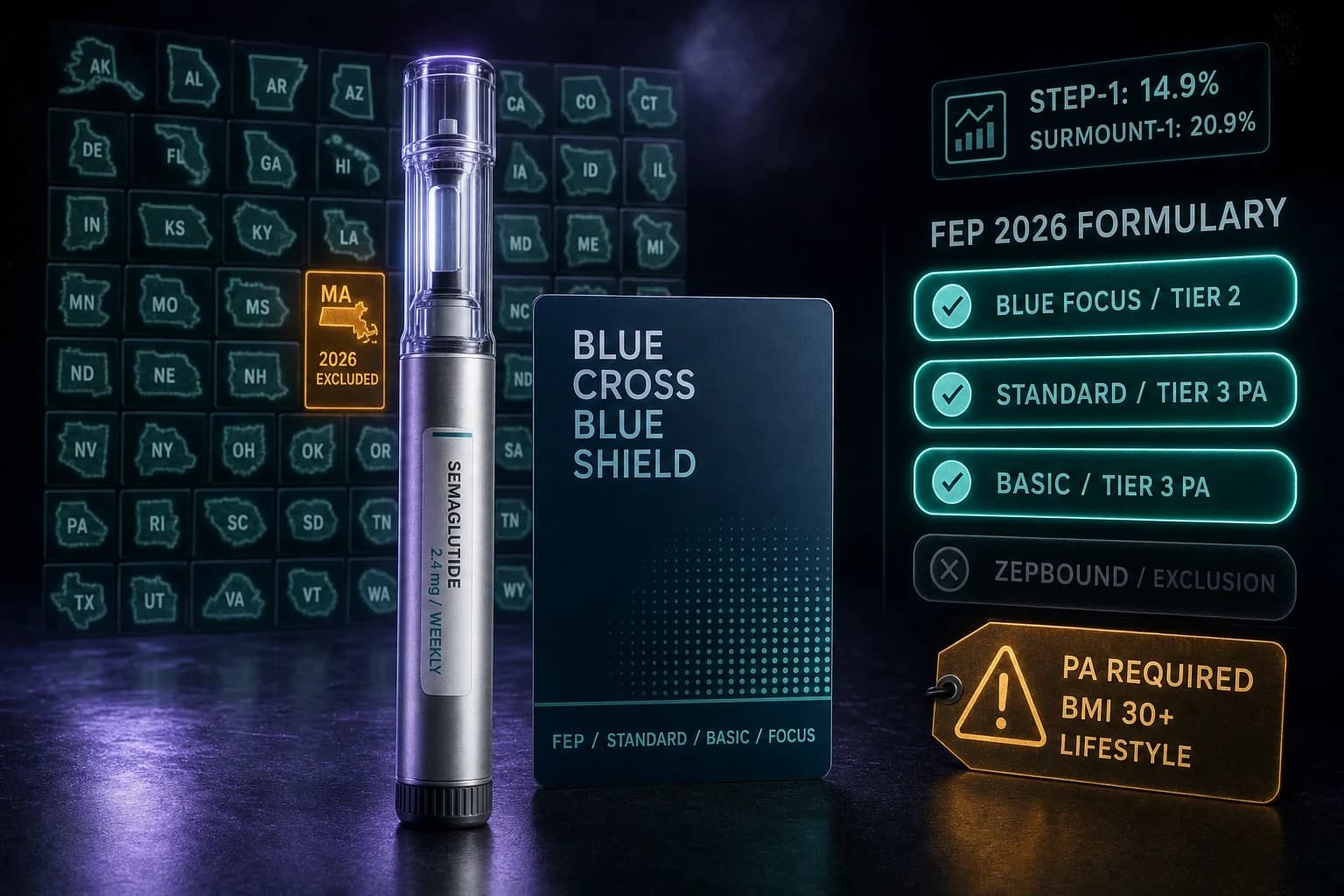
- FEP Blue Focus lists Wegovy and Zepbound as Tier 2 (preferred) in 2026, with prior authorization.
- FEP Standard and Basic place Wegovy at Tier 3 with PA; Zepbound needs a formulary exception under policy 5.99.031.
- BCBS Massachusetts is dropping Wegovy, Zepbound, and Saxenda for weight loss on renewals starting January 1, 2026.
- When BCBS denies, US-licensed compounded telehealth or research-vial routes both undercut brand cash pay by 60 to 85 percent.
Search "does Blue Cross Blue Shield cover GLP-1" and you will get three answers depending on the page: yes, no, and maybe. All three are correct, because there is no single BCBS. There are 34 independent licensees plus the Federal Employee Program, each writing its own formulary, and coverage on a $1,349 monthly drug turns on which of those 34 wrote the plan card in your wallet.
This page maps the 2026 coverage picture by plan type, names the affiliates that already dropped weight-loss GLP-1s, walks through the prior authorization criteria that actually decide the answer, and lays out what to do when the denial letter arrives. If you want to skip to the cheapest cash-pay lanes when BCBS says no, the GLP-1 cheapest routes guide has the current pricing.
Bottom line: For type 2 diabetes, most BCBS plans cover Ozempic and Mounjaro after a diabetes-diagnosis PA. For obesity, coverage is where it fractures: FEP still covers Wegovy and Zepbound with PA, BCBSMA is exiting weight-loss coverage on 2026 renewals, and roughly half of large-employer BCBS plans exclude the anti-obesity indication entirely. Do not read one page and assume it applies to your card.
Why "does BCBS cover GLP-1" has 34 different answers
Blue Cross Blue Shield Association is a federation. The 34 member companies (BCBS of Michigan, BCBSTX, BCBSIL, BCBSNC, Highmark, Anthem, Elevance, Carefirst, and so on) each license the Blue Cross and Blue Shield trademarks and each operate their own PBM contracts, drug formularies, prior authorization criteria, and step therapy. The Federal Employee Program (FEP) sits on top of that as a nationwide plan for federal workers, negotiated centrally with CVS Caremark, with its own uniform formulary.
The consequence for a GLP-1 answer: two people who both hand over a card that says "Blue Cross Blue Shield" can be on radically different formularies. A Highmark plan sold to a small employer in Pennsylvania and a BCBSTX plan sold to a large self-funded employer in Dallas share almost nothing except the brand mark.
Practical implication: never rely on a generic "BCBS covers Wegovy" post. Pull your own formulary. Search for "[your affiliate] drug formulary 2026" (for example "BCBSTX Performance drug list 2026" or "FEP Blue Standard formulary 2026") and check the tier plus the PA notes for the exact GLP-1 you were prescribed.
The three coverage buckets in 2026
Across the 34 affiliates and FEP, GLP-1 coverage in 2026 falls into three consistent buckets:
| Bucket | What it covers | Typical plans | Notes |
|---|---|---|---|
| Diabetes only | Ozempic, Mounjaro, Rybelsus, Trulicity for T2D with documented diagnosis + A1C. Wegovy, Zepbound, Saxenda excluded. | Roughly half of large-employer BCBS plans (self-funded) | Off-label weight-loss use is a hard no. The A1C threshold is usually stated (for example greater than or equal to 6.5 percent). |
| Diabetes plus weight loss with PA | Adds Wegovy, Zepbound, Saxenda with prior authorization (BMI + comorbidity + lifestyle documentation). | FEP Standard, FEP Basic, FEP Blue Focus, BCBSTX Performance, several state affiliates | This is the "generous" bucket. It still denies on paper if the PA documentation is thin. |
| Diabetes only starting 2026 or 2027 | Actively removing weight-loss GLP-1 coverage on renewals. | BCBS Massachusetts (2026), several employer plans following suit | If your renewal date is January 1, expect a formulary change letter. |
If your card says BCBS, the actual question is which of these three buckets your employer or plan sits in. Nothing else you read is more determinative.
Federal Employee Program (FEP): the clearest picture
FEP publishes a single national formulary and is the easiest BCBS variant to pin down. In 2026:
| Plan | Wegovy | Zepbound | Ozempic (T2D) | Mounjaro (T2D) |
|---|---|---|---|---|
| FEP Blue Focus | Tier 2 (preferred), PA required | Tier 2 (preferred), PA required | Tier 2, PA required | Tier 2, PA required |
| FEP Blue Standard | Tier 3, PA required | Excluded on standard formulary; formulary exception under policy 5.99.031 with step therapy | Tier 2, PA for non-T2D uses | Tier 2, PA for non-T2D uses |
| FEP Blue Basic | Tier 3, PA required | Excluded on standard formulary; formulary exception under 5.99.031 | Tier 2 | Tier 2 |
FEP requires 90-day mail order at the specialty tier, which cuts per-dose cost meaningfully. Starting in the 2027 plan year, OPM has signaled that BCBS FEP will add an intensive behavioral therapy requirement before and during GLP-1 coverage for obesity, so expect a documentation lift for renewals then.
The FEP prior authorization criteria are consistent with the wider BCBS pattern: BMI greater than or equal to 30, or BMI greater than or equal to 27 with a weight-related comorbidity (type 2 diabetes, hypertension, dyslipidemia, obstructive sleep apnea), plus a documented three to six month lifestyle intervention (diet, exercise, or behavioral program) at any point prior. The last piece trips up more approvals than the BMI check.
Massachusetts, Texas, and the state-affiliate split
Two 2026 developments illustrate why state affiliate matters as much as plan tier.
Blue Cross Blue Shield of Massachusetts announced that on plan renewals starting January 1, 2026, Wegovy, Saxenda, and Zepbound will not be covered for weight loss. GLP-1s approved for type 2 diabetes stay covered under PA with a documented T2D diagnosis. Members were told the exclusion cannot be appealed. If your employer's renewal date is later in the year, the change applies at that renewal, not on January 1.
BCBSTX took the opposite direction in spring 2026, expanding GLP-1 coverage across several employer product lines and clarifying the PA pathway for both Wegovy and Zepbound on the Performance and Balanced drug lists. BCBSIL and BCBSOK followed similar patterns.
Other affiliates sit between. Highmark, Anthem-affiliated Blues, and Regence generally cover anti-obesity GLP-1s under PA on their standard plans but let self-funded employer clients opt out, which many now do as premiums rise. If your card is a Highmark or Anthem BCBS card, the answer for you is set by your employer's opt-in, not by the affiliate's default.
What BCBS prior authorization actually requires
The PA criteria across BCBS affiliates converge on a common set. Coverage denials cluster on the same three items:
- BMI documentation. Greater than or equal to 30, or greater than or equal to 27 with a coded comorbidity. A clinic note that says "obese" without the actual BMI number is rejected.
- Lifestyle intervention proof. Some plans want three months, some six, some accept a documented past attempt. A single note that references "diet and exercise counseling" often passes; the omission of any lifestyle statement almost never does.
- Step therapy. Several plans require a trial of a preferred agent (usually Wegovy before Zepbound, or an older anti-obesity medication before either) unless a clinical contraindication is documented.
For T2D indications the criteria loosen: an A1C threshold (usually greater than or equal to 6.5 percent), plus a documented diagnosis code (E11.x), is typically enough. That is why the "Mounjaro for diabetes" answer is almost always yes on BCBS while the "Zepbound for obesity" answer is a coin flip.
If you want the raw dosing context regardless of the coverage answer, the semaglutide dosage chart and the tirzepatide dosage chart both show the FDA titration ladders that the PA letter will reference.
The evidence BCBS is weighing
Prior authorization criteria trace back to the pivotal weight-loss trials. Knowing them helps if you have to write an appeal.
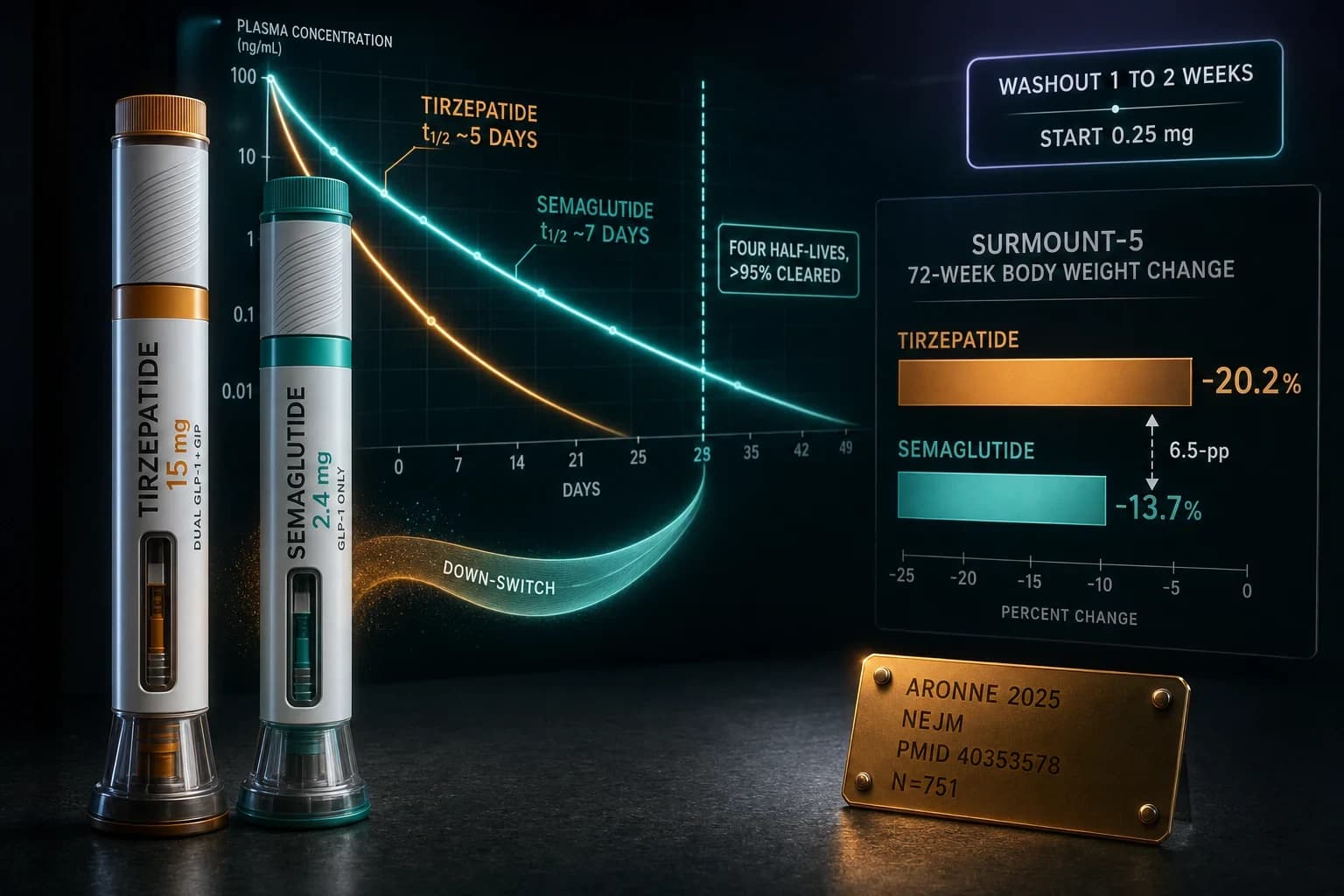
- STEP 1 (Wilding et al., 2021, NEJM) enrolled 1,961 adults with overweight or obesity without diabetes and randomized them 2:1 to weekly semaglutide 2.4 mg or placebo for 68 weeks. Mean weight loss was 14.9 percent with semaglutide versus 2.4 percent with placebo. Full record at PubMed.
- SURMOUNT-1 (Jastreboff et al., 2022, NEJM) randomized 2,539 adults with obesity or overweight without diabetes to tirzepatide 5 mg, 10 mg, 15 mg, or placebo for 72 weeks. Mean weight loss reached 20.9 percent at 15 mg versus 3.1 percent for placebo, with about nine in ten tirzepatide participants losing at least 5 percent of body weight. Full record at PubMed.
- SELECT (Lincoff et al., 2023, NEJM) enrolled 17,604 adults with preexisting cardiovascular disease and BMI greater than or equal to 27 but no diabetes, and showed that weekly semaglutide 2.4 mg reduced major adverse cardiovascular events versus placebo. This is the cardiovascular-benefit signal that lets appeals cite a comorbidity beyond BMI. Full record at PubMed.
- STEP 1 trial extension (Wilding et al., 2022, Diabetes, Obesity and Metabolism) followed a subset off treatment. From week 68 to week 120 (one year after stopping), participants regained about two-thirds of the weight they had lost, ending at a net 5.6 percent below baseline. Full record at PubMed.
- SURMOUNT-4 (Aronne et al., 2023, JAMA) took the same withdrawal question and answered it for tirzepatide. After a 36-week lead-in, 670 participants were randomized to continue or switch to placebo for 52 weeks. Continued treatment produced an additional 5.5 percent loss; placebo produced a 14 percent regain. Full record at PubMed.
Two implications for coverage: the medications work at the doses BCBS is being asked to fund, and the effect is not durable if the drug is stopped. That second point is what BCBS actuaries are pricing when they narrow the weight-loss benefit.
What BCBS costs you when it does cover
Approved coverage does not mean the drug is cheap. Even on Tier 2 with PA, out-of-pocket runs $25 to $150 per month depending on deductible position, and the specialty-tier landing (some plans put Wegovy at Tier 3 or specialty) pushes copays into the $200 to $400 range. FEP's 90-day mail-order specialty benefit cuts that per-dose. A commercial plan with 30-day retail-only pricing does not.
Real-world persistence data explains why the price still matters. In one large commercially insured cohort of adults without diabetes who initiated GLP-1 obesity treatment in 2021, about two-thirds became nonpersistent (a greater than 60-day gap in refills) within the first year, and one-year persistence hovered near 47 percent for once-weekly semaglutide. Cost sensitivity, side-effect drop-off, and prior-auth friction each contribute. If your plan approves but you cannot afford the copay, you are in the same practical position as someone who was denied.
When BCBS says no: the recovery playbook
Most searchers who type "does BCBS cover GLP-1" already suspect the answer is a qualified no. Three lanes matter when the letter arrives.
- Appeal, but only if the denial reason is fixable. If BCBS denied on "BMI not documented" or "no lifestyle intervention on record," a re-submission with the missing chart notes usually clears. If the denial cites a plan-level exclusion (BCBSMA weight-loss exclusion, for example), an appeal does not change the plan, and you should skip to lanes 2 and 3.
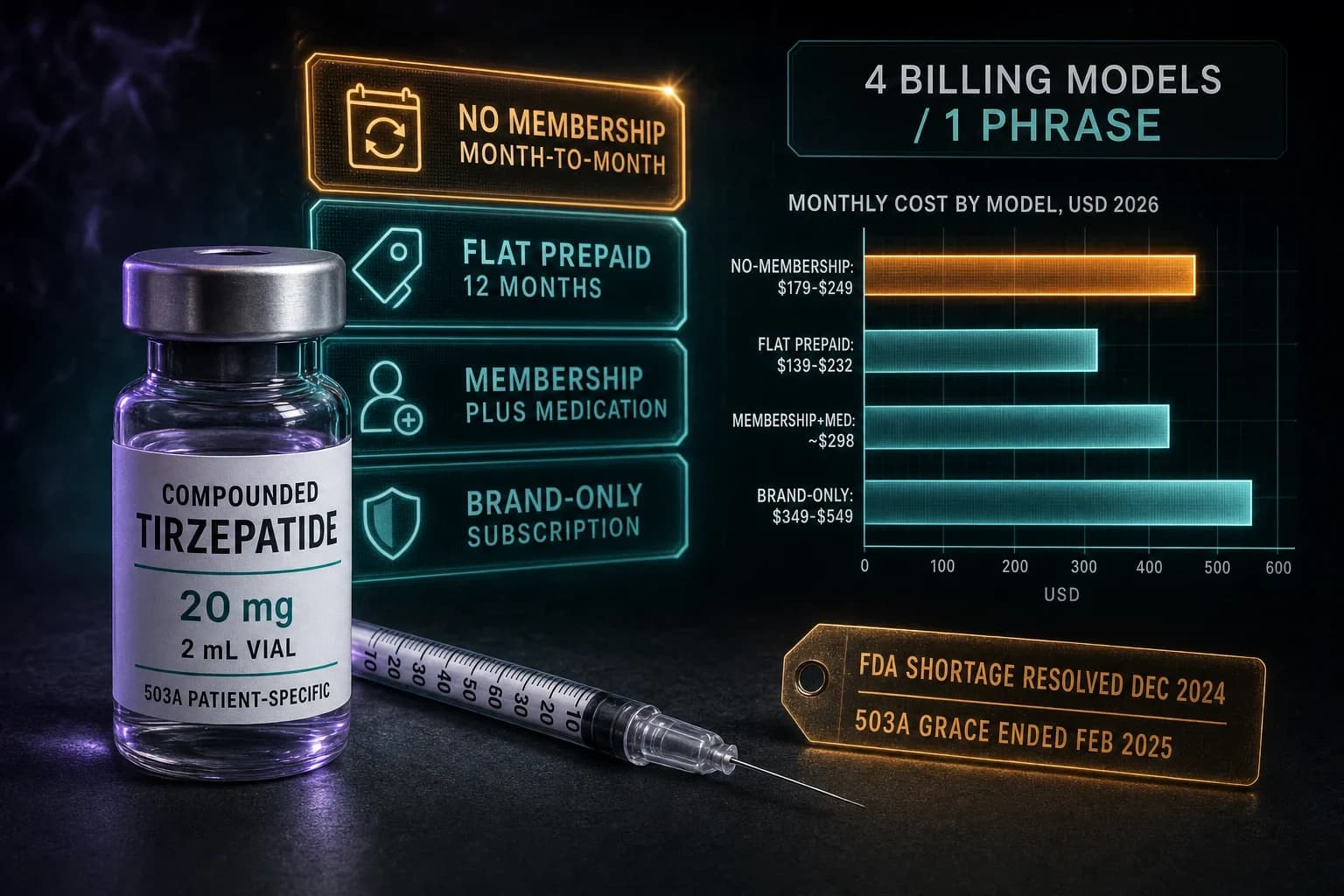
- US-licensed compounded semaglutide or tirzepatide via telehealth. Programs like Bodybuilding Health+ and Yucca Health route through 503A compounding pharmacies with US-licensed prescribers. Monthly costs run $139 to $206 for a supervised program, which is 60 to 85 percent below brand cash pay. The compounded semaglutide reviews guide walks through the five programs we have audited and the filter we used.
- Brand cash pay via LillyDirect (Zepbound single-dose vials) or Novo Nordisk direct programs. Zepbound vials are $299 (2.5 mg) to $449 (7.5 to 15 mg) monthly since the December 2025 price cut. That is not cheap, but it is the direct answer for anyone who wants a name-brand pen without an insurance path. See Zepbound vs Mounjaro for a full brand cash-pay breakdown and how much is tirzepatide without insurance for the per-milligram math.
For plans that never cover weight-loss GLP-1 at all, the cash-pay lane is not a bridge, it is the destination. Build the monthly budget around it.
Tip: If you are on a self-funded employer BCBS plan and coverage was recently pulled, your HR benefits team can (and sometimes will) add anti-obesity coverage back at open enrollment if enough employees ask. This is a policy-decision path most people never try.
Frequently asked
Does BCBS cover Ozempic for weight loss? Almost never. Ozempic is FDA-approved for type 2 diabetes. If a prescriber writes it off-label for weight loss, BCBS PA typically rejects. Wegovy is the on-label semaglutide for obesity.
Does BCBS cover Zepbound? On FEP Blue Focus, yes at Tier 2 with PA. On FEP Standard/Basic, only via formulary exception under policy 5.99.031. On BCBSMA, no for weight loss starting on 2026 renewals. On BCBSTX and BCBSIL, generally yes on Performance and Balanced formularies with PA. On most self-funded employer plans, it depends on whether the employer opted in.
Does BCBS Federal Employee Program cover Wegovy? Yes on all three FEP plans (Blue Focus at Tier 2 preferred, Standard and Basic at Tier 3), all with PA. 90-day mail order is available on specialty.
How do I check if my BCBS plan covers a specific GLP-1? Log into the member portal, pull the drug list PDF for your plan year, and search for the drug by brand name. Then read the PA policy for the drug (search the same portal). The PA policy names the coverage criteria you have to meet.
What if my employer just dropped GLP-1 coverage? Compounded telehealth from an audited program is usually the fastest and cheapest replacement. See the compounded semaglutide route and the compounded tirzepatide route for what US-licensed programs are running now.
The one-line answer
Does Blue Cross Blue Shield cover GLP-1 medications? Yes for type 2 diabetes on almost every BCBS plan with a documented diagnosis PA. For weight loss, the answer is plan-specific: FEP still covers Wegovy and Zepbound with PA, BCBSMA is dropping the benefit on 2026 renewals, and roughly half of large-employer plans exclude the anti-obesity indication entirely. Pull your own formulary before you assume the answer.
Research and education only. This is not medical advice, insurance advice, or a substitute for a licensed clinician or benefits consultant. Formularies and PA criteria change frequently; always confirm current coverage with your BCBS affiliate and pharmacy benefits manager before making a treatment decision.