At a glance
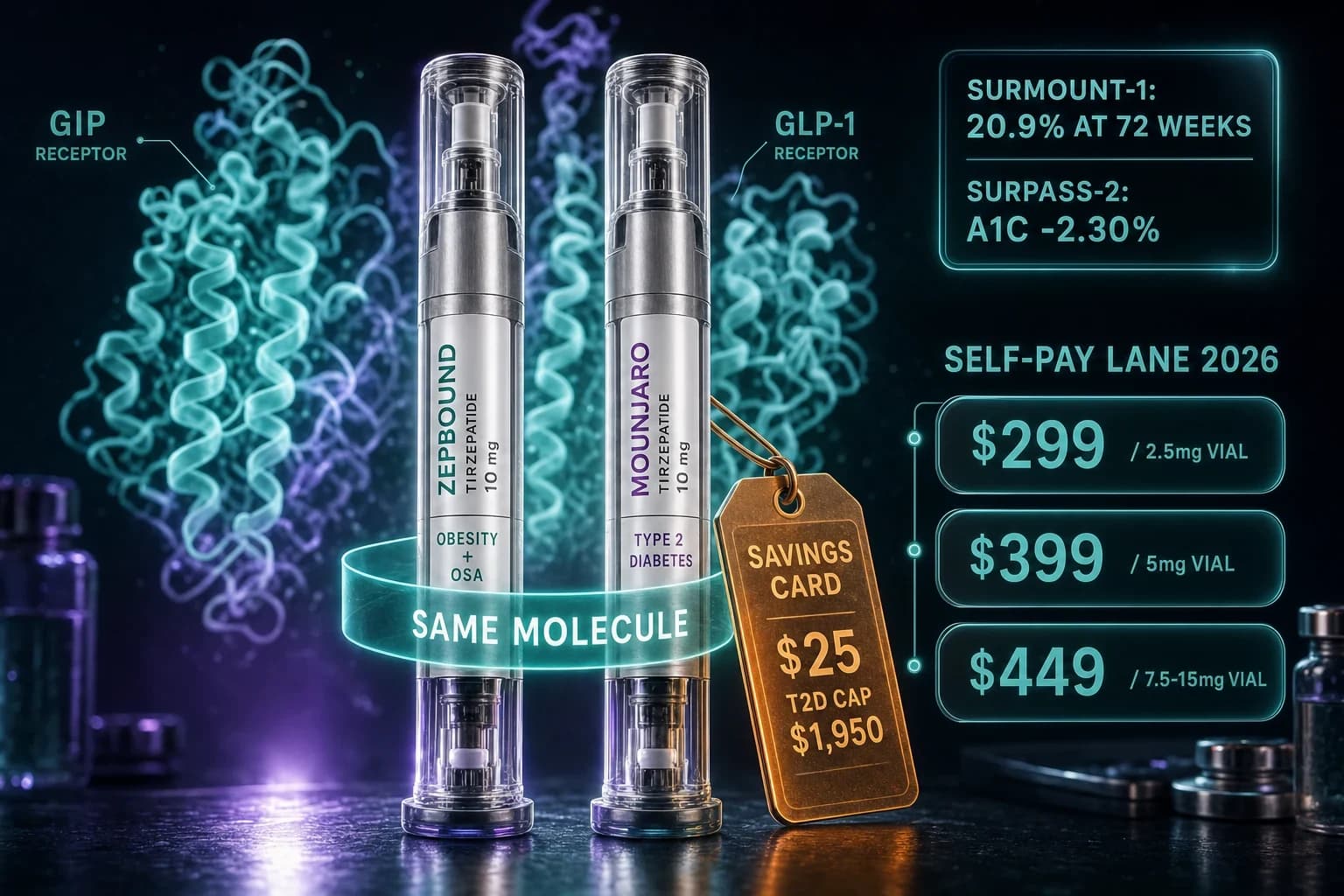
- Zepbound and Mounjaro are the same weekly tirzepatide molecule under two FDA labels.
- Mounjaro is FDA-approved for type 2 diabetes; Zepbound for obesity and OSA with obesity.
- Zepbound produced 20.9% mean weight loss at 72 weeks in SURMOUNT-1 (PMID 35658024).
- Mounjaro Savings Card takes commercial T2D copays to as low as $25/mo, capped $1,950/year.
- LillyDirect Zepbound single-dose vials cost $299 to $449 per month after the December 2025 cut.
Search "Zepbound vs Mounjaro" and every top result opens with "same drug, different name." That answer is correct and it hides everything a buyer actually needs to know. Zepbound and Mounjaro are both Eli Lilly's tirzepatide in the identical single-dose pen at the identical 2.5 to 15 mg weekly ladder. What changes when you fill one prescription instead of the other is the FDA label, the savings card you qualify for, the insurance verdict your plan hands back, and the cash-pay lane you land on. In 2026, one of those differences swings the monthly bill by more than $1,000.
This page compares the two brands on evidence, cost, coverage, and access. If you already have coverage for the right indication, the cheaper answer is straightforward. If you are paying cash, the answer changed twice in 2025 and again in December, so use the numbers below rather than any post older than that.
Bottom line: Mounjaro is the tirzepatide brand FDA-approved for type 2 diabetes; Zepbound is the one approved for obesity and moderate-to-severe obstructive sleep apnea in adults with obesity. Same molecule, same pen, same dose ladder. If you have T2D and a commercial plan, Mounjaro with the savings card is almost always the cheapest legitimate lane. If you are treating obesity or OSA without insurance, the Zepbound LillyDirect vial or a US-licensed compounded tirzepatide program is where the math lands.
Same tirzepatide, same pen, same dose ladder
Tirzepatide is a once-weekly dual GIP and GLP-1 receptor agonist. Both Zepbound and Mounjaro are supplied as single-dose auto-injector pens in six strengths: 2.5, 5, 7.5, 10, 12.5, and 15 mg. The titration schedule the label recommends is identical: 2.5 mg for weeks 1 to 4, then up in 2.5 mg steps every four weeks as tolerated, with the maintenance dose set by response and side-effect tolerance. Our tirzepatide compound page and the tirzepatide dosage chart cover the mechanics in depth.
The pens are manufactured on the same line and are pharmacologically interchangeable at equivalent doses. Molecule, excipient buffer, pen device, and 4-pen carton are the same product presented under two brand names for two FDA approvals.
Where the FDA labels split
Mounjaro was FDA-approved on May 13, 2022 as an adjunct to diet and exercise to improve glycemic control in adults with type 2 diabetes. Zepbound was approved on November 8, 2023 for chronic weight management in adults with obesity (BMI 30 or higher, or 27 or higher with at least one weight-related condition), and again on December 20, 2024 for moderate-to-severe obstructive sleep apnea in adults with obesity. That second Zepbound indication is the first GLP-1-class approval for OSA and it changed the reimbursement conversation for both the pen and the vial.
The gap matters because prescribers and payers work off the label, not off the molecule. A T2D patient's Mounjaro prescription runs against a diabetes formulary the plan usually covers. A weight-loss patient's Zepbound prescription runs against an obesity formulary many employer plans still exclude. A sleep-apnea patient with obesity and a documented AHI of 15 or higher now has a third path that some plans cover under respiratory care that would refuse the same molecule under obesity coverage.
Trial evidence, by label
Both brands carry Phase 3 evidence for their approved indication, and several of the SURMOUNT and SURPASS trials read the same tirzepatide molecule against different endpoints.
Mounjaro (T2D). SURPASS-2 randomized 1,879 adults with type 2 diabetes on metformin to tirzepatide 5, 10, or 15 mg weekly or semaglutide 1 mg weekly for 40 weeks. HbA1c fell by 2.01 to 2.30% on tirzepatide versus 1.86% on semaglutide, and body weight fell by 7.6 to 11.2 kg on tirzepatide versus 5.7 kg on semaglutide (Frias et al., NEJM 2021, PMID 34170647). Every dose of tirzepatide beat every efficacy endpoint against injectable semaglutide 1 mg, which anchored Mounjaro's diabetes label and the initial payer story.
Zepbound (obesity). SURMOUNT-1 enrolled 2,539 adults with BMI 30 or higher and no diabetes. At 72 weeks, mean weight loss was 15.0% on 5 mg, 19.5% on 10 mg, and 20.9% on 15 mg, versus 3.1% on placebo (Jastreboff et al., NEJM 2022, PMID 35658024). SURMOUNT-3 layered tirzepatide on a 12-week intensive lifestyle lead-in. Among responders who lost at least 5% during the lead-in, tirzepatide 10 or 15 mg produced an additional 18.4% weight loss over the next 72 weeks, versus a 2.5% weight gain on placebo (Wadden et al., Nature Medicine 2023, PMID 37840095).
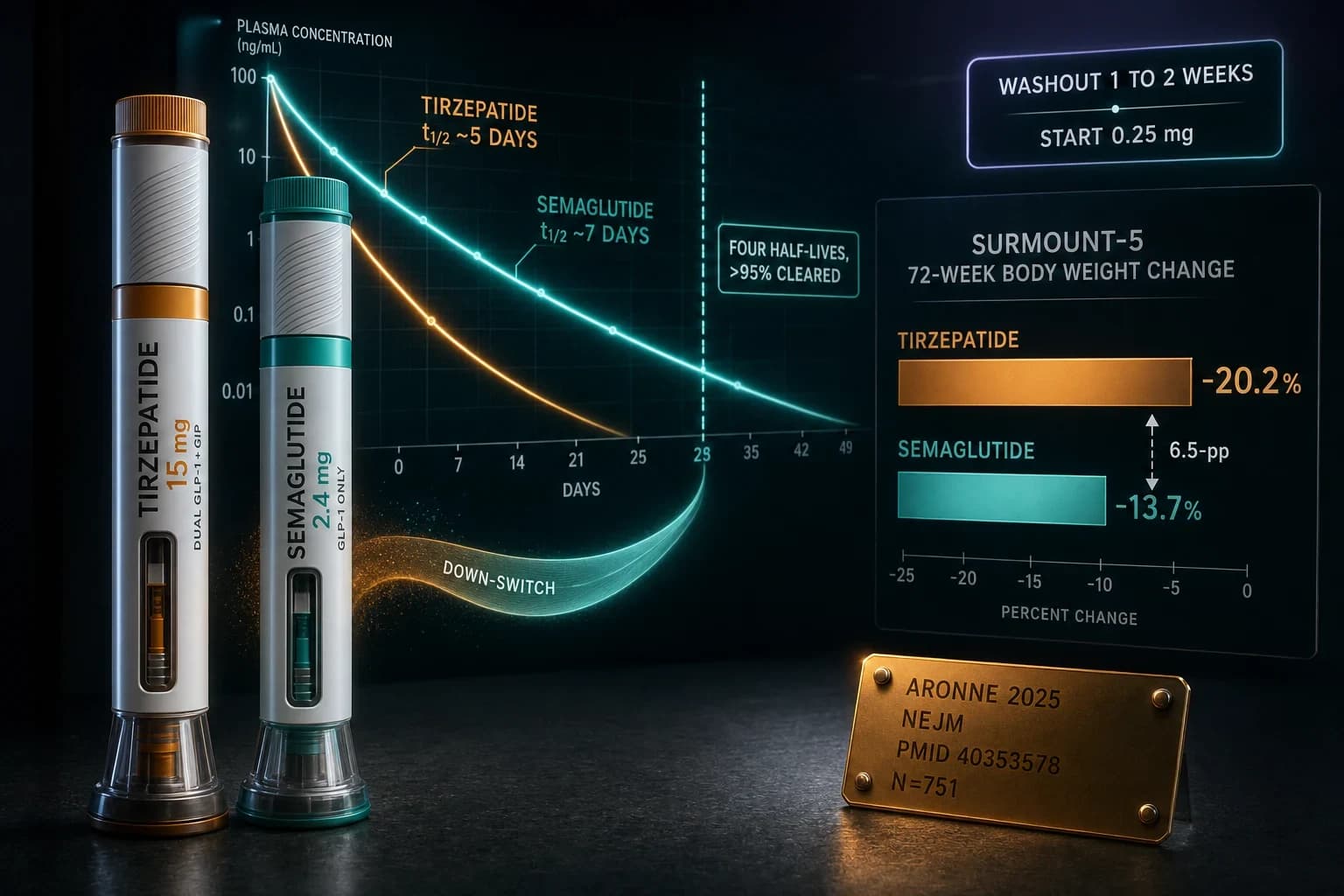
The head-to-head against semaglutide's high-dose obesity label came later. SURMOUNT-5, presented at ECO 2025 and published in NEJM, compared tirzepatide 10 or 15 mg to semaglutide 2.4 mg in 751 adults with obesity and no diabetes. At 72 weeks, tirzepatide produced 20.2% weight loss versus 13.7% for semaglutide, with gastrointestinal discontinuation lower on tirzepatide (2.7% vs 5.6%) (Aronne et al., NEJM 2025, PMID 40353578). Our tirzepatide vs semaglutide guide and the SURMOUNT-5 head-to-head deep dive unpack the design and the noninferiority margin.
Zepbound (obstructive sleep apnea). SURMOUNT-OSA ran two independent 52-week trials in adults with moderate-to-severe OSA and obesity: one in patients not using PAP therapy, one in patients on PAP for at least three months. Mean apnea-hypopnea index fell by 25.3 events per hour on tirzepatide versus 5.3 on placebo in the non-PAP trial, and 29.3 versus 5.5 in the PAP trial (Malhotra et al., NEJM 2024, PMID 38912654). This is the trial that unlocked Zepbound's December 2024 OSA indication.
Maintenance. Weight regain after discontinuation is not a marketing tagline; it is measured. SURMOUNT-4 ran a 36-week open-label tirzepatide lead-in, then randomized responders to continue tirzepatide or switch to placebo for 52 weeks. The continuation arm lost another 5.5% on top of the run-in; the placebo arm gained 14.0% (Aronne et al., JAMA 2023, PMID 38078870). Whichever brand you fill, staying on the drug is what preserves the loss.
What each costs in 2026
The list price is close. What you actually pay depends on which of four lanes you are in.
| Lane | Zepbound | Mounjaro |
|---|---|---|
| List price (4-pen box) | ~$1,086 | ~$1,079 |
| Commercial insurance with the savings card | Rarely covered for weight loss; when covered, ~$25/mo | ~$25/mo for T2D patients on eligible plans, capped at $1,950/yr |
| Manufacturer savings card without coverage | $650/mo prior-authorization pathway | Not available for T2D on non-diabetes plans |
| Self-pay through LillyDirect single-dose vials | $299 (2.5 mg), $399 (5 mg), $449 (7.5-15 mg) | Vial format not sold to consumers |
| Cash pay for the branded pen | ~$1,000-1,300 depending on pharmacy | ~$1,000-1,300 depending on pharmacy |
Numbers move often. Verify at checkout. Our cheapest GLP-1 guide tracks the current per-month spend across every legitimate lane.
Insurance in the real world
Insurance decides the price, not the pharmacy.
- T2D on a commercial plan. Mounjaro is usually covered as a preferred or non-preferred GLP-1 agent. The Mounjaro Savings Card takes commercial-plan copays as low as $25 per month, up to $150 per fill and $1,950 per year, through 12/31/2026. Government plans (Medicare, Medicaid, Tricare) are not eligible for the card.
- Weight loss on a commercial plan. Zepbound coverage varies by employer. Some employer plans added obesity coverage in 2025; many still exclude it. When Zepbound is covered under obesity, the savings card can drop the copay to as low as $25 per month for eligible patients; otherwise the card offers a $650 per month self-pay pathway that requires proof of prior authorization or a coverage denial.
- OSA on a commercial plan. The December 2024 OSA approval is the newest coverage frontier. Plans that carve out obesity drugs may still cover Zepbound under respiratory care for a documented AHI of 15 or higher plus obesity. The savings card follows the plan's decision.
- Medicare Part D. Federal statute still bars Part D from covering weight-loss drugs. Mounjaro is covered when prescribed for T2D. Zepbound is not covered for weight loss, and Part D coverage for the OSA indication is being litigated plan by plan. Check your specific PDP formulary rather than assuming.
- Medicaid. Fewer than a third of state Medicaid programs cover anti-obesity medications. Our Medicare and state Medicaid bridge tracks what changes and how the cash-pay lane fills the gap.
The self-pay lane: LillyDirect vials and compounded tirzepatide
Two shifts changed the self-pay math in the last 18 months.
First, Lilly opened Zepbound single-dose vials through LillyDirect in August 2024, initially at $349 (2.5 mg) and $549 (5 mg). Higher doses came online through 2025, and in December 2025 Lilly cut the vial prices to $299 (2.5 mg), $399 (5 mg), and $449 for 7.5 through 15 mg. The vials require a Zepbound prescription (obesity or OSA label) and ship refrigerated. There is no Mounjaro vial equivalent for retail self-pay; Mounjaro remains pen-only for consumers.
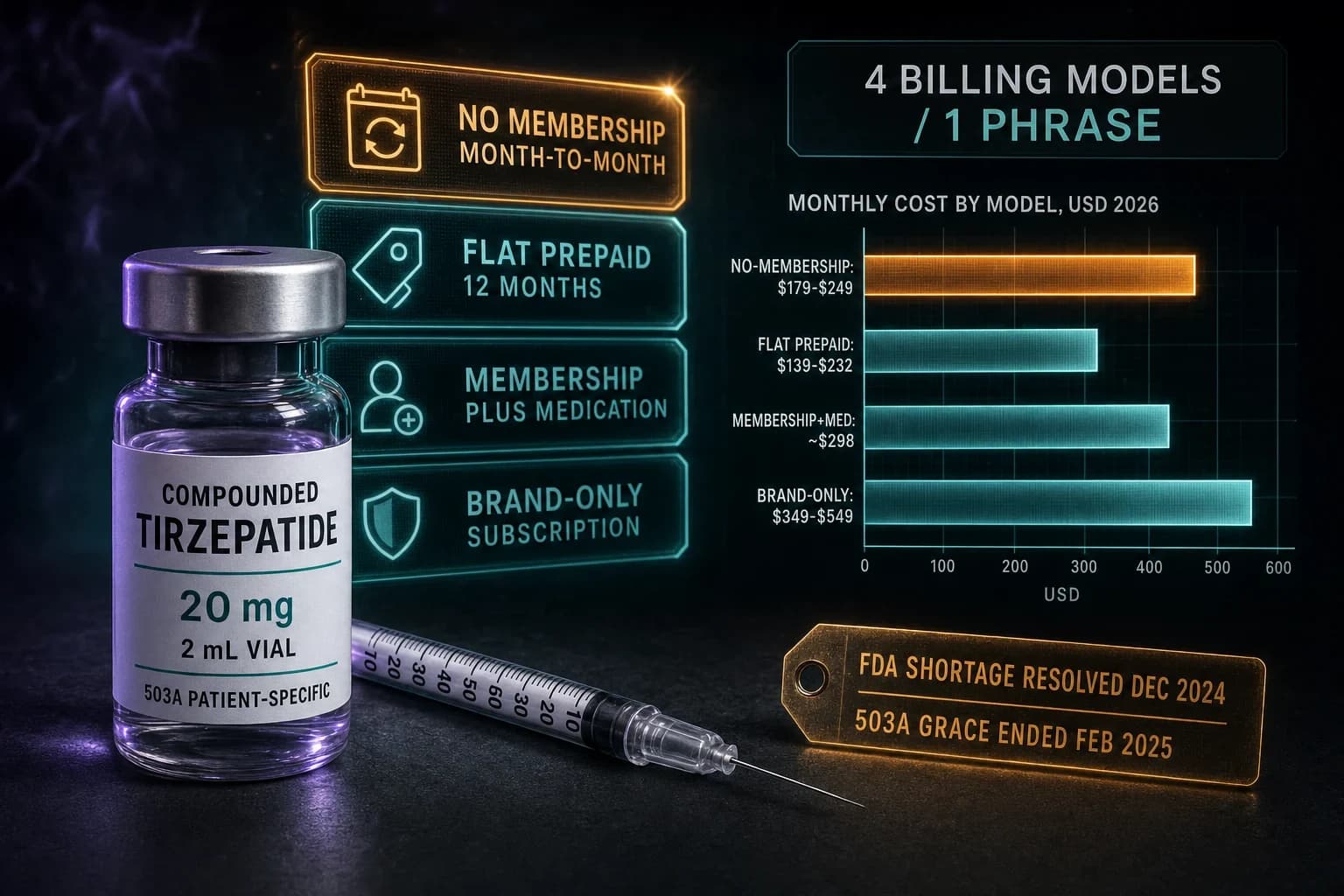
Second, US-licensed telehealth programs prescribe compounded tirzepatide through 503A and 503B pharmacies. Compounded is the molecule, not the brand, so it is neither Zepbound nor Mounjaro. Legitimate compounded tirzepatide programs sit at roughly $199 to $499 per month at typical maintenance doses and cover both weight-loss and dose-tapering use cases. We rank them in the compounded tirzepatide access guide.
The compounded lane narrowed after the FDA declared the tirzepatide shortage resolved. State-licensed 503A pharmacies can still compound for a documented per-patient medical need (a specific dose the manufactured pen does not offer, a documented allergy to an excipient), and 503B outsourcing facilities operate under different rules. Our FDA 503A peptide compounding review has the current legal frame.
Switching pens: what to expect
If your prescription switches from Mounjaro to Zepbound (usually because your indication or coverage changed), the dose does not change. A patient stable on 10 mg Mounjaro fills a 10 mg Zepbound pen at the same weekly rhythm. The switching from semaglutide to tirzepatide guide covers cross-molecule switching; brand-to-brand within tirzepatide is not a switch in any pharmacological sense.
Two practical notes:
- Refill timing resets when the brand code changes at the pharmacy. Fill a full 28-day supply of the new brand on the day the old brand runs out; do not stack overlapping prescriptions.
- Prior authorization runs again under the new indication. Zepbound PA usually requires a documented BMI plus one comorbidity (for the obesity label) or an AHI of 15 or higher plus obesity (for the OSA label). Mounjaro PA requires a T2D diagnosis and often prior metformin.
"Tirzepatide vs Mounjaro" is a naming question
Some readers search "tirzepatide vs Mounjaro" expecting a molecule-versus-brand comparison. The molecule is tirzepatide; Mounjaro is the diabetes brand name of that molecule; Zepbound is the obesity and OSA brand name. There is no separate generic tirzepatide product in the US, so the only tirzepatide you can fill in a US pharmacy under the FDA-approved label is either Mounjaro or Zepbound. Compounded tirzepatide is dispensed by state-licensed pharmacies against a per-patient prescription and is neither.
Two adjacent naming questions worth resolving before you buy:
- Zepbound vs Wegovy compares two molecules (tirzepatide vs semaglutide) at their obesity labels. Our Wegovy vs Zepbound comparison covers dosing and price side by side.
- Mounjaro vs Wegovy compares two molecules at mismatched labels (T2D vs obesity), which usually means the reader wants weight-loss data at the T2D-approved dose. Our Mounjaro vs Wegovy guide walks through the crossover.
For the dose ladder itself, the Mounjaro dosage chart and the Wegovy dosage chart list weekly titrations and injection-day mechanics; the tirzepatide chart itself lives at /dosage-charts/tirzepatide.
Getting a US-licensed prescription without insurance
If your plan will not cover either Zepbound or Mounjaro for your indication, the honest self-pay lanes are the LillyDirect vial and a US-licensed telehealth compounded program. We prefer telehealth partners that carry both branded and compounded tirzepatide so the same clinician can move you between lanes if pricing or supply changes.
Two audited programs handle the majority of legitimate compounded tirzepatide today: Bodybuilding Health+, our first recommendation for combined tirzepatide plus adjunct peptide therapy under one clinician, and Yucca Health, with the longest verifiable GLP-1-only review sample in the category. Both prescribe compounded tirzepatide through a US-licensed pharmacy at maintenance doses that undercut the branded pen for cash-paying buyers. See our telehealth overview for the full audited list.
Tip: If you already have a Mounjaro prescription for T2D on a covered commercial plan, do not switch to Zepbound to save money. The savings-card path on Mounjaro is almost always cheaper than any self-pay lane on Zepbound. If you have neither coverage nor a T2D diagnosis, the LillyDirect vial and the US-licensed compounded lane are the two legitimate answers, and the choice between them turns on dose, cadence, and whether you want a branded product.
Bottom line
The molecule is the same across both brands. Everything downstream of the molecule (label, savings card, insurance verdict, cash price) is where they actually diverge. In 2026 the decision map looks like this:
- T2D plus commercial insurance: Mounjaro with the savings card.
- Obesity plus commercial insurance that covers obesity: Zepbound with the savings card if eligible.
- Obesity plus no coverage: LillyDirect Zepbound vials ($299 to $449) or a US-licensed compounded tirzepatide program.
- Moderate-to-severe OSA plus obesity plus commercial insurance: check for respiratory-care Zepbound coverage before assuming the plan will refuse.
- Medicare Part D plus T2D: Mounjaro; the weight-loss label is not covered federally.
The right pick is the cheapest legitimate lane that fits your indication and your plan.
This article is for research and educational purposes only and is not medical advice. Tirzepatide is a prescription medication in the United States; use only under the care of a licensed clinician. Prices and coverage change frequently; verify current terms with Eli Lilly, LillyDirect, your insurance plan, and any telehealth or compounding pharmacy you use.