At a glance
- No published trial directly tests a tirzepatide-to-semaglutide switch; the protocol below is pharmacology-driven, not RCT-validated.
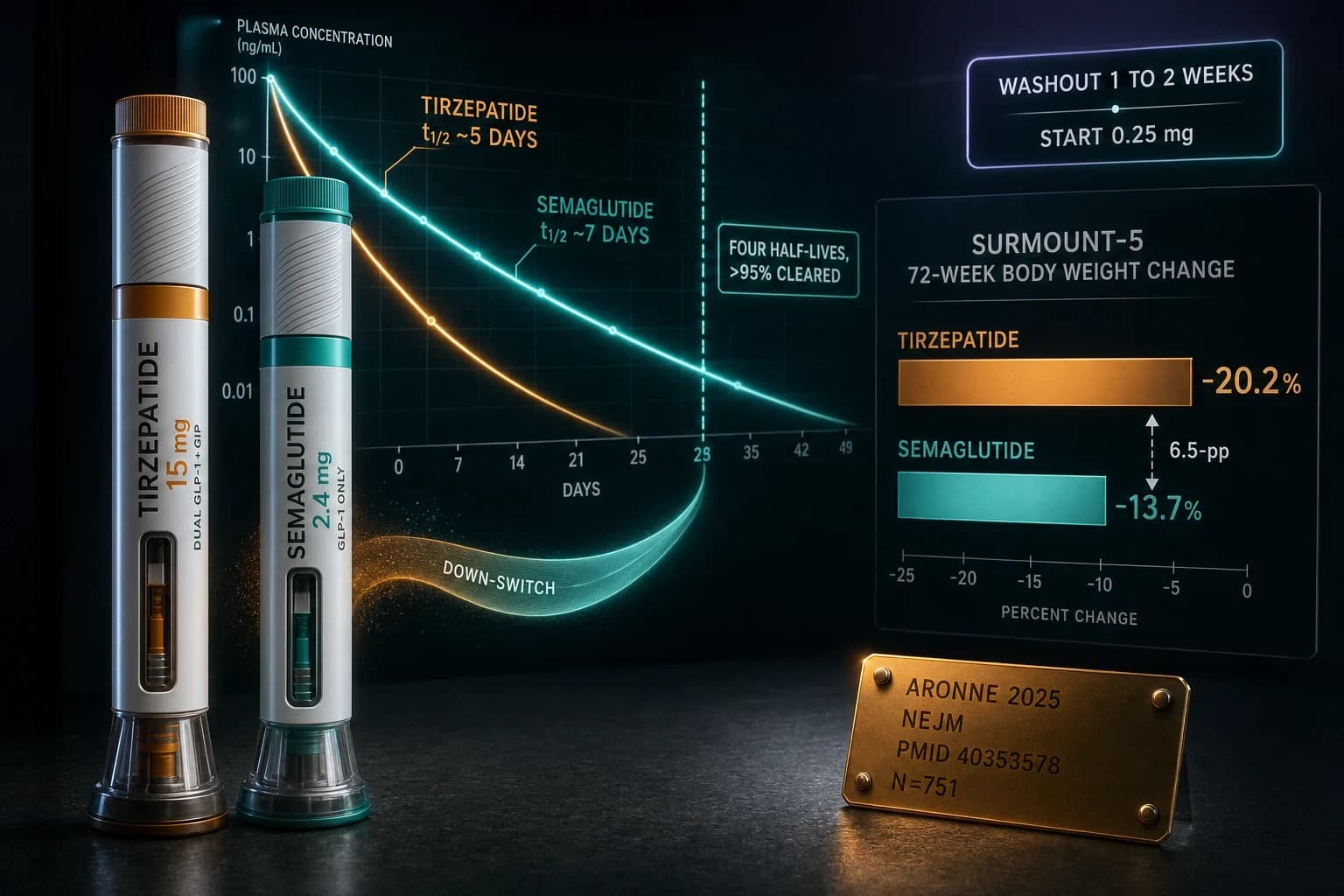
- Tirzepatide half-life is roughly 5 days; semaglutide is roughly 7 days. Four to five half-lives means tirzepatide is substantially cleared by about 25 days.
- SURMOUNT-5 (Aronne et al. 2025) measured a 6.5 percentage-point weight-loss gap favoring tirzepatide at 72 weeks (-20.2% vs -13.7%).
- Semaglutide prescribing information starts every patient at 0.25 mg weekly regardless of prior GLP-1 exposure.
- SELECT (Lincoff et al. 2023) remains the only completed cardiovascular outcomes trial in this class, and the molecule it tested was semaglutide.
Why anyone switches down from tirzepatide to semaglutide
The clinical trial literature frames the GLP-1 class as a ladder you climb: semaglutide first, tirzepatide if semaglutide fell short. The real-world flow is messier. People move the other direction too, and the reasons rarely show up in the primary trials.
Four cases cover almost every down-switch that reaches a telehealth intake form. GI side effects did not resolve on the lowest tolerated tirzepatide dose. The pharmacy benefit manager dropped tirzepatide from the formulary, or added a step-therapy requirement that semaglutide clears. The patient has established cardiovascular disease without diabetes, and their prescriber wants the molecule that has an outcomes trial behind that indication. Or the patient is at a maintenance weight they are comfortable with, and they are willing to trade some ceiling for a smaller, cheaper weekly injection.
Bottom line up front: No prospective trial has measured what happens when someone switches from tirzepatide to semaglutide. The protocol below is reconstructed from pharmacokinetics, from the two completed head-to-head trials pointed the other way, and from how prescribers handle other GLP-1 transitions. Treat every number as directional, not definitive, and work with a prescriber who can titrate on the real patient in front of them.
If your switch is going the other direction, our switching from semaglutide to tirzepatide guide handles that case and the dose-ladder math behind it. For a broader class-level view of relative efficacy, see our tirzepatide vs semaglutide 2026 breakdown.
What actually changes pharmacologically
Tirzepatide is a dual GLP-1 and GIP receptor agonist. Semaglutide binds only the GLP-1 receptor. That single difference drives everything downstream: the appetite-suppression ceiling, the glycemic effect, the GI side-effect pattern, the lean-mass trajectory, and the practical shape of the switch.
| Property | Tirzepatide | Semaglutide (subcutaneous) |
|---|---|---|
| Receptor target | GLP-1 + GIP | GLP-1 only |
| Terminal half-life | ~5 days (Furihata 2021) | ~7 days (Hall 2018) |
| Dosing | Once weekly SC | Once weekly SC |
| Max weight-management dose | 15 mg | 2.4 mg |
| Max T2D dose | 15 mg (Mounjaro) | 2.0 mg (Ozempic) |
| Weight loss ceiling (72-wk head-to-head) | -20.2% (Aronne 2025, SURMOUNT-5) | -13.7% (same trial) |
| CV outcomes trial completed | No | Yes (Lincoff 2023, SELECT) |
Both molecules clear through similar peptidase pathways and both require once-weekly injection. The 5-vs-7-day half-life difference matters most around the switch itself; the mechanism gap matters forever after.
Removing GIP agonism is not a cosmetic change. In SURPASS-2 (Frías 2021) tirzepatide 15 mg produced an HbA1c reduction of -2.30% against -1.86% for semaglutide 1 mg at 40 weeks in type 2 diabetes. In SURMOUNT-5 the obesity gap at 72 weeks was 6.5 percentage points of body weight. The appetite-reduction ceiling that comes from dual agonism is not something a semaglutide dose titration can match; the switch is a step down from that ceiling, and the honest conversation is about where you choose to land, not whether you can hold the same number.
The washout question
Half-life sets a hard constraint. After four to five half-lives, more than 95% of a drug has cleared from plasma. For tirzepatide that is about 20 to 25 days. For a weekly dose at steady state the clinically-relevant residual drops below one quarter of peak within about two weeks.
Clinical practice does not insist on a full washout. The Pharmaceutical Journal's switching review, drawn largely from guidance on other within-class GLP-1 transitions because no direct data exists, lays out two reasonable options. A one-to-two-week spacing before the first semaglutide injection, which prescribers tend to use when the switch is being made because of persistent GI intolerance. Or a same-week switch where the next scheduled weekly dose is simply filled with semaglutide, which prescribers use for patients tolerating tirzepatide fine but switching for cost or coverage reasons.
| Reason to switch | Common washout | Why |
|---|---|---|
| GI side effects, nausea, vomiting | 1 to 2 weeks before first semaglutide dose | Lets residual tirzepatide clear before layering a second GLP-1 agonist signal |
| Insurance / formulary / cost | Next scheduled weekly dose | Minimizes any plateau or regain window |
| CV disease, no diabetes | Next scheduled weekly dose | Preserves continuous receptor engagement; SELECT-eligible patients benefit from no gap |
| Pregnancy planning | At least 2 months before conception attempts | Both labels advise discontinuation; semaglutide's longer half-life means washout math matters more here |
| Dose stabilization at maintenance | Next scheduled weekly dose | Continuous coverage avoids an appetite-rebound window |
Warning: If your switch is driven by severe GI symptoms, tirzepatide clearance is only half the question. The other half is avoiding stacked exposure from two overlapping GLP-1 agonist signals. A one-to-two-week gap before starting semaglutide is the safer default here, and resuming at semaglutide 0.25 mg (not the dose that matches your prior tirzepatide) is the standard every semaglutide label recommends.
The starting dose: there is no conversion ratio
This is where most consumer-oriented switching guides get the pharmacology wrong. There is no validated conversion ratio from a tirzepatide dose to a semaglutide dose. The semaglutide label, for both Wegovy and Ozempic, instructs every new patient to begin at 0.25 mg once weekly for four weeks, regardless of prior GLP-1 exposure. That is not an oversight. It is the dose at which GI tolerability is best characterized, and both STEP 1 (Wilding 2021) and SELECT (Lincoff 2023) started every participant there.
| Prior tirzepatide dose | Semaglutide starting dose | Expected maintenance target |
|---|---|---|
| 2.5 mg | 0.25 mg | 1.0 to 1.7 mg |
| 5 mg | 0.25 mg | 1.7 mg |
| 7.5 mg | 0.25 mg | 1.7 to 2.4 mg |
| 10 mg | 0.25 mg | 2.4 mg |
| 12.5 or 15 mg | 0.25 mg | 2.4 mg (cap for weight management) |
The right-hand column is observational, not conversion math. These are the doses most patients land on, based on how prescribers describe maintenance after a down-switch; they are not guaranteed, and the titration still goes through the standard 0.25 mg → 0.5 mg → 1.0 mg → 1.7 mg → 2.4 mg ladder, four weeks at each step, with holds anywhere the GI tolerance demands.
A patient coming off tirzepatide 15 mg is not going to feel the same appetite suppression on semaglutide 0.25 mg; that is the entire point of the mechanism difference. The first four weeks of a down-switch are the window where hunger returns most noticeably, and planning for that window is more useful than hoping to skip it. For a reference on the full titration ladder with timing, see the semaglutide dosage chart and the tirzepatide dosage chart side by side.
What to expect across the first eight weeks
The transition is not seamless, and the biggest early risk is interpreting a predictable adjustment phase as the switch "not working."
Weeks 1 to 2. Residual tirzepatide still has meaningful plasma concentration. Appetite suppression is close to prior levels. The first semaglutide 0.25 mg dose adds a modest additional GLP-1 signal. Nausea is uncommon in this window because the body is already habituated.
Weeks 3 to 4. Residual tirzepatide drops below one-quarter of peak. GIP activity is effectively gone. For many patients this is where hunger returns most sharply. Semaglutide is still at the sub-therapeutic 0.25 mg starter dose. Weight loss stalls or small regain of 1 to 3 pounds is normal. This is the window that drives people to call their prescriber and ask whether the switch failed. It usually has not; the dose has not caught up yet.
Weeks 5 to 8. Semaglutide reaches 0.5 mg, then 1.0 mg. Appetite suppression is noticeable but still below the tirzepatide ceiling. GI side effects, if any, emerge now rather than earlier, because this is where the GLP-1 agonist signal reaches a dose that matters. Nausea rates on 1.0 mg in STEP 1 ran around 44% at some point during 68 weeks, and about 4.5% of participants discontinued for GI reasons overall.
Weeks 9 to 16. Target maintenance dose (1.7 or 2.4 mg) is reached. Weight loss resumes, usually at a pace about two-thirds of what the tirzepatide ceiling delivered. The STEP 1 and SURMOUNT-5 trajectory lines diverge in this window too: expect a slower slope, not a flat line.
Tip: The first six weeks are the hardest. If you can keep the switch in place through the trough, the semaglutide curve picks up. If you cannot, that is a signal worth talking through with your prescriber before week eight rather than quietly giving up and gaining back the gap.
What the evidence actually quantifies
Two head-to-head trials matter here, both of them in the same direction: tirzepatide first, semaglutide as comparator. SURMOUNT-5 (Aronne 2025) and SURPASS-2 (Frías 2021) between them anchor the realistic expectation for a down-switch.
| Trial | Population | Primary comparison | Tirzepatide result | Semaglutide result | Gap |
|---|---|---|---|---|---|
| SURMOUNT-5 | 751 adults, obesity, no diabetes | Body weight at 72 weeks | -20.2% | -13.7% | 6.5 percentage points |
| SURPASS-2 | 1,879 adults, T2D | HbA1c at 40 weeks | -2.30% (15 mg) | -1.86% (1 mg) | 0.44 percentage points |
| SURMOUNT-5 | Same | Waist circumference at 72 wk | -18.4 cm | -13.0 cm | 5.4 cm |
| SURMOUNT-5 | Same | GI-related discontinuation | 2.7% | 5.6% | semaglutide higher |
Two things stand out from the SURMOUNT-5 safety data that run against the usual intuition about switching. GI-related discontinuation was higher in the semaglutide arm, not the tirzepatide arm. And the tirzepatide group tolerated higher achieved doses in general. For a patient switching down specifically because of tirzepatide-induced nausea, that is not reassuring. The GI symptoms of a GLP-1 do not disappear when you remove GIP; they often ease, but the trial record says they can also persist or newly appear during semaglutide titration.
There is no completed trial of the inverse (tirzepatide to semaglutide) direction. The closest clinical signal comes from case series on cross-class GLP-1 transitions, none of which has enough power to recommend a specific protocol. That absence is why the washout and starting-dose rules above read like clinical judgment rather than citation anchors; the citations do not exist yet.
What the SELECT trial changes about the decision
The strongest argument for choosing semaglutide over tirzepatide in a specific patient is cardiovascular. SELECT (Lincoff 2023) randomized 17,604 adults aged 45 and older with established cardiovascular disease, BMI of 27 or greater, and no diabetes to semaglutide 2.4 mg weekly or placebo. Over a mean follow-up of 39.8 months the composite of cardiovascular death, nonfatal MI, and nonfatal stroke occurred in 6.5% of the semaglutide group versus 8.0% of the placebo group (hazard ratio 0.80, 95% CI 0.72 to 0.90, P<0.001). That is a 20% relative reduction and a 1.5 percentage-point absolute reduction over three to four years in a population at real cardiovascular risk.
No equivalent completed trial exists for tirzepatide yet. SURPASS-CVOT is ongoing. Until it reads out, prescribers who are weighing GLP-1 selection in a patient with existing coronary disease and overweight-without-diabetes have one molecule with a positive outcomes trial and one without. For that specific profile, switching down is not a step back; it is a step toward the evidence.
For patients with type 2 diabetes, this calculus flips. In SURPASS-2 the tirzepatide HbA1c advantage is real and meaningful. The CV outcomes story in this class is still the semaglutide story until SURPASS-CVOT reads out, but the diabetes-plus-weight story is tirzepatide's.
The weight-maintenance arithmetic
Switching down is not supposed to be a weight-loss strategy. It is a maintenance decision or a tolerability decision. Patients already near their stable weight will often hold most of their loss on semaglutide 1.7 or 2.4 mg; the handful of points of regain from losing GIP activity are usually smaller than the gap on the SURMOUNT-5 curve, because real-world intake is driven by behavior as much as receptor pharmacology.
The failure mode worth planning around is the opposite: discontinuing both. In the STEP 1 trial extension, participants who had lost 17.3% on semaglutide and then stopped treatment regained about two-thirds of that weight within a year. The implication for a switch is specific: a prolonged washout gap (two weeks is fine, six weeks is not) is more likely to drive regain than the switch itself. The semaglutide dose being too low for too long is the second-biggest risk; make sure your prescriber's titration cadence is actually four weeks per step, not an open-ended "we'll see how you feel."
If GLP-1-driven muscle loss has been part of your experience on tirzepatide, that question also stays with you after the switch. Our GLP-1 muscle preservation research guide covers the lean-mass evidence and the resistance-training protocol most clinicians anchor on; neither molecule solves it on its own.
Access and cost after the switch
The practical difference between the two molecules at full dose is money. Zepbound and Mounjaro brand pens, and the Wegovy and Ozempic brand pens on the semaglutide side, have broadly overlapping cash prices. Where the gap opens up is in compounded telehealth, where semaglutide has been more widely available for longer, and in LillyDirect's cash-pay vial path, which currently exists only on the tirzepatide side.
| Lane | Semaglutide (approx. monthly) | Tirzepatide (approx. monthly) |
|---|---|---|
| Insured copay with coverage | $25 to $100 | $25 to $100 |
| Cash LillyDirect vial | n/a | $349 to $499 |
| Cash brand pen without coverage | $900 to $1,350 | $1,000 to $1,100 |
| Compounded telehealth, US 503A | $199 to $349 | $249 to $499 |
Our cheapest GLP-1 options guide is the live source of truth for monthly pricing across lanes, and the compounded semaglutide online hub lists the US-licensed 503A clinics that currently prescribe compounded semaglutide. If you want a supervised telehealth clinic that will handle the switch with real titration guidance rather than a vial drop-ship, our Yucca Health review covers the clinic we currently recommend for this profile; our Bodybuilding Health+ review is the alternative with the widest compound menu and a straightforward intake.
Research-grade injectable semaglutide and tirzepatide, both outside the prescription channel, are stocked by Ascension Peptides. For readers specifically researching compound sourcing rather than running a prescribed program, our Ascension Peptides review covers lot testing, pricing, and the current 50% off with code ENHANCED. That lane is not a substitute for clinical oversight on a GLP-1 program, and nothing above should be read as a recommendation to replace prescribed therapy with a research vial.
Decision matrix: who should switch, and who should think again
The call is rarely binary, but these are the profiles where a down-switch has the strongest or weakest case.
Strong case for switching to semaglutide:
- Established cardiovascular disease, overweight or obese, no diabetes. The SELECT indication is the one place in this class where the molecule you choose carries a 20% MACE-reduction datum rather than a prescribing-information inference.
- Tirzepatide GI intolerance that did not resolve at the lowest tolerated dose. Downshifting to a GLP-1-only agonist removes one of the two receptor signals and often, though not always, eases the symptoms.
- Pharmacy-benefit changes that make semaglutide affordable and tirzepatide expensive. The clinical gap is smaller than the price gap for most patients already in maintenance.
- Pregnancy planning more than two months out. Semaglutide has the longer half-life of the two, so the washout math still has to be clean, but both labels require discontinuation ahead of attempts to conceive.
Weak case for switching to semaglutide:
- Weight loss has plateaued on tirzepatide and the goal is more loss. The direction is wrong. Add a dose step on tirzepatide or revisit lifestyle variables; semaglutide has a lower ceiling in head-to-head data, so a switch down will not restart loss.
- Type 2 diabetes patient near HbA1c goal on tirzepatide. The SURPASS-2 gap favors tirzepatide here, and giving up 0.4 percentage points of HbA1c is not neutral if you were already struggling to get to target.
- Supply disruption that is temporary. A two-to-three-week pharmacy delay does not justify a protocol change; a one-dose gap on the same molecule is cleaner than a cross-molecule switch.
- Belief that semaglutide is "the lower-side-effect option." SURMOUNT-5 did not support that; GI-related discontinuation was higher on semaglutide, not lower.
Note: The one scenario this article does not try to cover is switching between oral semaglutide (Rybelsus) and injectable tirzepatide or vice versa. The oral GLP-1 pharmacokinetics are different enough that the washout and starting-dose rules above do not translate. For that question, see our oral semaglutide Rybelsus vs orforglipron guide and talk through the switch with a prescriber.
Monitoring across the first 90 days
The data you collect in the first three months is what your prescriber uses to decide whether the switch worked. Thin data makes that call harder.
- Weekly weight, same time, same clothing. Expect a plateau or small regain in weeks three and four. If week eight has not resumed trending down, that is the titration-decision signal.
- Appetite rating, 0 to 10, daily. Noisier than weight but faster to react. A sustained two-point jump without concurrent weight change is where behavioral support most pays off.
- GI symptoms and injection-site reactions. The 2.4 mg dose is where many patients see tolerability constraints for the first time.
- HbA1c at week 12 if diabetic. The SURPASS-2 gap is real; a stable HbA1c is a successful switch, a 0.5-point climb is a conversation.
- Blood pressure and resting pulse at baseline and 90 days.
For patients using an injectable research-grade compound, reconstitution math is the usual source of dosing error. Our reconstitution calculator handles different vial strengths and desired doses, and the semaglutide reconstitution chart covers the standard 5 mg vial. Clinical patients on a brand pen do not need either.
Common mistakes
Skipping the titration ladder. Patients comfortable on tirzepatide 10 mg sometimes want to start semaglutide at 1.0 mg, reasoning that the body is already accustomed to a GLP-1 signal. GI side effects on semaglutide 1.0 mg are not reliably predicted by prior tirzepatide tolerance, and the four-week ladder exists for a reason.
Treating weeks three and four as the verdict. The appetite rebound in that window is predictable and temporary. Stopping the switch at week four is almost always stopping it at the trough.
Running an unsupervised DIY taper off both drugs. The STEP 1 extension data are unambiguous: two-thirds of the weight comes back inside a year off treatment. The sustainable move is to stay on something, not to try to taper off entirely and hope behavioral changes carry.
Bottom line: Switching from tirzepatide to semaglutide is a legitimate clinical move for the right patient, especially the SELECT-eligible profile and the ones whose tirzepatide tolerability never settled. It is not a weight-loss-upgrade move, and it is not a shortcut around GI side effects that come from the GLP-1 receptor itself. The pharmacology does most of the work of answering whether the switch suits you; a prescriber with your actual labs does the rest.
For the inverse question (semaglutide to tirzepatide, including dose-ladder math and the SURPASS-2 glycemic argument), the sibling article is switching from semaglutide to tirzepatide. For class-level comparison, tirzepatide vs semaglutide 2026 collects the head-to-head evidence in one place. For price-and-access lane analysis, GLP-1 dosing comparison 2026 is the current source of truth, and the cheapest GLP-1 options guide tracks per-month pricing.
This article is for educational and research purposes only. It discusses prescription medications and physiologic processes, and nothing above is medical advice or an instruction to start, stop, or alter a prescribed therapy. GLP-1 receptor agonists have specific indications, contraindications, and monitoring requirements. Any decision about switching between semaglutide and tirzepatide must be made with a licensed prescribing clinician who can evaluate your specific medical history. Research-grade peptides discussed are sold for laboratory research use only and are not substitutes for prescribed medication.