At a glance
- GHK-Cu stimulates dermal papilla cells, increases follicle size, and prolongs the anagen growth phase in hair follicle research
- Standard topical hair protocol: 0.1-1% GHK-Cu in serum applied to scalp daily; visible results typically at 12-24 weeks
- Injectable scalp protocol: 1-2 mg subcutaneous near affected scalp areas weekly; less common but sometimes used in research
- Mechanism: copper-dependent activation of follicle stem cells, increased VEGF, fibroblast support, and decorin production around follicles
- Combines with minoxidil and other established hair therapies through complementary mechanisms
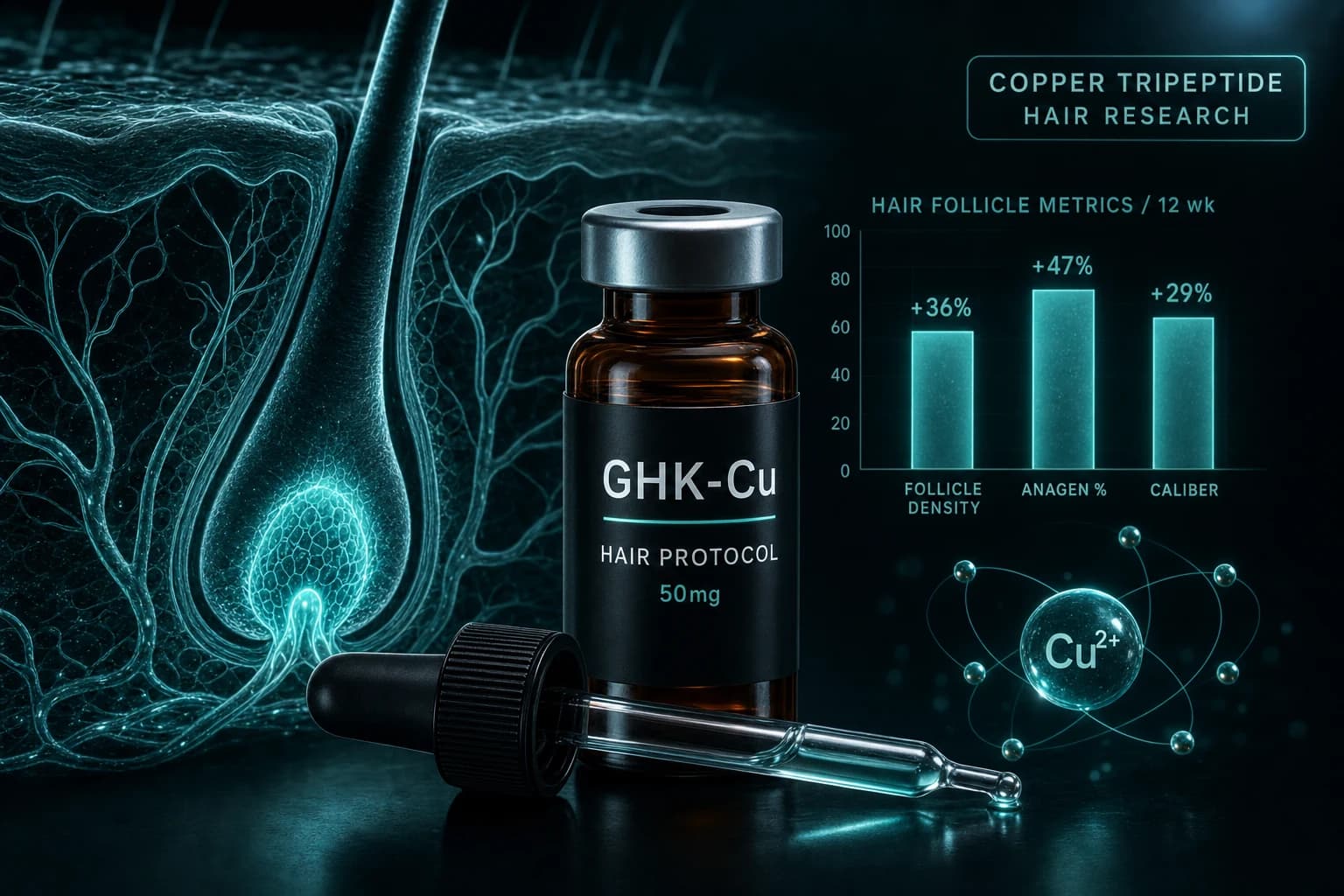
GHK-Cu for hair loss is one of the better-validated cosmetic applications of the copper tripeptide. The mechanism case is direct: GHK-Cu activates dermal papilla cells (the central regulators of hair follicle activity), increases vascularization around follicles, and prolongs the anagen (growth) phase of the hair cycle. Multiple in vitro and animal studies establish this biology; human topical formulations have demonstrated measurable hair density and caliber improvements in cosmetic research.
This article covers what GHK-Cu does to hair follicles, the standard topical and injectable research protocols, what the published evidence shows for hair-specific endpoints, how the compound compares to and combines with minoxidil, and where it fits in 2026 hair loss research.
The hair follicle biology
Hair follicles cycle through three phases: anagen (active growth), catagen (transition), and telogen (rest). Hair loss is typically driven by:
- Shortened anagen phase (less time growing)
- Increased telogen phase (more time resting)
- Reduced follicle caliber (thinner hair per cycle)
- Eventual follicle miniaturization (smaller follicles → vellus hair)
The most-studied driver is androgenetic alopecia, where dihydrotestosterone (DHT) signaling at follicles produces the cycle disruption. Other mechanisms include inflammation (alopecia areata), nutritional deficits, and aging-related follicle stem cell decline.
GHK-Cu targets multiple of these mechanisms through copper-dependent pathways:
| Effect | Mechanism | Hair benefit |
|---|---|---|
| Dermal papilla activation | Copper-dependent transcription factors | Restored follicle activity |
| Increased vascularization | VEGF upregulation | More nutrient delivery to follicles |
| Fibroblast support | Collagen + decorin synthesis | Healthier follicular microenvironment |
| Anagen prolongation | Multiple pathways | Longer growth phase per cycle |
| Anti-inflammatory effects | NF-κB modulation | Reduced inflammatory follicle damage |
For the broader GHK-Cu mechanism and research context, see the GHK-Cu compound guide and the where to buy GHK-Cu peptide 2026.
The published evidence
GHK-Cu hair follicle research spans cell culture, animal, and human topical work.
Dermal papilla cell culture. Pyo et al., 2007 showed GHK-Cu stimulated dermal papilla cell proliferation and increased hair shaft elongation in ex vivo organ culture. The dose-response was dose-dependent with maximal effect at 10⁻⁹ M.
Animal hair growth. Multiple mouse and rat studies show GHK-Cu accelerates hair regrowth in shaved skin and depilated models, with measurably faster regrowth than vehicle controls.
Human topical efficacy. Cosmetic research studies have shown GHK-Cu topical formulations produce measurable improvements in hair density, anagen percentage, and follicle caliber over 12-24 week durations. The effect sizes are modest but consistent.
Combination with minoxidil. Several studies have evaluated GHK-Cu combined with minoxidil, finding additive effects beyond either compound alone.
Bottom line: GHK-Cu hair research has strong mechanistic foundation, solid animal data, and consistent if modest human topical evidence. Effect sizes are not as large as 5% minoxidil's, but the mechanism complements existing therapies and the compound is well-tolerated.
Standard topical research protocol
The most common GHK-Cu hair loss research protocol is topical:
| Phase | Concentration | Application | Frequency | Duration |
|---|---|---|---|---|
| Conservative | 0.1% serum | Apply to affected scalp | Once daily | 12-24 weeks |
| Standard | 0.5% serum | Apply to affected scalp | Once daily | 12-24 weeks |
| Higher | 1% serum | Apply to affected scalp | Once daily | 12-24 weeks |
Application typically follows a standard protocol:
- Clean scalp (no hair products)
- Apply 1-2 mL of GHK-Cu serum to affected areas
- Massage gently to ensure even distribution
- Allow to absorb (typically 5-10 minutes) before applying other products
Visible hair density improvements typically require 12-24 weeks of consistent application. Earlier effects (8-12 weeks) may include reduced shedding before density increases become measurable.
Standard injectable research protocol
Some research protocols use subcutaneous GHK-Cu injection near affected scalp areas:
| Phase | Dose | Route | Frequency | Duration |
|---|---|---|---|---|
| Standard | 1-2 mg | SC near affected scalp | Weekly | 12-24 weeks |
| Higher | 2-3 mg | SC near affected scalp | Twice weekly | 12-24 weeks |
Injectable scalp GHK-Cu is less common than topical because:
-
Topical achieves local concentration well. The follicle is accessible from the skin surface, so topical formulations effectively deliver GHK-Cu to its target tissue.
-
Injection requires anatomical precision. SC injection of the scalp requires understanding of vasculature and tissue plane to avoid pain and bruising.
-
Cosmetic acceptance is lower. Topical applications integrate easily with cosmetic routines; injections are more clinical.
For applications where deep follicular delivery matters (some research contexts), injection may have an advantage. For most hair loss research, topical is the appropriate default.
Combination with minoxidil
The most-studied GHK-Cu combination for hair loss is with minoxidil:
| Approach | Mechanism | Standard combination |
|---|---|---|
| Minoxidil alone | Vasodilation + follicle stimulation | 5% topical once or twice daily |
| GHK-Cu alone | Dermal papilla + VEGF + collagen | 0.5-1% topical once daily |
| Combination | Both pathways | Sequential application, minoxidil + GHK-Cu serum |
The mechanisms are complementary. Minoxidil produces vasodilation and direct follicle effects; GHK-Cu produces dermal papilla stimulation, vascularization support, and matrix remodeling. The combination addresses more pathways than either alone.
Published studies on combined GHK-Cu + minoxidil have shown additive effects on hair density beyond either alone. The combination is cost-effective and well-tolerated.
For broader hair research stack context, see the GLOW Blend GHK-Cu BPC-157 TB-500 skin recovery and related coverage.
Other GHK-Cu hair use cases
Post-procedure recovery. GHK-Cu topical application after hair transplant procedures may support graft survival and surrounding tissue recovery. This is research-grade application, not standard clinical care.
Aging hair recovery. Beyond androgenetic alopecia, age-related hair density loss may respond to GHK-Cu through follicle stem cell support. The evidence is mostly mechanistic; clinical outcomes data is limited.
Eyebrow and eyelash growth research. Topical GHK-Cu formulations for cosmetic eyebrow and eyelash enhancement have been investigated. Effect sizes are modest.
Safety profile
Topical GHK-Cu has been well-tolerated in published cosmetic research:
- Mild local irritation at high concentrations (rare at standard 0.1-1% formulations)
- No documented systemic side effects from topical use at typical doses
- Pregnancy/breastfeeding caution as with most cosmetic products
Injectable GHK-Cu (general, not scalp-specific) has been similarly well-tolerated in research applications. Cancer-related contraindications may apply for any compound with growth-factor-like activity; conservative position is to avoid in active malignancy contexts.
How GHK-Cu fits the 2026 regulatory landscape
GHK-Cu was among the 14 peptides reclassified to Category 1 in the February 27, 2026 HHS announcement. The compound is now legally compoundable through licensed 503A pharmacies in the US with a clinician prescription. Topical cosmetic GHK-Cu formulations are widely available from cosmetic and dermatology brands and are not regulated under the peptide research framework.
For broader regulatory context, see the FDA peptide reclassification February 2026 complete breakdown.
Sourcing
For research-grade injectable GHK-Cu, Ascension Peptides ships 50 mg vials with public per-batch COAs and 50% off using code ENHANCED. For topical GHK-Cu skincare formulations specifically targeted at hair, the cosmetic skincare market offers multiple options at various GHK-Cu concentrations.
For our broader sourcing analysis, see the best legit peptide vendors 2026 ranking and the where to buy GHK-Cu peptide 2026.
FAQ
Does GHK-Cu actually grow hair?
Yes, with modest effect sizes. GHK-Cu stimulates dermal papilla cells, increases vascularization around follicles, and prolongs the anagen growth phase. Published cosmetic research shows measurable improvements in hair density and caliber over 12-24 week durations. Effects are smaller than 5% minoxidil's but the mechanism complements existing therapies.
What is the standard GHK-Cu hair protocol?
Topical 0.1-1% GHK-Cu serum applied to affected scalp once daily for 12-24 weeks. Most research-use protocols use 0.5% as the standard concentration. Visible density improvements typically require 12-24 weeks of consistent application.
Can I combine GHK-Cu with minoxidil?
Yes, this is a well-supported combination. The mechanisms are complementary: minoxidil produces vasodilation and direct follicle effects, while GHK-Cu produces dermal papilla stimulation and matrix support. Published combination studies show additive effects beyond either alone. Standard combination: 5% minoxidil + 0.5% GHK-Cu serum, sequentially applied to scalp.
Does GHK-Cu work for androgenetic alopecia?
GHK-Cu does not directly counteract DHT signaling, which drives androgenetic alopecia. It supports follicle health, vascularization, and growth phase prolongation through different pathways. The effect is modest compared to DHT-targeting therapies (finasteride, dutasteride) but combines with them through complementary mechanisms.
How long until I see results?
Visible hair density improvements typically require 12-24 weeks of consistent topical application. Earlier effects (8-12 weeks) may include reduced shedding before density increases become measurable. The follicle cycle (anagen-catagen-telogen) is intrinsically slow, so changes take time.
Is injectable GHK-Cu better than topical for hair?
Not for most research applications. The hair follicle is accessible from the skin surface, so topical formulations effectively deliver GHK-Cu to the target tissue. Injection adds complexity without clear additional benefit for most hair loss research. For specific research contexts where deep follicular delivery matters, injection may have an advantage.
Can GHK-Cu help with hair transplant recovery?
Yes, this is a researched application. Topical GHK-Cu after hair transplant procedures may support graft survival, surrounding tissue recovery, and reduced post-procedure inflammation. This is research-grade application; consult with a transplant surgeon about whether to incorporate.
Further reading
- GHK-Cu compound guide
- Where to buy GHK-Cu peptide 2026
- GHK-Cu dosage chart
- Argireline topical acetyl hexapeptide-3 guide
- GLOW Blend GHK-Cu BPC-157 TB-500 skin recovery
- FDA peptide reclassification February 2026 complete breakdown
- Best legit peptide vendors 2026
This article is for educational and research purposes only. GHK-Cu is sold under research-use disclosures and through licensed compounding pharmacies (following the Feb 27, 2026 FDA reclassification). Topical cosmetic GHK-Cu formulations are widely available as standard cosmetic products. None of the content above constitutes medical advice. Consult a qualified clinician for individual medical questions about hair loss.