At a glance
- IGF-1 rose significantly within 2 weeks of GHRH(1-29) dosing (Khorram 1997).
- Lean mass gains were modest and seen in men only, not women.
- GH in healthy elderly shifted fat and lean by ~2.1 kg each, with no strength gain.
- Body-composition change shows over 8-24 weeks, never in days.
- Research-market sermorelin is not an FDA-approved product.
Search "sermorelin before and after" and you get transformation grids: leaner waistlines, sharper jawlines, someone's arm looking 15% more vascular by week 6. Almost none of it is measured. The published record on GHRH(1-29), the peptide sermorelin actually is, tells a quieter and more useful story. It moves one blood marker fast, moves body composition slowly, and does not touch a few things people expect it to.
So before you judge sermorelin by a stranger's lighting, look at what researchers put on a scale, a DEXA scanner, and an assay.
What sermorelin is, and why the "before" matters
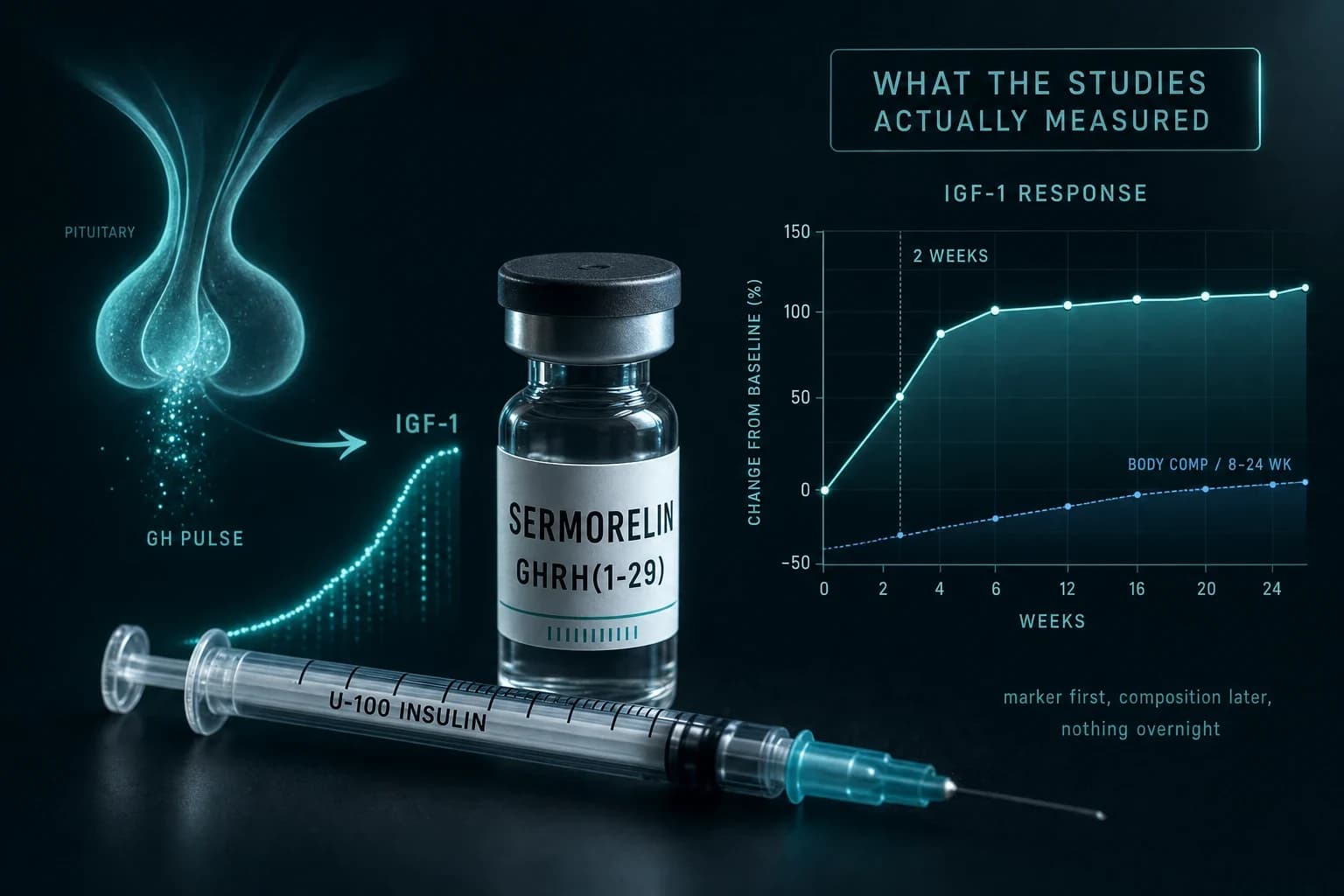
Sermorelin is GHRH(1-29), the first 29 amino acids of growth hormone-releasing hormone. That fragment is the biologically active part. Inject it and it signals your pituitary to release your own growth hormone in a pulse, which then raises insulin-like growth factor 1 (IGF-1) from the liver. You are nudging an existing system, not replacing it.
That mechanism is the entire reason the "before and after" question is subtle. Sermorelin works upstream of GH, so it stays under the body's own negative feedback. Walker (2006) framed this as the practical case for GHRH-based therapy in adult GH insufficiency: preserve pulsatile, self-limiting release instead of forcing a flat exogenous GH level. The upside is a more physiologic signal. The downside, for anyone hoping for a dramatic 30-day transformation, is that a self-regulating pulse produces gradual change, not a switch.
Sermorelin also has real clinical history, which separates it from most research peptides. It was FDA-approved as Geref for diagnosing and treating pediatric growth hormone deficiency, then pulled from the US market around 2008 for commercial reasons, not a safety signal. What circulates now in the research space is not that approved drug. It is lab-use-only material, and that distinction matters for every claim below.
Warning: Almost every physique "before and after" you find for sermorelin is an anecdote, not a measured outcome. GH secretagogues genuinely raise IGF-1, but IGF-1 is a hormone with real considerations (glucose, edema, tissue growth), and research-market sermorelin is not an approved product. Treat transformation photos as marketing, not evidence.
The one thing that changes fast: IGF-1
If any single number is sermorelin's "after," it is IGF-1. And it moves quickly.
In a single-blind placebo-controlled trial of the GHRH(1-29) analog in older men and women, Khorram et al. (1997) reported that serum IGF-1 rose significantly within 2 weeks of dosing and stayed elevated through the trial. That is the earliest, most reliable marker to shift, which is exactly why it is the one worth tracking with a lab draw rather than a mirror.
The IGF-1 response is not new. Corpas et al. (1992) showed that GHRH(1-29) given twice daily reversed the age-related decline in both GH and IGF-1 in healthy old men. Two doses a day restored levels that had drifted down with age. The word "reversed" is doing honest work there: it returned a lowered marker toward a younger baseline, it did not push a healthy young person into supraphysiologic territory.
Here is the practical takeaway. A "before and after" on IGF-1 is a blood test at week 0 and again around week 8-12, not a photo. If you want the honest version of sermorelin results, that is where it lives. You can see how to baseline the right markers on our lab-tests guide.
What changes slowly: body composition
This is where expectations and evidence diverge most.
Khorram et al. (1997) did find a body-composition signal, but a specific and limited one: lean body mass increased in men only, alongside increased skin thickness in both sexes. Women saw the IGF-1 rise without the lean-mass change. So even in a controlled trial, the composition "after" was partial and sex-dependent, not a universal recomposition.
The frequency of dosing also matters more than most before-and-after posts admit. Vittone et al. (1997) gave healthy elderly men a single nightly GHRH injection for 6 weeks and found no change in weight, BMI, waist-to-hip ratio, or DEXA-measured muscle and fat. There was a hint of improved muscle strength and altered muscle bioenergetics, but the visible composition needle did not move. The authors' read: one nightly dose is less effective than multiple daily doses for driving GH- and IGF-1-mediated effects. Dosing schedule is not a footnote. It is part of whether anything happens at all.
For the ceiling on what raising GH can do, the cleanest evidence is not from sermorelin but from direct growth hormone. A systematic review by Liu et al. (2007) pooled GH trials in healthy older adults: fat mass fell about 2.1 kg and lean mass rose about 2.1 kg, while total body weight stayed essentially flat. Real, measurable, and modest. Critically, the same review found no meaningful improvement in strength or function, plus higher rates of edema, joint pain, carpal tunnel symptoms, and glucose problems. Sermorelin raises GH more gently than injecting GH, so it is not reasonable to expect a bigger composition effect than that ceiling.
Bottom line: The measured "after" is a couple kilograms of fat-for-lean recomposition at most, appearing over months, with strength gains unproven and IGF-1 as the only fast-moving marker. Anyone promising a visible transformation in weeks is selling the photo, not the pharmacology.
An honest evidence timeline
Here is what the published studies actually observed, when, and how they measured it. Note that every real signal is weeks to months out, and the human-relevant data comes from older or GH-insufficient adults, not young healthy lifters.
| What changed | Which study | Timeframe | How it was measured |
|---|---|---|---|
| IGF-1 rose significantly | Khorram 1997 | Within 2 weeks, sustained | Serum IGF-1 assay |
| GH and IGF-1 restored toward youthful levels | Corpas 1992 | Over weeks of twice-daily dosing | Serum GH and IGF-1 |
| Lean body mass up (men only) | Khorram 1997 | Across a ~4-5 month trial | Body-composition assessment |
| No change in weight, DEXA fat or muscle | Vittone 1997 | 6 weeks, single nightly dose | DEXA, anthropometrics |
| Fat down ~2.1 kg, lean up ~2.1 kg (direct GH) | Liu 2007 | Study durations, weeks to months | Pooled DEXA and body-comp |
| No strength or function gain (direct GH) | Liu 2007 | Same | Strength and functional testing |
The pattern is consistent across 15 years of data. Marker first, composition later, function questionable, and nothing overnight.
Realistic timelines: what to expect and when
If you are mapping a sensible before-and-after window, anchor it to the biology instead of the marketing.
- Weeks 1-2: IGF-1 begins rising if the protocol is dosed adequately (Khorram 1997). Sleep quality is the most common early self-reported change, consistent with GH's role in slow-wave sleep, though it is subjective and not a body-comp result.
- Weeks 4-8: IGF-1 stabilizes at its new level. This is the earliest honest point to re-test blood work. Visible composition change is unlikely yet.
- Weeks 8-24: If any recomposition happens, it accumulates here, on the order of the modest fat-for-lean shift Liu 2007 documented for GH, and skewed toward men per Khorram. This is your real "after" window.
Days is not a unit sermorelin operates in. Anyone showing a 10-day transformation is showing you water weight, training, a cut, or a camera.
How sermorelin compares, and where it fits
Sermorelin is the gentlest, most feedback-preserving option in the GH-secretagogue family, which is also why its effects are the most gradual. If you want the full head-to-head, our sermorelin vs CJC-1295 vs ipamorelin comparison breaks down half-life, pulse duration, and why people combine them.
The short version: CJC-1295 is a longer-acting GHRH analog that sustains the signal, and ipamorelin is a selective GH secretagogue that works through a different receptor to amplify the pulse without spiking cortisol or prolactin. Sermorelin sits at the physiologic, short-pulse end. Which is "better" depends entirely on the research endpoint, not on which one has flashier before-and-after grids.
For the compound overview and current research context, see the sermorelin peptide profile. For protocol-level dosing, the sermorelin dosage chart lays out the unit ladder, and the reconstitution calculator converts a target microgram dose into syringe units so your "before and after" is at least measuring a known input.
Getting research-grade material
If you are running sermorelin in a research setting, the input has to be defined before any output means anything. Ascension Peptides supplies research-grade sermorelin, lab-use-only, and Peptides:Enhanced readers get 50% off with code ENHANCED. Pair it with a baseline and follow-up IGF-1 draw so your data is measured, not imagined.
Disclaimer: This article is for research and educational purposes only and is not medical advice. Sermorelin sold in the research market is a lab-use-only material and is not an FDA-approved product for human use. Nothing here is a promise of results. Consult a qualified healthcare professional before making any health decisions.