At a glance
- Three formats with different research applications: injectable (systemic), oral (digestive/systemic), topical (skin and hair follicle)
- Injectable is the format with the most published systemic research; topical is the format with the most skincare and hair-follicle research
- Standard injectable vial: 50 mg lyophilized GHK-Cu, reconstituted with bacteriostatic water
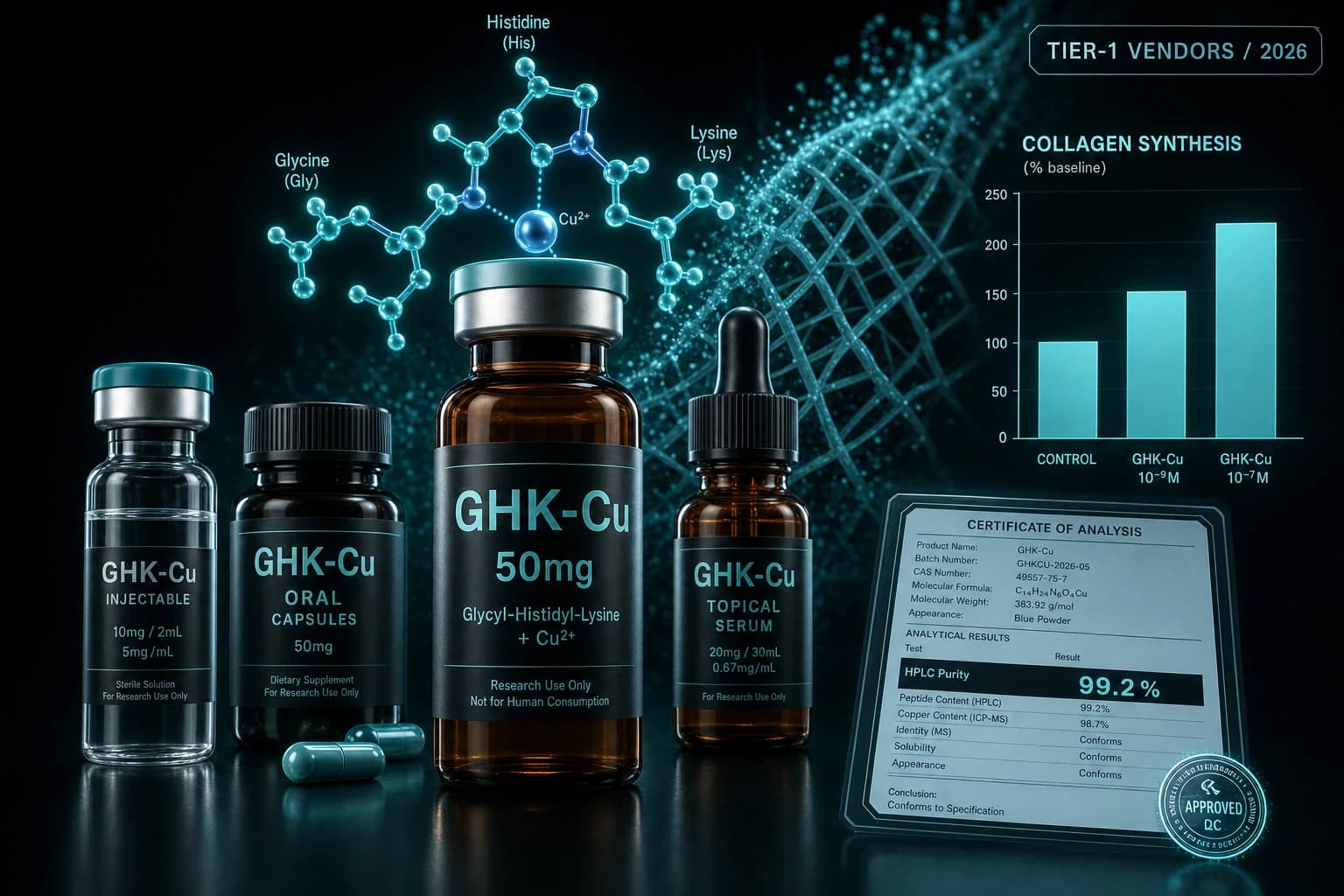
- Tier-1 verification means lot-specific HPLC purity COAs, not vendor-marketing purity claims
- Format-aware sourcing: Ascension for injectable, Limitless for oral capsules, established skincare brands for topical
GHK-Cu is unusual among research peptides in that it has three legitimate format options. Injectable lyophilized vials, oral capsules, and topical serums or creams. Each format has a different research application and a different optimal vendor.
This guide covers what to look for in a GHK-Cu vendor, how to choose between the three formats based on your research endpoint, and which research-grade source matches each format. The compound itself has the deepest skincare and wound-healing literature of any research peptide outside of BPC-157 and TB-500, so the question is rarely "is GHK-Cu real" and almost always "which vendor and which format."
What GHK-Cu actually is
GHK is a tripeptide (glycyl-L-histidyl-L-lysine) naturally present in human plasma at low concentrations. It binds copper(II) ions to form GHK-Cu, the complex responsible for the published biological activity. The original characterization came from Pickart et al., 1988, which showed GHK-Cu stimulates collagen synthesis in fibroblast cultures, with maximal effect at 10⁻⁹ M concentration.
The peptide drives a remodeling program that includes collagen synthesis, elastin production, matrix metalloproteinase regulation, fibroblast and keratinocyte proliferation, hair follicle stimulation, and angiogenesis. Pickart and Margolina, 2018 is the most recent comprehensive review covering the regenerative and protective actions of GHK-Cu across multiple tissues.
For the depth of mechanism, the compound has been studied in over 100 peer-reviewed papers across skincare, wound healing, hair follicle development, and CNS gene expression. This makes it one of the better-validated research peptides in terms of publication volume, even though large human RCTs are limited.
Format selection: which to buy depends on what you are studying
This is the question to answer before evaluating vendors.
| Format | Primary research endpoint | Standard concentration | Pros | Cons |
|---|---|---|---|---|
| Injectable (lyophilized) | Systemic, wound healing, anti-aging | 50 mg vial reconstituted with bac water | Most published systemic research, dose precision, COA-verified vendors | Requires reconstitution and SC/IM injection |
| Oral (capsule) | Digestive, systemic adjacent | 5-10 mg per capsule | Convenience, no needles | Lower bioavailability, less direct published research at this format |
| Topical (serum/cream) | Skincare, hair follicle | 0.1-3% in carrier | Most published skincare research at this route, no needles, well-tolerated | Localized effect only, formulation matters |
The three formats are not interchangeable. They map to different research targets.
For systemic GHK-Cu research (wound healing studies, post-surgical recovery research, internal anti-aging mechanism work), the injectable format is the route most-studied in the literature. Pickart et al., BioMed Res Int, 2015 covers the GHK peptide as a natural modulator of multiple cellular pathways and frames the systemic research case.
For skincare and hair-follicle research, topical formulations have the most published data at the matching route. Pickart et al., 2024 is the most recent specific to topical applications and the anti-wrinkle case. The published topical research uses concentrations ranging from 0.1% to 3% in established carrier systems.
For oral GHK-Cu, the published research at the oral route is limited. The mechanistic case rests on absorption from the GI tract entering systemic circulation, but oral capsules have not been the format used in most of the published GHK-Cu literature. Researchers running oral GHK-Cu protocols are extrapolating from injectable systemic data to a route that has fewer direct studies.
What to verify in a GHK-Cu vendor
The verification standards we use across the best legit peptide vendors 2026 ranking apply to GHK-Cu specifically:
- Lot-specific HPLC certificate of analysis. Not a vendor-wide marketing purity claim. The vial in your hand should reference a specific document with a lot number, test date, and HPLC quantitative purity.
- Third-party laboratory. The COA should be from an independent lab, not the vendor's internal QC.
- Copper content verification. GHK-Cu specifically requires the copper(II) ion to bind correctly. Vendor verification should confirm both peptide purity and copper binding.
- Peptide concentration matches the label. A 50 mg vial should test as 50 mg lyophilized peptide content, not less.
- Storage and shipping conditions disclosed. GHK-Cu is reasonably stable but stability degrades with prolonged exposure to light and heat.
The standard we apply across our where-to-buy BPC-157 with COAs coverage is the same standard for GHK-Cu: per-batch documentation beats vendor-wide marketing claims every time.
Vendor recommendations by format
Injectable lyophilized GHK-Cu
For research-grade injectable GHK-Cu vials, Ascension Peptides ships 50 mg lyophilized vials with public per-batch COAs. The COA library at ascensionpeptides.com/certificates-of-analysis/ shows lot-specific HPLC purity for each batch shipped. Code ENHANCED takes 50% off.
This is the same vendor we recommend for BPC-157, retatrutide, and the Wolverine Stack. The per-batch COA library is the differentiator, not pricing.
Oral GHK-Cu capsules
For oral capsule format, Limitless Biotech is the partner we recommend for oral peptide research with code ENHANCED. Oral GHK-Cu capsules are less common than the injectable format, and the published oral-route research is thinner. If oral is the route your research requires, COA verification matters more.
The injectable vs oral peptides bioavailability guide covers the route-of-administration tradeoffs in detail. For GHK-Cu specifically, the oral route is mechanistically reasonable for systemic effects but has less direct published data than either the injectable or topical routes.
Topical GHK-Cu
For topical formulations (the format with the most published skincare research), the vendor question is different. Topical GHK-Cu is widely formulated by skincare brands at concentrations ranging from 0.1% to 3% in serum, cream, or lotion carriers. Loren Pickart's company Skin Biology produces some of the most-cited topical formulations.
We do not have an affiliate partnership for topical skincare brands. For research applications targeting skin or hair endpoints, the format question is more important than the affiliate recommendation: a topical formulation from any reputable skincare manufacturer with disclosed GHK-Cu concentration will deliver the published research effect, while an injectable applied topically will not (the formulation matters).
Stacking GHK-Cu with other research peptides
GHK-Cu is one of the three peptides in the GLOW Blend (BPC-157 + TB-500 + GHK-Cu) and the KLOW Blend (GLOW + KPV). The mechanistic rationale for these stacks is that GHK-Cu provides matrix remodeling and collagen synthesis support on top of the angiogenic and cell-migration mechanisms of BPC-157 and TB-500.
For the deeper mechanism on the synergy of GHK-Cu and hyaluronic acid in collagen IV upregulation, the published 2023 work by Wang et al. covers how GHK-Cu interacts with other matrix-modifying compounds.
For research-grade premixed stacks with both injectable peptides plus GHK-Cu, Ascension Peptides ships GLOW and KLOW with 50% off using code ENHANCED. The premixed format saves a reconstitution step and the cost of three separate vials.
Reconstitution math for injectable GHK-Cu
Most research-grade GHK-Cu ships as 50 mg lyophilized vials.
| Vial mass | Bacteriostatic water added | Concentration | 0.1 mL draw |
|---|---|---|---|
| 50 mg | 1.0 mL | 50 mg/mL | 5 mg |
| 50 mg | 2.0 mL | 25 mg/mL | 2.5 mg |
| 50 mg | 5.0 mL | 10 mg/mL | 1 mg |
For typical research dosing of 1-2 mg per injection, 50 mg into 5 mL bacteriostatic water is the cleanest reconstitution. A 0.1-0.2 mL draw on a U-100 insulin syringe (10-20 IU) delivers 1-2 mg. The vial yields 25-50 doses depending on target dose.
The GHK-Cu dosage chart covers the standard injectable research dosing protocols in detail. The reconstitution calculator handles arbitrary vial sizes and target doses.
What to avoid
Three patterns we have seen in the GHK-Cu vendor space that we recommend avoiding:
- Vendor purity claims without batch-specific COAs. A "≥99% HPLC" statement on a vendor's homepage is not the same as a third-party document tied to the lot in your hand. This applies to GHK-Cu the same way it applies to any other research peptide.
- Topical creams sold as research peptides. Topical formulations are skincare products. They are not research-grade injectable material. If a vendor is selling a topical product under a research-peptide branding, they are blurring categories and the COA standards typically do not apply.
- Underpriced injectable GHK-Cu without COA documentation. GHK-Cu peptide synthesis costs are well established. Significantly underpriced injectable vials without the COA library should be treated with skepticism. The market floor for COA-verified 50 mg vials is fairly stable.
FAQ
Should I buy injectable, oral, or topical GHK-Cu?
It depends on your research endpoint. Injectable is the format with the most published systemic research and is the standard for wound-healing and anti-aging research at the systemic level. Topical has the most published skincare and hair-follicle research at the matching route. Oral has the least direct published research at its format. If your research is about skin or hair specifically, topical is mechanistically appropriate and well-tolerated. If your research is systemic, injectable is the format the literature supports best.
What is a fair price for GHK-Cu?
Research-grade injectable 50 mg vials with public per-batch COAs typically run around $75-$120 before discount codes, with established vendors. Code ENHANCED at Ascension Peptides takes 50% off, which puts the discounted price meaningfully below most of the unverified-COA market.
Is GHK-Cu safe to inject?
In the published animal and limited human work, GHK-Cu has had a generally favorable safety profile. Reported side effects in topical studies are minimal (transient mild skin irritation at high concentrations). Injectable GHK-Cu in research settings has not produced concerning safety signals at standard research doses. As with any research peptide, the long-term human safety database at therapeutic dosing is limited.
Why does GHK-Cu need copper specifically?
The biological activity of GHK depends on the bound copper(II) ion. The peptide alone (without copper) does not produce the same effects on collagen synthesis or matrix remodeling. This is why the compound is sold as GHK-Cu rather than just GHK, and why vendor verification should confirm copper content as part of the COA.
Can I use cosmetic-grade topical GHK-Cu for research?
For research targeting skin endpoints (wrinkle reduction, skin firmness, hair follicle stimulation), well-formulated cosmetic-grade GHK-Cu products at established concentrations are the format the published topical research has used. For research targeting systemic endpoints, injectable lyophilized vials are the format the literature supports.
How long should I run a GHK-Cu cycle?
Standard research cycles run 8-12 weeks. The published topical anti-aging research has used 4-12 week protocols. There is no specific safety reason to cap longer cycles, but the literature has tested predominantly within this window. Beyond 12 weeks, researchers are extrapolating beyond the published data.
Verdict
For injectable research-grade GHK-Cu with public per-batch COAs, Ascension Peptides is our recommended Tier 1 vendor with code ENHANCED for 50% off. For oral capsules, Limitless Biotech with code ENHANCED is the partner for that format.
For topical formulations targeting skin and hair endpoints, the format itself matters more than the brand affiliate. Established skincare manufacturers with disclosed GHK-Cu concentration in the 0.1-3% range deliver the published research effect at the matching route.
Affiliate disclosure
We are an affiliate partner of Ascension Peptides and Limitless Biotech. Code ENHANCED earns us a commission on checkouts that originate from this site. The discount applies the same way regardless of how the buyer arrives at checkout. Our format and vendor recommendations are based on what is publicly verifiable in COA libraries and published research; we would hold the same positions without the partnerships, but you should weigh the affiliate context as you would for any vendor review.
Further reading
- GLOW Blend: BPC-157 + TB-500 + GHK-Cu skin recovery
- KLOW Blend: premium skin and gut recovery protocol
- Best legit peptide vendors 2026
- Where to buy BPC-157 with COAs
- Injectable vs oral peptides: bioavailability guide
- GHK-Cu compound guide
- GHK-Cu dosage chart
This article is for educational and research purposes only. GHK-Cu is sold under research-use disclosures and is not approved by the FDA for any indication outside of established cosmetic-grade topical formulations. None of the content above constitutes medical advice. Consult a qualified clinician for individual medical questions.