At a glance
- GLP-1 receptors are expressed in ovarian granulosa cells (Sun et al. 2020)
- Tirzepatide cuts oral contraceptive Cmax up to 66%; semaglutide does not
- Liraglutide improved ovarian function in a randomized PCOS trial (Nylander 2017)
- FDA label: stop semaglutide at least 2 months before planned conception
- Neuroplasticity and long-term learning effects of GLP-1s remain unstudied
The short version
GLP-1 receptors live in places most people never associate with a weight-loss drug, including the ovary. That single fact drives most of what you have heard about "Ozempic babies," the birth-control warnings, and the pregnancy contraindication. On the June 2026 Huberman Lab episode, Dr. Abud Bakri flagged exactly this: GLP-1 receptors exist in reproductive tissue, animal and some human data point to real fertility effects, and the long-term influence on things like neuroplasticity and learning is genuinely unknown.
Here is what the human data actually supports, what it does not, and where the honest answer is still "nobody knows yet."
GLP-1 receptors are in your ovaries
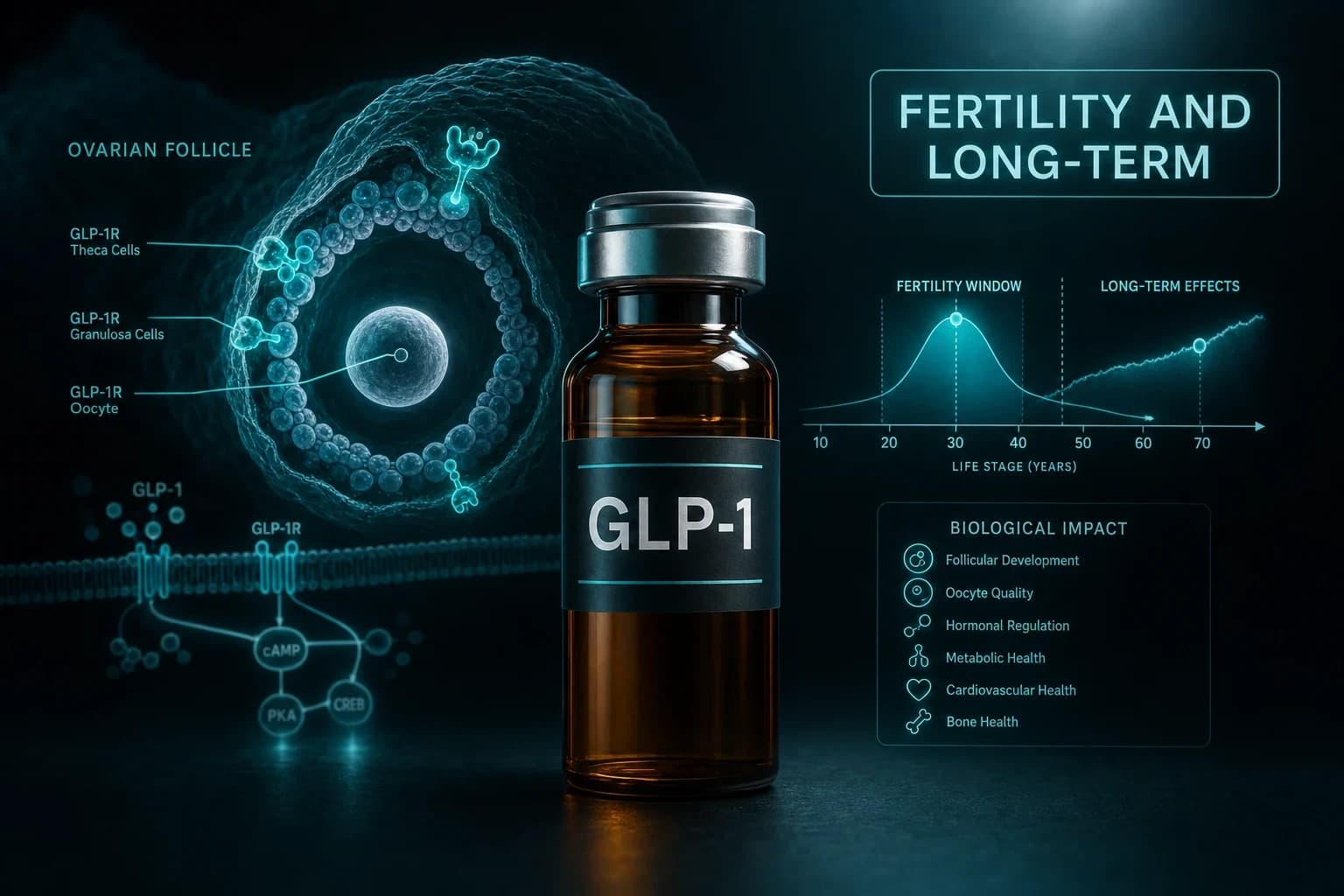
GLP-1 was first isolated from Gila monster venom (that work produced exenatide). The receptor it activates, GLP-1R, is not confined to the pancreas and brain. It is expressed in ovarian tissue, including the granulosa cells that surround a developing egg.
A 2020 mechanistic study showed that GLP-1/GLP-1R signaling regulates granulosa cell proliferation and resists apoptosis in PCOS-associated ovarian tissue, acting through phosphorylation of the FOXO1 transcription factor (Sun et al., Int J Endocrinol 2020). In plain terms, activating GLP-1R inside the ovary changed how follicle-supporting cells survived and divided.
That work was done in a PCOS mouse model and in cultured cells, not in women. It establishes a biological basis for direct ovarian effects. It does not by itself prove that injecting semaglutide makes a human ovary work better. Keep that distinction in mind, because it is the line most internet coverage blurs.
The "Ozempic babies" phenomenon, explained properly
The viral story is real, but it runs through two separate mechanisms that often get collapsed into one.
Mechanism one: weight loss restores ovulation. Obesity and PCOS both suppress regular ovulation. Losing a meaningful fraction of body weight can restart it. In a double-blind randomized trial of 72 women with PCOS, liraglutide produced about 5.2 kg more weight loss than placebo over 26 weeks, raised SHBG, lowered free testosterone, and improved bleeding (menstrual) patterns (Nylander et al., Reprod Biomed Online 2017). A separate single-arm study of 27 obese PCOS patients on semaglutide reported that 80% of the women who responded with greater than 5% weight loss normalized their menstrual cycles within six months (Carmina & Longo, J Clin Med 2023).
Restoring ovulation in someone who was not reliably ovulating restores fertility. That is the first half of the "surprise pregnancy" story, and it is the half with the strongest human data.
Mechanism two: the drug quietly weakens oral birth control. This is the second half, and it is specific to one molecule. More on that below.
Note: "Ozempic babies" is mostly two known mechanisms stacked together, not a mysterious new direct fertility drug effect. Improved ovulation through weight loss is well documented. The ovarian-receptor signaling work is still preclinical.
PCOS: the strongest fertility signal
PCOS is where GLP-1 fertility data is most developed, because it sits at the intersection of insulin resistance, excess weight, and disordered ovulation.
The liraglutide PCOS trial above is the cleanest randomized example of improved ovarian markers (Nylander et al., 2017). The semaglutide PCOS data adds the menstrual-normalization signal at a real-world dose (Carmina & Longo, 2023). Both fit the same pattern: drop the weight, improve insulin sensitivity, and ovulation tends to follow.
What the data does not yet show is a head-to-head proving GLP-1 therapy beats metformin or standard care on live-birth rates as a primary endpoint. The reproductive outcomes are mostly secondary measures. The signal is consistent and biologically coherent, but it is not the same as a fertility drug with a fertility label.
The tirzepatide birth-control interaction (this one is real)
Here is the detail that catches people off guard, and it is on the official Mounjaro and Zepbound label, not a forum rumor.
Tirzepatide slows gastric emptying more aggressively than the single-agonist GLP-1 drugs, especially right after you start and right after each dose step-up. That delay reduces how much of an oral contraceptive gets absorbed. In the manufacturer pharmacokinetic study, a single 5 mg tirzepatide dose cut the peak concentration (Cmax) of ethinyl estradiol by 59% and norgestimate by 66%, with total exposure (AUC) down roughly 20 to 23% and a delayed time to peak.
The class comparison is the part that matters. A 2024 review concluded that tirzepatide is the only agent in this space with a clinically significant effect on oral contraceptive bioavailability; exenatide, liraglutide, dulaglutide, lixisenatide, albiglutide, and semaglutide did not meaningfully change it (Skelley et al., J Am Pharm Assoc 2024). Semaglutide also delays gastric emptying, but the effect attenuates with continued dosing and the PK studies did not show a contraception-relevant change.
The label guidance for tirzepatide is concrete: switch to a non-oral contraceptive method, or add a barrier method, for 4 weeks after starting and for 4 weeks after every dose increase.
Warning: If you take an oral contraceptive and start tirzepatide (Mounjaro or Zepbound), the pill can become unreliable for the first 4 weeks and after each dose escalation. Use a backup barrier method or a non-oral method during those windows. This interaction is not on the semaglutide label, but no GLP-1 drug is safe to continue into a pregnancy you intend to keep.
How the three big GLP-1s compare on reproduction
| Agent | Fertility signal | Oral contraceptive interaction | Pregnancy status |
|---|---|---|---|
| Semaglutide | Menstrual cycles normalized in 80% of responders in obese PCOS (Carmina 2023) | No clinically significant interaction (Skelley 2024) | Contraindicated. Stop at least 2 months before planned conception |
| Tirzepatide | Weight-loss-driven ovulation improvement; PCOS data emerging | Yes. Cmax cut up to 66%; barrier backup 4 wks after start and each escalation | Contraindicated. Washout before conception |
| Retatrutide | Triple agonist; deepest weight loss, so largest expected ovulation effect | No human label yet (investigational) | Investigational. No human pregnancy data |
The takeaway is not "GLP-1s and birth control do not mix." It is narrower and more useful: tirzepatide specifically can blunt the pill, semaglutide does not appear to, and retatrutide has no human label to judge yet. For the full efficacy comparison across all three, see retatrutide vs tirzepatide vs semaglutide, and for dose-by-dose differences the GLP-1 dosing comparison.
Pregnancy: why these drugs are contraindicated
Every GLP-1 and GLP-1-based drug on the market is contraindicated in pregnancy, and the reason is animal reproductive toxicity, not a single human disaster.
In the nonclinical reproductive studies submitted for semaglutide approval, subcutaneous dosing during organogenesis produced embryofetal mortality, early pregnancy loss, reduced fetal growth, and visceral and skeletal abnormalities in rats, with similar minor-malformation and pregnancy-loss signals in rabbits and cynomolgus monkeys, in some cases at exposures near the human therapeutic range (FDA and TGA nonclinical evaluation reports for semaglutide; not indexed as a standalone PubMed citation). The rat mechanism is partly tied to a rodent-specific yolk-sac placenta that does not translate cleanly to primates, which is one reason the human risk is uncertain rather than proven.
The human data that exists is reassuring but thin. A first-trimester semaglutide exposure series found no clear excess of major congenital anomalies, with the one significant cardiac case occurring alongside very poor maternal glycemic control, obesity, and hypertension (Morton & He, Obstet Med 2026). A larger Danish cohort analysis reached a similar read, finding no signal of increased major malformations in semaglutide-exposed pregnancies versus comparators (Kolding et al., Basic Clin Pharmacol Toxicol 2025).
That is not a green light. These are observational, modest in size, and underpowered for rare outcomes. The FDA label recommends discontinuing semaglutide at least 2 months before a planned pregnancy, which lines up with its roughly one-week half-life and the five to six weeks it takes to clear most of the drug. Tirzepatide carries the same discontinue-before-conception logic.
Bottom line: Treat GLP-1 therapy as incompatible with trying to conceive. Plan a washout (about 2 months for semaglutide), and remember that improved ovulation can make conception happen faster than expected, which is exactly when an accidental exposure is most likely.
The genuinely unknown long-term effects
This is the part Bakri was most careful about, and the honesty is warranted.
Neuroplasticity and learning. GLP-1 receptors are dense in the brain, including regions tied to reward, appetite, and memory. The drugs cross into central circuits and clearly change eating behavior and reward signaling. What years of supraphysiologic GLP-1R activation does to learning, memory consolidation, and long-term neuroplasticity has not been characterized in humans. There is active research on GLP-1 drugs in neurodegeneration, but that is a different question from whether chronic use subtly reshapes a healthy brain over a decade. The honest status is unstudied.
Bone. Rapid weight loss generally reduces bone mineral density, and the dedicated long-term bone-density data for the newer high-efficacy agents is still limited. Lighter mechanical load plus a large caloric deficit is not a bone-friendly combination, and the multi-year fracture data is not in yet.
Muscle and lean mass. This one is better quantified and still concerning. Across the major trials, roughly 25 to 40% of total weight lost on these drugs is lean mass. STEP 1 measured a 9.7% drop in total lean body mass alongside a 19.3% drop in fat mass over 68 weeks of semaglutide 2.4 mg (Wilding et al., NEJM 2021). SURMOUNT-1 drove deeper total weight loss with tirzepatide, which means larger absolute lean-mass loss even when the ratio holds (Jastreboff et al., NEJM 2022). The full breakdown, and what actually preserves muscle, is in our GLP-1 muscle loss research.
What ties these three together is the same theme: the metabolic benefits are well measured over one to two years, and the decade-scale effects on brain, bone, and body composition are mostly extrapolation.
Bakri's model: lowest effective dose, real lifestyle, then taper
Bakri's framework for these drugs is not "avoid them." It is to use the smallest dose that produces the result, pair it with genuine lifestyle change rather than treating it as a replacement for one, and taper off once the change holds.
The reproductive angle makes that model sharper:
- Use the lowest effective dose. Higher doses drive deeper weight loss and, with tirzepatide, the strongest gastric-emptying effect on contraceptive absorption. Less drug, less perturbation.
- Front-load lifestyle. Resistance training and adequate protein blunt the lean-mass loss that no current peptide has been shown to fix in a published trial. The lifestyle floor (sleep, sunlight, training, diet) is what makes the result durable after the taper.
- Plan reproduction deliberately. If pregnancy is on the table, build in the washout. If it is not, treat the contraception interaction as real and use backup methods during the windows the label specifies.
- Taper, do not cliff-stop. Stopping after rapid loss tends to regain fat preferentially over the muscle you lost, which can leave body composition worse than baseline.
For the deeper dosing mechanics across the class, the GLP-1 dosing comparison covers titration and the retatrutide vs tirzepatide vs semaglutide comparison covers efficacy head to head.
Where to source research-grade compounds
Researchers working with semaglutide, tirzepatide, and retatrutide can find these injectables from Ascension Peptides with 50% off using code ENHANCED. Source quality matters more than most coverage admits: an independent certificate of analysis confirming identity and purity at 98% or higher is the minimum standard worth accepting, and reproductive-age researchers should treat the contraception and pregnancy considerations above as part of the protocol, not an afterthought.
Frequently Asked Questions
Do GLP-1 drugs actually make you more fertile?
Indirectly, yes, for some people. In women with PCOS or obesity who were not ovulating reliably, the weight loss and improved insulin sensitivity can restart ovulation, which restores fertility. Liraglutide improved ovarian markers in a randomized PCOS trial (Nylander et al., 2017) and semaglutide normalized cycles in 80% of responders in an obese PCOS study (Carmina & Longo, 2023). The ovarian-receptor signaling that might add a direct effect is still preclinical.
Does Ozempic interfere with birth control pills?
The data says semaglutide (Ozempic, Wegovy) does not have a clinically significant interaction with oral contraceptives. The interaction that does exist is with tirzepatide (Mounjaro, Zepbound), which can reduce oral contraceptive absorption by up to 66% at peak (Skelley et al., 2024). The tirzepatide label recommends a backup barrier method for 4 weeks after starting and after each dose increase.
How long before pregnancy should I stop a GLP-1?
For semaglutide, the FDA label recommends stopping at least 2 months before planned conception, consistent with its roughly one-week half-life and the five to six weeks needed to clear most of the drug. Tirzepatide carries the same discontinue-before-conception logic. All GLP-1 and GLP-1-based drugs are contraindicated during pregnancy.
Are GLP-1 drugs safe to take while pregnant?
No. They are contraindicated. Animal reproductive studies showed embryofetal mortality and skeletal and visceral malformations, which is the basis for the contraindication. The limited human first-trimester data has not shown a clear excess of major anomalies (Morton & He, 2025; Kolding et al., 2025), but those datasets are small and not a basis for use in pregnancy.
What are the long-term risks nobody talks about?
The decade-scale effects on the brain (neuroplasticity, learning, memory), bone density, and muscle mass are not well characterized. Lean-mass loss is the best quantified of the three, running 25 to 40% of total weight lost (Wilding et al., 2021). Neuroplasticity and learning effects of chronic supraphysiologic GLP-1R activation in a healthy brain are essentially unstudied.
This article is for educational and research purposes only and is not medical advice. GLP-1 and GLP-1-based drugs are contraindicated in pregnancy and have specific contraception and washout considerations. All dosing, safety, and reproductive information is drawn from published clinical research and product labeling. Consult a qualified healthcare professional before making any decision about GLP-1 therapy, contraception, fertility, or pregnancy planning.