At a glance
- CJC-1295 raised mean GH 2-10x for 6+ days and IGF-1 1.5-3x for 9-11 days after a single dose (Teichman 2006).
- IGF-1 stayed above baseline for up to 28 days after multiple doses. That is the fast-moving marker.
- Pulsatile GH release was preserved, not flattened, during continuous stimulation (Ionescu and Frohman 2006).
- Serum proteomic changes appeared within one week of a single injection (Sackmann-Sala 2009).
- No published human trial measured DEXA fat, lean mass, or strength. The composition part of any before/after is unpublished.
Search "CJC-1295 before and after" and you get progress grids: leaner obliques by week 4, arms up half an inch by week 8, someone's cheek fat gone by week 12. The published clinical record for CJC-1295 has four papers, one preclinical mouse study, and one Phase 2 trial that was quietly halted after a participant death. None of them measured a physique. They measured blood.
That gap is the entire article. If you want an honest before-and-after for this peptide, you have to know what the trials actually put on a machine, and what everyone assumes was measured but never was.
For the mechanism-first primer, the CJC-1295 peptide profile covers what the molecule is and how it signals. This piece is the results question, answered from the papers.
What CJC-1295 actually is
CJC-1295 is a synthetic 30-amino-acid analog of GHRH(1-29). It comes in two forms that behave completely differently, and the confusion between them is the first place before-and-after claims fall apart.
The "with DAC" version carries a Drug Affinity Complex, a maleimide group that covalently bonds to Cys34 on circulating serum albumin within minutes of a subcutaneous injection. Because albumin has roughly a 19-day half-life in humans, the peptide gets tethered in plasma and shielded from renal filtration. Teichman and colleagues estimated the resulting half-life at 5.8 to 8.1 days (Teichman et al. (2006)). That is the version most "CJC-1295" vendor pages actually mean, and the one used in the two published human trials.
The "no DAC" version, correctly called Modified GRF(1-29) or Mod GRF(1-29), lacks the albumin-binding modification and clears from plasma in roughly 30 minutes. Every serious human trial published on the compound tested the DAC form. Anything you read framed as "CJC-1295 clinical data" is almost always DAC data. For the practical distinction, our CJC-1295 DAC vs Modified GRF(1-29) breakdown walks through the two molecules side by side.
Warning: Vendor grids that pool "with DAC" and "no DAC" results into a single physique timeline are conflating two different pharmacokinetic profiles. The trial data behind any 24-hour GH area-under-the-curve claim comes from the DAC form only.
The one thing that changes fast: GH and IGF-1
If any single number is CJC-1295's "after," it is IGF-1. And the paper that established it is small, clean, and specific.
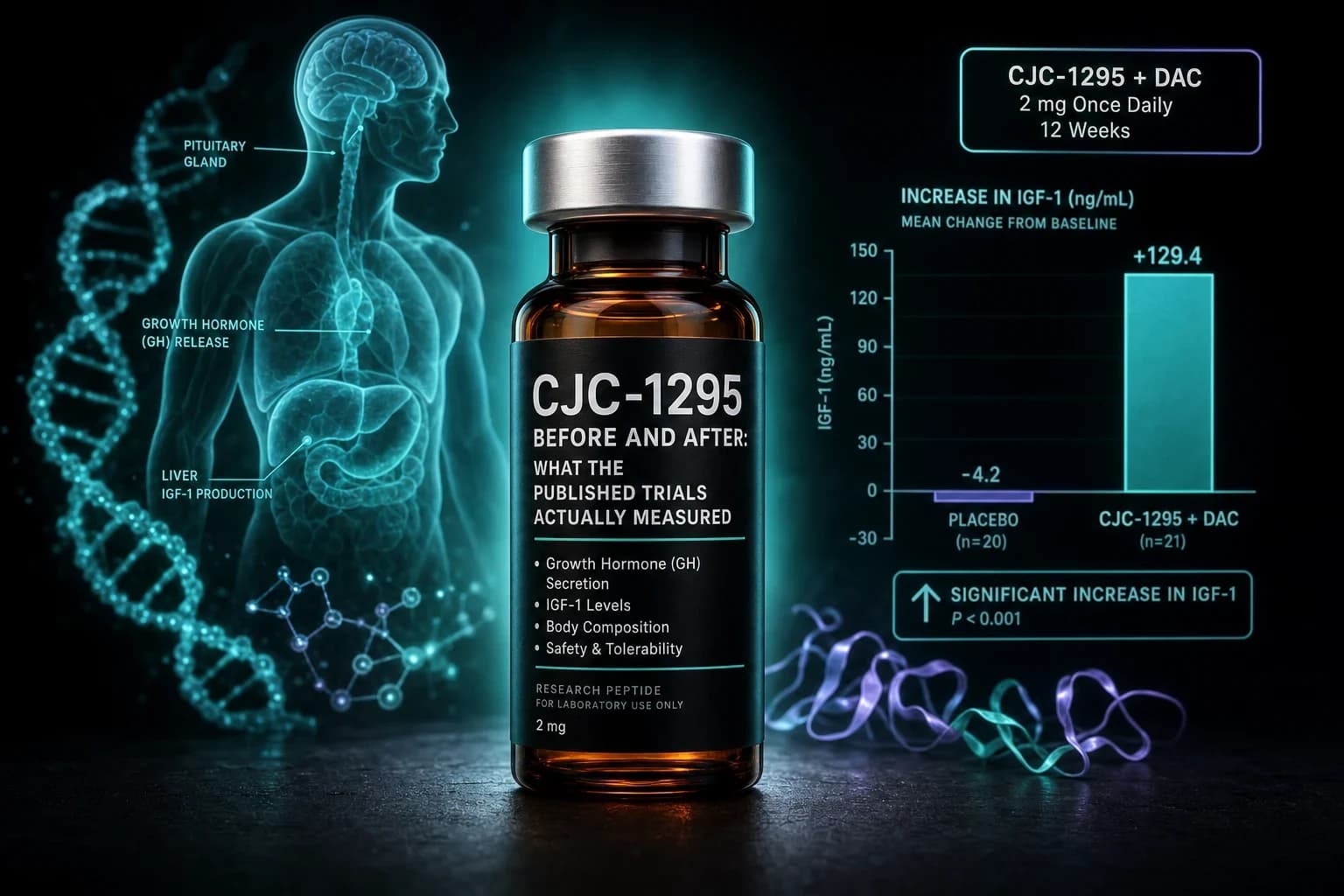
Teichman et al. (2006) enrolled 21 healthy adults, aged 21 to 61, and gave single subcutaneous doses of CJC-1295 with DAC at 30, 60, 125, or 250 mcg/kg. After that single injection, mean plasma GH rose 2- to 10-fold above baseline and stayed elevated for six days or more. Mean plasma IGF-1 rose 1.5- to 3-fold and stayed elevated for nine to eleven days. In the multiple-dose arm, mean IGF-1 stayed above baseline for up to 28 days. The estimated half-life of the compound landed between 5.8 and 8.1 days.
That is the entire fast-moving "after" in the human record. A blood marker rose, dose-dependently, and stayed elevated for a predictable window. No composition endpoint, no strength endpoint, no fat-mass endpoint was reported in the paper.
The paper also reported the safety read at those doses. CJC-1295 was described as safe and relatively well tolerated, particularly at the 30 and 60 mcg/kg doses. Injection-site reactions, headache, and fatigue were the reported adverse events. Any before-and-after grid that promises a visible physique change in a week is claiming a result the trial did not measure, on a timeline the trial did not test.
Why pulsatility matters, and what the second paper added
The second published human trial answered a mechanism question the first one did not. Because CJC-1295 sits in circulation for days, one worry was that continuous GHRH-receptor stimulation would flatten the body's normal pulsatile GH secretion and drive the pituitary toward desensitization or overshoot.
Ionescu and Frohman (2006) tested this directly in healthy adults. They found that pulsatile GH release persisted through continuous CJC-1295 stimulation, with pulse amplitude and trough levels both increased above baseline. The natural rhythm was preserved, not overwritten. That result is the mechanistic reason CJC-1295 is treated as a GHRH-preserving stimulus rather than a GH-replacement analog. It is also why the "before and after" question for this peptide is a slow-moving one: pulsatile stimulation feedbacks physiologically, unlike exogenous GH.
If you want the closest sibling comparison, our sermorelin, CJC-1295, and ipamorelin comparison walks through why researchers stack them or pick between them for different endpoints.
What proteomics found, and what it doesn't tell you
Sackmann-Sala, Ding, Frohman, and Kopchick (2009) took a different angle. They analyzed sera from 11 healthy young adult men before and one week after a single CJC-1295 injection, using two-dimensional gel electrophoresis and mass spectrometry to identify which serum proteins changed and how those changes correlated with GH and IGF-1 elevations.
The finding, in plain terms: activating the GH/IGF-1 axis with CJC-1295 measurably shifted the serum protein profile within a week, and specific protein changes correlated with the GH and IGF-1 rise. That is genuinely useful evidence for downstream biology, and it is the closest a published trial has come to describing what "systemic effects" actually look like at the molecular level.
What it does not tell you: whether any of those protein shifts translate into visible body composition change, and on what timeline. The paper measured proteins, not physiques.
The preclinical body composition data: a mouse ceiling
The only "before and after" body-composition data on CJC-1295 comes from mice, not people.
Alba et al. (2006) treated one-week-old GHRH-knockout mice with CJC-1295 at intervals of 24, 48, and 72 hours for five weeks. Once-daily dosing normalized body weight and length in these growth-deficient animals. Mice dosed every 48 or 72 hours grew above placebo but did not fully catch up. Relative lean mass and subcutaneous fat mass were normal in all treated groups, and femur and tibia length stayed normal in the 24- and 48-hour arms. Total pituitary RNA and GH mRNA rose, suggesting somatotroph proliferation.
Two important reads follow. First, dosing frequency mattered as much as dose in a chronic study. Second, this was a rescue experiment in animals born unable to make their own GHRH, not a physique-enhancement experiment in normal mice. The relevance to a healthy adult human trying to change body composition is indirect at best. It shows that CJC-1295 can drive growth and composition in a system starved of GHRH signaling. It does not show what it does on top of an already-intact axis.
What no published human trial has measured
Here is the honest inventory of what the CJC-1295 human record does not contain.
- No DEXA-measured fat-mass change over any dosing window.
- No DEXA-measured lean-mass change.
- No strength or power endpoint.
- No published cross-over trial comparing CJC-1295 with DAC to the no-DAC form on any physiological endpoint.
- No published Phase 2 efficacy readout on lipodystrophy, which is the indication the compound's Phase 2 program was originally designed for.
- No long-term (over one year) safety data at any dose.
That is not a claim CJC-1295 does nothing to those endpoints. It is a claim the trials that would tell you have not been published. Anyone showing you a week-by-week physique timeline is showing you inference from GH/IGF-1 biology plus training, diet, and photography, not a measurement.
Evidence at a glance
| What was measured | Study | Model and timeframe | Result |
|---|---|---|---|
| Mean plasma GH | Teichman 2006 | 21 healthy adults, single SC 30-250 mcg/kg | 2-10x above baseline for 6+ days |
| Mean plasma IGF-1, single dose | Teichman 2006 | Same | 1.5-3x above baseline for 9-11 days |
| Mean plasma IGF-1, multiple doses | Teichman 2006 | Same | Above baseline for up to 28 days |
| GH pulsatility | Ionescu and Frohman 2006 | Healthy adults, continuous stimulation | Pulses preserved, amplitude and trough up |
| Serum proteomic changes | Sackmann-Sala 2009 | 11 healthy young adult men, single dose, 1 week | Specific serum proteins shifted with GH/IGF-1 |
| Body composition (preclinical) | Alba 2006 | GHRHKO mice, 5 weeks, three intervals | Growth and body composition normalized on daily dosing |
| DEXA fat/lean, strength, function | Not published | n/a | No human data |
The pattern is consistent. Blood first, protein signature within a week, preclinical composition in a rescue model, and nothing on human physique.
The 2006 Phase 2 signal that ended the program
The largest human program CJC-1295 was ever entered into was a 2006 Phase 2 trial in HIV-associated lipodystrophy, run by ConjuChem in roughly 192 patients on the DAC form. The program was halted after a participant died of a heart attack about two hours after their 11th weekly injection. The trial physician attributed the death to pre-existing, asymptomatic coronary artery disease and judged it unrelated to CJC-1295 (aidsmap 2006 news report). No efficacy or safety results from that program were ever formally published in the peer-reviewed literature.
That "not formally published" is important context. Two decades on, the compound's regulatory status reflects that unresolved evidence gap. On December 4, 2024, the FDA's Pharmacy Compounding Advisory Committee voted against including CJC-1295 on the 503A Bulks List, citing cardiac side effects, immunogenicity concerns, and insufficient clinical evidence. For the broader regulatory context on that vote and what it meant for the compounding market, see our FDA 503A peptide compounding review.
Warning: CJC-1295 is not FDA-approved for human use in any form. The largest human program was halted in 2006 and the FDA's compounding advisory committee voted against 503A inclusion in 2024. The material sold in the research space is lab-use-only and is subject to grey-market purity variance. Independent third-party lab testing and COA verification is the single most useful risk-reduction step for anyone working with it.
Realistic timeline: what to expect and when
Anchor a sensible before-and-after window to the published biology, not the marketing.
- Days 1-6: Mean plasma GH rises 2-10x above baseline after a single DAC dose and stays elevated for six days or more (Teichman 2006). This is a serum shift, not a mirror shift.
- Days 7-11: IGF-1 reaches its post-dose peak and starts settling. The earliest honest "after" you can measure is a serum IGF-1 draw at day 7 to day 10 after a first dose. Sackmann-Sala's proteomic signal shows up in this same one-week window.
- Weeks 2-4: With repeated dosing, IGF-1 can stay above baseline for up to 28 days. This is the window where a blood-tracked before/after actually accumulates data.
- Weeks 4-12: Any composition change would sit here, on the timescale of a full GH-secretagogue axis response, and is not directly measured in the published CJC-1295 literature. Extrapolating from adjacent GH work, expect modest at best. If you want a compound with an actual measured composition timeline, sermorelin's before-and-after record is the honest sibling piece.
Days is not a unit CJC-1295 operates in for visible change. Anyone showing a five-day transformation is showing you training, cutting, water, or a camera.
What to actually measure for a real before/after
If you are running CJC-1295 in a research setting and want a "before and after" that means something, measure what the trials measured. That is a fasting morning IGF-1 at week 0 and again at week 4 to 8, ideally at the same lab and time of day. The GH pulse itself is diagnostically messy to sample in a self-run protocol; IGF-1 is the trailing marker that integrates the signal and is the one the published trials tracked as the "after."
For the dosing math and unit ladder that get you from a target microgram dose to a syringe reading, the CJC-1295 and ipamorelin dosage chart and reconstitution calculator handle the arithmetic. Getting the input wrong is the fastest way to make an "after" mean nothing.
Where CJC-1295 fits in the GH-secretagogue family
CJC-1295 sits at the long-acting GHRH-analog end of a family with three practical members.
Sermorelin is the shortest-acting and most feedback-preserving of the group. CJC-1295 sustains the GHRH signal for days. Ipamorelin is a selective GH secretagogue acting through the ghrelin receptor and is often paired with CJC-1295 to combine sustained GHRH tone with a discrete GH-releasing pulse. The stack rationale, dosing, and evidence are covered in the CJC-1295 and ipamorelin stack protocol.
Which one is "best" depends on the research endpoint, not on which one has the most vendor grids. If the endpoint is "sustained elevation of IGF-1 with fewer injections," the CJC-1295 papers speak to that directly. If the endpoint is "visible body composition change in twelve weeks," no CJC-1295 human trial has measured it, and honest before-and-after content has to say so.
Getting research-grade material
If you are running CJC-1295 in a research setting, the input has to be defined before any output means anything. Ascension Peptides supplies research-grade CJC-1295 with DAC, lab-use-only, and Peptides:Enhanced readers get 50% off with code ENHANCED. For the broader honest read on their catalog and QC, our Ascension Peptides review walks through what they carry, how they test, and where the practical trade-offs sit. Pair any protocol with a baseline and follow-up IGF-1 draw so your "after" is measured, not imagined.
Bottom line: The published CJC-1295 human record is small, specific, and blood-based. Four papers, one clean pharmacokinetic result, one pulsatility result, one proteomics result, and one preclinical mouse composition result. No DEXA, no strength, no long-term composition data. A responsible before-and-after protocol treats IGF-1 as the measured "after," accepts that composition change is unmeasured in humans, and refuses to buy any vial without a batch-matched COA.
Disclaimer: This article is for research and educational purposes only and is not medical advice. CJC-1295 is not approved by the FDA or any comparable regulator for human use. The material sold in the research market is lab-use-only and is not intended for clinical human administration. Nothing here is a promise of results or a treatment recommendation. Consult a qualified healthcare professional before making any health decisions.