At a glance
- Six randomized trials enrolled 900+ subjects. Only the smallest Phase IIa arm (300, 12wk) hit statistical significance for weight loss.
- Best-case result: 2.6 kg mean loss at 1 mg/day vs 0.8 kg on placebo (METAOD005, oral, 12 weeks).
- The 536-subject, 24-week Phase IIb (METAOD006) missed its primary endpoint. Metabolic Pharmaceuticals discontinued the program in 2007.
- IGF-1 stayed flat across every human trial, confirming AOD-9604 does not act via the GH receptor (Heffernan et al. 2001).
- No published human trial has run injectable AOD-9604 for weight loss. Every efficacy trial used oral tablets.
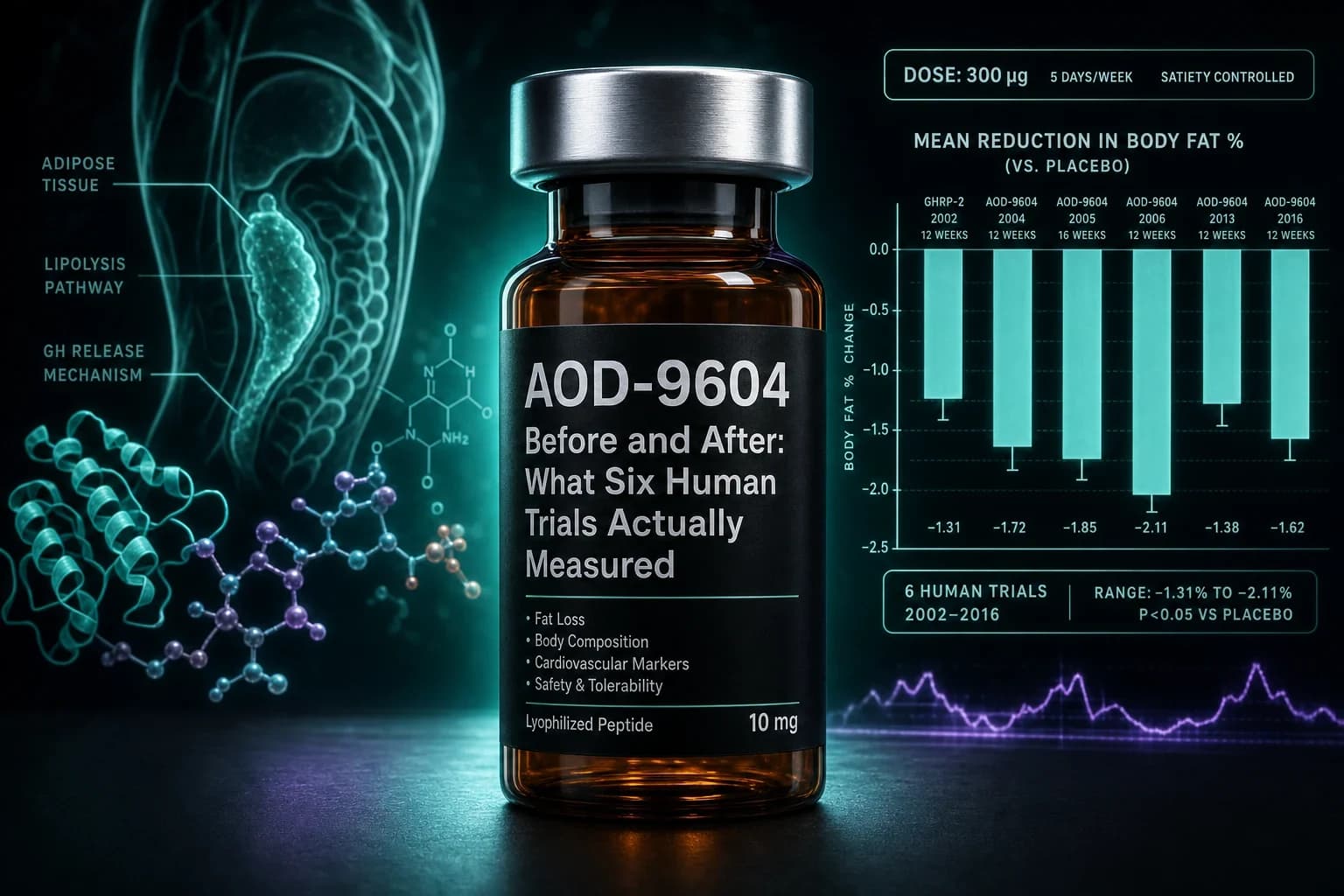
The photos on vendor pages are not from the trial database. Metabolic Pharmaceuticals ran six randomized placebo-controlled trials of AOD-9604 with more than 900 subjects between 2000 and 2007. The company owned the compound, funded the trials, and had every commercial reason to publish a strong efficacy signal. The published data shows a 2.6 kg mean loss in the best 12-week arm and a null primary endpoint in the 24-week pivotal. That is the whole "before and after" record for this molecule in humans.
If you searched for AOD-9604 before-and-after photos, you found marketing built on a footnote to that record. The actual research trajectory is worth walking through, because the deltas that exist are small, specific, and easy to misread.
For the mechanism, dosing math, and how to run the compound in a research protocol, the AOD-9604 dosage guide and AOD-9604 dosage chart cover the protocol side. This article is the results question, honestly answered.
Bottom line: AOD-9604's best published human result is a 2.6 kg weight loss at 1 mg/day in a 12-week Phase IIa. The 24-week, 536-subject Phase IIb missed its primary endpoint and ended the drug program. IGF-1 did not move in any human trial. Injectable outcomes in people are not published; the entire human efficacy record is oral.
What "before and after" means in the AOD-9604 literature
Three categories of data exist. Rodent body-composition experiments where researchers weighed obese and lean mice before and after chronic AOD-9604 dosing. Human weight-loss trials where obese adults were randomized to AOD-9604 tablets or placebo for 12 or 24 weeks. And one preclinical rabbit intra-articular study where cartilage thickness was measured after weekly injections into osteoarthritic knees.
That is the entire evidence base for direct "before and after" data on this molecule. There is no human MRI adipose-tissue quantification. There is no injectable-route human efficacy trial. There is no published Phase 3. Everything else circulating online is anecdote layered on top of the numbers in the table below.
The evidence at a glance
| What was measured | Study | Model and timeframe | Result |
|---|---|---|---|
| Weight loss, oral 1 mg/day | METAOD005 (summarized in Stier 2013 review) | 300 obese adults, BMI >= 35, 12 weeks | 2.6 kg vs 0.8 kg placebo |
| Weight loss, oral | METAOD006 (2007, unpublished) | 536 obese adults, 24 weeks, up to 1 mg | Missed statistical significance vs placebo |
| Fat oxidation, body weight | Heffernan et al. 2001 (Int J Obes) | ob/ob mice, chronic SC | Weight gain reduced, fat oxidation increased |
| Lipid metabolism, beta-3-AR restoration | Heffernan et al. 2001 (Endocrinology) | ob/ob and beta3-AR knockout mice | Beta-3-AR expression normalized; effect blunted in KO |
| Metabolic profile in obese rodents | Ng et al. 2000 (Horm Res) | Zucker rats, chronic SC | Weight loss without hyperglycemia |
| Cartilage regeneration | Kwon and Park 2015 | 32 rabbits, 4-7 weekly IA injections | Improved histology vs saline; AOD+HA combo best |
| Metabolism, detection window | Esposito et al. 2014 | In vitro human liver enzymes | Rapid hepatic metabolism; short detection window |
Read the table with intent. The mouse results are consistent and clean. The one adequately powered human trial for weight loss did not work. The one animal signal outside obesity (cartilage) has never been replicated in a human joint.
What the 12-week Phase IIa actually measured
METAOD005 is the trial every vendor page cites. It enrolled 300 obese adults, BMI at or above 35, randomized to placebo or 1, 5, 10, 20, or 30 mg oral AOD-9604 tablets daily for 12 weeks. The primary endpoint was change in body weight versus placebo.
The result that stuck: the 1 mg arm lost a mean 2.6 kg over 12 weeks. Placebo lost 0.8 kg. That difference (roughly 1.8 kg net) was statistically significant. A summary of the 12-week program appears in the Stier 2013 safety review published in the Journal of Endocrinology and Metabolism, which is the closest thing to a peer-reviewed source for the METAOD005 numbers. The trial itself was never published in a PubMed-indexed journal, which is the first thing to know about this data set.
Two features of the METAOD005 result are worth pausing on. First, the dose response was flat above 1 mg. The 5, 10, 20, and 30 mg arms did not lose more weight than 1 mg. In a compound with a clean mechanism you would expect at least some upward slope. The absence of one suggests either that 1 mg saturated the effect (unlikely for an orally dosed peptide) or that the signal itself was small relative to trial noise. Second, oral peptide bioavailability is a known problem. Whatever fraction of the tablet actually reached lipolytic receptors is unknown. The trial did not measure plasma AOD-9604.
What the 24-week Phase IIb (536 subjects) measured
METAOD006 was designed as the pivotal efficacy trial. Around 502 to 536 obese adults (the reported figures vary slightly across sources), 24 weeks, three doses (0.25, 0.5, 1 mg) plus placebo. Same oral tablet, same primary endpoint of change in body weight.
None of the three doses reached statistical significance versus placebo. The trial summary is again not in a PubMed-indexed journal; the outcome is reported in the Stier 2013 review and in Metabolic Pharmaceuticals disclosures at the time. On the basis of the null result, the company halted the AOD-9604 obesity development program in 2007. Nobody has tried to reproduce the Phase IIb since.
That failure is the single most important data point in this article. Six randomized trials, one arm worked (small), one large and adequately powered trial did not. Marketing pulls the "before and after" number from the smaller arm; the outcome the larger trial actually measured is closer to the truth of what the compound does to human body weight at oral doses.
IGF-1 before and after (the mechanistic anchor that held up)
The one endpoint AOD-9604 hit consistently across every human trial is the one it was designed to hit: nothing.
IGF-1 did not rise. The design hypothesis was that stripping the growth-promoting regions of full-length hGH off the peptide would leave the lipolytic activity intact while eliminating IGF-1 elevation and its downstream risks (glucose disruption, growth effects, insulin resistance). That is exactly what the trials showed. Serum IGF-1 in AOD-9604 arms was indistinguishable from placebo across all six studies.
Mechanistic support for that pattern comes from Heffernan et al. 2001 (Endocrinology), which showed in mice that AOD-9604 does not compete for the hGH receptor and normalizes beta-3-AR expression on adipocytes without triggering the growth-hormone axis. In beta-3-AR knockout mice, the fat-loss effect was blunted, which localizes the mechanism to peripheral adipose lipolysis rather than a central or hepatic pathway.
So the IGF-1 "before and after" is a null result that is actually informative. It confirms the compound does not do what full-length hGH does. It does not, on its own, confirm the compound does anything useful. For the GH-axis alternatives that actually raise IGF-1 (and the trade-offs that come with it), the tesamorelin compound page and the sermorelin vs tesamorelin comparison cover the FDA-approved and research-grade GHRH options.
Safety endpoints before and after
Across the six trials totaling more than 900 subjects, the safety database is unremarkable. Adverse event rates were not different from placebo at the doses tested. No dose-dependent glucose disruption. No dose-dependent hepatic effects. No serious adverse events attributable to the compound. That safety record is real and it is one reason AOD-9604 has persisted as a research-grade compound even after commercial development ended.
Two caveats worth naming. Every trial used oral tablets, so the safety database does not directly cover injectable dosing at higher effective plasma exposures. And the trials were 12 to 24 weeks, so the long-term profile at multi-year exposure is not established for either route. The Esposito 2014 metabolism paper, an anti-doping detection study, characterized rapid hepatic metabolism of AOD-9604 with a short detection window, which speaks to why oral tablets may have delivered too little intact peptide to matter.
Warning: AOD-9604 is not approved by the FDA or any regulatory body for weight loss or any other clinical indication. It is sold for laboratory use only. It is on the WADA prohibited list (S2, peptide hormones). Nothing in the trial record supports self-administration as a fat-loss protocol. Every published efficacy trial used oral tablets, not injections.
The rabbit cartilage before and after (Kwon 2015)
The one non-weight-loss "before and after" in the peer-reviewed record is Kwon and Park 2015, a rabbit osteoarthritis study. Researchers randomized 32 New Zealand white rabbits with collagenase-induced knee osteoarthritis to weekly ultrasound-guided intra-articular injections of saline, 6 mg hyaluronic acid, 0.25 mg AOD-9604, or the AOD-9604 plus HA combination for 4 to 7 weeks.
Histologic scoring showed cartilage regeneration in the AOD-9604 groups versus saline, with the combination arm outperforming either agent alone. Force-plate weight-bearing improved. The paper is often quoted as evidence that AOD-9604 has orthopaedic value; what it actually shows is a rabbit cartilage signal with a small n, in a chemically induced OA model, at a single institution.
Rabbit cartilage regeneration is not human knee OA relief. No human intra-articular AOD-9604 trial has been published. The compound is not FDA-approved for any joint indication, and no legitimate orthobiologics clinic offers it as a validated therapy. The rabbit signal is real and interesting; extrapolating from it to a human before-and-after in someone's own knee is a leap the literature does not support.
What a realistic AOD-9604 "before and after" looks like today
For someone running AOD-9604 as a research protocol at conventional injectable doses (250 to 500 mcg subcutaneous daily), the honest expected observable changes are small. The published human weight-loss delta at oral 1 mg over 12 weeks was 1.8 kg net over placebo. The injectable route should deliver more intact peptide than the oral route, but there is no head-to-head human data to quantify how much more.
Endpoints a serious research protocol would track: body weight and waist circumference weekly, DEXA scan for lean vs. fat mass before and after, fasting glucose and lipid panel, and IGF-1 (expected: no change, and confirmation of that is a mechanistic check). Photographs are not evidence. A 2 kg mean loss over 12 weeks is not visible in a photo, and any visible change is more likely to reflect the training and diet run alongside the compound than the compound itself.
For a compound with actual human before-and-after data at the scale of visible body composition change, tirzepatide produced a 22.5% mean weight reduction at 72 weeks in SURMOUNT-1, and retatrutide produced 24.2% in 48 weeks in its Phase 2 trial (Jastreboff et al. 2023). The retatrutide vs tirzepatide vs semaglutide 2026 comparison is where the "before and after" question actually has answers backed by hundreds of Phase 3 kilograms of weight loss. AOD-9604 sits in a different category: a mechanism study, small delta, oral bioavailability constraint, discontinued for lack of efficacy.
How to interpret vendor before-and-after posts
Three patterns to filter through when you see one online:
- Missing controls. The photos rarely include starting weight, ending weight, or a protocol. Even the best AOD-9604 arm dropped 2.6 kg mean. That does not produce a visible transformation photo on its own.
- Confounded stacks. Most reported protocols run AOD-9604 alongside fasted cardio, a caloric deficit, and often growth-hormone secretagogues like CJC-1295 and ipamorelin. Attributing the outcome to AOD-9604 requires isolating it, which almost no forum log does.
- Wrong mechanistic prediction. The mechanistic prediction of AOD-9604 is a modest bump in adipose lipolysis, not appetite suppression or gastric emptying delay. Visible fat loss over a short window at physiological doses is not what the peptide is expected to do. If someone shows a dramatic photo change on AOD-9604 alone, the diet did most of the work.
Sourcing research-grade AOD-9604
For laboratory-use-only material, Ascension Peptides stocks AOD-9604 as a lyophilized injectable vial with per-batch COAs published in their certificate library. Code ENHANCED applies at checkout for 50% off. We covered their COA standards, HPLC purity levels, and supply chain in the Ascension Peptides review, and re-audited them recently in the 2026 revisit.
On the oral side, Limitless Biotech carries an AOD-9604 oral option with code ENHANCED. Oral bioavailability was the specific limitation that likely capped the METAOD005/006 signal, so understand that trade-off before running a capsule protocol. Any research-grade vial or capsule should be cross-referenced against our public lab-tests library for lot-matched purity documentation before use.
Whatever the route, the reconstitution calculator handles vial-to-units math for injectable protocols. The AOD-9604 dosage chart is the structured protocol reference, and the AOD-9604 dosage guide covers the Phase IIb reality check in more depth.
Disclaimer: This article is for research and educational purposes only. AOD-9604 is not approved by the FDA or any regulatory body for weight loss, fat loss, cartilage repair, or any other clinical indication. It is sold strictly for laboratory research use, not for human administration. Every efficacy figure cited is drawn from published or company-summarized trial data and reflects group-average changes under specific trial conditions. Individual outcomes are not predictable and are not being promised. Consult a qualified healthcare professional before making any decisions about peptide research, weight loss interventions, or any other health matter.