At a glance
- Kisspeptin sits upstream of GnRH and is the master switch for the HPG axis
- JAMA Network Open RCTs (2022, 2023) showed real effects on sexual brain processing in HSDD
- Penile rigidity rose up to 56% over placebo in 32 men with HSDD (Mills et al. 2023)
- Kisspeptin-54 triggers oocyte maturation in IVF and lowers OHSS risk vs hCG (Abbara et al. 2015)
- Kisspeptin-10 raises LH pulse frequency and modestly raises testosterone in some men
- Half-lives differ: kisspeptin-10 around 4 minutes, kisspeptin-54 around 28 minutes
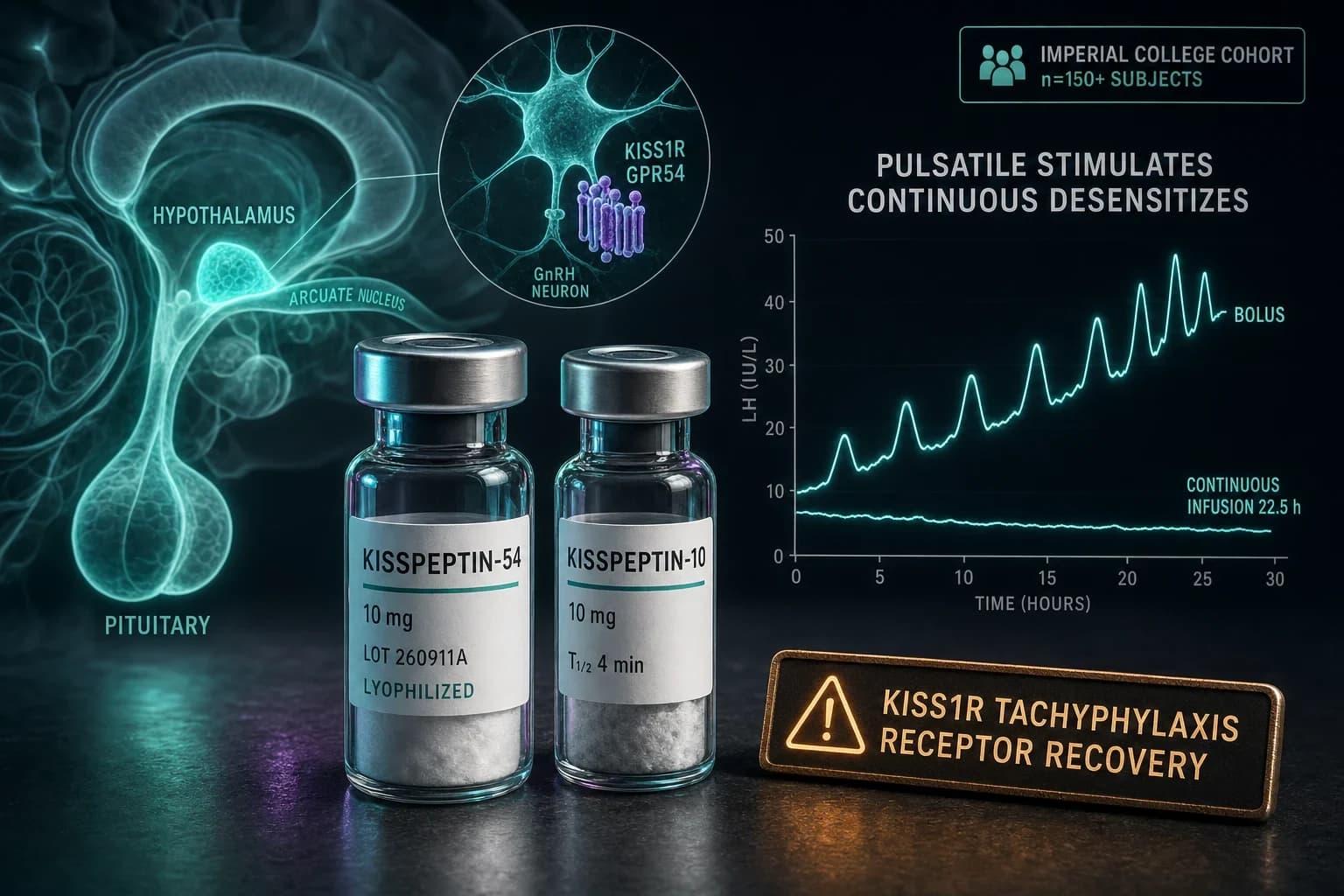
- Continuous exposure desensitizes KISS1R within hours and blunts LH output
Kisspeptin is not a libido peptide. The libido data is downstream.
Most write-ups frame kisspeptin as a sex peptide because the headline trials measured sexual brain processing. That is a narrow read. Kisspeptin is the upstream regulator of the entire hypothalamic-pituitary-gonadal axis. Every clinical use case studied in humans, from IVF egg maturation to hypogonadism testosterone response to hypoactive sexual desire disorder, sits downstream of the same KISS1R activation event in the hypothalamus.
That distinction matters because it changes how you read the evidence. The Imperial College trials with kisspeptin in HSDD are interesting precisely because they isolated a signal in the brain that was not driven by acute hormonal change. The IVF data, by contrast, depends entirely on a controlled LH surge. Same molecule, different mechanism in play.
This article walks through the verified human evidence at each level: brain processing, sexual function, fertility, and HPG axis hormones. It contrasts kisspeptin-10 with kisspeptin-54 where the dose forms diverge, and it lays out where the data is strong, where it is preliminary, and where it does not exist yet.
What kisspeptin actually does
Kisspeptin is a family of peptides encoded by the KISS1 gene. The 54-amino-acid form is the parent peptide. Kisspeptin-10 is the C-terminal decapeptide that retains full binding activity at KISS1R, also known as GPR54. Both bind the same receptor on hypothalamic GnRH neurons, and both trigger downstream luteinizing hormone (LH) and follicle-stimulating hormone (FSH) release from the pituitary.
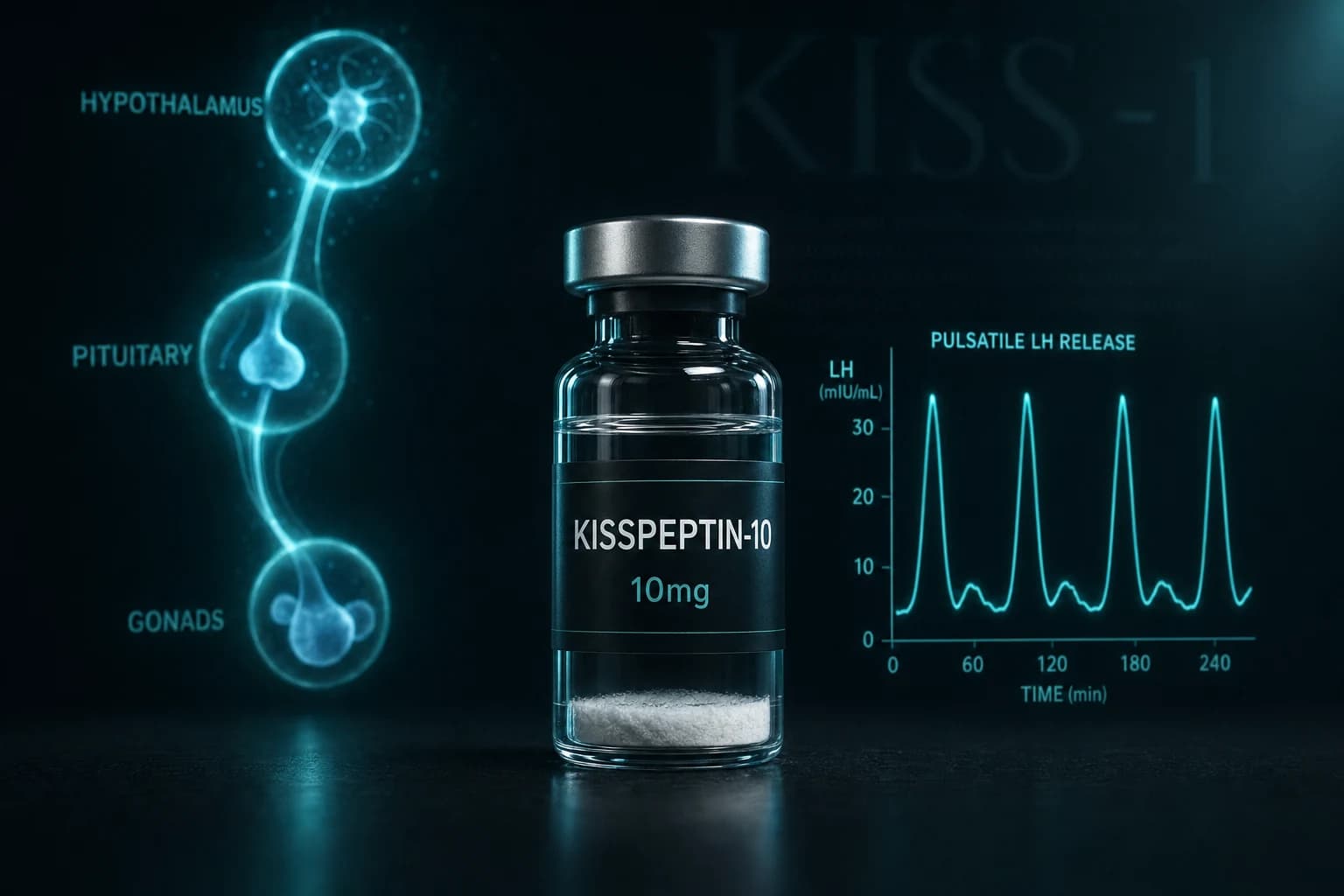
The order of operations is short and worth memorizing. Kisspeptin binds KISS1R on GnRH neurons. GnRH pulses into the pituitary portal system. The pituitary releases LH and FSH. LH drives Leydig cell testosterone production in men and, in women, triggers the ovulatory surge. Without kisspeptin signaling, the axis does not start. People with inactivating KISS1R mutations present with idiopathic hypogonadotropic hypogonadism.
Two pharmacokinetic facts shape every protocol decision. First, plasma half-lives are short. Kisspeptin-10 clears in roughly 4 minutes; kisspeptin-54 clears in roughly 28 minutes. Second, KISS1R desensitizes under continuous exposure. A bolus dose produces a clean LH pulse; sustained exposure flattens the response within hours. This is the opposite of the GnRH agonist pattern that drives medical castration with leuprolide. Pulsatile use stimulates. Continuous use does not.
Note: Kisspeptin is sometimes confused with GnRH itself or with GnRH agonists. It is neither. It is one step upstream of GnRH and operates through a different receptor with different desensitization kinetics.
The HSDD trials people are actually citing
Two JAMA Network Open RCTs from the Dhillo group at Imperial College London produced the bulk of the libido conversation. Both are small, both are crossover, and both used kisspeptin-54 by infusion rather than the kisspeptin-10 form circulating in research markets. Read them as proof-of-concept neuroimaging studies, not Phase 3 efficacy trials.
The men's trial enrolled 32 men with HSDD in a double-blind, placebo-controlled, 2-way crossover at a single UK academic center. Participants received kisspeptin-54 or placebo by intravenous infusion while undergoing functional MRI with sexual stimuli, and penile rigidity was measured directly. Kisspeptin produced significant modulation of sexual brain processing, and penile rigidity in response to sexual stimuli rose by up to 56% over placebo (Mills et al., JAMA Network Open 2023). Participants also reported greater happiness about sex on validated psychometric scales. No serious adverse events were reported.
The women's trial used the same design with 32 premenopausal women with HSDD (Comninos et al., JAMA Network Open 2022). Kisspeptin modulated brain processing in regions tied to sexual and facial-attraction stimuli, including deactivation of the left inferior frontal gyrus, a region associated with behavioral inhibition. Self-reported feelings of attractiveness rose against placebo on the Sexual Arousal and Desire Inventory.
Both trials build on a 2017 study in 29 healthy men that first showed kisspeptin enhances limbic activity in response to sexual and couple-bonding cues, with effects on mood and sexual aversion that correlated with the imaging data (Comninos et al., J Clin Invest 2017). A follow-up demonstrated that kisspeptin enhanced brain responses to olfactory and visual cues of attraction in healthy men, suggesting the effect is not limited to overtly erotic stimuli (Yang et al., JCI Insight 2020).
| Study | Population | N | Endpoint | Effect |
|---|---|---|---|---|
| Comninos et al. 2017 | Healthy men | 29 | Limbic fMRI to sexual/bonding stimuli | Enhanced limbic activity, correlated with mood and reward measures |
| Yang et al. 2020 | Healthy men | 33 | fMRI to attraction cues | Enhanced response to olfactory and visual attraction stimuli |
| Comninos et al. 2022 | Premenopausal women with HSDD | 32 | fMRI plus SADI psychometrics | Modulated sexual/attraction brain processing; higher self-reported "sexy" rating |
| Mills et al. 2023 | Men with HSDD | 32 | fMRI plus penile tumescence | Up to 56% greater penile rigidity vs placebo; modulated sexual brain processing |
Bottom line: Real human RCTs in HSDD show a measurable signal on sexual brain processing, with one trial showing 56% greater penile rigidity over placebo. The cohorts are small and the dose form is kisspeptin-54 by infusion, which is not what is sold in the research market.
The fertility evidence is the strongest
If kisspeptin had to be judged on any single body of human work, the IVF data wins. The Imperial group ran a series of dose-finding and Phase 2 trials using kisspeptin-54 as a substitute for human chorionic gonadotropin (hCG) to trigger oocyte maturation in women undergoing in vitro fertilization.
The original 2014 dose-finding study tested 1.6, 3.2, 6.4, and 12.8 nmol/kg subcutaneous kisspeptin-54 as a single trigger injection in 53 women. Egg maturation occurred at every dose tested, with mature-oocyte rates between 75% and 85%, and absolute mature oocyte yield rose with dose. Twelve clinical pregnancies resulted from the cohort, establishing that kisspeptin-54 can substitute for hCG and produce live births (Jayasena et al., J Clin Invest 2014).
The mechanistic appeal is concrete. hCG has a long half-life and provides sustained LH-receptor activity, which is part of why it raises ovarian hyperstimulation syndrome (OHSS) risk in women with high follicle counts. Kisspeptin-54 produces a more physiological, shorter LH surge through endogenous pituitary release rather than direct LH-receptor agonism. A subsequent Phase 2 RCT in 60 women at high OHSS risk tested whether a second dose of kisspeptin-54 at 36 hours after the first improved oocyte maturation. It did, with no cases of moderate or severe OHSS in the kisspeptin arms (Abbara et al., J Clin Endocrinol Metab 2015).
This is the only kisspeptin use case where Phase 2 data exists in a clinically defined population, with reproducible primary outcome data and pregnancies as a downstream endpoint. It is also the use case least relevant to the average research-market buyer, since IVF triggering is a hospital procedure with cycle monitoring.
Hypogonadism, testosterone, and the LH pulse data
The earliest human work with kisspeptin focused on the LH axis. In healthy men, intravenous boluses of kisspeptin-10 reliably evoke LH pulses, and continuous infusion increases LH pulse frequency, pulse amplitude, and serum testosterone (Chan et al., J Clin Endocrinol Metab 2011). This is the foundational pharmacology study that frames every later trial.
In men with type 2 diabetes and mild biochemical hypogonadism, kisspeptin-10 infusion increased LH pulse frequency and serum testosterone over placebo (George et al., Clin Endocrinol 2013). The trial was small but mechanistically clean: it specifically targeted men whose hypogonadism appeared to be central rather than primary, which is the population where an upstream stimulator should help.
Two qualifications matter for anyone reading this as a TRT-alternative pitch. First, the testosterone rise was modest in absolute terms and occurred during acute infusion, not after chronic dosing. Second, kisspeptin does not bypass any negative feedback. If endogenous testosterone or estradiol is suppressing GnRH release, raising kisspeptin tone may not produce a clinically meaningful testosterone rise. A separate study of patients with idiopathic hypogonadotropic hypogonadism showed that exogenous kisspeptin probes GnRH neuron function and helps stratify defects, but does not consistently rescue gonadotropin output in patients whose lesion is at or below the GnRH neuron itself (Chan et al., J Clin Endocrinol Metab 2014).
The clinical translation is that kisspeptin is a probe and a research tool for the male HPG axis. It is not a verified chronic testosterone therapy, and no Phase 3 trial has tested it for that purpose.
Kisspeptin-10 vs kisspeptin-54
Most published clinical work uses kisspeptin-54. Most research-market vials sold to consumers contain kisspeptin-10. They are not interchangeable on a microgram basis, and protocols translated naively from the literature produce confused exposures.
| Property | Kisspeptin-10 | Kisspeptin-54 |
|---|---|---|
| Length | 10 amino acids (C-terminal fragment) | 54 amino acids (parent peptide) |
| Receptor binding | Full activity at KISS1R | Full activity at KISS1R |
| Plasma half-life | ~4 minutes | ~28 minutes |
| Most common clinical use | LH pulse studies, hypogonadism research | IVF oocyte trigger, HSDD imaging trials |
| Typical clinical dose | 0.1-3 nmol/kg IV bolus or infusion | 1.6-12.8 nmol/kg subcutaneous bolus |
| Research-market form | Lyophilized vial, subcutaneous reconstitution | Less commonly available |
| Practical implication | Short pulse, multiple daily doses to mimic infusion | Longer pulse from a single subcutaneous injection |
A useful way to read the literature: when a paper says "kisspeptin produced an LH pulse," they almost always mean kisspeptin-10 by short IV bolus, often in research nmol/kg doses that translate to a few hundred micrograms total. When a paper says "kisspeptin enhanced sexual brain processing," they mean kisspeptin-54 by intravenous infusion at 1.0 nmol/kg/h. Direct dose translation across forms is not valid because the half-lives, receptor occupancy curves, and routes of administration are different.
Warning: Kisspeptin-10 sold in research-market vials is dosed in mcg as flat amounts. Clinical kisspeptin-54 dosing is in nmol/kg by body weight. Converting protocols across forms requires accounting for the molecular weight difference and the half-life difference, and even then the sustained LH pulse of kisspeptin-54 cannot be reproduced by a single small bolus of kisspeptin-10.
How kisspeptin compares to PT-141 for sexual function
The cleanest contrast is with bremelanotide. Both peptides have human RCTs in HSDD. They act on completely different receptors with different downstream effects. Reading them as substitutes for each other misses what the data actually shows.
| Feature | Kisspeptin (kisspeptin-54 in trials) | PT-141 (Bremelanotide) |
|---|---|---|
| Receptor | KISS1R on hypothalamic GnRH neurons | MC3R/MC4R in hypothalamus |
| Downstream | LH/FSH release, transient sex hormone change, brain processing modulation | Dopamine release in desire circuits, no hormonal change |
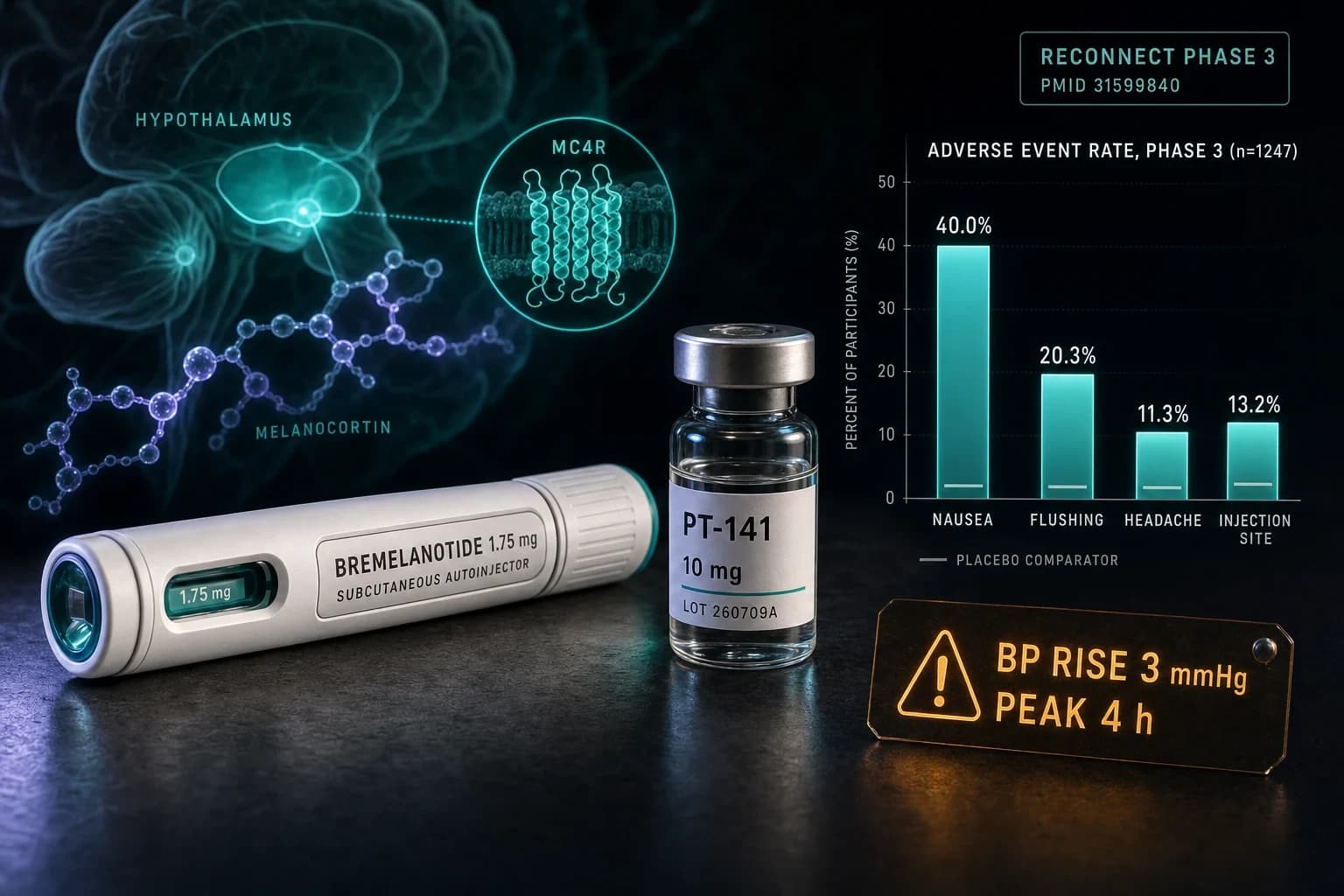
| FDA status | None | Approved as Vyleesi for premenopausal HSDD |
| Onset | Brain effects measurable during infusion | 30-60 minutes after subcutaneous injection |
| Duration of action | Short, tied to infusion or bolus | Several hours per dose |
| Common side effect | Few reported in published trials | ~40% nausea rate in Phase 3 |
| Effect on testosterone | Modest acute rise via LH | None |
| Effect on fertility | Used clinically as IVF oocyte trigger | None |
| Practical research use | HPG axis, fertility, brain imaging | Acute sexual desire research |
The honest read is that PT-141 is the more mature pharmacological tool for sexual function in research, with FDA approval and consistent acute effects. Kisspeptin is the more interesting tool for HPG axis questions, where it can produce hormonal changes that bremelanotide cannot. For a deeper read on bremelanotide pharmacology and the RECONNECT trial data, see the PT-141 guide.
Practical research notes
Three pharmacology facts decide most protocol questions.
The first is half-life. Kisspeptin-10 plasma half-life is roughly 4 minutes, which is functionally a single LH pulse per dose. Kisspeptin-54 is roughly 28 minutes, which produces a longer LH surge. Anyone designing a kisspeptin-10 protocol around once-daily dosing is using the molecule the way clinical work has not validated.
The second is receptor desensitization. KISS1R desensitizes under continuous exposure within hours. The literature is consistent on this. Continuous infusion in primate work blunts the LH response within 24-48 hours; pulsatile dosing maintains it. Any chronic, sustained-release version of kisspeptin would face this problem and is part of why the IVF use case is a single trigger, not chronic therapy.
The third is feedback. Kisspeptin sits upstream of GnRH but downstream of estradiol and testosterone feedback to KISS1 neurons in the arcuate nucleus and AVPV. In men with normal-to-high endogenous testosterone, exogenous kisspeptin will not chronically push testosterone past the body's set point. In men with central hypogonadism and an intact pituitary, it can probe the axis and may transiently raise testosterone. In men with primary hypogonadism (testicular failure), it does not help.
For research-only kisspeptin reconstitution and dosing math, the reconstitution calculator handles the volume and unit conversion. The peptide reconstitution guide covers buffer selection, storage, and stability for short-half-life peptides.
Tip: Kisspeptin's short half-life means timing matters more than dose for any pulsatile use. A single small bolus produces a single small LH pulse. The IVF data uses a single larger trigger; the LH pulse studies use bolus or short infusion. Long-acting daily flat-dose schedules are not what the published protocols use.
What the data does and does not support
The published human evidence supports four narrow claims:
- Kisspeptin-54 enhances sexual brain processing in men and women with HSDD over placebo, with measurable physiological correlates in men.
- Kisspeptin-54 can substitute for hCG as an IVF oocyte trigger and produces clinical pregnancies, with lower OHSS risk in high-risk women.
- Kisspeptin-10 reliably evokes LH pulses in healthy men and modestly raises testosterone in men with central hypogonadism during acute administration.
- KISS1R receptor activation is required for the HPG axis to function; this is confirmed by genetic loss-of-function data in humans.
The published evidence does not support several common claims that show up in marketing copy:
- That kisspeptin is a verified chronic testosterone therapy. No Phase 3 trial exists.
- That kisspeptin treats erectile dysfunction. The Mills trial showed greater rigidity in response to sexual stimuli during infusion, not maintained erections in the absence of stimuli.
- That kisspeptin can be used continuously. Continuous exposure desensitizes KISS1R within hours.
- That kisspeptin-10 microdoses replicate the JAMA Network Open results. Those trials used kisspeptin-54 by infusion at clinical doses.
- That kisspeptin restores fertility in men with primary hypogonadism. It does not bypass testicular failure.
This is the gap between what is true and what is marketable. Research-purposes use should track the published evidence, not the marketing.
Where this fits with adjacent peptides
For researchers comparing kisspeptin to other peptides that touch reproductive or sexual physiology:
- PT-141 (bremelanotide): MC4R-driven, FDA-approved for HSDD, no hormonal action. The cleanest acute desire signal in the published record.
- Oxytocin: bonding and social cognition research, separate receptor system, indirect interaction with sexual reward.
- Melanotan-II: also melanocortin agonist, with weaker evidence than PT-141 and more skin pigmentation effect.
- Kisspeptin compound page: receptor pharmacology, vial formats, and current research-market availability.
Kisspeptin is the only one of these that operates upstream of the HPG axis. That makes it useful for distinct research questions, not as a replacement for any of them.
Research-grade kisspeptin is available from Ascension Peptides with 50% off using code ENHANCED. As with any short-half-life peptide, reconstitution choice and storage matter.
Bottom line for 2026
Kisspeptin is the most rigorously studied upstream HPG-axis peptide in humans, with real RCTs in HSDD, real Phase 2 fertility data, and a deep mechanistic literature on LH and testosterone. The trials are small, the dose form most often used in publications is kisspeptin-54 by infusion, and the chronic therapy case is unproven. The fertility data is the most clinically translated; the libido data is real but proof-of-concept; the testosterone story is mechanistically clean and clinically incomplete.
Bottom line: Treat kisspeptin as a research tool for the HPG axis with strong proof-of-concept data and small trial sizes. The 56% penile rigidity result and the IVF pregnancies are real. Sustained chronic dosing protocols are not what the published trials used, and the receptor desensitization data argues against them.
This article is for educational and research purposes only. Kisspeptin is not approved by the FDA for any of the uses discussed. The cited efficacy, dose, and pharmacokinetic data are derived from published peer-reviewed research. Consult a qualified healthcare professional before making any decisions about peptide research.