At a glance
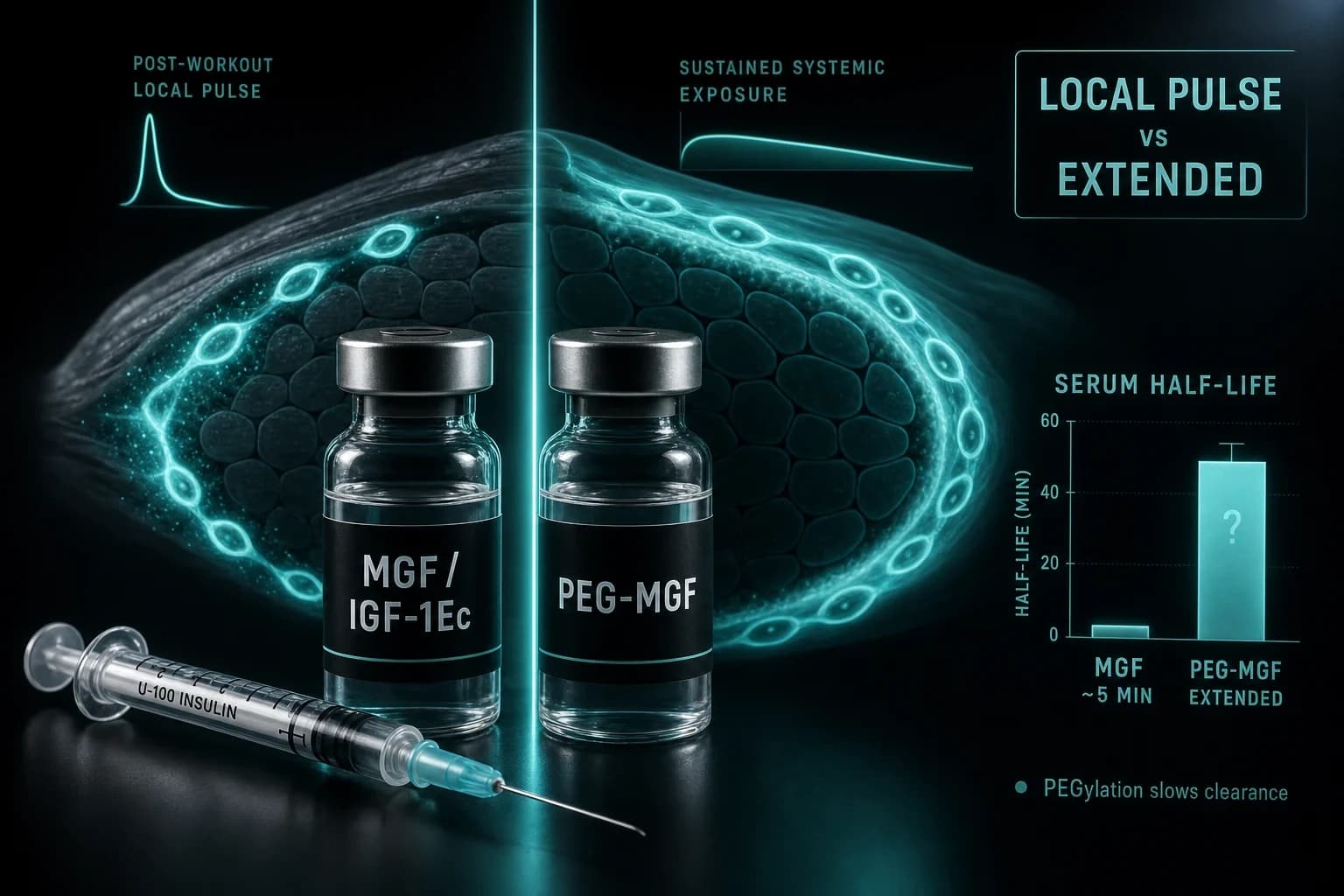
- Native MGF has a serum half-life of roughly 5 to 7 minutes, which drives local post-workout dosing
- MGF's E-peptide activates satellite cells and myoblast proliferation in cell culture (Yang & Goldspink 2002)
- PEG-MGF adds a polyethylene glycol chain to extend half-life, but the multi-day figure is a vendor claim, not published human data
- Injectable MGF human efficacy is unproven; Fornaro (2014) found no myoblast effect at up to 500 ng/ml
- MGF is a local, minutes-long pulse; IGF-1 LR3 is a long systemic burn. Different tools for different jobs.
Native MGF clears your bloodstream in about five minutes. That single number is the whole story. It explains why researchers inject it straight into the muscle they just trained, why a PEGylated version exists at all, and why the human evidence behind both is thinner than any vendor page will admit.
MGF and PEG-MGF are the same peptide with one thing bolted on. Understanding that difference, and staying honest about what the studies actually show, separates a protocol that makes mechanistic sense from one built on marketing copy.
What MGF actually is
Mechano Growth Factor is not a separate hormone. It is a splice variant of the IGF-1 gene. When muscle gets loaded or damaged, the gene splices differently, reading exons 5 and 6 in a way that produces a unique 24-amino-acid C-terminal tail called the E-peptide (the Ec peptide in humans, so IGF-1Ec; IGF-1Eb in rodents).
The synthetic peptide sold as "MGF" is that E-domain fragment on its own, usually the 24-amino-acid MGF-E peptide. It is not full-length IGF-1. That distinction matters for every study below, because researchers keep testing the isolated tail and asking whether it does anything by itself.
Hill, Wernig & Goldspink (2003) established the timing that made MGF famous. After mechanical damage or a myotoxic injection in rat muscle, MGF expression spiked first, ahead of the systemic IGF-IEa variant, and it tracked with the activation of satellite cells, the resident stem cells that repair fibers. The pulse came before repair, which is why the group framed MGF as the trigger rather than the follow-through.
Yang & Goldspink (2002) split the two jobs cleanly in cell culture. The MGF E-domain pushed myoblasts to multiply while holding them back from terminal differentiation, keeping a larger pool of proliferating precursors on hand. Mature IGF-1, by contrast, drove those same cells to fuse into myotubes. Two peptides from one gene: one to expand the repair crew, one to put them to work. That two-phase model is the reason MGF became interesting to anyone chasing recovery.
The five-minute problem
Here is the catch that shapes every dosing decision. The synthetic E-peptide is degraded in serum fast, with a half-life commonly cited around five to seven minutes. Injected systemically, most of it is gone before it can reach much tissue.
So the logic researchers borrowed from the biology is blunt. If the molecule only lives for a few minutes, put it exactly where you want it, right after you have created the damage that would normally trigger it. In practice that means a subcutaneous or intramuscular injection into or near the muscle you just trained, in the post-workout window, when satellite cells are already primed.
The short half-life is not really a flaw to engineer around. It is the mechanism. Native MGF is built by the body to be a local, transient spark, not a circulating hormone. Reading it any other way sets you up to misuse it.
Bottom line: Native MGF's roughly 5 to 7 minute serum half-life is why it is dosed locally and post-workout. It is a pulse, not a background signal. Inject it expecting systemic, days-long action and you have misread the molecule.
Why PEG-MGF exists
PEGylation is the workaround. Attach a polyethylene glycol chain to the peptide and you slow enzymatic degradation and kidney clearance, which stretches how long it stays in circulation. The same chemistry turns short-lived proteins into weekly drugs across dozens of approved biologics.
PEG-MGF applies that trick to the E-peptide. Vendors claim a half-life extended from minutes to hours or even days, which is why PEG-MGF protocols call for far fewer injections, often once or twice a week, and treat the peptide as steady systemic exposure rather than a targeted local hit.
Be careful with those numbers. The multi-day half-life quoted for PEG-MGF is a preclinical and vendor claim, not a figure established in published human pharmacokinetic trials. PEGylation genuinely extends half-life as a principle of chemistry. The specific days-long values passed around peptide forums are not backed by the kind of controlled human PK data that exists for approved PEGylated drugs. Believe the direction of the effect; hold the exact numbers loosely.
MGF vs PEG-MGF at a glance
| Feature | MGF (native) | PEG-MGF |
|---|---|---|
| Structure | Synthetic 24-aa IGF-1Ec E-peptide | Same E-peptide with a PEG chain attached |
| Serum half-life | ~5 to 7 minutes | Vendor-claimed hours to days (not established in published human PK) |
| Dosing timing | Post-workout, into or near the trained muscle | Spread across the week, often on non-training days |
| Frequency | Multiple times per week, immediately post-damage | Once or twice per week |
| Proposed mechanism | Local pulse: satellite cell activation, myoblast proliferation | Same target, sustained systemic exposure |
| Human efficacy | Unproven; cell-culture data is split | Unproven; no controlled human trials |
| Best-fit rationale | Localized post-damage pulse | Convenience and adherence with fewer injections |
The honest part: the human evidence is thin and split
Now the caveat every responsible write-up owes you. Almost all of the encouraging MGF data is in cell culture or in animals, and even that literature is contested.
On the positive side, Ates et al. (2007) found the MGF E-peptide increased progenitor cell numbers in cultured human muscle from healthy, muscular dystrophy, and ALS donors. Kandalla et al. (2011) reported that MGF-E extended the proliferative lifespan and delayed senescence of satellite cells from neonatal and young adult muscle, though pointedly not from old adult muscle, a nuance anyone hoping to use it against age-related muscle loss should sit with. Outside skeletal muscle, Carpenter et al. (2008) showed the MGF E-domain reduced loss of cardiac function after an induced heart attack in sheep, apparently by blocking apoptosis in the tissue bordering the infarct.
Then came the pushback. Fornaro et al. (2014), working at Novartis, tested synthetic MGF peptide at concentrations up to 500 ng/ml on mouse C2C12 cells, primary human myoblasts, and primary muscle stem cells. It did nothing measurable. No increase in proliferation, no delay in differentiation, no effect on stem cell activation. Full-length IGF-1 produced a robust response in the very same cells, so the assay clearly worked. The authors questioned whether the isolated MGF peptide has any physiological role at all.
That paper landed hard enough that Rotwein (2014) published an editorial in Molecular Endocrinology titled "The fall of mechanogrowth factor?", framing the whole MGF story as a case study in confirmation bias and calling for experiments designed to falsify the hypothesis rather than confirm it.
So where does that leave you? With a genuinely divided literature. Several labs report satellite cell effects; a well-controlled study from a major pharma group found none and doubted the premise. And no published, controlled human trial has shown that injectable MGF or PEG-MGF builds muscle, speeds recovery, or does anything measurable in a living person. Everything past the petri dish is extrapolation.
Bottom line: Injectable MGF and PEG-MGF human efficacy is unproven. The cell-culture evidence is split, with Fornaro (2014) finding no myoblast effect and questioning the entire premise. Treat any muscle-building claim as a hypothesis, not a result.
How the two dosing philosophies differ
The two versions imply two different protocols, and that follows directly from the half-life gap.
Native MGF is the local tool. The research rationale is a small post-workout injection into or adjacent to the trained muscle, timed to the window right after you have created the mechanical damage that would ordinarily trigger endogenous MGF. Because it clears in minutes, systemic exposure stays minimal and the thinking is entirely site-specific. Some protocols split injections across the specific muscles trained that session.
PEG-MGF is the systemic, convenience-first tool. Fewer injections, spread across the week, often on non-training days, on the logic that the extended half-life keeps the peptide around long enough to reach tissue without repeated post-workout shots. You trade the local-pulse precision of native MGF for adherence and steadier exposure.
Both start as lyophilized powder, and the small doses involved make accurate mixing non-negotiable. Run your numbers through the reconstitution calculator before you draw anything, because at these microgram amounts an eyeballed dilution is a guess, not a dose.
Where MGF sits next to IGF-1 LR3 and CJC-1295
Placing MGF in the wider growth-factor toolkit helps, because it gets confused with peptides that behave nothing like it.
IGF-1 LR3 is almost the mirror image of native MGF. It is a modified full-length IGF-1 with a far longer half-life, measured in hours rather than minutes, built for sustained systemic IGF-1 receptor activation. Where MGF is a brief local spark, IGF-1 LR3 is a long systemic burn. They are not interchangeable, and any stacking logic that treats them as one category misreads both.
CJC-1295 works a level up the axis. It is a growth-hormone-releasing hormone analog that prompts your pituitary to release more of your own growth hormone, which then raises systemic IGF-1 downstream. MGF sits at the far local end of that same axis, as the tissue-level splice product, while CJC-1295 pulls the central lever. Understanding the pathway (GHRH to GH to systemic IGF-1, with MGF as the local, damage-triggered branch) is worth more than memorizing any single protocol.
Which one, for what
If your interest is the local satellite-cell pulse that made MGF famous, native MGF is the version that matches the biology, dosed post-workout and locally, with the honest understanding that the human payoff is unproven.
If your priority is fewer injections and steadier systemic exposure, PEG-MGF is the version designed for exactly that, with the honest understanding that its multi-day half-life is a claim rather than a published fact, and that no human trial backs a muscle benefit either.
If what you actually want is sustained systemic IGF-1 receptor signaling, neither MGF version is really your tool. IGF-1 LR3 is the one built for that job, and CJC-1295 is the one that raises your own IGF-1 through the growth hormone axis.
Both MGF and PEG-MGF are available from Ascension Peptides with 50% off using code ENHANCED. Certificates are in the lab-tests library.
Bottom line: MGF is a local, minutes-long pulse aimed at satellite cell activation; PEG-MGF is the same peptide re-engineered for fewer, more systemic doses. Choose MGF for the local-pulse rationale, PEG-MGF for convenience, and neither if you want sustained systemic IGF-1 signaling. Whichever you study, dose from the position that the human data is minimal and mixed.
Disclaimer
This article is for research and educational purposes only. It is not medical advice. MGF and PEG-MGF are research compounds and are not approved by the FDA for human use to treat, cure, or prevent any condition. No controlled human trial has demonstrated safety or efficacy for muscle growth or recovery. Consult a qualified healthcare professional before making any health-related decisions.