At a glance
- Semaglutide's thyroid boxed warning comes from rodent C-cell tumors, not human cancer data (Bjerre Knudsen 2010).
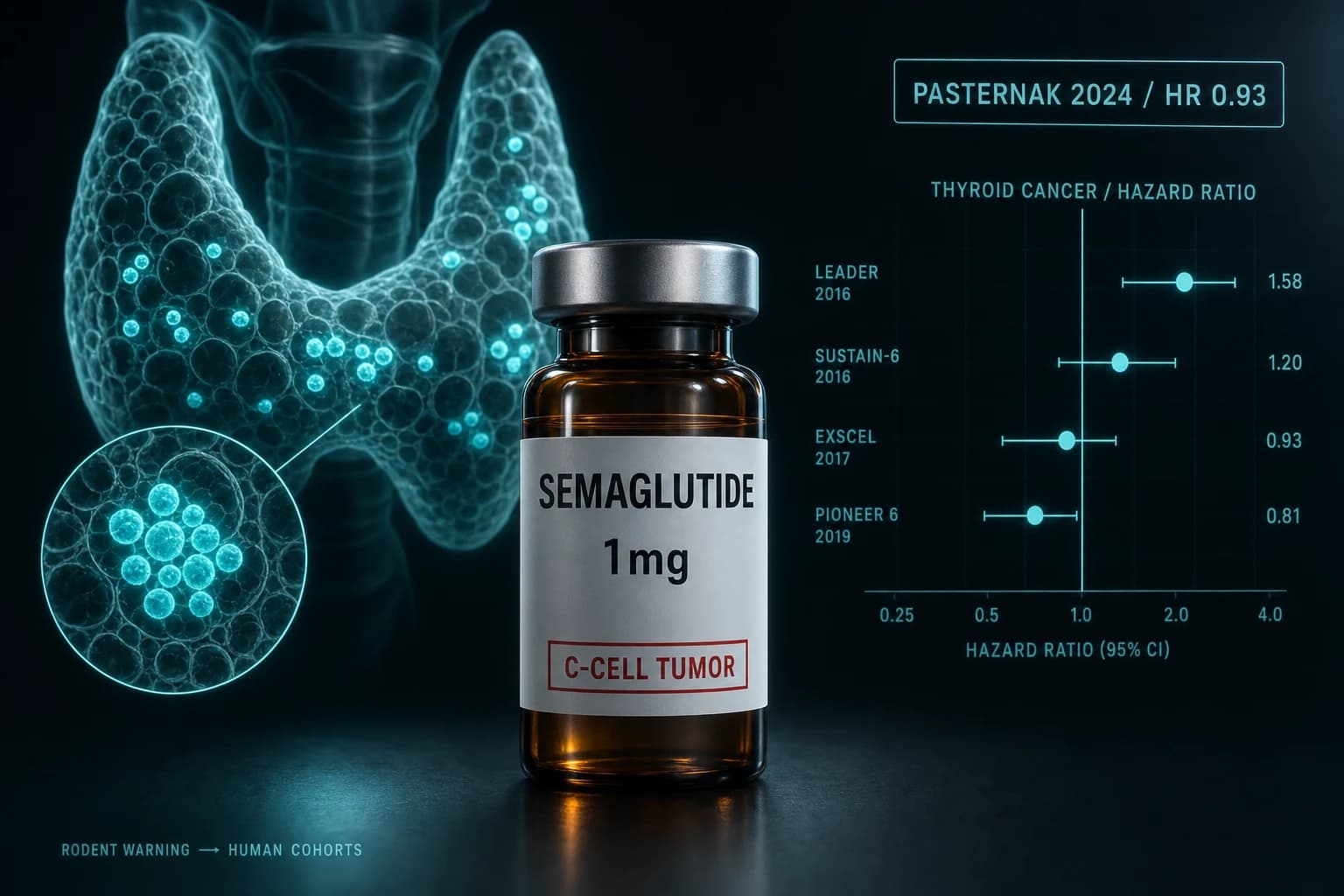
- Bezin 2023 found a thyroid cancer HR of 1.58 over 1 to 3 years of use, later read as detection bias.
- Larger cohorts found nothing: Pasternak 2024 HR 0.93; multisite 2025 pooled HR near 0.81.
- A 460,032-user cohort (2025) showed no increased thyroid tumor risk versus other diabetes drugs.
- The real contraindication is a personal or family history of medullary thyroid cancer or MEN2.
Every box of Ozempic, Wegovy, Mounjaro, and Zepbound ships with the same line near the top of the label: a boxed warning for thyroid C-cell tumors. That is the most serious warning the FDA issues, printed on one of the most-prescribed drug classes on the planet. The question worth answering is narrow and specific: does semaglutide actually cause thyroid cancer in people, or does the warning describe something that never made the jump from rats to humans?
Here is the honest summary before the detail. The warning rests almost entirely on rodent studies. Human evidence on the specific cancer that warning was built around is reassuring. One early human study looked alarming, and most of that alarm has since been traced to how the data were gathered rather than to the drug. The one real exception is a small group with an inherited cancer syndrome, and for them the caution is genuine.
Bottom line: Semaglutide carries a boxed warning for medullary thyroid cancer because it caused C-cell tumors in rodents. The largest human cohort studies have not found an increased risk of thyroid cancer, and the one positive study is widely read as detection bias. The firm contraindication is a personal or family history of medullary thyroid cancer or MEN2.
Where the thyroid warning actually came from
The warning traces back to rodents, and the key paper is Bjerre Knudsen et al. (2010), published in Endocrinology. When researchers gave rats and mice long-term liraglutide, a GLP-1 receptor agonist in the same family as semaglutide, the animals developed thyroid C-cell changes: calcitonin release, then C-cell hyperplasia, then in the most heavily exposed animals C-cell adenomas and medullary carcinoma. The effect tracked with both dose and duration, and blocking the GLP-1 receptor prevented it, which pinned the mechanism on GLP-1 signaling itself.
That finding sounds damning until you look at why rodents respond this way. Rodent thyroid C-cells are studded with GLP-1 receptors, so chronic stimulation drives them hard. Human C-cells express far fewer of those receptors, and primate studies did not reproduce the same proliferation. The central interpretive problem with the whole thyroid question sits right here: a strong, reproducible rodent effect on a cell type that behaves differently in humans.
What the boxed warning actually says
Read the label closely and it is narrower than the headlines suggest. The boxed warning describes a risk of thyroid C-cell tumors, and it lists one hard contraindication: a personal or family history of medullary thyroid carcinoma, or Multiple Endocrine Neoplasia syndrome type 2 (MEN2). Medullary thyroid cancer is the C-cell cancer the rodent data pointed to, and it is rare, accounting for only a small fraction of all thyroid cancers. The label for tirzepatide carries the same warning, because rats on tirzepatide developed the same dose-dependent C-cell tumors, and the documents state plainly that the human relevance has not been determined.
Warning: The boxed warning is a contraindication for people with MEN2 or a family history of medullary thyroid cancer. It does not state that the drug causes thyroid cancer in the general population. Those are different claims, and conflating them drives most of the fear.
The human study that set off the alarm
One study did more than any other to turn a rodent footnote into a headline. Bezin et al. (2023), in Diabetes Care, used the French national health insurance database to run a nested case-control analysis: 2,562 people with thyroid cancer matched against 45,184 controls, all with type 2 diabetes on second-line drugs. Among people who had used a GLP-1 receptor agonist for one to three years, the adjusted hazard ratio for all thyroid cancer was 1.58 (95% CI 1.27 to 1.95), and for medullary thyroid cancer specifically it reached 1.78 (95% CI 1.04 to 3.05).
Taken at face value, that is a real and statistically significant signal, and it is the number that powered a wave of "Ozempic and thyroid cancer" coverage. The face value is exactly the problem.
Why that signal is probably not what it looks like
Several features of the Bezin result point away from cause and toward measurement. The increased diagnoses showed up early, within months to a couple of years of starting the drug, which is biologically hard to square with a newly induced cancer. Tumors do not appear that fast. What does happen that fast is detection: people starting GLP-1 drugs see clinicians more often, get more lab work, and get more imaging, and thyroid cancers are frequently small papillary microcarcinomas that sit silent until a scan catches them. Find more nodules, biopsy more nodules, and the diagnosis count climbs without the underlying biology changing.
Two other gaps weaken the signal further. Bezin's model did not adjust for obesity, which independently raises thyroid cancer risk and is common in the GLP-1 group, so some of the apparent effect could be confounding. Researchers at Mayo Clinic and elsewhere have since framed the French result as a case of surveillance bias rather than evidence of causation (Mayo Clinic, 2025). None of this proves the drug is safe on its own. It means the one scary study is shaky, which is why the larger ones carry more weight.
What the larger, better-designed studies found
Bigger cohorts with active comparators have repeatedly come up empty. The Scandinavian cohort study, Pasternak et al. (2024) in The BMJ, followed 145,410 people starting a GLP-1 agonist against 291,667 starting a DPP-4 inhibitor across Denmark, Norway, and Sweden, with a mean follow-up of 3.9 years. Thyroid cancer risk was not elevated: hazard ratio 0.93 (95% CI 0.66 to 1.31). Even for medullary thyroid cancer, the cancer the warning targets, the estimate was 1.19 (95% CI 0.37 to 3.86), a confidence interval so wide it tells you events were rare and the result uncertain in either direction.
Larger still, an international multisite cohort published in Thyroid in 2025 (Baxter et al.) pooled six population-based databases across Canada, Denmark, Norway, South Korea, Sweden, and Taiwan, comparing 98,147 GLP-1 users against roughly 2.5 million DPP-4 inhibitor users. Overall, GLP-1 use was not associated with thyroid cancer relative to DPP-4 inhibitors, with a pooled estimate below 1. A separate active-comparator analysis of more than 460,032 GLP-1 users, reported in Diabetes Care (2025), found thyroid tumor incidence of roughly 0.88 to 1.03 per 1,000 person-years and no increased risk against SGLT2 inhibitors, DPP-4 inhibitors, or sulfonylureas.
| Study | Design | Who it studied | Thyroid cancer finding | What it adds |
|---|---|---|---|---|
| Bjerre Knudsen 2010 | Rodent (rats, mice) | Liraglutide-exposed animals | Dose-dependent C-cell hyperplasia and tumors | Mechanistic basis for the warning, in a species rich in C-cell GLP-1 receptors |
| Bezin 2023 | Nested case-control (France) | 2,562 cases, 45,184 controls | HR 1.58 all thyroid; 1.78 medullary (1 to 3 years) | The original alarm; later read as detection bias |
| Pasternak 2024 | Active-comparator cohort | 145,410 GLP-1 vs 291,667 DPP-4i | HR 0.93 (0.66 to 1.31) | Large, well-matched null result over 3.9 years |
| Baxter 2025 | Multisite cohort (6 countries) | 98,147 GLP-1 vs ~2.5M DPP-4i | No association, pooled HR below 1 | Broadest geographic replication of the null |
| Diabetes Care 2025 | Active-comparator cohort | 460,032 GLP-1 users | No increase vs SGLT2i, DPP-4i, SU | Incidence near 1 per 1,000 person-years, no signal |
The pattern is consistent. When the analysis moves from a single database with weak confounding control to large active-comparator cohorts, the signal fades out.
The randomized-trial angle, and its limits
Randomized trials should settle this, except they cannot, and the reason is worth understanding. A 2025 meta-analysis of 50 trials, Silverii et al. (2025) in Diabetes, Obesity and Metabolism, found no increase in overall cancer (Mantel-Haenszel OR 1.05, 95% CI 0.98 to 1.13) but did detect a thyroid cancer signal (OR 1.55, 95% CI 1.05 to 2.27) that was more evident in longer trials. That looks like it cuts against the cohort data, until you count events: thyroid cancer is so rare inside trial populations that the estimate rests on a handful of cases, which is why the confidence interval scrapes against 1.0. A more recent 2026 systematic review and meta-analysis in Annals of Internal Medicine (PMID 41359966) found little meaningful effect on cancer risk overall.
Put plainly, trials are underpowered for rare cancers, and the cohort studies are the better instrument for this specific question. The cohorts are mostly null. The trial signal is fragile. An honest reading weighs them accordingly rather than picking the scarier number.
Medullary thyroid cancer, specifically
Everything circles back to medullary thyroid cancer, because that is the C-cell cancer the rodent data and the warning are about. Human evidence for a medullary signal is thin to absent: trials have not reported medullary cases tied to the drugs, and calcitonin, the C-cell hormone that climbs in rodents, has not shown the same clinically meaningful increases in people. The population with a real reason to avoid these drugs is narrow and well defined: anyone with MEN2 or an inherited predisposition to medullary thyroid cancer, where C-cells are already primed to go wrong.
So who should actually be cautious
The practical reading sorts people into three groups. For anyone with a personal or family history of medullary thyroid cancer or MEN2, the contraindication stands without argument, and that is the one place the warning has teeth. For people with existing thyroid nodules or differentiated thyroid cancer under monitoring, current evidence does not show that GLP-1 drugs worsen those cancers, though that belongs in a conversation with the treating endocrinologist rather than a decision made alone. For everyone else, the absolute risk is low: baseline lifetime thyroid cancer risk sits near 1.2%, and the strongest cohorts show no measurable increase on top of it.
Tip: The symptom worth knowing is a new firm lump in the neck, persistent hoarseness, or trouble swallowing. Any of those warrants imaging. Do not order your own calcitonin test as a screen, because false positives are common and an isolated mildly elevated result tends to generate more anxiety and biopsies than answers.
Does this apply to tirzepatide and compounded semaglutide
Tirzepatide sits in the same position. Its rodent C-cell findings drove the same boxed warning, and the same lack of human confirmation applies, so the head-to-head choice between the two compounds turns on efficacy and tolerability rather than thyroid risk. Our tirzepatide versus semaglutide breakdown and the GLP-1 dosing comparison cover those trade-offs in detail.
Compounded semaglutide carries the identical theoretical thyroid profile, because it is the same molecule. It also brings separate quality questions around purity and dosing accuracy that have nothing to do with C-cells, which is reason enough to confirm third-party testing regardless of the thyroid debate.
What this means if you are researching semaglutide
The thyroid warning is real, but it describes a rodent finding plus a genuine contraindication for a small genetic-risk group, not a demonstrated cancer risk for the average user. That framing matters because semaglutide carries other documented trade-offs worth weighing in the same clear-eyed way, from the rare NAION eye risk to questions about bone density, set against its strongest evidence, the cardiovascular benefit seen in the SELECT trial.
Researchers sourcing injectable semaglutide for study use can find it through Ascension Peptides with 50% off using code ENHANCED. Whatever the source, verifying third-party purity testing is worth the effort, since contamination is a separate concern from any of the clinical questions covered here.
This article is for educational and research purposes only. It summarizes rodent studies, observational cohorts, and regulatory assessments that establish association and mechanism, not proven human causation, and it is not medical advice. Semaglutide and tirzepatide products are prescription medications in approved markets; peptides sold for research are not intended for human use. Do not start, stop, or change any medication based on this article. If you have a personal or family history of medullary thyroid cancer or MEN2, or you notice a new neck lump, hoarseness, or difficulty swallowing, consult a qualified clinician.