At a glance
- TRIUMPH-4 randomized 445 adults with obesity and knee osteoarthritis to retatrutide 9 mg, 12 mg, or placebo for 68 weeks (Giblin, Diabetes Obes Metab 2026, PMID 41090431).
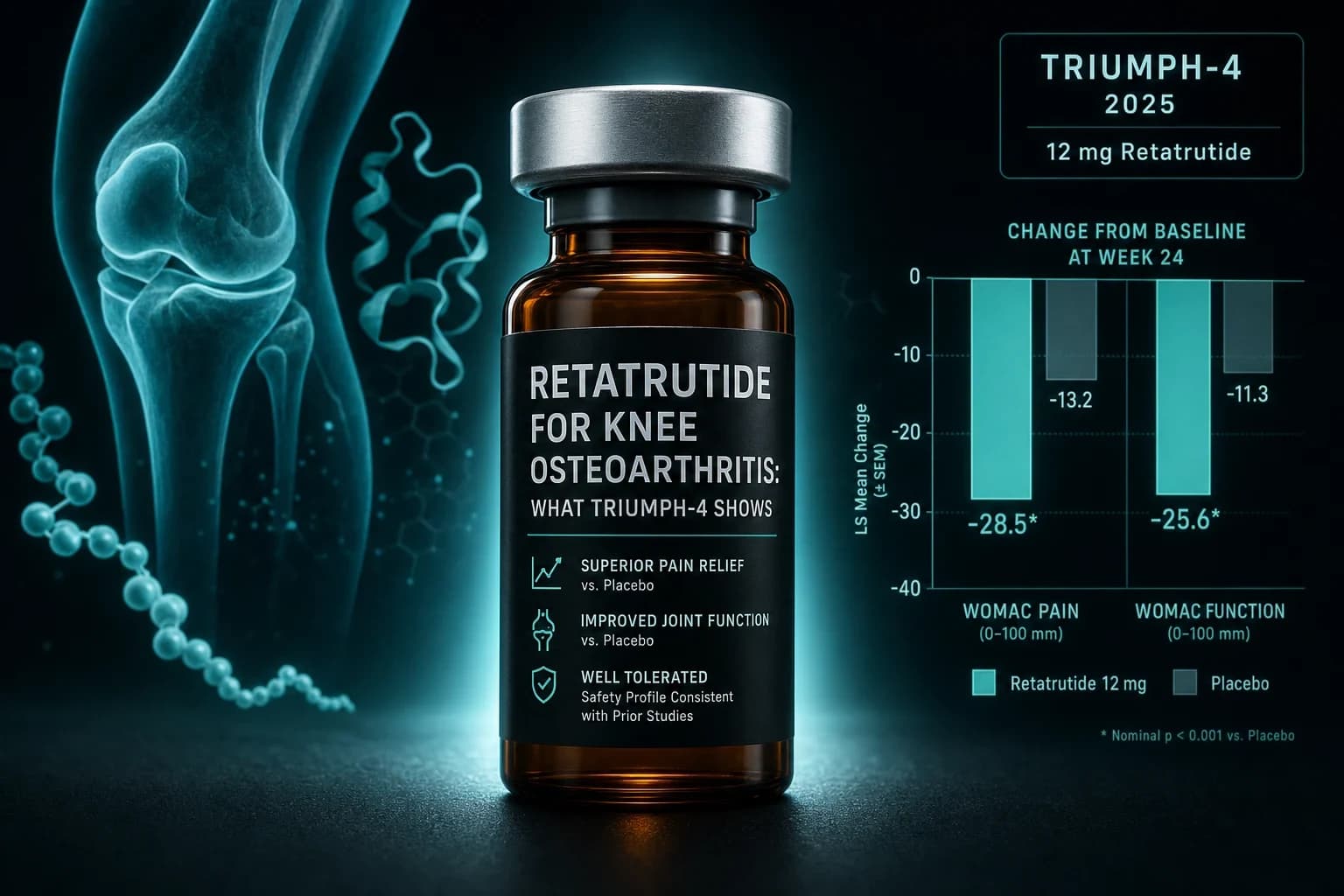
- WOMAC pain fell 4.0 points at 9 mg and 3.7 at 12 mg versus 2.1 on placebo, from a mean baseline of 6.0 on the 0 to 10 scale.
- Body weight dropped 28.7% at 12 mg and 26.4% at 9 mg versus 2.1% on placebo; 12.0% of the 12 mg arm reported zero knee pain at 68 weeks.
- STEP 9 semaglutide 2.4 mg cut WOMAC pain 41.7 versus 27.5 on a 0 to 100 scale at 13.7% weight loss (Bliddal, NEJM 2024, PMID 39476339).
- Retatrutide is not FDA approved for any indication; peer-reviewed TRIUMPH-4 publication is still pending as of July 2026.
Retatrutide's Phase 3 knee osteoarthritis readout landed as a two-sentence Eli Lilly press release in December 2025. That release said retatrutide cut WOMAC pain by up to 75.8% and drove 28.7% weight loss in adults with obesity and knee OA. The peer-reviewed paper is still not out. That gap between the topline number and the published data is where most of the current confusion lives.
TRIUMPH-4 is the trial. 445 adults. 68 weeks. Three arms: retatrutide 9 mg, 12 mg, and placebo. Weekly subcutaneous. Randomized 1:1:1. Design paper published by Giblin et al. in Diabetes, Obesity and Metabolism 2026. Topline endpoints hit on both weight and pain. What we do not have yet is the full randomization, the safety table, the responder curves, or the imaging substudy. This article walks through what was released, how it compares to the semaglutide STEP 9 knee OA trial, and what the honest read is for anyone thinking about retatrutide with a bad knee.
What TRIUMPH-4 actually tested
The trial, registered as NCT05931367, is the stand-alone knee osteoarthritis Phase 3 in the retatrutide TRIUMPH program. Inclusion required:
- BMI 30 or higher
- Clinically diagnosed knee OA
- Radiographic evidence sufficient for symptomatic OA classification
- WOMAC pain subscale score of 4 or higher on the 0 to 10 scale at screening
- No diagnosis of type 2 diabetes
Mean baseline body weight ran 112.7 kg. Mean baseline WOMAC pain subscale ran 6.0 out of 10. Participants were randomized 1:1:1 to weekly subcutaneous retatrutide 9 mg, 12 mg, or matching placebo, in addition to counseled diet and physical activity. The trial ran 68 weeks. The primary endpoints were change in body weight and change in WOMAC pain subscale at week 68.
The TRIUMPH design paper by Giblin et al. (2026) frames TRIUMPH-4 as the OA-focused sibling of the pivotal TRIUMPH-1 obesity trial. TRIUMPH-1, TRIUMPH-2, and TRIUMPH-3 all nest OSA and OA substudies inside their main weight-management protocols. TRIUMPH-4 is the only stand-alone OA trial in the program, which is why it hit its readout first.
For a full breakdown of the pivotal obesity readout that ran alongside this trial, see the retatrutide TRIUMPH-1 Phase 3 topline coverage. This article stays inside the OA lane.
The pain numbers, as released
Eli Lilly's December 2025 press release and the follow-up conference summaries reported the following at week 68:
| Endpoint (week 68) | Retatrutide 9 mg | Retatrutide 12 mg | Placebo |
|---|---|---|---|
| Mean change in WOMAC pain (0 to 10) | -4.0 | -3.7 | -2.1 |
| Complete resolution of knee pain (%) | 14.1% | 12.0% | 4.2% |
| Mean change in body weight (%) | -26.4% | -28.7% | -2.1% |
Two things stand out.
First, the pain reduction is not a linear function of dose. The 9 mg arm outperformed the 12 mg arm on the WOMAC change, and the pain-free rate was higher at 9 mg (14.1%) than at 12 mg (12.0%). Weight loss ran the other direction, larger at 12 mg. That divergence is the most interesting single feature of the readout and it is not something the topline commentary has fully engaged with. It could be noise in a 148-person-per-arm sample. It could also be a real signal that the highest-tolerated dose is not always the highest-effect dose for a specific downstream endpoint.
Second, the 75.8% relative pain reduction figure that Lilly led with is calculated as a percent change from baseline against a baseline that started already high. On a mean baseline WOMAC pain of about 6.0, a 4.5-point drop is 75 percent. The absolute-scale delta (4.0 to 3.7 points on a 0 to 10 scale) is more informative for anyone comparing to prior GLP-1 OA trials. Both framings are technically accurate. Only one lets you compare cleanly to STEP 9.
Bottom line: Both retatrutide doses beat placebo on pain and weight. The 9 mg arm was the pain leader; the 12 mg arm was the weight leader. Full peer-review data will tell us whether that divergence is real or noise.
How TRIUMPH-4 compares to STEP 9 and LOSEIT
Retatrutide is not the first GLP-1 tested in symptomatic knee OA. STEP 9 (semaglutide) and LOSEIT (liraglutide) are the two prior randomized trials that set the comparison baseline.
| Trial | Compound | Dose | Sample (OA arm) | Duration | Baseline WOMAC pain | Weight loss | WOMAC pain change | Reference |
|---|---|---|---|---|---|---|---|---|
| TRIUMPH-4 (topline) | Retatrutide | 9 mg / 12 mg wk | 445 (148 / 148) | 68 wk | 6.0 (0 to 10) | -26.4% / -28.7% | -4.0 / -3.7 (0 to 10) | Giblin design 2026, PMID 41090431 |
| STEP 9 | Semaglutide | 2.4 mg wk | 407 (271 / 136) | 68 wk | 70.9 (0 to 100) | -13.7% vs -3.2% | -41.7 vs -27.5 (0 to 100) | Bliddal NEJM 2024, PMID 39476339 |
| LOSEIT | Liraglutide | 3 mg daily | 156 (post diet run-in) | 52 wk | ~26 (0 to 100) | -2.8 kg additional vs +1.2 kg | No significant pain difference | Gudbergsen Am J Clin Nutr 2021, PMID 33471039 |
Two of those numbers need calibration. STEP 9 used the WOMAC 0 to 100 index format; TRIUMPH-4 reports the 0 to 10 subscale. Multiplied out, TRIUMPH-4's 4.0-point drop is roughly a 40-point drop on the STEP 9 scale, which lands within a few points of the STEP 9 semaglutide result (41.7 points). That is remarkable given the very different weight-loss magnitudes (13.7% for semaglutide, 28.7% for retatrutide).
The LOSEIT result is the outlier that made STEP 9 so surprising when it published. Liraglutide 3 mg added weight loss on top of an 8-week diet run-in but did not add pain relief beyond what the run-in already produced. That was often cited as evidence that GLP-1s work on OA pain only through weight loss and only if the initial dietary loss window has not already extracted the pain benefit.
STEP 9 and now TRIUMPH-4 push the conversation back toward mechanism. Both trials showed pain relief substantially larger than what LOSEIT's weight-loss-mediated model would predict. Retatrutide doubled the STEP 9 weight loss but did not double the pain relief. That failure to scale linearly is the strongest hint in the current data set that the weight-loss-independent pathway is real but capped.
The weight-loss-independent mechanism hypothesis
The 2026 Cell Metabolism paper by Qin et al. (PMID 41666927) is the closest thing to a mechanistic anchor. In pair-fed mouse models, semaglutide protected articular cartilage from osteoarthritic degeneration without any weight loss advantage over controls. The proposed pathway runs through GLP-1 receptor signaling in the chondrocyte, activating AMPK and modulating PFKFB3 to shift chondrocyte metabolism from a glycolytic, inflammatory state toward oxidative phosphorylation. A small human pilot MRI study cited in the same paper reported a mean 17% increase in cartilage thickness at six months on semaglutide.
Qin's data is semaglutide-specific and preclinical for the mechanism, plus a small imaging pilot for humans. It is not TRIUMPH-4 data. But it is what the field has for a plausible weight-loss-independent GLP-1 story in chondrocytes. Retatrutide activates the same GLP-1 receptor plus GIP and glucagon receptors. Whether the extra receptors help or hurt the chondrocyte story is unknown and testable.
Alongside that mechanistic paper sits the Shanghai Osteoarthritis Cohort observational data by Zhu et al., Ann Rheum Dis 2023 (PMID 37258065). In roughly 6,000 T2D-OA patients followed prospectively, GLP-1 receptor agonist use tracked with a 3.5-fold lower incidence of knee surgery over five years, plus slower cartilage thinning on serial imaging. Observational, confounded, and specific to T2D, so not a clean causal read, but consistent with the direction of the STEP 9 and TRIUMPH-4 signals.
Note: TRIUMPH-4's imaging substudy has not been reported. When it publishes, the question of whether retatrutide changes cartilage structure the way the Qin semaglutide pilot suggested will get an answer with 148 subjects at each dose instead of a single-arm pilot of 20.
The nonlinear dose response and what it might mean
The 9 mg pain result exceeding the 12 mg pain result is the single most conversation-worthy detail in the TRIUMPH-4 topline. Three candidate explanations, ranked by likelihood based on the current data:
- Sampling noise. 148 participants per arm on an ordinal pain scale can flip the ordering on a small delta. Full data with confidence intervals will tell.
- Tolerability dilution. Higher-dose GI adverse events could disrupt sleep, mobility, and daily activity in a way that dampens the reported pain improvement without changing the underlying joint biology. This is speculation until the safety and adherence data are out.
- True biphasic effect. GLP-1 receptor internalization at higher receptor occupancy could reduce the downstream chondrocyte signaling that carries the disease-modifying benefit even while systemic weight-loss effects continue. There is precedent for biphasic GPCR effects on tissue targets, though not specifically documented for GLP-1R in cartilage.
The honest answer today is that we cannot pick between these. The peer-reviewed publication with prespecified analyses will address it. Do not assume the 9 mg > 12 mg ordering will survive. Do assume the effect is real at both doses.
Retatrutide's Phase 2 obesity dose-response by Jastreboff et al. (2023) in NEJM (PMID 37366315) also showed the 12 mg arm slightly under-performing 8 mg on a secondary metabolic endpoint at 24 weeks before it recovered and overtook by 48 weeks. Dose-response in Phase 2 was not perfectly monotonic. TRIUMPH-4's pain readout might be the same story compressed into a shorter window.
What TRIUMPH-4 does not tell us
Five gaps worth flagging before anyone extrapolates:
- Peer-reviewed dataset. As of July 2026, the WOMAC change confidence intervals, primary-endpoint p-values, KOOS subscores, and rescue medication use are all still press-release territory. That is normal for Phase 3 topline. It is not enough to build a treatment decision on.
- Structural imaging. The MRI substudy has not been reported. If retatrutide replicates the Qin semaglutide cartilage-thickness signal, the drug moves from symptomatic pain relief on top of weight loss into disease-modifying territory.
- Longer-term durability. 68 weeks is a Phase 3 window. Knee OA is a decades-long disease. Whether the pain improvement holds after 3 years is unknown and untested.
- Head-to-head vs semaglutide and tirzepatide. No trial has directly compared retatrutide to semaglutide or tirzepatide on any OA endpoint. The cross-trial comparison in this article is exactly that, a cross-trial comparison, with all the population-mixing caveats that entails. The SURMOUNT-5 head-to-head between tirzepatide and semaglutide is the closest apples-to-apples GLP-1 data the field has.
- Safety in an OA population. GI adverse events at 12 mg retatrutide in TRIUMPH-1 ran higher than the tolerability profile most primary care physicians are used to with semaglutide. See the retatrutide side effects deep dive for the full profile. In an older, higher-BMI OA population, the tolerability trade-off may look different than it did in the pivotal obesity trial.
Who this actually matters for
Two groups where TRIUMPH-4 changes the practical calculus and one where it does not.
Adults with obesity and moderate-to-severe knee OA who have not tried GLP-1s. For this group, the STEP 9 case for semaglutide 2.4 mg is already strong: FDA-approved for weight management, established safety, a 41.7-point WOMAC pain drop, and now a plausible mechanistic story from Qin et al. TRIUMPH-4 does not change that first-line calculus in 2026 because retatrutide is not approved and semaglutide is. It does say that if retatrutide receives FDA approval, the OA population becomes a plausible label-expansion target.
Adults on tirzepatide with residual knee pain. Tirzepatide has no dedicated OA trial. The TRIUMPH design paper explicitly nests OA substudies in TRIUMPH-1 and TRIUMPH-2 but did not power a stand-alone comparator OA trial for tirzepatide. This is the group most likely to migrate toward retatrutide when it is available, if the tolerability trade-off is acceptable.
Adults using research-grade retatrutide outside a clinical setting. The practical answer here is simple and unsatisfying. TRIUMPH-4 does not authorize this use, does not establish it as safe outside supervision, and does not change the FDA status. If you are in this population, the retatrutide 12-week titration protocol reference and retatrutide reconstitution guide are the pragmatic starting points, and the retatrutide side effects article is the required reading.
A decision framework, honestly
| Situation | What TRIUMPH-4 supports | What it does not support |
|---|---|---|
| BMI 30+ with symptomatic knee OA, no prior GLP-1 | Considering GLP-1 therapy with a clinician; semaglutide 2.4 mg is the approved option today. | Skipping semaglutide because retatrutide is stronger. Retatrutide is not approved and cross-trial deltas are not head-to-head data. |
| BMI 30+ on tirzepatide, mild residual knee pain | Continuing tirzepatide and revisiting when retatrutide OA data is peer-reviewed. | Switching now based on a press release. Full data may narrow the perceived retatrutide advantage. |
| BMI 30+ on semaglutide 2.4 mg with strong OA benefit already | Staying on semaglutide. STEP 9 is your data. | Switching to retatrutide for OA. The topline TRIUMPH-4 pain delta is comparable in absolute terms once you adjust the scale. |
| Normal BMI with knee OA and no metabolic disease | Waiting for weight-loss-independent OA data. | Using retatrutide off-label for OA. No trial supports this indication at any BMI without obesity. |
For the broader retatrutide picture, the retatrutide vs tirzepatide vs semaglutide 2026 comparison covers cross-class efficacy, and the retatrutide triple agonist explainer walks through the receptor pharmacology that underpins the whole program. Anyone doing their own dose math should also run the reconstitution calculator before mixing a research vial.
Cost, access, and the FDA path
Retatrutide is not FDA approved for any indication, including obesity and knee OA. It is expected to file for the obesity indication first based on TRIUMPH-1, and to pursue OA and OSA label expansions from the nested substudies. TRIUMPH-4 gives the OA case a Phase 3 anchor even if the label conversation runs behind the obesity approval.
Two access realities to keep separate.
- Clinical (not currently available). No retatrutide prescription exists outside investigational trial enrollment. If TRIUMPH-1 leads to approval in 2026 to 2027, expect compounded telehealth channels to be blocked by law during the initial exclusivity window, which is what happened when Wegovy and Zepbound came off shortage. The site's cheapest GLP-1 access routes and the Ascension Peptides review walk through the vetted compounded paths that will apply once retatrutide is available. Independently, the retatrutide cost breakdown covers the pricing math for what a compounded regimen is likely to look like.
- Research (available today). Research-grade retatrutide is sold for laboratory use by several verified vendors. Ascension Peptides carries research-grade retatrutide with 50% off using code ENHANCED. This is not a clinical prescription and does not constitute medical advice. See the where to buy retatrutide guide for the sourcing and COA discussion before ordering.
Either way, the TRIUMPH-4 result does not shortcut the safety, tolerability, and monitoring calculus that any real OA use case requires.
The bottom line
TRIUMPH-4 is a real Phase 3 signal that the largest GLP-1 receptor agonist in development also produces the largest weight loss anyone has ever seen in a randomized OA trial, and a WOMAC pain reduction that, once you calibrate the scales, is comparable in absolute terms to what semaglutide produced in STEP 9 at half the weight loss. That comparability at very different weight-loss magnitudes is the biggest hint yet that GLP-1 receptor engagement in the joint is doing something the load-reduction story cannot fully explain.
Everything past that is still to be shown. The peer-reviewed paper will settle the confidence intervals. The MRI substudy will settle the disease-modifying question. The safety table will settle the tolerability trade-off. And the TRIUMPH-2 and TRIUMPH-3 OA substudies will tell us how the effect holds up in the T2D and cardiovascular populations who make up most of the real-world OA-with-obesity denominator.
For anyone tracking the space, TRIUMPH-4 is the clearest sign yet that GLP-1s are becoming an OA drug class in their own right, separate from the weight-loss-mediated knee benefit. For anyone making a treatment decision this week, the answer is unchanged: semaglutide 2.4 mg is the approved GLP-1 OA option, tirzepatide is the more powerful weight-loss option without a dedicated OA readout, and retatrutide is a Phase 3 trial with a great topline and a peer-reviewed publication still to come.
Disclaimer
This article is for educational and informational purposes only. It is not medical advice. The TRIUMPH-4 topline data summarized here comes from Eli Lilly's press release and conference commentary; the peer-reviewed publication is still pending. Retatrutide is investigational and not approved by any regulatory authority for obesity, knee osteoarthritis, or any other indication. Semaglutide, tirzepatide, and liraglutide have documented risks including gastrointestinal adverse events, pancreatitis, gallbladder disease, medullary thyroid carcinoma contraindications, and hypoglycemia when combined with insulin or sulfonylureas. Decisions about GLP-1 initiation, dose selection, or symptomatic OA management require individual assessment by a qualified clinician familiar with the patient's full medical history. Self-administration of research chemicals outside a supervised setting is not endorsed.