At a glance
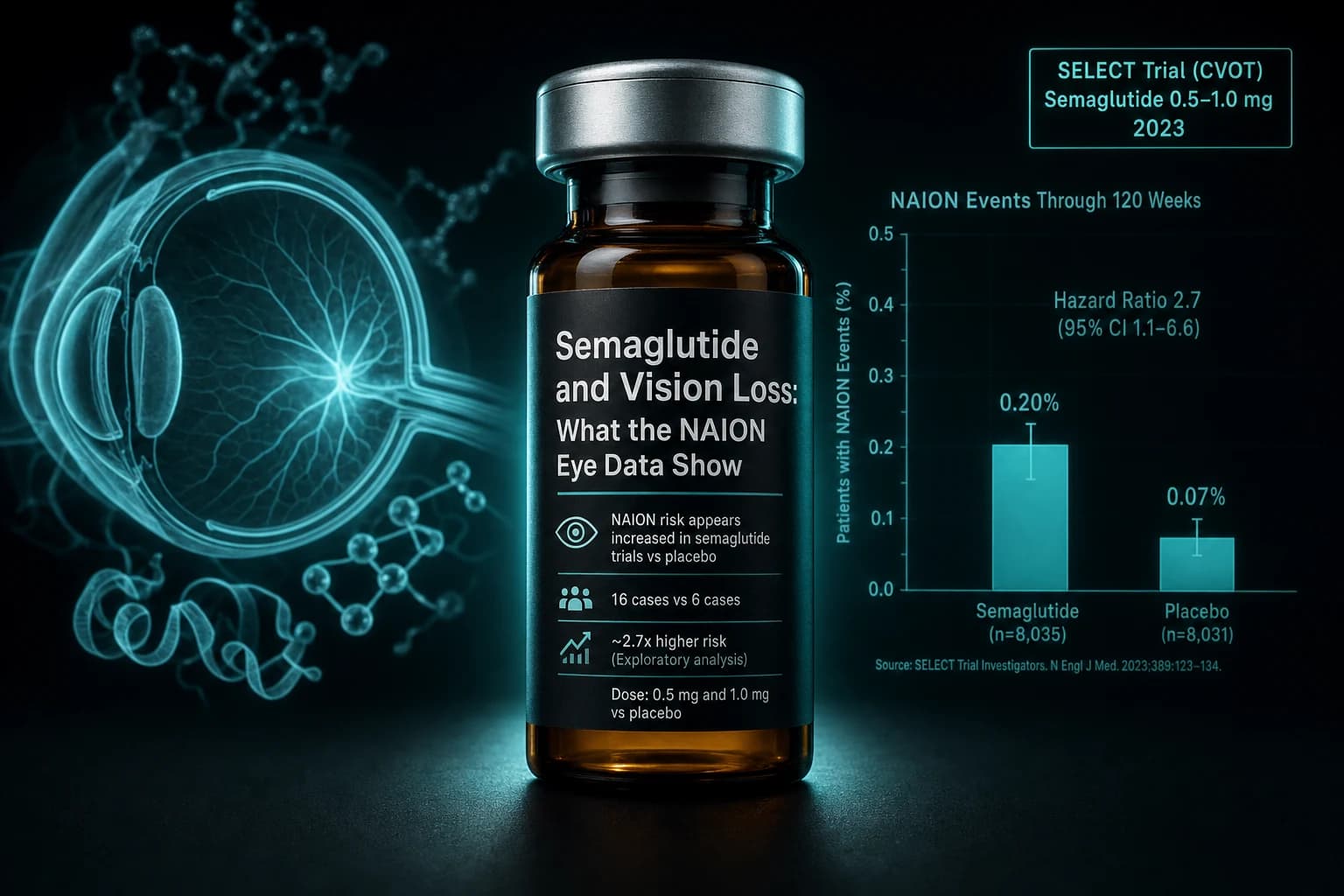
- NAION is now a regulator-recognized very rare side effect of semaglutide: up to 1 in 10,000 users (EMA, 2025).
- Hathaway et al. 2024 reported NAION hazard ratios of 4.28 (diabetes) and 7.64 (obesity) in a single-center cohort.
- Larger data show smaller effects: Cai et al. 2025 found a 1.32 incidence rate ratio across 37.1 million adults.
- Absolute risk stays low: roughly 2 to 3 NAION cases per 10,000 person-years on semaglutide (Simonsen et al. 2025).
- Excess risk concentrates after about 2 years; sudden painless vision loss in one eye is an urgent eye exam.
In June 2025, European regulators added a line to the safety labels of Ozempic, Rybelsus, and Wegovy that had not been there before: a rare eye condition that can cause sudden, permanent loss of vision in one eye. The condition is NAION, and the decision capped two years of studies that pointed in uncomfortably different directions.
Those studies are easy to misread. One single-center analysis reported a four- to sevenfold higher risk. A separate study covering 37 million people found an effect a fraction of that size. Both can be correct at once, because they measured different populations in different ways. What follows is what the published record actually supports, how large the risk becomes once you convert it from relative to absolute terms, and which groups have the most reason to pay attention.
Bottom line: Semaglutide is associated with a higher relative risk of NAION, and regulators now classify it as a very rare side effect affecting up to 1 in 10,000 users. The absolute risk is small, the evidence is observational rather than randomized, and causation is not settled. For most users the added risk is low, though not zero, and a handful of higher-risk groups should watch more carefully.
What NAION actually is
NAION stands for nonarteritic anterior ischemic optic neuropathy. Blood flow to the front of the optic nerve drops far enough to damage nerve fibers, and the result is sudden, usually painless loss of part of the visual field in one eye. Many people notice it on waking. The damage is often permanent, there is no proven treatment that reliably restores vision, and the second eye carries a higher risk afterward.
It is the most common acute optic neuropathy in adults over 50 after glaucoma, yet it stays uncommon in absolute terms. Background incidence in the general population over 50 runs in the range of a few cases per 100,000 people per year. Several conditions raise that baseline on their own: a small, crowded optic disc (the so-called disc at risk), obstructive sleep apnea, hypertension, and diabetes. That last one matters for interpreting every study below, because diabetes both pushes people toward semaglutide and independently raises NAION risk.
The study that triggered the alarm
The signal came from a retrospective cohort at Massachusetts Eye and Ear, published in July 2024 (Hathaway et al., JAMA Ophthalmology 2024, PMID 38958953). The team reviewed patients seen in their neuro-ophthalmology clinic between late 2017 and late 2023, splitting them into two groups: 710 people with type 2 diabetes and 979 with overweight or obesity. Within each group they compared people prescribed semaglutide against people prescribed non-GLP-1 medications.
The hazard ratios were striking. Among patients with type 2 diabetes, semaglutide use carried a NAION hazard ratio of 4.28 (95% CI 1.62 to 11.29), with a 36-month cumulative incidence of 8.9% versus 1.8% in the comparison group. Among patients with overweight or obesity, the hazard ratio reached 7.64 (95% CI 2.21 to 26.36).
Read those numbers with the study design in mind. This was a single center, and the patients were already attending a specialist neuro-ophthalmology clinic, a population enriched for exactly the kind of eye disease being measured. That selection is why the absolute incidence (close to 9% over three years) sits so far above anything seen in the general population. The authors presented the work as hypothesis-generating rather than proof, and the obvious next question was whether the effect held up in broader, less selected groups.
What the larger studies found
Two big analyses answered that question, and they pulled the estimate down toward earth without erasing it.
The largest looked at roughly 37.1 million adults with type 2 diabetes across 14 databases in the OHDSI research network (Cai et al., JAMA Ophthalmology 2025, PMID 39976940). Pooled across sources, semaglutide exposure carried a meta-analytic incidence rate ratio of 1.32 (95% CI 1.14 to 1.54, P < .001). A 32% relative increase is real and statistically solid at that scale, but it sits a long way from a sevenfold jump.
A national-registry study from Denmark and Norway added an active-comparator design, which is harder to fool (Simonsen et al., Diabetes, Obesity and Metabolism 2025, PMID 40098249). It followed 44,517 Danish and 16,860 Norwegian semaglutide users with type 2 diabetes, compared them against people starting SGLT-2 inhibitors, and counted 32 NAION events. The pooled adjusted hazard ratio was 2.81 (95% CI 1.67 to 4.75). The authors also reported absolute rates: roughly 2.19 versus 1.18 cases per 10,000 person-years in Denmark and 2.90 versus 0.92 in Norway, an absolute difference of about 1.4 extra cases per 10,000 person-years.
Pooling the field, a 2025 systematic review and meta-analysis of 10 studies put the combined hazard ratio at 2.62 (95% CI 1.81 to 3.80) and reported that the risk became statistically significant only after about two years of exposure (PMID 40962119).
| Study | Design | Who it studied | Comparator | NAION effect | What it adds |
|---|---|---|---|---|---|
| Hathaway 2024 | Single-center, retrospective | 710 T2D, 979 overweight/obese (neuro-ophthalmology clinic) | Non-GLP-1 users | HR 4.28 (T2D); 7.64 (obesity) | First signal; high-risk referral population, hypothesis-generating |
| Cai 2025 | Multi-database (OHDSI) | 37.1M adults with T2D, 14 databases | Non-exposed | IRR 1.32 (1.14 to 1.54) | Largest sample; modest effect measured at population scale |
| Simonsen 2025 | National registry cohort | 61,377 semaglutide users (Denmark + Norway) | SGLT-2 inhibitor users | HR 2.81 (1.67 to 4.75) | Active comparator; absolute risk near 2 to 3 per 10,000 person-years |
| Meta-analysis 2025 | Pooled (10 studies) | T2D and weight-loss users | Mixed controls | HR 2.62 (1.81 to 3.80) | Risk significant after roughly 2 years of use |
The estimates disagree on size, and that disagreement is the honest headline. Single-center data overstated the effect; population-scale data shrank it; the active-comparator study landed in between. What none of them found was zero.
Warning: Relative risk is the wrong number to fixate on. A two- to threefold increase sits on top of a baseline of roughly 1 to 2 NAION cases per 10,000 person-years, so it adds on the order of 1 to 2 extra cases per 10,000 people per year. That is why regulators settled on the label very rare. The relative figures look alarming; the absolute figures stay small.
Who appears to be at higher risk
The pooled analysis flagged a consistent set of features that travel with higher NAION risk, and they line up with what eye specialists already knew about the condition. Older age, male sex, longer diabetes duration, higher HbA1c, existing diabetic retinopathy, and obesity all showed up as risk-raising factors. Add the structural ones that predate any drug: a small crowded optic disc, obstructive sleep apnea, and a prior NAION event in the other eye.
Time on the drug matters too. Across studies the excess risk concentrated after roughly two years of use rather than in the first few months, which fits a slow vascular mechanism more than an acute reaction to the first dose. Someone in their 30s taking semaglutide for a year for weight management sits at the low end of this range. A 65-year-old man with long-standing diabetes, retinopathy, and sleep apnea sits at the high end, and that gap is worth raising with a clinician before starting.
Does this apply to tirzepatide and compounded semaglutide
Most of the evidence is semaglutide-specific, which is a real limitation. Tirzepatide, the dual GIP and GLP-1 agonist, has generated occasional pharmacovigilance reports but no large cohort study confirming or ruling out a comparable NAION signal. A lack of strong data is not the same as a clean bill of health; it means the question has not been answered yet. Anyone weighing the two compounds can compare their broader profiles in our tirzepatide versus semaglutide breakdown and the GLP-1 dosing comparison.
Compounded semaglutide carries the same theoretical risk as the branded product, because it is the same molecule. It also brings separate quality concerns around dosing accuracy and purity that have nothing to do with the optic nerve. Those are different problems that happen to share a compound.
The older eye signal people confuse with this one
Semaglutide already carried an eye-related warning, and it is not the same as NAION. In the SUSTAIN-6 cardiovascular trial, semaglutide was linked to more diabetic retinopathy complications than placebo, with a hazard ratio of 1.76 (95% CI 1.11 to 2.78) and an event rate of 3% versus 1.8% (Marso et al., New England Journal of Medicine 2016, PMID 27633186). That effect is generally attributed to rapid blood-sugar lowering in people who already had retinopathy, a phenomenon called early worsening, and it involves the retina rather than the optic nerve.
Keeping the two straight matters. Diabetic retinopathy worsening is a known, mechanistically understood effect tied to how fast HbA1c falls. NAION is a separate optic-nerve event with a less certain link to the drug. Conflating them inflates the apparent danger and muddies the actual decision.
What regulators concluded
After reviewing the accumulating data, the European Medicines Agency's safety committee (PRAC) concluded in June 2025 that NAION is a very rare side effect of semaglutide, meaning it may affect up to 1 in 10,000 people, and recommended updating the product information for Ozempic, Rybelsus, and Wegovy (EMA, 2025). The committee estimated roughly a twofold increase in relative risk among adults with type 2 diabetes and advised that anyone with confirmed NAION should stop semaglutide. The World Health Organization issued a parallel safety note the same month (WHO, 2025).
Tip: The warning sign to memorize is simple: sudden, painless loss or blurring of vision in one eye, often noticed first thing in the morning. Treat that as an urgent ophthalmology visit, not a wait-and-see symptom, whether or not you take semaglutide.
What this means if you are researching semaglutide
The practical reading is narrow and specific. NAION is a genuine, regulator-recognized risk that is also genuinely rare, and the people most exposed are older, male, longer-diagnosed, and already carrying optic-nerve or vascular risk factors. For a young, otherwise healthy person using semaglutide short term, the added risk is small in absolute terms. For a higher-risk profile, it is a real conversation to have with a clinician before starting and a reason to report any visual change promptly.
None of this argues for stopping a prescribed medication on your own. Abrupt discontinuation carries its own consequences for weight and glucose, which we cover in the guide to stopping GLP-1s. The sensible move is informed monitoring: know the warning sign, flag your risk factors, and get sudden vision changes checked the same day. That same balanced approach applies to the drug's other documented trade-offs, from bone density questions to its cardiovascular benefits in the SELECT trial, which remain the strongest point in semaglutide's favor.
Researchers sourcing injectable semaglutide for study use can find it through Ascension Peptides with 50% off using code ENHANCED. Whatever the source, confirming third-party purity testing is worth the effort, since contamination is a separate issue from any of the clinical risks discussed here.
This article is for educational and research purposes only. It summarizes observational studies and regulatory assessments that establish association, not proven causation, and it is not medical advice. Semaglutide products are prescription medications in approved markets; peptides sold for research are not intended for human use. Do not start, stop, or change any medication based on this article. If you experience sudden vision loss or any rapid change in eyesight, seek care from a qualified ophthalmologist immediately, and discuss your personal risk with a licensed clinician.