At a glance
- Sermorelin is a GHRH analog (residues 1-29 of GHRH); CJC-1295 is a modified GHRH analog with extended half-life via DAC; Ipamorelin is a GHRP that acts on the ghrelin receptor
- GHRH analogs (Sermorelin, CJC-1295) and GHRPs (Ipamorelin) work through different receptors and combine synergistically; this is the rationale for stack protocols like the FIT Stack
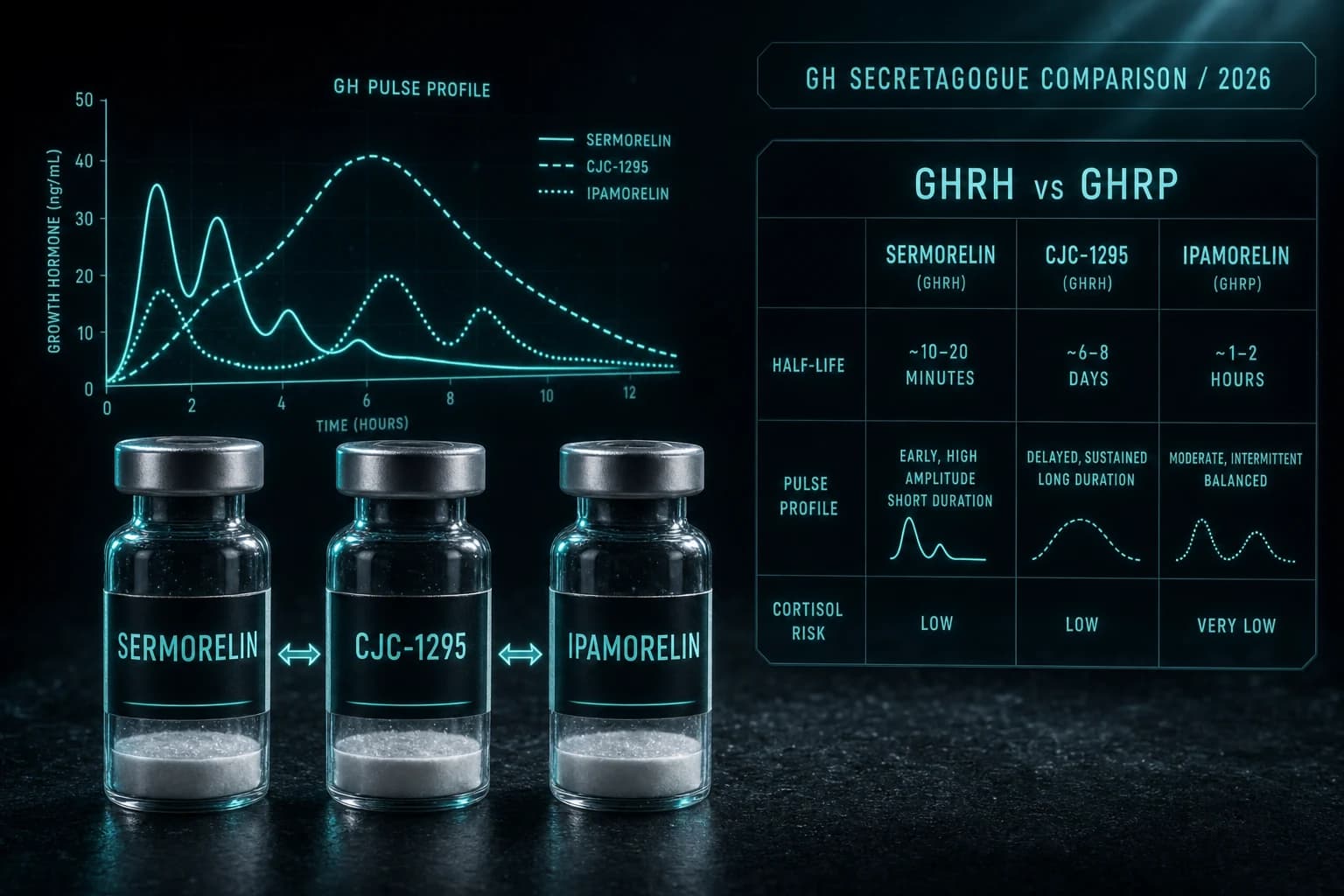
- Sermorelin half-life: ~10-20 minutes. CJC-1295 (no DAC): ~30 minutes. CJC-1295 (with DAC): ~6-8 days. Ipamorelin: ~2 hours.
- Ipamorelin produces minimal cortisol/prolactin elevation; Sermorelin and CJC-1295 produce no direct cortisol effect; hexarelin is the GHRP that DOES produce cortisol
- Standard combined research stack: CJC-1295 no DAC + Ipamorelin at 100 mcg each, three times daily, subcutaneous; this is the FIT Stack mechanism
The Sermorelin vs CJC-1295 vs Ipamorelin question is one of the most-asked in GH-pathway research. Each compound has a defined niche but they are not interchangeable. The three operate through two different receptor systems (GHRH receptor for Sermorelin and CJC-1295, ghrelin receptor for Ipamorelin) with different half-lives, pulse profiles, and risk-benefit trade-offs. For most research applications the question is not "which one of the three" but "which two of the three to stack."
This article covers the mechanism of each compound, the practical differences in half-life and pulse profile, how they pair in stack protocols, and how to think about choosing between them for specific research goals.
What each compound actually is
| Compound | Class | Receptor | Mechanism |
|---|---|---|---|
| Sermorelin | GHRH analog | GHRH-R | First 29 residues of native GHRH; stimulates pituitary GH release |
| CJC-1295 (no DAC) | GHRH analog | GHRH-R | Modified GHRH 1-29 with stability enhancements; extended half-life over Sermorelin |
| CJC-1295 (with DAC) | GHRH analog | GHRH-R | CJC-1295 with Drug Affinity Complex (DAC) for albumin binding; week-long half-life |
| Ipamorelin | GHRP | GHSR-1a (ghrelin) | Synthetic pentapeptide; activates ghrelin receptor for GH release |
| Hexarelin | GHRP | GHSR-1a (ghrelin) | Stronger GHSR-1a binding than Ipamorelin; more potent but with cortisol effect |
The fundamental distinction is GHRH vs GHRP:
GHRH analogs (Sermorelin, CJC-1295) work through the GHRH receptor in the anterior pituitary to stimulate GH production. The mechanism is upstream: cells synthesize more GH and release it through normal pulsatile mechanisms.
GHRPs (Ipamorelin, Hexarelin, GHRP-2, GHRP-6) work through the GHSR-1a (ghrelin receptor) in the anterior pituitary to trigger GH release. The mechanism is acute: existing GH stores get released in pulses.
Combining a GHRH analog with a GHRP produces synergistic GH release through both pathways simultaneously. This is the rationale for stacked protocols.
For the broader compound context, see the Sermorelin compound guide, the CJC-1295 compound guide, and the Ipamorelin compound guide.
Half-life and pulse profile
The half-life differences shape practical dosing:
| Compound | Half-life | Pulses per day at typical dose | Dosing schedule |
|---|---|---|---|
| Sermorelin | ~10-20 min | 1-2 per injection | 2-3x daily SC |
| CJC-1295 (no DAC) | ~30 min | 1-2 per injection | 2-3x daily SC |
| CJC-1295 (with DAC) | 6-8 days | Sustained, no defined pulses | Weekly SC |
| Ipamorelin | ~2 hours | 1 sustained pulse | 2-3x daily SC |
| Hexarelin | ~70 min | 1 strong pulse | 1-3x daily SC |
The CJC-1295 with vs without DAC distinction is important. The DAC version produces sustained GH elevation rather than discrete pulses, which is mechanistically different from the natural pulsatile GH pattern. Most research protocols prefer the no-DAC version because it preserves pulse pattern.
Ipamorelin's 2-hour half-life is the sweet spot for GHRP. Each injection produces a discrete, well-defined GH pulse that doesn't bleed into the next injection. Hexarelin's effect lingers longer with more pronounced effect, but at the cost of cortisol elevation.
For the deep-dive on hexarelin specifically, see the Hexarelin GHRP dosing and cortisol risk guide.
Cortisol and prolactin: the GHRP-specific concern
GHRPs vary substantially in their off-target effects on cortisol and prolactin:
| Compound | Cortisol effect | Prolactin effect |
|---|---|---|
| Ipamorelin | Minimal | Minimal |
| GHRP-2 | Mild elevation | Mild elevation |
| GHRP-6 | Mild elevation | Mild elevation |
| Hexarelin | Moderate elevation | Mild elevation |
| Sermorelin (GHRH) | None | None |
| CJC-1295 (GHRH) | None | None |
This is the central reason Ipamorelin is the preferred GHRP for most research applications. The compound produces clean GH pulses without the cortisol/prolactin overhead that limits Hexarelin's role.
GHRH analogs (Sermorelin, CJC-1295) do not directly affect cortisol or prolactin because the GHRH receptor is independent of the ACTH-cortisol axis and the prolactin axis.
The classic GHRH + GHRP stack
Combining a GHRH analog with a GHRP produces synergistic GH release because the two pathways amplify each other:
| Stack | Profile | Notes |
|---|---|---|
| CJC-1295 (no DAC) + Ipamorelin | Strong pulse with minimal cortisol | The standard "FIT Stack" |
| Sermorelin + Ipamorelin | Cleaner GHRH pulse with Ipamorelin | Less common but valid |
| CJC-1295 (with DAC) + Ipamorelin | Sustained CJC + Ipamorelin pulses | Less natural pulse pattern |
| CJC-1295 (no DAC) + Hexarelin | Stronger pulse with cortisol cost | Maximum amplitude but with trade-offs |
The FIT Stack (CJC-1295 + Ipamorelin) is the convergent default research stack because:
- Clean mechanism. No cortisol/prolactin elevation
- Natural pulse pattern. No-DAC CJC produces discrete pulses
- Established research database. Most-studied combination at this dose tier
- Reasonable cycle profile. Tolerated for 8-12 week cycles in most research
Standard combined dose: 100 mcg CJC-1295 (no DAC) + 100 mcg Ipamorelin, three times daily, subcutaneous. The most common variation is 100 mcg twice daily (morning and pre-bed) for moderate-intensity protocols. See the FIT Stack CJC-1295 + Ipamorelin GH protocol for detailed dosing.
Bottom line: For most general GH-pathway research, the CJC-1295 (no DAC) + Ipamorelin stack is the default. Sermorelin is the cleaner GHRH choice for short-protocol research; CJC-1295 (with DAC) is for sustained-elevation research where pulse pattern matters less; Hexarelin is for maximum-amplitude research where cortisol overhead is acceptable.
When each compound is the right choice
Sermorelin is the right choice when:
- Research budget is constrained and the cheaper GHRH option matters
- Trial design calls for short-acting GHRH where each injection produces a defined window
- The research subject has GHRH-deficient profile and direct GHRH replacement is the goal
- Stacking with other compounds where GHRH timing precision matters
CJC-1295 (no DAC) is the right choice when:
- Research subject needs slightly longer GHRH effect than Sermorelin
- Stacking with Ipamorelin in the FIT Stack mechanism
- Most general body composition or recovery research applications
- Cost-effectiveness favors slightly less frequent injection than Sermorelin
CJC-1295 (with DAC) is the right choice when:
- Research design calls for sustained GHRH elevation rather than pulses
- Once-weekly dosing is the practical priority
- Compliance with the natural pulse pattern is not the research priority
Ipamorelin is the right choice when:
- GHRP-side of a stacked protocol is needed
- Standalone GH-pulse research without cortisol concerns
- Most general body composition research
- Pediatric or sensitive-population research where cortisol elevation is undesirable
Hexarelin is the right choice when:
- Maximum-amplitude single GH pulse is the research priority
- Short cycles (2-4 weeks) where desensitization doesn't matter
- Cardio-protection research where the unique hexarelin profile may apply
- Cortisol elevation is acceptable as a research trade-off
Stack examples for specific goals
| Research goal | Recommended stack | Notes |
|---|---|---|
| General body composition | CJC-1295 (no DAC) + Ipamorelin (FIT Stack) | The default for most users |
| Recovery + GH support | FIT Stack + BPC-157 + TB-500 | Adds recovery peptides |
| Maximum GH pulse research | CJC-1295 + Hexarelin | Cortisol-aware protocol |
| Anti-aging clean protocol | Sermorelin alone | Conservative GHRH-only approach |
| Pulse-pattern research | CJC-1295 (no DAC) + Ipamorelin | Natural pulse architecture |
| Once-weekly convenience | CJC-1295 (with DAC) + occasional Ipamorelin | Less natural pulse but easier |
The combinations are not all mutually exclusive. Researchers running long-term protocols often cycle between approaches (e.g., FIT Stack for 8 weeks, then 4 weeks off, then Hexarelin for 4 weeks targeted amplitude work).
For broader context on muscle and recovery research peptides outside the GH pathway, see the TB-500 dosage guide, the IGF-1 LR3 research dosing protocol, and the Wolverine Stack: BPC-157 + TB-500 recovery protocol.
Reconstitution math
All three compounds typically ship as small lyophilized vials.
| Compound | Typical vial size | Recommended bac water | Concentration | 0.1 mL draw delivers |
|---|---|---|---|---|
| Sermorelin | 5-10 mg | 2 mL | 2.5-5 mg/mL | 250-500 mcg |
| CJC-1295 (no DAC) | 5 mg | 2.5 mL | 2 mg/mL | 200 mcg |
| Ipamorelin | 5 mg | 2.5 mL | 2 mg/mL | 200 mcg |
For typical 100 mcg dosing, the standard reconstitution allows precise dose-by-volume math. The reconstitution calculator handles arbitrary vial sizes.
How these compounds fit the 2026 regulatory landscape
The Feb 27, 2026 HHS announcement moved CJC-1295, Ipamorelin, and Sermorelin (among others) from FDA Category 2 back to Category 1, restoring legal compounding-pharmacy access. All three compounds in this comparison are now accessible through licensed compounding pharmacies with a prescription, in addition to research-grade retail channels.
For broader regulatory context, see the FDA peptide reclassification February 2026 complete breakdown.
Sourcing
For research-grade injectable Sermorelin, CJC-1295 (no DAC), and Ipamorelin with public per-batch COAs, Ascension Peptides carries all three with 50% off using code ENHANCED. The pre-mixed FIT Stack vial combines CJC-1295 + Ipamorelin in a single injection for convenience.
For our broader sourcing analysis, see the best legit peptide vendors 2026 ranking.
FAQ
What is the difference between Sermorelin and CJC-1295?
Both are GHRH analogs that work through the GHRH receptor to stimulate GH production. Sermorelin is the first 29 amino acids of native GHRH. CJC-1295 is a modified version of Sermorelin with chemical modifications that extend its half-life. CJC-1295 (no DAC) has ~30 minute half-life versus Sermorelin's ~10-20 minutes. CJC-1295 (with DAC) has ~6-8 day half-life through albumin binding.
What is the difference between CJC-1295 (no DAC) and CJC-1295 (with DAC)?
DAC stands for Drug Affinity Complex. CJC-1295 with DAC has a modification that allows the peptide to bind albumin in circulation, extending its half-life to 6-8 days. CJC-1295 without DAC clears in approximately 30 minutes. Most research protocols use the no-DAC version because it preserves the natural pulsatile GH pattern; sustained CJC-1295 with DAC produces continuous GH elevation that doesn't match physiological pulse architecture.
Why combine CJC-1295 and Ipamorelin?
CJC-1295 acts through the GHRH receptor to stimulate GH production. Ipamorelin acts through the ghrelin receptor (GHSR-1a) to trigger GH release. Combining the two amplifies GH pulses through both pathways simultaneously. Stacking is mechanistically additive rather than competing.
Which is better for muscle growth, Sermorelin or Ipamorelin?
Neither alone is particularly strong for muscle growth. The convergent research-grade approach for GH-pathway muscle support is the FIT Stack (CJC-1295 no DAC + Ipamorelin). If you must choose one alone, Ipamorelin's GHRP mechanism produces a cleaner discrete GH pulse than Sermorelin's GHRH pulse alone.
Does Ipamorelin cause cortisol elevation?
Minimal. Ipamorelin is the cleanest of the GHRP class in this respect. Hexarelin produces measurable cortisol elevation; GHRP-2 and GHRP-6 produce mild elevation; Ipamorelin produces minimal effect at standard research doses. This is the central reason Ipamorelin is the preferred GHRP for most research applications.
Can I use these compounds long-term?
Most research-grade protocols cap GHRH + GHRP cycles at 8-12 weeks with extended washouts between cycles. Sustained continuous use beyond this window can produce GHSR-1a desensitization (for the GHRP component) and other downstream effects. Cycling supports sustained responsiveness.
Are these compounds legal?
Following the Feb 27, 2026 HHS announcement, Sermorelin, CJC-1295, and Ipamorelin are all Category 1 peptides accessible through licensed compounding pharmacies with a prescription. Research-grade retail availability is also unchanged. All three are on the WADA prohibited list under category S2, so athletes in WADA-compliant testing pools should not use them.
Further reading
- Sermorelin compound guide
- CJC-1295 compound guide
- Ipamorelin compound guide
- FIT Stack CJC-1295 + Ipamorelin GH protocol
- Hexarelin GHRP dosing and cortisol risk guide
- IGF-1 LR3 research dosing protocol
- MK-677 (Ibutamoren) oral GH secretagogue guide
- Sermorelin GHRH(1-29) clinical research guide
- FDA peptide reclassification February 2026 complete breakdown
- Best legit peptide vendors 2026
- Reconstitution Calculator
This article is for educational and research purposes only. Sermorelin, CJC-1295, and Ipamorelin are sold under research-use disclosures and through licensed compounding pharmacies; none are FDA-approved for the general indications discussed. All three compounds are on the WADA prohibited list under category S2. None of the content above constitutes medical advice.