KLOW BlendPre-mixed peptide stack
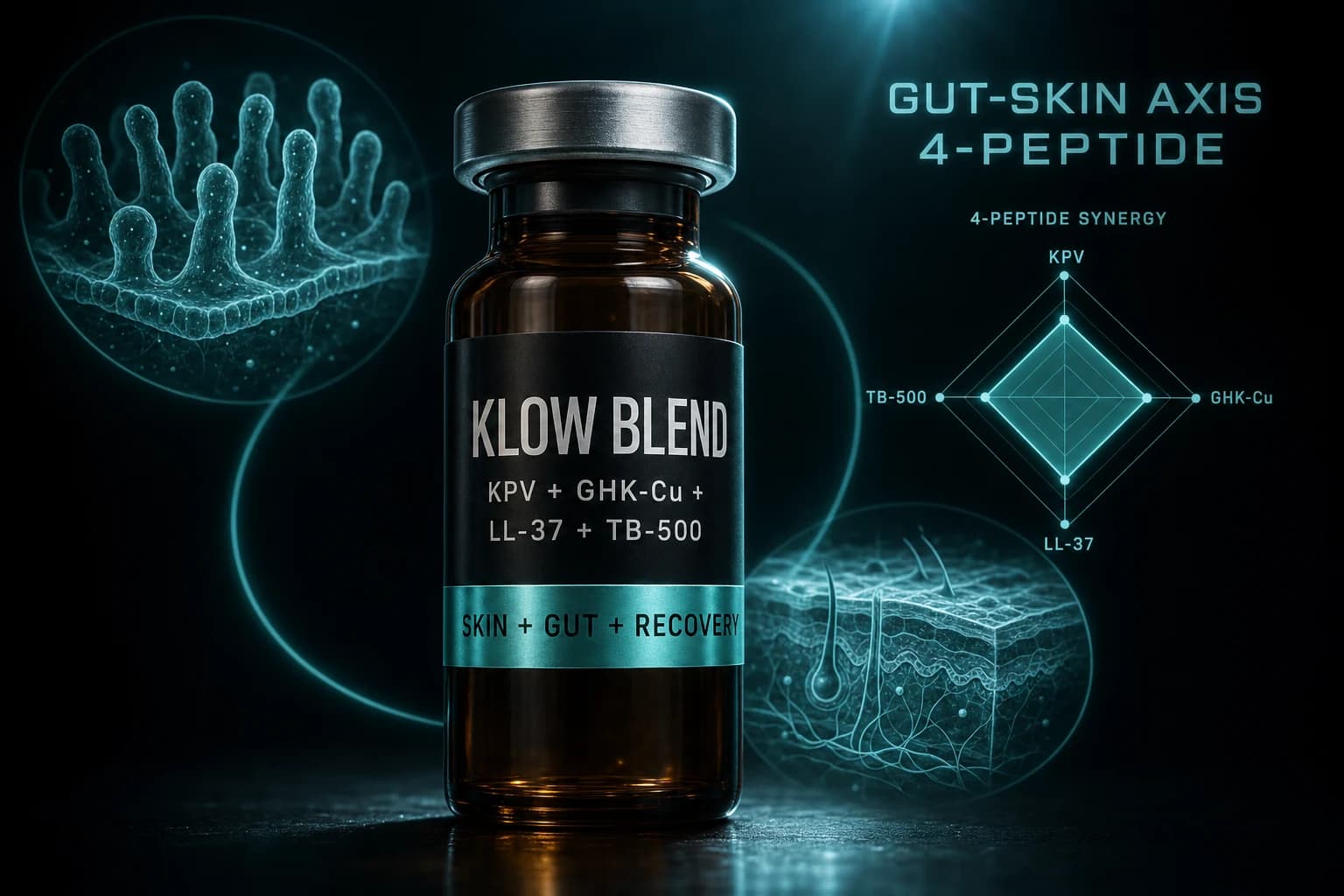
GHK-Cu + BPC-157 + TB-500 + KPV — the premium 4-peptide skin & gut formulation
Price
$180
Compounds
4 peptides
Category
Skin & Anti-Aging
Format
Pre-Mixed Injectable
Overview
KLOW is a four-peptide blend: GHK-Cu, BPC-157, TB-500, and KPV in a single lyophilized vial. The common formulation runs 80 mg total, weighted heavily toward GHK-Cu at 50 mg with 10 mg each of the other three, though ratios differ between suppliers and the vial label is the authority.
The name sits one letter away from GLOW and the two get confused constantly. GLOW is the three-peptide version: GHK-Cu, BPC-157, TB-500. KLOW is that same base with KPV added, and the K is the addition. Worth knowing before ordering either: at least one compounding pharmacy dispenses an unrelated glutathione and ascorbic acid injection under the GLOW name, so a product page that does not list its peptides individually is not necessarily selling what the name implies.
KPV is the reason the fourth letter is there. It is the C-terminal tripeptide of alpha-MSH, Lys-Pro-Val, and it keeps the parent hormone's anti-inflammatory activity while leaving behind the melanogenic effect, which resides elsewhere in the sequence [1].
The mechanism that makes KPV interesting for gut research is transport rather than signaling. It is taken up by PepT1, an intestinal peptide transporter that is upregulated in inflamed colonic tissue, so the molecule concentrates in exactly the tissue that is already inflamed [2]. Orally delivered KPV reduced colitis severity in mouse models when formulated for targeted intestinal release [3].
The other three carry the repair load. BPC-157 drives local angiogenesis and tendon outgrowth [4]. TB-500 is the actin-binding fragment of Thymosin Beta-4, which accelerates wound closure and endothelial cell migration [5]. GHK-Cu handles matrix remodeling and collagen synthesis, and at 50 mg it is the bulk of the vial [6].
Why this combination works
Four compounds, four distinct nodes in the repair network, which is the argument for the blend rather than any one of its parts. BPC-157 acts locally, driving angiogenesis and growth factor expression at the site of interest [4]. TB-500 acts systemically, sequestering G-actin to enable the cell migration that wound closure depends on [5]. GHK-Cu acts structurally, rebuilding collagen and the surrounding matrix [6]. KPV acts on the inflammatory signal itself, suppressing NF-kB-mediated signaling rather than promoting growth [1]. That last one is the genuine difference from GLOW. TB-500 reduces inflammation as a side effect of what it does to actin dynamics. KPV targets the inflammatory cascade directly, and its PepT1 uptake route means it accumulates in inflamed intestinal tissue specifically [2]. Researchers looking at gut-skin axis questions tend to reach for KLOW over GLOW for that reason, not for the extra 10 mg.
What's inside
GHK-Cu
~2-3 hours half-lifeCopper tripeptide driving collagen/elastin synthesis and extracellular matrix remodeling. The skin rejuvenation and structural repair layer.
BPC-157
~4 hours half-lifeLocal tissue repair via VEGF upregulation and angiogenesis. The targeted healing compound for tendon, ligament, and gut tissue.
TB-500
~2-3 hours half-lifeSystemic anti-inflammatory and cell-migration support. Provides the body-wide healing context through actin regulation.
KPV
~1 hour half-lifeAlpha-MSH-derived tripeptide that inhibits NF-κB inflammatory signaling. Researched for gut (IBD), skin inflammation, and immune modulation, without melanogenic effects.
Researched benefits
- Four peptides in one vial: local repair, systemic migration, matrix rebuilding, and inflammatory suppression
- KPV adds direct NF-kB suppression, which the three-peptide GLOW blend does not have
- KPV concentrates in inflamed intestinal tissue via the PepT1 transporter
- GHK-Cu at 50 mg makes this the most matrix-weighted of the pre-mixed blends
- Single reconstitution for a four-compound protocol
- COA-verified purity from Ascension Peptides
Dosing & reconstitution
Research dosing
Research protocols use a single daily subcutaneous draw from the reconstituted vial, with cycles running 4-8 weeks. Because the pre-mixed ratio is heavily weighted toward GHK-Cu, a draw sized to deliver a typical BPC-157 amount will carry roughly five times as much GHK-Cu, which is by design rather than an error. Read the label for the per-compound breakdown before setting draw volume. Site rotation matters more here than with the two-peptide stacks. GHK-Cu stings more on injection than BPC-157 or TB-500, and it is the dominant component by mass.
Reconstitution
Add 2 mL of bacteriostatic water to the 80 mg vial. Inject the water slowly down the vial wall rather than directly onto the powder, then swirl gently until dissolved. Do not shake. Refrigerate immediately and use within 21-28 days. The reconstitution calculator handles the unit math if your vial size differs.
Open reconstitution calculatorFrequently asked
What is KLOW peptide?
KLOW is a pre-mixed research blend of four peptides in one vial: GHK-Cu, BPC-157, TB-500, and KPV. It is typically supplied at 80 mg total, most of that GHK-Cu. The blend covers tissue repair, cell migration, matrix rebuilding, and inflammatory suppression in a single reconstitution.
KLOW vs GLOW: what is the difference?
One peptide. GLOW is GHK-Cu, BPC-157, and TB-500. KLOW is those three plus KPV. If the research interest is skin and structural repair, GLOW covers it. If gut or inflammatory questions are also in scope, KPV is what KLOW adds.
What does KPV do that the other three do not?
It suppresses the inflammatory signal directly rather than promoting repair. KPV inhibits NF-kB-mediated signaling, and it enters cells through PepT1, a transporter upregulated in inflamed intestinal tissue, so it concentrates where inflammation already exists. The other three compounds are growth and remodeling signals.
Is KPV the same as Melanotan?
No, though both trace back to alpha-MSH. KPV is the C-terminal tripeptide fragment and carries the anti-inflammatory activity. Melanotan I and II are analogs built to hit melanocortin receptors and drive pigmentation. KPV does not cause tanning; that activity sits in a different region of the parent sequence.
Why is the reconstituted solution blue?
GHK-Cu is a copper complex, and copper in solution is blue. At 50 mg it is the largest component of an 80 mg KLOW vial, so the tint is pronounced. A clear KLOW solution would be the thing worth questioning.
Can I start on GLOW and move to KLOW?
Yes, and it is a common sequence. The two share the same GHK-Cu, BPC-157, and TB-500 base, so moving to KLOW adds the KPV layer without changing anything underneath it.
Does the copper in KLOW accumulate?
Copper is an essential trace mineral with regulated absorption and excretion, but GHK-Cu delivers it directly and KLOW carries more of it than any other blend in this range. That is the reason protocols favor defined 4-8 week cycles with breaks rather than continuous administration, and the reason stacking it with other copper sources deserves attention.
References
- [1]
Brzoska T, Böhm M, Lügering A, et al. (2010). Terminal signal: anti-inflammatory effects of alpha-melanocyte-stimulating hormone related peptides beyond the pharmacophore.
Advances in Experimental Medicine and Biology · PubMed 21222263
- [2]
Dalmasso G, Charrier-Hisamuddin L, Nguyen HT, et al. (2008). PepT1-mediated tripeptide KPV uptake reduces intestinal inflammation.
Gastroenterology · PubMed 18061177
- [3]
Xiao B, Xu Z, Viennois E, et al. (2017). Orally targeted delivery of tripeptide KPV via hyaluronic acid-functionalized nanoparticles efficiently alleviates ulcerative colitis.
Molecular Therapy · PubMed 28143741
- [4]
Chang CH, Tsai WC, Lin MS, et al. (2011). The promoting effect of pentadecapeptide BPC 157 on tendon healing involves tendon outgrowth, cell survival, and cell migration.
Journal of Applied Physiology · PubMed 21030672
- [5]
Malinda KM, Sidhu GS, Mani H, et al. (1999). Thymosin beta4 accelerates wound healing.
Journal of Investigative Dermatology · PubMed 10469335
- [6]
Pickart L. (2008). The human tri-peptide GHK and tissue remodeling.
Journal of Biomaterials Science, Polymer Edition · PubMed 18644225
Ready to start your research
Get the KLOW Blend from Ascension Peptides
4 compounds, one vial, one reconstitution. COA-verified, US-based, discreet shipping. Use code ENHANCED for 50% off your entire order.
Buy KLOW Blend — $180