At a glance
- Most research peptides are legal to sell labeled 'research use only', not as human drugs.
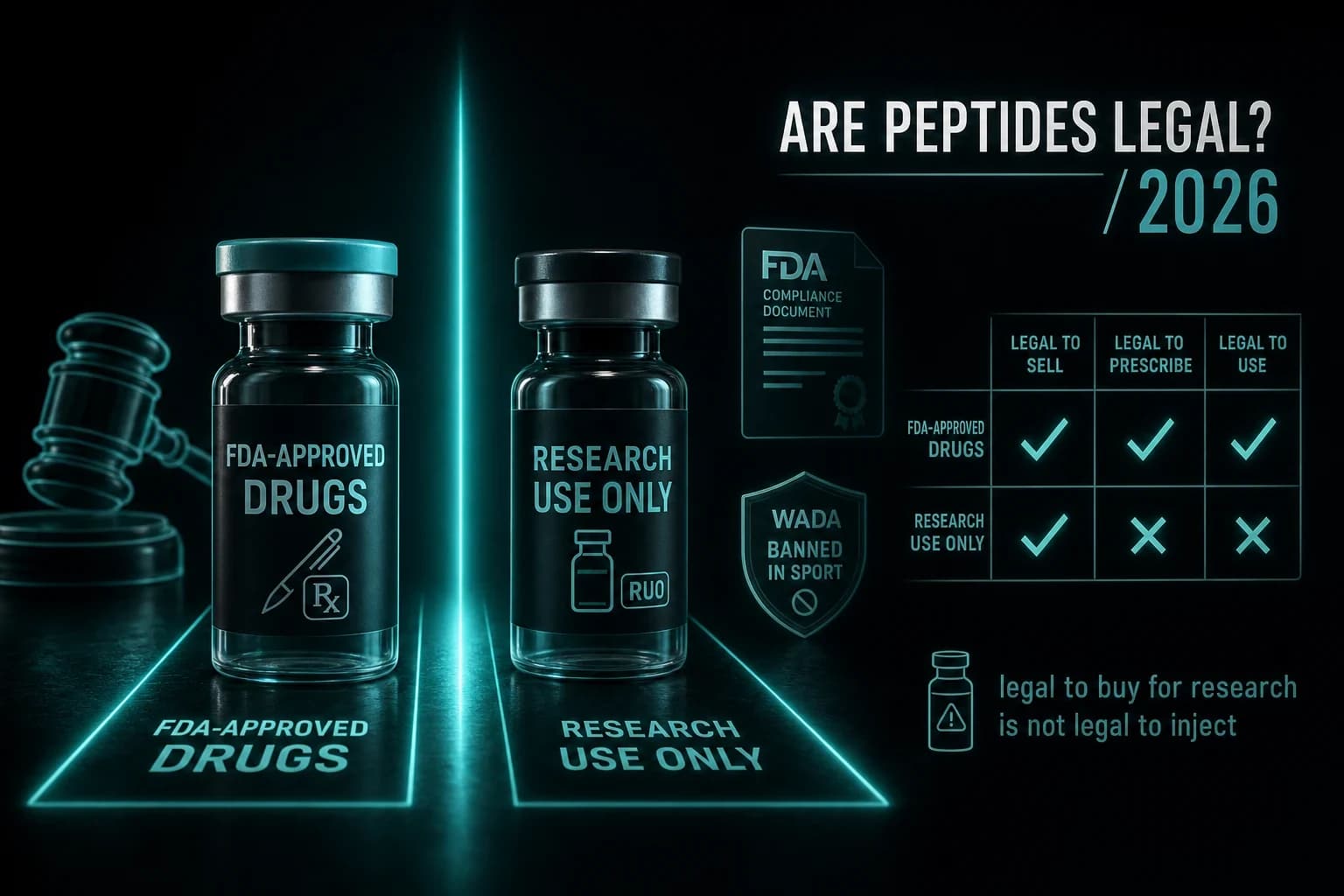
- Legal to buy for research does not mean legal or safe to inject yourself.
- A handful of peptides are FDA-approved drugs; most popular ones are not.
- BPC-157 and TB-500 are banned for competing athletes under WADA rules.
- Legality shifts by country and state, so verify your own jurisdiction.
Type "are peptides legal" into a search bar and you get a hundred confident answers that all contradict each other. One vendor swears everything is perfectly legal. A forum post insists BPC-157 is banned. A clinic says its peptides are FDA-cleared. They cannot all be right, and most of them are answering a different question than the one you actually care about.
Here is the honest version. The word "legal" is doing a lot of quiet work, and the whole confusion collapses once you separate the three questions hiding inside it: legal to sell, legal to prescribe, and legal to use. A compound can sit in a completely different bucket for each one. That is not a loophole. It is just how drug law is built.
This guide walks the 2026 framework as it actually stands, keeps it neutral about the law, and points you toward the parts that matter for your own decisions. It is not legal advice, and your jurisdiction has the final word.
The one distinction that explains everything
Nearly every peptide falls into one of two legal worlds.
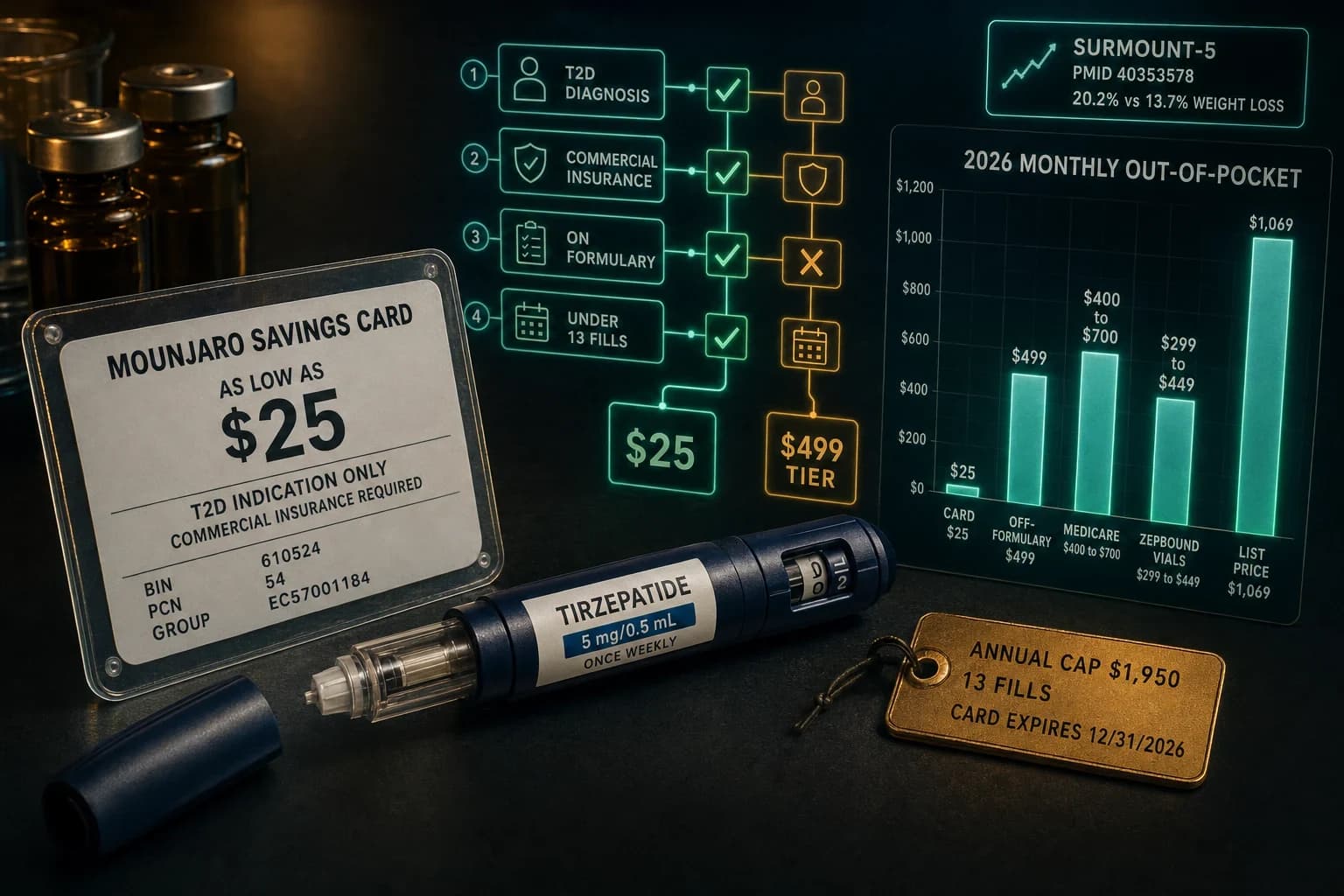
World one: FDA-approved drugs. A small set of peptides have run the full clinical gauntlet, Phase 1 through Phase 3, and earned FDA approval for a specific medical use. Semaglutide (Ozempic, Wegovy, Rybelsus) and tirzepatide (Mounjaro, Zepbound) are the household names, both GLP-1 receptor agonists approved for type 2 diabetes and obesity, and as of 2026 for metabolic dysfunction-associated steatohepatitis too. Tesamorelin (Egrifta) is the only FDA-approved GHRH peptide, cleared for HIV-associated lipodystrophy. These are prescription drugs. Legal to manufacture, legal for a licensed clinician to prescribe, legal for you to use under supervision.
World two: everything else. BPC-157, TB-500, CJC-1295, ipamorelin, epitalon, semax, and the long tail of "research peptides" have not been approved by the FDA for any human use. They have not gone through the review that verifies a drug is safe, effective, and consistently made. That does not make them contraband in the way an illegal narcotic is. It means they legally exist only as research chemicals, which is exactly why every reputable listing stamps them "research use only, not for human consumption."
That label is not marketing fluff or a wink. It is the legal basis on which the product can be sold at all.
Bottom line: Most popular peptides are legal to buy as laboratory research material and simultaneously illegal to market or sell as drugs for humans. Both things are true at once, and collapsing them is where nearly all the confusion comes from.
"Research use only" is a real legal category, not a wink
When a vendor sells a vial labeled "research use only," they are operating in the research-chemical lane. In that lane the material is intended for in-vitro or preclinical laboratory work, and it is not sold with dosing instructions, medical claims, or any suggestion that a human should inject it. The moment a seller tells you it treats an injury or helps you recover, they have stepped over the line into selling an unapproved drug, and that is what draws FDA warning letters.
So the honest reading of "are peptides legal to buy" is: yes, the sale of the research chemical itself is generally legal in the United States, provided nobody is marketing it as a human drug. The honest reading of "is it legal to inject into yourself" is much murkier, and the plain safety answer is a firm no on the "safe" part. Legal to buy for research is not a green light to use.
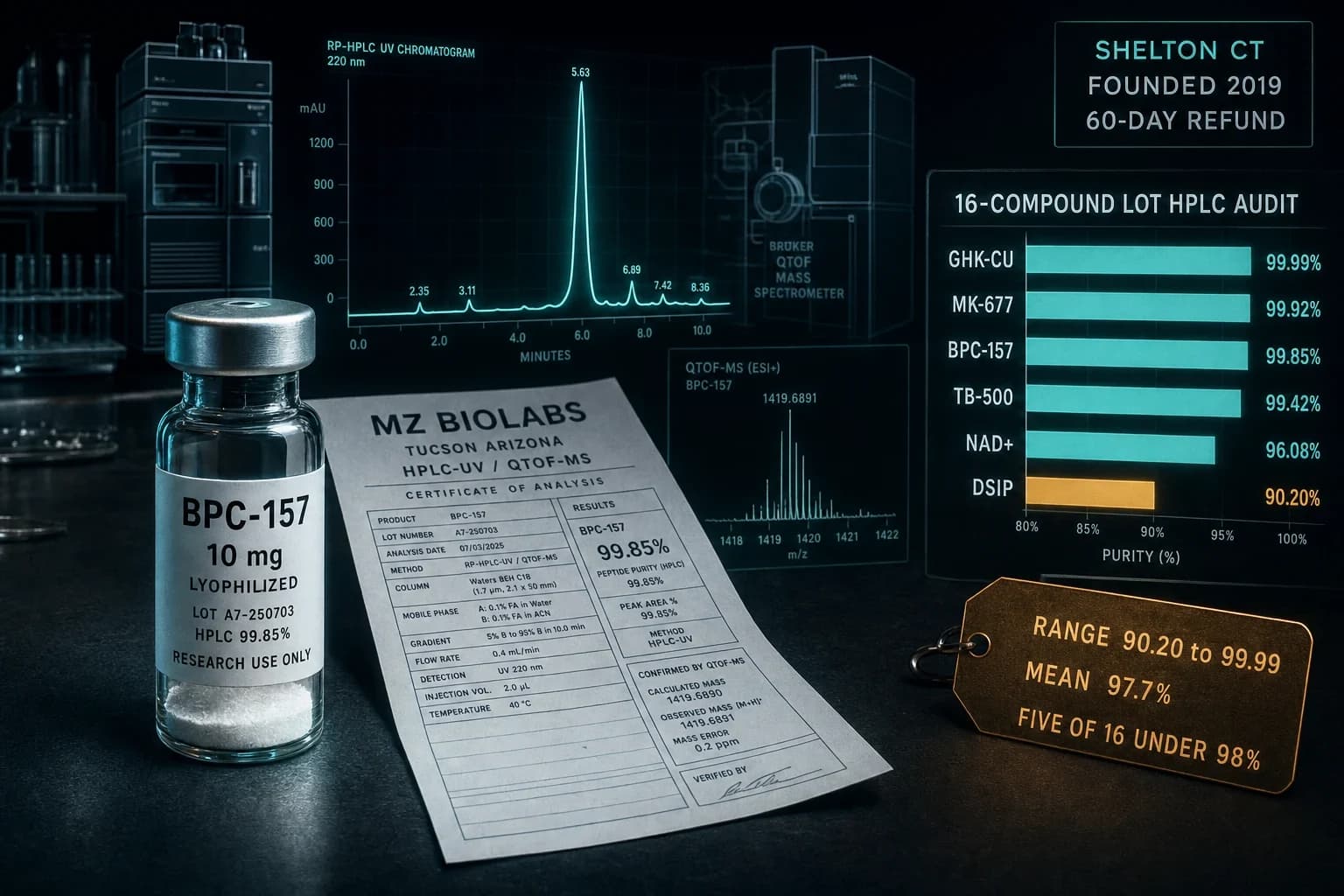
There is a reason this matters beyond semantics. Because these products live outside the drug-quality system, nothing guarantees what is in the vial. Independent testing of gray-market peptides has repeatedly found underdosed material, wrong compounds, and contamination. We go deep on why the supply chain is the way it is in our breakdown of the peptide gray-market sourcing truth, and it is the single biggest reason a third-party certificate of analysis is non-negotiable before anything enters your life.
Where BPC-157 actually sits in 2026
BPC-157 deserves its own paragraph because its status genuinely moved this year, and a lot of older articles are now wrong.
In late 2023 the FDA placed BPC-157 into Category 2 of the 503A bulks list, the "substances with safety concerns" bucket, which effectively barred compounding pharmacies from making it for patients. That is the source of the widespread "BPC-157 is banned" claims. But effective April 23, 2026, BPC-157 came off that Category 2 list, and it is one of seven peptides the Pharmacy Compounding Advisory Committee is reviewing at its July 23-24, 2026 meeting to decide whether it can return to the compounding pathway.
So is BPC-157 legal? As a research chemical, it is generally sold legally under research-use labeling, same as before. As a compounded prescription drug, its path is being actively re-litigated in 2026 and is not settled. As an FDA-approved drug, it is not one, and never has been. Three answers, one molecule. Check the current PCAC outcome rather than trusting any article, including this one, as the last word.
The GLP-1 situation: legal drug, contested shortcut
GLP-1s are the clearest case of the approved-drug world, and also the messiest enforcement story, because demand outran supply.
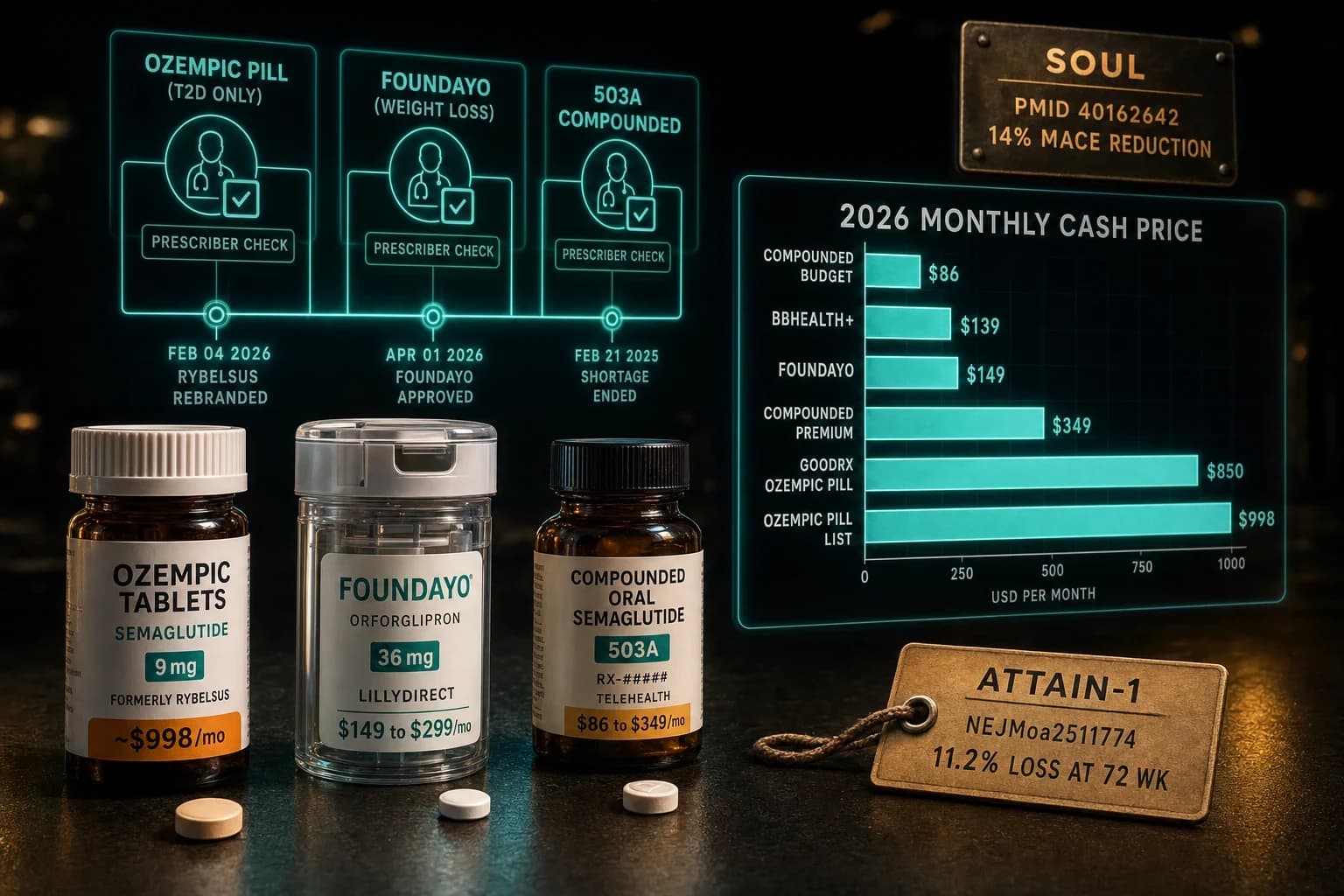
During the shortage years, compounding pharmacies were permitted to make semaglutide and tirzepatide to fill the gap. As supply stabilized, the FDA moved to close that door. In May 2026 the agency proposed not to include semaglutide, tirzepatide, or liraglutide on the 503B bulks list, the list that governs what outsourcing facilities may compound in bulk, citing no clinical need now that the branded products are available. The comment period on that proposal was extended to July 30, 2026. The FDA has pointed to hundreds of adverse-event reports tied to compounded GLP-1s, many from dosing errors, as part of its reasoning.
The practical takeaway: the safe and legal way to access a GLP-1 is a genuine prescription through a supervised telehealth or in-person clinic, using either the branded drug or a legitimately compounded version where still permitted. If you want the full picture of that legal route, we keep it current in our guide to compounded semaglutide online. Anything sold to you as "semaglutide, research use only" is not the supervised medical route, and it is not the same product a pharmacy dispenses.
The athlete question: WADA does not care that it is legal to buy
If you compete in any drug-tested sport, "legal to buy" is irrelevant to you. Anti-doping bodies write their own rules, and they are stricter than criminal law.
Under the World Anti-Doping Agency's 2026 Prohibited List, BPC-157 is banned as an S0 unapproved substance, and TB-500 is prohibited under S2 (peptide hormones, growth factors, and related substances). Many other research peptides fall under the same categories, prohibited both in and out of competition. Because BPC-157 has no approved human therapeutic use, it does not even qualify for a Therapeutic Use Exemption. A substance being sold openly online has zero bearing on whether it will end an athlete's season.
The framework at a glance
| Category | Legal status (US, 2026) | Notes |
|---|---|---|
| FDA-approved peptide drugs (semaglutide, tirzepatide, tesamorelin, liraglutide) | Legal as prescription drugs | Require a prescription; supervised use only; some GLP-1 compounding being phased out |
| Research peptides (BPC-157, TB-500, CJC-1295, ipamorelin, epitalon) | Generally legal to sell as "research use only" | Not FDA-approved for human use; not legal to market as drugs; injecting is off-label at your own risk |
| Compounded peptides via 503A/503B pharmacy | Depends on the bulks list | Actively shifting in 2026; BPC-157 off Category 2 as of April, under PCAC review July 23-24 |
| Peptides for tested athletes | Prohibited under WADA regardless of purchase legality | BPC-157 (S0) and TB-500 (S2) banned in and out of competition; no TUE for BPC-157 |
| Non-US jurisdictions | Varies widely | Some countries treat research peptides as prescription-only or controlled; verify locally |
Legal is not the same as safe
This is the part vendors skip. The two most common ways "legal" gets stretched are pretending research-chemical legality means a product is fit for injection, and pretending that because a peptide is not a scheduled substance, quality is guaranteed. Neither follows.
Because research peptides sit outside the drug-manufacturing system, purity and dosing are entirely on the seller's word unless independently verified. A vial can be legal to sell and still be underdosed, mislabeled, or contaminated. This is why we built a searchable peptide reference library and maintain independent lab-test results on real products, so the quality question is answered with data rather than a label. If you are trying to separate the credible suppliers from the rest, our roundup of the most legit peptide vendors of 2026 applies the same standard.
Warning: "Legal to buy for research" is not "legal, approved, or safe to inject into a human." Those are different sentences with different consequences. Treat any product with no third-party COA as an unknown, no matter how legal the checkout page looks.
How to stay on the right side of all this
You do not need a law degree to make sound decisions here. A few principles cover most of it.
Know which world your peptide is in before anything else. If it is an FDA-approved drug like a GLP-1, the legitimate path is a real prescription through a supervised clinic, not a research vial. If it is a research peptide, accept that human use is off-label and unstudied, and that the legal sale of the chemical says nothing about what is inside it.
Demand proof of what you are buying. A recent, third-party certificate of analysis matched to the specific batch is the floor, not a bonus. If a seller cannot produce one, the "legal" question is moot because you do not actually know what the substance is.
Verify your own jurisdiction. Laws differ by country and by US state, they change, and 2026 has already proven how fast the compounding rules in particular can move. What is described here is a general framework, not a ruling for your situation.
If you are sourcing research-grade material and want quality you can actually check, we point readers to COA-backed suppliers like Ascension Peptides (code ENHANCED), and cross-reference everything against our own lab-test data. For GLP-1s specifically, the legal, supervised telehealth route is the one worth taking. The goal is not to find the loophole. It is to know exactly which world you are operating in, and to buy only what you can verify.
This article is for general informational purposes only. It is not legal advice and it is not medical advice. Regulations vary by country and by state and change over time, and nothing here should be relied on as a statement of the law in your jurisdiction. Consult a qualified attorney for legal questions and a licensed healthcare provider before using any peptide or medication. Always verify the current regulatory status yourself before making any decision.