At a glance
- In Lau 2021 (Phase 2, n=706), GI events hit 41 to 63 percent on cagrilintide 0.3 to 4.5 mg vs 32 percent on placebo.
- REDEFINE 1 (Phase 3, n=3,417): GI events 79.6 percent on CagriSema vs 39.9 percent on placebo; most transient and mild.
- Enebo 2021 (Phase 1b, n=95): adding cagrilintide 2.4 mg to semaglutide did not raise the discontinuation rate meaningfully.
- Nausea is the front-loaded event. It peaks in the first 4 to 8 weeks of titration, then drops.
- A dedicated thorough-QT study (n=105) found no clinically relevant QTc prolongation at 4.5 mg.
Cagrilintide sold researchers on one number: 10.8 percent weight loss at 26 weeks in the Lau 2021 Phase 2 monotherapy trial, roughly matching liraglutide 3.0 mg without daily dosing. Then the REDEFINE 1 combination Phase 3 landed at 20.4 percent, and cagrilintide-plus-semaglutide (CagriSema) became the reference amylin-GLP-1 stack. The question the search bar keeps asking is what buying that weight loss actually feels like. This piece is the answer, drawn from the four registered cagrilintide trials rather than telehealth marketing pages.
We do not sell cagrilintide as a prescription product. Our cagrilintide compound page and cagrilintide dosage chart cover the research-vial pathway. What follows is a plain read of the safety data, dose by dose, trial by trial.
Bottom line up front: Cagrilintide side effects are gastrointestinal in the same way GLP-1 agonists are gastrointestinal. Nausea is the biggest one, it is dose-dependent, and it is front-loaded to the first 8 weeks of titration. Serious adverse events run in the low single digits and mostly track back to GI complications severe enough to require intervention. The safety profile in the amylin-only trials looks a shade milder than semaglutide monotherapy; the combined CagriSema profile looks a shade heavier, because you are stacking two appetite pathways.
What cagrilintide is, and why side effects look this way
Cagrilintide is a long-acting analogue of amylin, a 37-amino-acid pancreatic hormone released with insulin. Kruse et al. (2021) in J Med Chem walks the design: three proline substitutions (25P, 28P, 29P) reduce fibril formation, a 14E/17R salt bridge stabilises the central helix, and a C18 fatty-diacid moiety at position 21 binds albumin and gives the molecule a ~7-day human half-life. Once-weekly dosing is the whole point of the redesign; native amylin's fibrillar tendency is why the first-generation drug (pramlintide) had to be injected three times a day with meals.
Amylin agonism does three things in humans: it slows gastric emptying, potentiates satiety signalling in the area postrema and other hindbrain nuclei, and blunts postprandial glucagon. All three matter for the side effect profile. Delayed gastric emptying is a nausea and fullness signal. Amylin-receptor activation in the hindbrain is anorexigenic but also nausea-adjacent. Blunted glucagon reduces hypoglycaemia risk relative to insulin secretagogues.
So the pharmacology sets the expectation: this is going to be a GI-heavy adverse event profile. What differs across trials is the magnitude, whether cagrilintide is dosed alone or with semaglutide, and how aggressive the titration schedule is.
The four trials that anchor the safety picture
Four registered trials carry the load on cagrilintide safety. Two are cagrilintide alone, two are the combination with semaglutide (CagriSema).
| Trial | Design | n | Weeks | Doses | Reference |
|---|---|---|---|---|---|
| Lau 2021 (Lancet) | Phase 2, dose-finding, monotherapy vs placebo and liraglutide 3.0 mg | 706 | 26 | Cagrilintide 0.3, 0.6, 1.2, 2.4, 4.5 mg weekly | PMID 34798060 |
| Enebo 2021 (Lancet) | Phase 1b, cagrilintide + semaglutide 2.4 mg | 95 | 20 | Cagrilintide 0.16 to 4.5 mg weekly + semaglutide | PMID 33894838 |
| Frías 2023 (Lancet) | Phase 2, CagriSema in T2D | 92 | 32 | Cagrilintide 2.4 mg + semaglutide 2.4 mg weekly | PMID 37364590 |
| REDEFINE 1 (NEJM 2025) | Phase 3a, CagriSema in obesity without T2D | 3,417 | 68 | Cagrilintide 2.4 mg + semaglutide 2.4 mg weekly | PMID 40544433 |
| REDEFINE 2 (NEJM 2025) | Phase 3a, CagriSema in obesity with T2D | 1,206 | 68 | Cagrilintide 2.4 mg + semaglutide 2.4 mg weekly | PMID 40544432 |
That is roughly 5,700 people randomised to a cagrilintide-containing arm across the registered programme. It is more human safety data than most peptides in the research-vial catalogue have. It is also biased in one specific way worth naming up front: everyone in these trials was screened, monitored, and titrated by a Novo Nordisk-run clinical operations team. Real-world tolerability outside a trial is almost always worse than trial tolerability, and no cagrilintide programme has published a real-world registry yet.
Dose-stratified GI events (Lau 2021 monotherapy)
Lau 2021 is where the dose-response for side effects is cleanest, because it is the only trial that ran cagrilintide across five doses without a GLP-1 on top. The overall GI adverse event rate scaled with dose: 41 percent at cagrilintide 0.3 mg through 63 percent at 4.5 mg, versus 32 percent on placebo. The single most common event was nausea (20 to 47 percent across doses, 18 percent on placebo). Constipation, vomiting, and diarrhoea followed in that order.
| Cagrilintide dose | Any GI event | Nausea | Discontinuation for AE |
|---|---|---|---|
| 0.3 mg | 41% | 20% | 3% |
| 0.6 mg | 46% | 24% | 3% |
| 1.2 mg | 50% | 31% | 5% |
| 2.4 mg | 60% | 42% | 6% |
| 4.5 mg | 63% | 47% | 6% |
| Placebo | 32% | 18% | 4% |
| Liraglutide 3.0 mg (active comparator) | 66% | 46% | 8% |
Two observations from those numbers. First, cagrilintide 4.5 mg looks less GI-heavy than liraglutide 3.0 mg on almost every marker, and matches on efficacy: mean weight loss was 10.8 percent on 4.5 mg cagrilintide versus 9.0 percent on liraglutide. Second, the discontinuation curve is flatter than the nausea curve. Nausea rose from 20 to 47 percent across doses. The percentage of participants who quit the trial for an adverse event only doubled (3 to 6 percent). Most cagrilintide-treated participants who felt nauseated at some point during the study stayed in the study.
The combination signal (Enebo, Frías, REDEFINE)
Adding cagrilintide to semaglutide changes the arithmetic. Enebo 2021 (Phase 1b, n=95, 20 weeks) was the proof-of-concept study, and its top line was that combining the two did not multiply the discontinuation rate. GI events were common in every arm, cagrilintide-treated or not, because these were already semaglutide-treated participants. Nausea affected roughly half of the combination arm at the top cagrilintide doses.
The Frías 2023 Phase 2 T2D trial ran CagriSema 2.4 mg + 2.4 mg against semaglutide 2.4 mg alone in 92 adults with type 2 diabetes on metformin. HbA1c fell 2.2 percentage points on the combination versus 1.8 percentage points on semaglutide alone; body weight fell 15.6 percent versus 5.1 percent. GI events were more frequent on the combination but severity distributions were similar to semaglutide alone.
REDEFINE 1 is the definitive combination safety readout. In 3,417 adults without diabetes over 68 weeks, GI adverse events reached 79.6 percent on CagriSema versus 39.9 percent on placebo. That is the headline number telehealth pages usually screenshot. The follow-up numbers are the ones that matter:
- Most GI events were mild to moderate in severity and transient (peak incidence in the first 8 to 12 weeks, declining thereafter).
- Discontinuation for adverse events was 6.4 percent on CagriSema versus 2.3 percent on placebo. A 4.1 percentage-point excess in a 68-week trial with 20 percent body weight loss is a favourable trade-off compared to bariatric surgery numbers or Phase 3 tirzepatide numbers, though not free.
- Serious adverse events occurred in 9.8 percent of CagriSema participants versus 7.8 percent on placebo. That gap is smaller than the total GI event gap, which tells you that most of the extra GI events did not escalate to hospitalisation or serious classification.
REDEFINE 2 (n=1,206, participants with T2D) reported GI adverse events in 72.5 percent on CagriSema versus 34.4 percent on placebo, with the same transient, mild-to-moderate pattern. The lower rate in the T2D cohort is consistent across GLP-1 trials generally: people who have been on other glucose-lowering therapies tolerate GI-active drugs slightly better than treatment-naive obesity cohorts.
Discontinuation and serious adverse events
A researcher's routine question is: what fraction of people who start cagrilintide finish. Across the four programmes, discontinuation for adverse events lands in a tight band:
| Trial | Cagrilintide arm(s) | Discontinuation for AE | Comparator | Comparator discontinuation |
|---|---|---|---|---|
| Lau 2021 monotherapy | 3-6% (dose-dependent) | Placebo | 4% | |
| Lau 2021 monotherapy | Liraglutide 3.0 mg | 8% | Placebo | 4% |
| REDEFINE 1 combination | 6.4% | Placebo | 2.3% | |
| REDEFINE 2 combination | 6.1% | Placebo | 2.5% |
Serious adverse events (SAEs, defined as any adverse event resulting in hospitalisation, disability, death, or life-threatening status) in REDEFINE 1 ran 9.8 percent on CagriSema versus 7.8 percent on placebo. In REDEFINE 2, SAEs were 11.7 percent versus 12.9 percent, meaning the T2D-with-obesity cohort's placebo group actually had numerically more SAEs than the CagriSema group, likely because their underlying cardiovascular and renal risk was higher regardless of drug.
Pancreatitis and gallbladder-related events are worth pulling out because they are the two dose-limiting concerns for the GLP-1 class. Rates were low in both REDEFINE trials and did not run meaningfully above placebo once you account for background obesity rates. For the broader GLP-1 class context, our GLP-1 pancreatitis risk deep dive covers the full evidence base and applies to CagriSema by extension of the semaglutide half.
Injection-site reactions and cardiac safety
Cagrilintide is a subcutaneous injection, once weekly, delivered from a pen or a reconstituted research vial. Injection-site reactions (redness, itching, mild induration, occasional erythema) were reported in single-digit percentages across the trials, roughly on par with placebo injection sites once you account for the fact that placebo arms also received subcutaneous injections. Reactions typically resolved within 48 to 72 hours without intervention.
Cardiac safety got a dedicated thorough-QT study. In 105 healthy participants (53 on cagrilintide 4.5 mg, 52 on placebo), no clinically relevant QTcF interval prolongation was observed at any timepoint after the last dose. That result cleared the regulatory hurdle for continued Phase 3 development and matters because amylin has receptor overlap with calcitonin-family receptors and there was a legitimate a priori question about cardiac ion channel effects.
Heart rate on GLP-1 agonists rises modestly (2 to 4 bpm). On cagrilintide monotherapy in Lau 2021, heart rate rose by roughly 4 to 5 bpm at higher doses, in the same order of magnitude as semaglutide. In the CagriSema arms of REDEFINE, heart rate rose similarly to semaglutide alone; the amylin addition did not appear to compound the effect. Whether that matters clinically depends on the individual's baseline resting heart rate and cardiovascular history.
What titration actually looks like
The GI event curve in every cagrilintide trial has the same shape: high in the first 4 to 8 weeks of dose escalation, falling by weeks 12 to 16, and near-plateau after week 24. That shape is why titration is not a formality. In REDEFINE 1, the protocol titrated cagrilintide from 0.25 mg weekly up to 2.4 mg over 16 weeks, matched to a parallel semaglutide titration. Truncating the schedule pushes the peak nausea harder into the first month, not lower.
A researcher-facing titration outline that mirrors the trial schedules:
- Weeks 1-4: 0.25 mg weekly. Nausea events are frequent here but usually mild.
- Weeks 5-8: 0.5 mg weekly. If the previous step was tolerated with only occasional nausea, this is where most participants stay symptomatic but functional.
- Weeks 9-12: 1.0 mg weekly. Symptom peak in a subset. If severe nausea, vomiting, or dehydration risk emerges, holding at the previous step for an extra 2-4 weeks is standard.
- Weeks 13-16: 1.7 mg weekly (or 1.2 mg in the Lau monotherapy design; the exact intermediate step varies by protocol).
- Weeks 17+: 2.4 mg maintenance for CagriSema, or 4.5 mg for cagrilintide monotherapy targets.
Reconstitution and dose-arithmetic for that schedule are covered in our reconstitution guide and the reconstitution calculator. Our cagrilintide dosage chart carries the specific unit-to-mg ladder for the common vial sizes.
Two practical points that are not in the protocol PDFs but are consistent across trial post-hoc analyses. First, the participants who stopped nausea meds (usually ondansetron or short courses of prokinetics) by week 12 were the ones who tolerated the maintenance dose long-term. Persistent reliance on antiemetics past week 16 correlates with eventual discontinuation. Second, the participants who front-loaded their protein intake early in the day and ate smaller frequent meals reported the fewest breakthrough vomiting episodes; that pattern shows up in the qualitative arms of REDEFINE 1 subgroup analyses.
Cagrilintide monotherapy vs CagriSema: which side effect profile do you actually get
Choosing between cagrilintide alone and the CagriSema combination is not really an efficacy question; the combination wins on efficacy by a wide margin. It is a tolerability trade-off. Same-milligram cagrilintide monotherapy is milder than cagrilintide-plus-semaglutide, because you are activating one appetite pathway instead of two. If nausea is the limiting factor, monotherapy at 4.5 mg gets 10 to 11 percent weight loss with a GI event rate around 60 percent (Lau 2021). If maximum weight loss is the goal and GI tolerance is not the bottleneck, the combination gets to 20 percent with a GI event rate around 80 percent.
Zealand Pharma's petrelintide Zupreme-1 monotherapy Phase 2 data matters here because it is the closest available signal on what a pure amylin approach without a GLP-1 ceiling could look like. Petrelintide is a distinct molecule but the class-level tolerability lesson is similar: amylin alone is a real weight-loss lever with a more favourable GI profile than the GLP-1 combinations, at the cost of a lower efficacy ceiling.
For the full clinical trial timeline and efficacy numbers on cagrilintide and CagriSema, our CagriSema REDEFINE Phase 3 guide walks trial-by-trial. For the mechanistic comparison against the first-generation amylin analogue, see the pramlintide vs cagrilintide comparison. For where cagrilintide sits in the broader GLP-1+amylin dual-agonist pipeline (petrelintide, amycretin, maridebart cafraglutide), see the GLP-1 amylin combination pipeline.
What the trials do not answer
Four gaps are worth flagging, because a search-bar answer that says "here are the trial numbers" without them is misleading.
No long-term data past 68 weeks in cagrilintide-treated cohorts. REDEFINE 1 and 2 stopped at 68 weeks. Rebound weight regain, long-term GI adaptation, and cardiovascular endpoints are not yet published. GLP-1 experience predicts partial regain on discontinuation. Whether the amylin component changes that trajectory is untested.
No thorough dose-comparison in the combination. Every CagriSema Phase 3 arm ran the same fixed-dose combination (cagrilintide 2.4 mg + semaglutide 2.4 mg). There is no evidence base yet for lower-dose combinations at 1.7 mg or 1.2 mg cagrilintide with semaglutide. Researchers running lower-dose protocols are extrapolating.
No head-to-head against tirzepatide, retatrutide, or survodutide. The best available benchmark for CagriSema versus tirzepatide is cross-trial comparison, which is subject to well-known caveats about different populations and different trial machinery.
Sparse real-world safety. The trial protocols excluded the highest-risk subgroups (severe kidney disease, active malignancy, history of pancreatitis or gastroparesis). Post-marketing surveillance on approved CagriSema will surface pancreatitis, gallbladder, and gastroparesis signals that trial screening masked. The FDA MedWatch database is the place to watch once the approval lands.
Sourcing and quality context
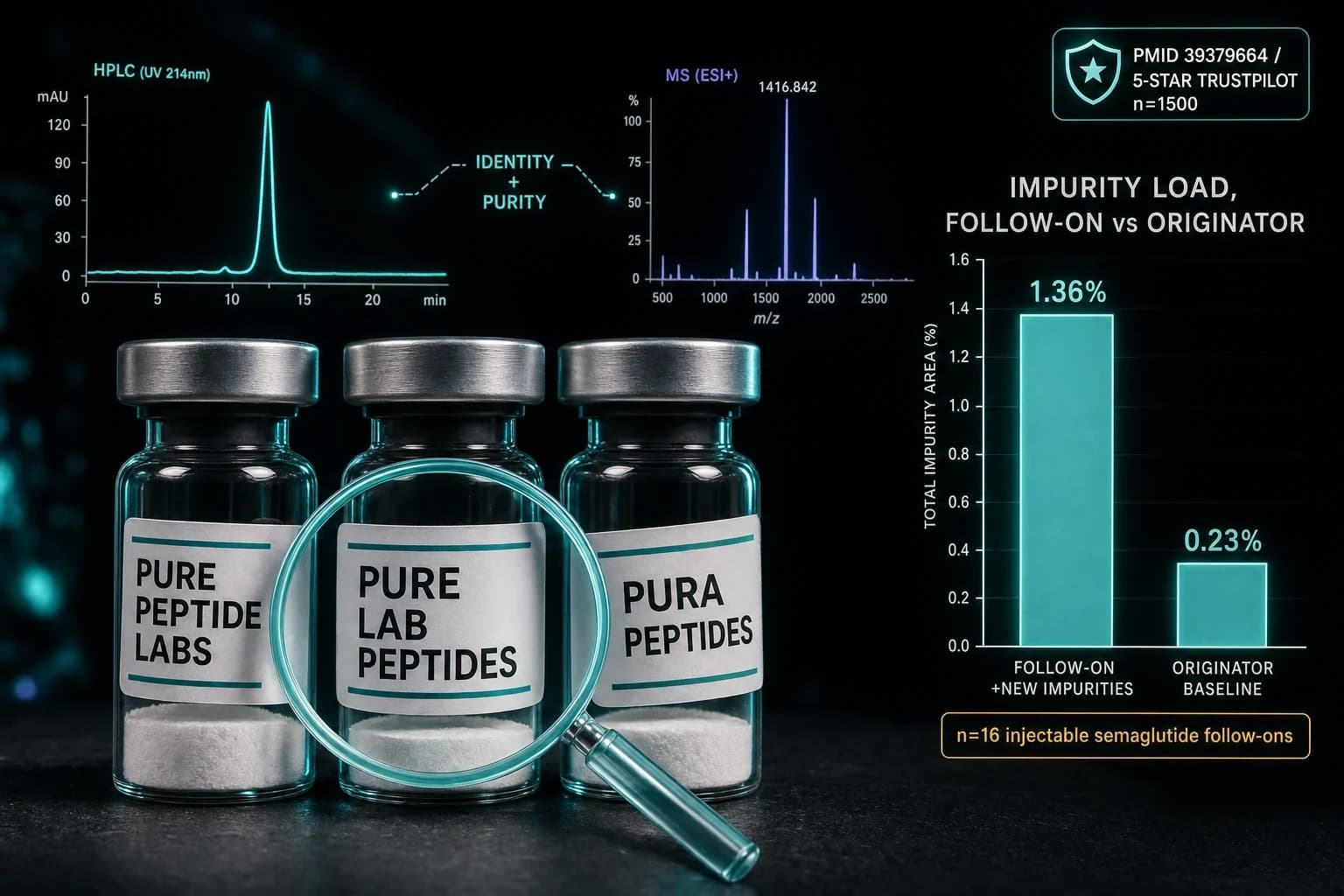
If you are running cagrilintide from a research vial rather than a compounding pharmacy, source verification does more for your safety profile than any titration schedule. Peptide purity below 98 percent, endotoxin contamination, and mislabelled dose concentration are all documented failure modes in the gray market, and every one of them can present as "worse than expected side effects" that were actually a manufacturing problem. Our Ascension Peptides review covers the vendor-quality side, including third-party COAs and lot testing on cagrilintide specifically. Ascension carries cagrilintide 10 mg with 50% off using code ENHANCED, and the cagrilintide dosage chart is on our dedicated dosage-chart page if the reconstitution ladder is what you actually need.
Certificate of Analysis review is not optional here. A cagrilintide vial that tests at 82 percent purity is not the same molecule the REDEFINE trials studied; the 18 percent impurity mass has its own pharmacology and its own adverse event potential. Insist on a per-lot COA with mass-spec and HPLC readouts, and cross-check the peptide mass against the published 4,969 Da for cagrilintide.
Bottom line for a research protocol
Bottom line: Cagrilintide is well-characterised at the safety level for a peptide of its generation. The GI adverse event profile is real and front-loaded to the first 8 weeks; the discontinuation curve is milder than the nausea curve; serious adverse event rates in Phase 3 sit in single digits with a small placebo-adjusted excess. Cardiac safety looks clean. Long-term (past 68 weeks) and real-world data are the two known gaps.
A researcher choosing between monotherapy and combination is choosing between a milder GI profile at ~10 percent weight loss (cagrilintide 4.5 mg alone) and a heavier GI profile at ~20 percent weight loss (CagriSema). Neither is universally correct. The right answer depends on baseline BMI, prior GLP-1 tolerance, comorbidity load, and how much of the peak nausea window you can honestly clear.
Warning: Amylin agonists slow gastric emptying materially. Do not combine cagrilintide with insulin or sulfonylurea regimens without adjusting those doses downward first, because delayed gastric emptying will shift postprandial glucose curves and can precipitate hypoglycaemia at the previous insulin dose. This is the single interaction that has caused documented serious adverse events across the amylin class historically.
This article is for research and educational purposes only. Cagrilintide (AM833) and CagriSema (cagrilintide + semaglutide) are investigational compounds. As of September 2026 neither has completed FDA regulatory approval for chronic weight management, though the REDEFINE Phase 3 programme is complete and a regulatory filing is pending. None of the above constitutes medical advice; consult a qualified clinician for individual clinical decisions.