At a glance
- Zero published human clinical trials of 5-Amino-1MQ exist as of September 2026.
- Every real "before and after" number in the literature comes from mice, not people.
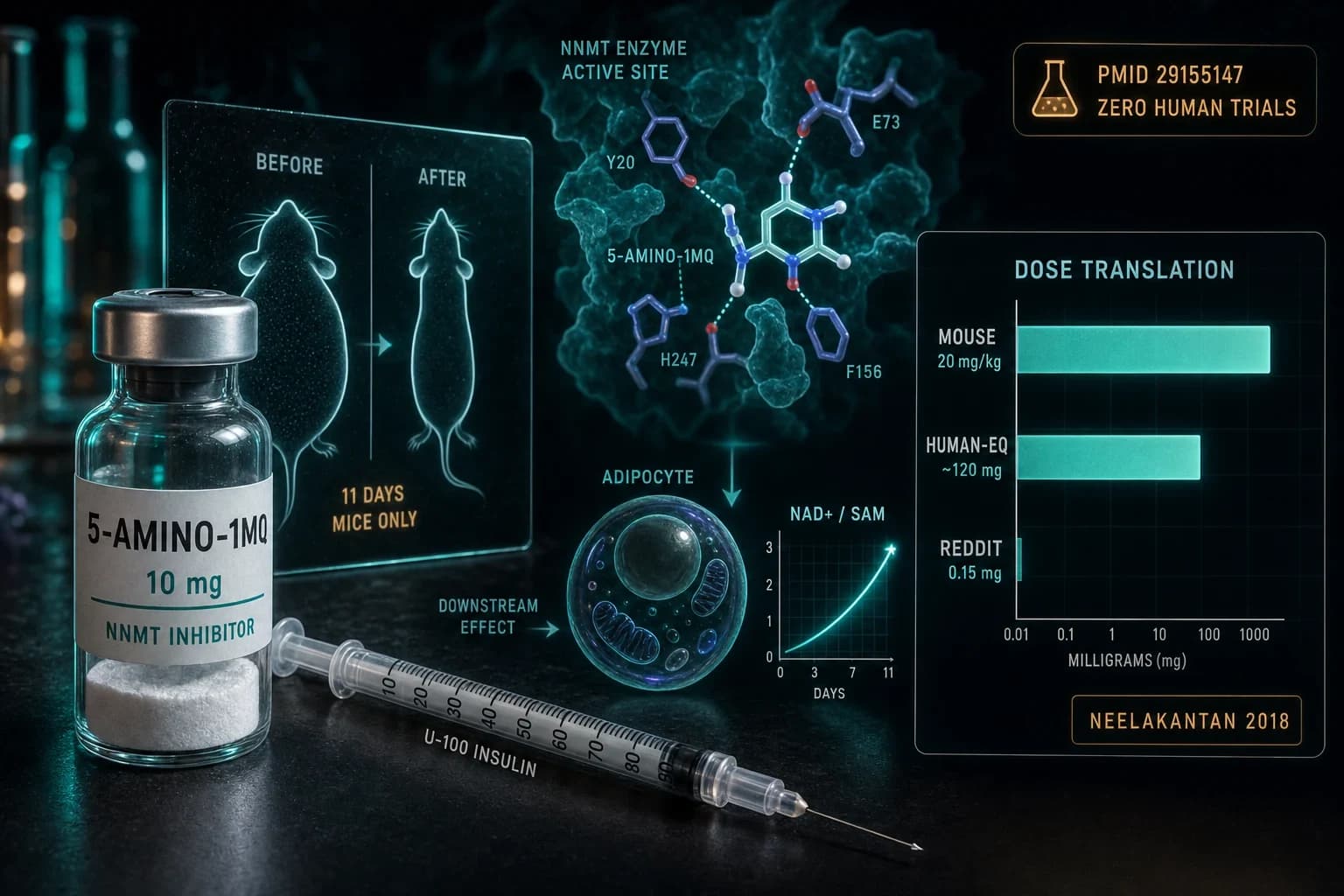
- Neelakantan 2018 (PMID 29155147): 11-day mouse study, ~20 mg/kg/day SC, weight and fat mass dropped with unchanged food intake.
- Medspa marketing timelines of "3-4 weeks to visible fat loss" are extrapolated, not measured in humans.
- Forum reports at 100-150 mcg (a rodent-scale dose) predictably show nothing; effective research doses sit in the low-milligram range.
The awkward truth behind the search phrase
Type "5-amino-1MQ before and after" into a search bar and the first page hands you clinic photos, YouTube thumbnails, and vendor blogs quoting fat-loss timelines to the week. What it does not hand you is a single published human trial. As of September 2026 there is no completed Phase 1, no published pharmacokinetic paper in humans, no registered Phase 2 or 3 result. Every graph, timeline, and body-composition number that carries any scientific weight comes from mice.
That does not automatically make 5-Amino-1MQ useless. It makes the "before and after" question harder than the vendors admit. This piece walks the honest version: what the animal studies actually measured, what the forum reports track, why the medspa timelines are cosmetic-industry math rather than pharmacology, and what a real before-and-after protocol would look like if a researcher wanted one.
For the underlying mechanism and full evidence hierarchy, see our 5-Amino-1MQ NNMT inhibitor research review. This companion piece stays focused on the "what will I actually see" question buyers keep typing.
Bottom line up front: No published human trial reports body-composition change from 5-Amino-1MQ. The rodent evidence is real but does not translate one-to-one to a 3-4 week photo timeline. Treat any "before and after" claim as anecdote unless it names a dose in milligrams, a duration, a diet, and a training program, and even then, ask whether the same person would have gotten the same result on caloric restriction alone.
What the animal studies actually measured
The evidence base for 5-Amino-1MQ is four preclinical papers plus follow-on mechanistic work. All four moved biology in a consistent direction. None of them measured what a human buyer usually means by "before and after."
Kraus et al. (2014), published in Nature, is the foundational paper. This one did not use 5-Amino-1MQ. The team used adipose-tissue antisense oligonucleotides to knock down NNMT in high-fat-fed mice. Knockdown animals gained less weight than controls despite eating the same food, showed higher cellular NAD+ and SAM in fat, and improved insulin sensitivity. This paper set the rationale for pharmacologic NNMT inhibition. It is a mechanism paper, not a before-and-after.
Neelakantan et al. (2018) in Biochemical Pharmacology is the paper the marketing photos borrow their numbers from. The team screened quinolinium analogs, landed on 5-Amino-1MQ as the lead compound, and ran diet-induced-obese (DIO) mice on roughly 20 mg/kg/day subcutaneously for 11 days. Body weight fell versus vehicle controls. White adipose mass dropped. Adipocyte size shrank. Food intake did not change.
That last detail is the finding vendors put in bold. It is also the finding that requires the most caveats. "Food intake unchanged over 11 days in DIO mice" is a mechanism signal, not a human weight-loss claim.
Neelakantan et al. (2019), also in Biochemical Pharmacology, moved the compound into aged muscle. 24-month-old mice received 5 or 10 mg/kg NNMTi for 1-3 weeks after tibialis anterior injury. Muscle stem cell proliferation and fusion increased, cross-sectional area of regenerating fibers grew nearly 2-fold, and functional torque recovered closer to young-adult levels. This is a regeneration paper, not a fat-loss one, but it is the study behind the "muscle-preservation" marketing bullet.
Brachs et al. (2019) in Diabetes tested NNMT knockout mice on obesity-inducing diets. Insulin sensitivity improved. Glucose tolerance did not. Effects were sex- and diet-specific. This one matters because it clips the "5-Amino-1MQ fixes glucose" claim you will see repeated on medspa sites: genetic knockout, the strongest possible NNMT knockdown, did not shift glucose tolerance.
Dimet-Wiley et al. (2022) in Scientific Reports added the combination angle. DIO mice on 5-Amino-1MQ plus a switch to a low-fat diet lost adiposity and normalized body weight to age-matched lean controls, an outcome the diet switch alone did not produce in the same time frame. The paper also flagged a distinct cecal microbiome signature. This is the study most honestly cited as "5-Amino-1MQ accelerates fat loss," and even here the effect is measured in mice on a controlled low-fat diet, not free-living humans on a normal Western diet.
The dose-translation trap the marketing exploits
The single largest reason "5-Amino-1MQ before and after" content is misleading is a dose-translation error the vendor blogs never surface. The Neelakantan 2018 paper dosed DIO mice at 20 mg/kg/day. The 2019 muscle study used 5 to 10 mg/kg. Naive conversion to a 75 kg adult gives you 375 to 1,500 mg per day.
Body-surface-area (BSA) adjusted allometric scaling, the FDA-recommended method for translating mouse dosing to a human equivalent dose, divides by roughly 12.3. That drops the equivalent to about 30 to 120 mg per day for a 75 kg adult, in line with the "50-150 mg daily" positioning Ascension carries on its 5-Amino-1MQ product page. It also implodes the anecdotal Reddit doses of 100-300 mcg (0.1-0.3 mg) that show up on peptide forums. Those doses are 100- to 1,000-fold below the human-equivalent projection.
If the compound works the way the papers suggest, a 150 mcg subcutaneous dose is not a "starter." It is a dose the mouse literature would predict does nothing. Which is exactly what most forum users at that dose report.
| Dose in the literature | Species | Human-equivalent (BSA, 75 kg) | What it maps to on forums |
|---|---|---|---|
| 20 mg/kg/day SC (Neelakantan 2018) | Mouse, DIO | ~120 mg/day | The "high end" of research-grade dosing |
| 10 mg/kg/day SC (Neelakantan 2019) | Aged mouse | ~60 mg/day | The middle of the 50-150 mg/day band |
| 5 mg/kg/day SC (Neelakantan 2019) | Aged mouse | ~30 mg/day | The "low starter" band |
| 100-300 mcg/day SC | Not in the literature | Sub-therapeutic by allometry | Common Reddit self-experiment dose. Predictably ineffective. |
The takeaway is not "just take more." It is that anyone posting a "5-Amino-1MQ did nothing for me" review at 150 mcg is testing a homeopathic dilution of the compound, not the compound.
What forum users actually report
Anecdote is not evidence, but forum posts are the best window into what real self-experimenters see. Threads on AnabolicMinds and Reddit converge on a few consistent patterns, none of which resemble a magazine-cover transformation.
At 100 to 300 mcg per day, most users report no perceptible effect on weight, appetite, energy, or workout output. This is consistent with the dose-translation math above. At 5 to 10 mg per day, some users describe modest energy shifts and slightly improved training tolerance. At the 50 to 150 mg per day band that maps to the rodent human-equivalent dose, individual reports get more variable: a handful describe faster fat loss on the same diet, some report no change, and a smaller subset report GI upset or lethargy that resolves on discontinuation.
None of these are trials. Self-selection bias, placebo, concurrent training and nutrition changes, and vendor purity variance all confound the reports.
Note: A "5-Amino-1MQ before and after" photo on Reddit with visible body-fat loss is almost never the compound alone. Look at the poster's comments and you will typically find a caloric deficit, a training program, and often a GLP-1 agonist, retatrutide, or an oral fat-loss stack running in the same window. The compound gets the credit because it is the one thing they paid extra for.
Why the medspa "before and after" photos usually aren't the drug
Clinic and medspa marketing photos for 5-Amino-1MQ typically follow one of three patterns, and every pattern has a cleaner alternative explanation than "this compound did that."
The first is the concurrent-GLP-1 pattern. Many clinics run 5-Amino-1MQ as an add-on to a semaglutide or tirzepatide program. The photos are real, the patient did lose fat, but the mechanism responsible is nearly certainly the GLP-1, which is measured in humans and has SURMOUNT-scale effect sizes. See our Semaglutide dosage chart and Tirzepatide dosage chart for what those programs actually deliver on their own.
The second is the "starter package" pattern. Clinics sell 5-Amino-1MQ into a package that includes a calorie-controlled meal plan, weekly weigh-ins, and often a stimulant. Any one of those interventions produces the "3-4 week visible change" the marketing claims. Attributing the outcome to the injectable is convenient for pricing.
The third is the flat-lighting-to-side-lighting pattern. This one is not pharmacology at all. Front-on flat lighting flattens muscle definition and softens the waist. Side lighting at 45 degrees, taken after a low-carb day and a bathroom visit, sharpens both. Two photos of the same abdomen taken 30 minutes apart in different lighting can pass for a 4-week transformation. Nothing about NNMT inhibition changes that.
If a clinic will not disclose (a) the exact 5-Amino-1MQ dose, (b) the exact concurrent regimen, (c) the diet and training program, and (d) whether the photos are their own patients or stock, the "before and after" is marketing, not data.
What the research actually predicts on a realistic timeline
Extrapolating cautiously from the animal literature, a plausible research-grade expectation for 5-Amino-1MQ in an adult on the human-equivalent 50 to 150 mg/day band, with a controlled diet, looks less like a 4-week magazine transformation and more like a slow compositional shift.
The Neelakantan 2018 mouse timeline (11 days to measurable fat mass change) does not linearly scale to humans, but the mechanistic argument is that NNMT inhibition raises tissue NAD+ and SAM, shifts adipocyte metabolism toward lipolysis and thermogenesis, and preserves muscle stem cell function. If those mechanisms carry across species at all, they would show up on the order of weeks to months as easier maintenance of a caloric deficit, slightly better preservation of lean mass during that deficit, and modestly higher measured resting energy expenditure. None of those are photogenic in the first four weeks.
| What buyers imagine "before and after" means | What the research actually predicts |
|---|---|
| Visible fat loss in 3-4 weeks | Not measured in humans; mouse timelines translate to weeks-to-months at best |
| Appetite suppression | Explicitly ruled out in the 2018 mouse study, food intake did not change |
| Rapid glucose normalization | Genetic NNMT knockout did not improve glucose tolerance (Brachs 2019) |
| Muscle growth during a cut | Mechanistically plausible for preservation, not hypertrophy; only aged-mouse regeneration data exists |
| Standalone weight-loss drug | Mouse fat-loss effect was largest in combination with a low-fat diet (Dimet-Wiley 2022), not on Western diet alone |
What a real before-and-after protocol would require
If a researcher wanted to actually document a 5-Amino-1MQ before-and-after in a way that could be defended, the design would look almost nothing like a clinic photo shoot. It would need a fixed daily dose in the human-equivalent range, a locked diet macronutrient composition, a locked training program, DEXA scans at baseline and week 12 rather than mirror photos, weekly fasting labs (glucose, insulin, HbA1c), baseline and endpoint NAD+ measurements where accessible, and a matched control period on the same diet and training without the compound.
Individually, some of this is achievable at home. The full protocol is what a Phase 1b/2a human trial actually looks like, and it is exactly the trial that does not yet exist.
Tip: If you are running an at-home self-experiment on 5-Amino-1MQ, at minimum lock everything except the compound for the trial window: same food (measured, not eyeballed), same training program, same sleep, same weigh-in time. Take DEXA scans if your budget allows, tape measurements if not. Without a controlled input, you cannot claim any output belongs to the compound.
If you are still running your own protocol, here is the honest checklist
The site's position is that 5-Amino-1MQ is a research-grade compound with real preclinical evidence and no completed human trials, and the "before and after" search intent is largely served by marketing content that is either uncontrolled anecdote or actively misleading. If you are going to run it anyway, run it like a researcher.
- Confirm the product before you inject anything. For a compound this early in the development curve, purity and identity matter more than for a widely characterized peptide. Prefer vendors that publish third-party identity and purity certificates. Our best legit peptide vendors 2026 roundup and the lab-verified peptide directory exist for exactly this problem.
- Use the dose the mouse data actually supports. A 100-300 mcg subcutaneous dose is a rodent-scale dose in a human body. Sub-therapeutic exposure is not "the compound not working." It is not testing the compound.
- Reconstitute correctly. Small-molecule and peptide reconstitution errors are one of the two most common reasons a research protocol produces nothing. See our peptide reconstitution guide and use the reconstitution calculator to translate mg per mL into insulin-syringe units.
- Fix the confounders. Lock the diet, lock the training, lock the sleep. Any variable you change in the same window will contaminate the read.
- Track something measurable. Body weight at a fixed daily time. Waist and hip tape. A DEXA at baseline and 12 weeks if possible. Photos taken at the same time of day in the same lighting from the same angle. Anything else is a story.
Where to source it, and what to ask for
Ascension carries 5-Amino-1MQ in the injectable 10 mg vial format that maps to the low end of the human-equivalent dose band from the rodent studies. That is the presentation used in most research protocols, and it is a research compound sold for research use only. Code ENHANCED discounts the vial 50% at Ascension Peptides and stacks with the site's transparency baseline (COAs, batch records, US-side fulfillment). If you buy anywhere, buy from a vendor whose COA library you can pull up before ordering.
For related metabolic compounds with either better human data or a different mechanism, our best peptides for fat loss roundup and the MOTS-c before and after breakdown cover the adjacent options a serious buyer usually considers alongside 5-Amino-1MQ.
Bottom line
The honest answer to "what does a 5-Amino-1MQ before and after look like" is that no published human study has documented one, the animal literature predicts a slow compositional shift rather than a magazine transformation, and every glossy 4-week photo you find on the SERP is either concurrent GLP-1 therapy, an aggressive diet dressed up as pharmacology, or lighting.
The compound has plausible mechanism and consistent rodent effects. It does not have the human trials that would justify the timeline vendors put on the box. Buy it with clear expectations, dose it at the range the animal data actually used, and control your inputs like you would in a real trial.
Warning: This article summarizes preclinical research on a compound with no approved human indication and no published Phase 1 trial. It is not medical advice. 5-Amino-1MQ is a research chemical, and any use outside a research setting is at the user's own risk. Talk to a qualified clinician before starting any protocol.