At a glance
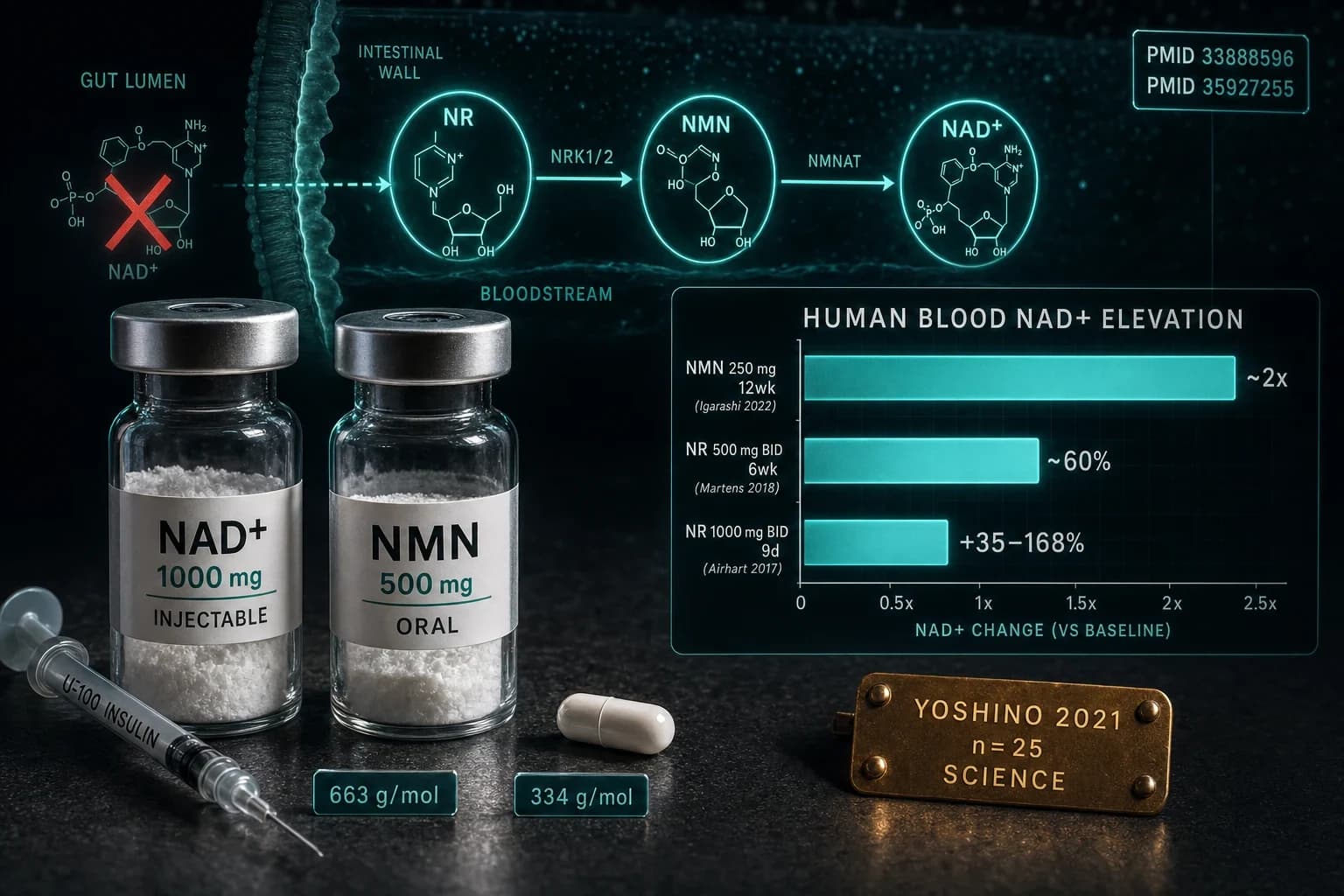
- NAD+ (663 g/mol) has near-zero intact oral absorption; NMN (334 g/mol) is absorbed within minutes.
- Yoshino 2021 (n=25 prediabetic women, Science): 250 mg NMN daily for 10 weeks lifted muscle insulin sensitivity.
- Igarashi 2022 (n=42 older Japanese men, npj Aging): 250 mg NMN for 12 weeks roughly doubled blood NAD+.
- Martens 2018 (n=22, Nature Communications): 500 mg NR twice daily raised NAD+ metabolome markers ~60% at 6 weeks.
- Only subcutaneous or IV NAD+ bypasses precursor conversion; oral NMN and NR route through NAMPT and NMNAT.
"NAD vs NMN" is a search that hides a chemistry problem. Both molecules keep sirtuins working and mitochondria fed. Only one is the coenzyme itself. The other is a precursor two enzymatic steps upstream, and the two behave differently when you swallow, inject, or infuse them. This piece walks the molecular difference, what human trials actually measured (n-counts, doses, PMIDs), and where injectable NAD+ beats an oral capsule and where it does not.
We are not selling either. Our NAD+ compound page covers the injectable channel because that is what our partner catalog carries. Oral NMN is a dietary supplement outside our stack. What follows is the editorial comparison, not the pitch.
Bottom line up front: NAD+ is the working coenzyme (663 g/mol, two phosphates, adenine ring, nicotinamide ring). NMN is one salvage-pathway step upstream (334 g/mol, one phosphate). NR is another step upstream (255 g/mol, no phosphate). Oral NAD+ hydrolyzes in the gut before it can be absorbed intact. Oral NMN and NR do get in, but they raise NAD+ through the salvage pathway rather than delivering it directly. Injection is the only route that bypasses precursor conversion.
What the letters actually mean
NAD+ stands for nicotinamide adenine dinucleotide. Every mammalian cell needs it. Sirtuins (SIRT1 through SIRT7) consume it as a substrate during deacetylation cycles. PARP enzymes consume it during DNA repair. CD38 on immune cells consumes it as part of calcium signalling. The electron transport chain shuttles reducing equivalents through the NAD+/NADH couple to make ATP. Cells rebuild NAD+ continuously from smaller pieces because the demand is that high. Molecular weight: about 663 grams per mole. Structure: two phosphates linking two ribose-nucleoside halves, one carrying an adenine ring and one carrying a nicotinamide ring.
NMN stands for nicotinamide mononucleotide. It sits one enzymatic step upstream of NAD+ in the salvage pathway. The enzyme NAMPT takes nicotinamide (vitamin B3 base) and adds a phosphoribose group to produce NMN. NMNAT then adds the adenylyl group from ATP to produce NAD+. Molecular weight: about 334 grams per mole. Structure: one phosphate, one ribose, one nicotinamide ring. Half the atomic footprint of NAD+, and no adenine half.
NR stands for nicotinamide riboside. It sits one more step upstream. Cellular kinases NRK1 and NRK2 phosphorylate NR to NMN, which then follows the same NMNAT step to NAD+. Molecular weight: about 255 grams per mole. No phosphate at all in the free molecule.
The order matters because gut absorption depends on it. Charge, molecular size, and phosphate groups decide what crosses the intestinal epithelium intact. The Yoshino, Baur, and Imai (2018) review in Cell Metabolism walks through the biochemistry in more depth and is the canonical reference for the whole precursor family.
The oral bioavailability wall
Swallowed NAD+ is a bad candidate. The molecule is large, doubly charged, and gets hydrolyzed by gut enzymes into nicotinamide plus other pieces before any intact NAD+ can be absorbed. Whatever nicotinamide is liberated then enters cells and gets re-salvaged. Functionally, an oral NAD+ capsule is closer to a nicotinamide supplement than to a direct NAD+ elevator. That is why the longevity field moved to precursors in the first place.
NR fares much better on absorption. Trammell et al. (2016) in Nature Communications ran the first human pharmacokinetic study of the molecule. Single doses of 100, 300, and 1,000 mg produced dose-dependent rises in the blood NAD+ metabolome, with a 2.7-fold peak elevation at the top dose. That study also established that NR reaches cells through pathways distinct from nicotinamide, giving it a real biochemical rationale beyond "another B3 form."
NMN also gets in, though the transporter story is unsettled. Grozio et al. (2019) in Nature Metabolism argued that a small-intestine transporter called Slc12a8 moves NMN across the gut wall directly. That finding was disputed by an independent group in the same journal within months, and the field has not converged on a single answer. What is not disputed: oral NMN produces reliable dose-dependent rises in blood NAD+ metabolome markers in humans. Whether the intact molecule crosses via Slc12a8 or gets cleaved to nicotinamide riboside first and then re-phosphorylated inside cells is an interesting biochemistry question that does not change the practical pharmacokinetics much.
One wall stays real. Swallowing NAD+ itself is not how you raise NAD+.
What the NMN human trials actually show
Human NMN evidence is a small stack of small trials. Two are load-bearing for the "does this do anything measurable?" question.
Yoshino et al. (2021) in Science enrolled 25 postmenopausal women with prediabetes on a 10-week, 250 mg per day oral NMN protocol against placebo. Insulin-stimulated glucose disposal, measured by hyperinsulinemic-euglycemic clamp (the reference method), rose meaningfully in the NMN arm. Skeletal muscle insulin signaling markers (phospho-AKT, phospho-mTOR on biopsy) went up. Body weight did not fall. Fasting glucose did not shift much. The paper stated a specific, narrow claim: at 250 mg daily for 10 weeks, NMN improved muscle insulin sensitivity in a prediabetic, overweight postmenopausal cohort. That is real data, and it is also a small trial with soft downstream signals.
Igarashi et al. (2022) in npj Aging ran 42 healthy older Japanese men (age 65 or older) on 250 mg NMN daily for 12 weeks against placebo. Blood NAD+ roughly doubled in the NMN arm. Grip strength and gait speed shifted favourably. No safety signal emerged. The paper framed this as evidence that chronic oral NMN elevates systemic NAD+ and moves muscle-function biomarkers in an ageing cohort.
The animal predecessors set the priors. Mills et al. (2016) in Cell Metabolism dosed wild-type mice with NMN for 12 months from middle age. NMN suppressed age-associated body weight gain, improved insulin sensitivity, altered plasma lipid profile, improved eye function, and shifted mitochondrial gene expression in skeletal muscle. No overt toxicity. Before that, Yoshino et al. (2011) in Cell Metabolism had shown that NMN restored NAD+ and improved glucose tolerance in diet- and age-induced diabetic mice.
None of the human NMN trials to date have tested doses higher than 900 mg per day, run longer than 12 weeks against hard clinical endpoints, or been powered to detect small effects on real outcomes like cardiovascular events or mortality. The evidence is what it is: dose-related NAD+ elevation, some downstream muscle and insulin-sensitivity signals, no established clinical benefit yet.
| Trial | n | Dose | Duration | Primary outcome | Result |
|---|---|---|---|---|---|
| Yoshino 2021 (Science, PMID 33888596) | 25 | 250 mg/day | 10 weeks | Muscle insulin sensitivity | Improved vs placebo |
| Igarashi 2022 (npj Aging, PMID 35927255) | 42 | 250 mg/day | 12 weeks | Blood NAD+, muscle function | NAD+ ~2x; grip and gait improved |
| Mills 2016 (Cell Metab, PMID 28068222) | Mice | 100 or 300 mg/kg/day | 12 months | Age-associated decline | Attenuated across multiple markers |
| Yoshino 2011 (Cell Metab, PMID 21982712) | Mice | 500 mg/kg/day IP | 7-10 days | Glucose tolerance | Restored in diet- and age-induced diabetic mice |
What the NR human trials show
NR has a bigger clinical bench than NMN, mostly because it reached the supplement market first as Niagen and cleared US GRAS review in 2016.
Martens et al. (2018) in Nature Communications enrolled 22 healthy middle-aged and older adults in a 2x6-week crossover trial of 500 mg NR twice daily against placebo. Whole-blood NAD+ rose about 60% at 6 weeks in the NR arm. No adverse safety signal. A pre-specified secondary analysis in participants with stage-1 hypertension showed a small drop in systolic blood pressure and arterial stiffness, which the paper flagged for a larger follow-up.
Airhart et al. (2017) in PLOS ONE ran 1,000 mg NR twice daily for 8 days in 8 healthy adults. Whole-blood NAD+ rose 35% to 168% above baseline by day 9, with no serious adverse events at that dose. This was the pharmacokinetic study that anchored later dosing choices.
Across roughly a dozen small NR trials, the pattern is consistent. Oral NR is well-tolerated up to at least 2,000 mg per day. It reliably raises NAD+ metabolome markers. Downstream signals (blood pressure, arterial stiffness, inflammatory markers, some muscle biomarkers) show small effects in some studies and null in others. No large hard-endpoint trial has closed the case either way.
Injection changes the math
Subcutaneous or intravenous NAD+ bypasses the oral gauntlet entirely. There is no gut hydrolysis to survive, no first-pass hepatic conversion to lose product in, no reliance on a partly-characterized intestinal transporter. The tradeoff is real: injecting NAD+ hurts. Users describe chest tightness, flushing, and sometimes nausea that scale with infusion rate and dose. IV NAD+ protocols run over 1 to 2 hours precisely to blunt the sensation. Subcutaneous protocols use small volumes (50 to 100 mg per injection) for the same reason. See our NAD+ dosage chart for the SC and IV protocol bands people actually use, and the NAD+ injection protocol guide for the fuller research walk-through.
Published human trial evidence for parenteral NAD+ is thinner than for the oral precursors. Most clinical experience is from addiction medicine (the "NAD+ IV taper" used in some opioid and alcohol dependence programs) and longevity clinics, neither of which produces the volume of placebo-controlled RCT data that NMN and NR now have. The mechanistic case is straightforward. If the goal is to raise the coenzyme itself without depending on how efficiently your cells convert a precursor, injection is the cleaner route. The empirical case for a clinical benefit that oral precursors cannot match is not yet established.
Practical trade-off summary. NMN and NR capsules are cheap, need no needles, and have real human PK and biomarker data behind them. Injectable NAD+ costs more, requires reconstitution and refrigeration, hurts on administration, and delivers the coenzyme rather than a precursor. No published randomized head-to-head trial has compared injectable NAD+ to oral NMN or oral NR for any hard endpoint. Anyone claiming otherwise is inventing evidence.
Why anyone takes these at all: the sirtuin question
Both precursor families are marketed on the sirtuin story. The mechanism is real. Sirtuins are NAD+-dependent deacetylases, so anything that raises intracellular NAD+ raises the ceiling on sirtuin activity. The question is whether the elevation is large enough, in the right tissues, for long enough, to produce a phenotype that matters.
Mouse experiments consistently produce phenotype changes. Improved glucose handling. Improved muscle regeneration. Improved eye function in the Mills 12-month study. Altered fat distribution. Sirtuin-dependent gene expression shifts. Human trials consistently produce biomarker changes. Higher blood NAD+. Better insulin sensitivity in a subset of trials. Sometimes better muscle-function markers. What human trials have not yet produced is a hard-endpoint result of the kind that would end the debate: a large RCT showing extended healthspan, lower incidence of an age-related disease, or a mortality reduction.
The honest reading: NAD+ precursors do raise NAD+ in humans at the doses tested. Whether that translates to meaningful clinical benefit at scale is still open. The best peptides for longevity roundup and best peptides for anti-aging guide cover where NAD+ sits relative to other longevity-adjacent compounds sharing the same evidence gap.
Practical decision matrix
| If your priority is... | Reasonable channel | Why |
|---|---|---|
| Lowest friction, no needles | Oral NR (500-1000 mg/day) | Strongest oral PK and safety bench; GRAS-affirmed in the US since 2016 |
| Best-studied insulin-sensitivity signal | Oral NMN (250 mg/day) | Yoshino 2021 is the specific trial that named this outcome |
| Muscle-function signal in older adults | Oral NMN (250 mg/day) | Igarashi 2022 measured this outcome directly |
| Direct coenzyme delivery, bypass precursor conversion | Injectable NAD+ (SC 50-100 mg or IV 250-500 mg, slow) | The only route that avoids the salvage pathway |
| Established regulatory clarity in the US | Oral NR | NMN is in a contested dietary-supplement status; NAD+ IV is compounded or research-grade |
| Peak blood NAD+ elevation on a validated dose | Oral NMN 250 mg/day (Igarashi doubled it) or injection | Both have PK data; NR at 1,000 mg BID also elevates |
| You want a big randomized trial before spending money | None yet qualifies | The definitive hard-endpoint trial has not been run |
The matrix does not include an "oral NAD+" row because the molecule does not survive the gut intact. Any product marketed as oral NAD+ is effectively a nicotinamide product with extra packaging.
Safety, purity, and the supplement market problem
NR has been GRAS-affirmed by the FDA since 2016 and is sold as a dietary supplement in the US. Trials to 2,000 mg per day for weeks show a clean safety profile.
NMN's regulatory story is messier. In November 2022 the FDA excluded NMN from being marketed as a dietary supplement in the US, citing its status as an active ingredient under investigation as a new drug. Enforcement has been uneven. NMN is still widely sold, but the legal footing is not identical to a normal dietary supplement, and the market includes a wide spread of quality control. Some brands publish third-party HPLC purity data. Others publish internal COAs. Others publish none at all. If you buy oral NMN, third-party COA verification is not optional.
Injectable NAD+ is a compounded or research-grade injectable, so vendor auditing matters. On any injectable, we treat a third-party Certificate of Analysis as the minimum bar: identity (mass spec or NMR), purity (HPLC), endotoxin (LAL), and sterility. Our lab tests library collects the assay types that actually mean something for research-grade injectables.
For NAD+ specifically, Ascension Peptides ships 1000 mg NAD+ vials with public per-batch COAs and 50% off using code ENHANCED. The full audit is in our Ascension Peptides review. Oral NMN capsules are outside our partner catalog, so we cannot vouch for any specific brand; if you are shopping oral, buy from a vendor whose HPLC assay is done by a lab whose name you can look up. Reconstitution math for injectable NAD+ (or any peptide) lives in our reconstitution calculator.
FAQ
Is NMN the same as NAD+?
No. NMN (nicotinamide mononucleotide) is a precursor two enzymatic steps below NAD+ in the salvage pathway. It weighs half as much (about 334 vs about 663 g/mol) and carries one phosphate rather than two. Cells convert NMN to NAD+ via NMNAT.
Is oral NAD+ the same as an NMN capsule?
No. Oral NAD+ is largely hydrolyzed to nicotinamide before it can be absorbed intact, so it functions more like a nicotinamide supplement. Oral NMN reaches circulation and raises blood NAD+ metabolome markers in humans (Igarashi 2022, PMID 35927255). This is the practical reason the field studies precursors rather than NAD+ itself for oral delivery.
NMN vs NR: which raises NAD+ more?
Both raise blood NAD+ metabolome markers in humans at their tested doses. No published head-to-head human RCT settles the ranking. NR has a bigger clinical bench (Martens 2018, Airhart 2017). NMN has the two most-cited outcome trials (Yoshino 2021 for muscle insulin sensitivity, Igarashi 2022 for muscle function). Pick by outcome of interest and regulatory comfort, not by molecule-worship.
What dose of NMN is used in human trials?
The two load-bearing outcome trials used 250 mg per day (Yoshino 2021 for 10 weeks, Igarashi 2022 for 12 weeks). PK studies have gone as high as 900 mg per day for shorter periods. Consumer supplement doses often exceed the trial doses, which is not necessarily more effective; nothing published shows a monotonic benefit at higher doses.
Does NAD+ IV work better than oral NMN?
The mechanistic case is stronger (direct coenzyme delivery bypasses conversion), but no published RCT compares them head-to-head for a hard endpoint. Injectable NAD+ is what our partner catalog carries; that reflects the delivery-route logic rather than settled comparative-efficacy data.
Is NMN legal in the US?
Legally messy. The FDA excluded NMN from being marketed as a dietary supplement in November 2022 based on its investigational-new-drug status, but enforcement has been uneven and NMN is still widely sold. NR remains a straightforward dietary supplement.
Are there side effects?
Trials of NR up to 2,000 mg per day and NMN up to 900 mg per day have not surfaced serious adverse events. Injectable NAD+ commonly causes flushing, chest tightness, and nausea that scale with infusion rate; slower administration blunts all three. None of these compounds have long-term human safety data on the scale that would rule out slow-emerging effects.
What does the site actually sell?
Our partner catalog carries injectable NAD+ (Ascension, 1000 mg vials, code ENHANCED). Oral NMN and oral NR are dietary supplements outside our stack. This piece is the editorial comparison, not the pitch.
Bottom line
Bottom line: NAD+ is the coenzyme. NMN and NR are precursors that reach it through the salvage pathway. Oral NAD+ does not work because the molecule is hydrolyzed in the gut. Oral NMN and NR do raise blood NAD+ metabolome markers in humans at 250 to 1,000 mg per day, with real but small downstream biomarker signals in the trials that have been run. Injectable NAD+ delivers the coenzyme directly at the cost of needles, flushing sensation, and thinner published-RCT support. No head-to-head human trial has ranked these routes against each other on a hard endpoint, so route selection is a judgement call about mechanism, regulatory footing, tolerability, and cost.
Related reading
- NAD+ compound page
- NAD+ dosage chart
- NAD+ injection protocol 2026
- Best peptides for longevity
- Best peptides for anti-aging
- Ascension Peptides review
- Reconstitution calculator
- Lab tests library
This article is for educational and research purposes only. NAD+, NMN, and NR are studied in humans, animals, and in vitro. None of the content above constitutes medical advice. Injectable products discussed are for research use as described by the vendor. Consult a qualified clinician for individual decisions about supplementation or injection.