At a glance
- ZUPREME-1 Phase 2 (493 adults, 42 weeks) hit -10.7% mean weight loss on the top petrelintide dose vs -1.7% on placebo, with full data presented at ADA 2026
- Vomiting rate was 3% on petrelintide vs 6.2% on placebo, the cleanest GI profile any incretin-class candidate has reported at this efficacy
- Petrelintide (ZP8396) is a 36-amino-acid acylated amylin analogue with 10-day half-life and 85% bioavailability (Brændholt Olsen et al. DOM 2026, doi:10.1111/dom.70753)
- Phase 3 was announced April 29, 2026; ZUPREME-2 in obesity plus type 2 diabetes (NCT06926842) reports later this year
- Petrelintide is amylin monotherapy, structurally distinct from CagriSema (combination), eloralintide (AMY1R-selective), and cagrilintide (dual AMY/calcitonin)
Petrelintide is the first long-acting amylin monotherapy with a credible Phase 2 weight-loss read and the cleanest tolerability profile any incretin-class candidate has published. ZUPREME-1 produced 10.7% mean weight loss at 42 weeks on the top dose, vomiting was less common with petrelintide than with placebo, and Roche and Zealand announced Phase 3 in April 2026. Full ZUPREME-1 data landed at the ADA 2026 Scientific Sessions in June.
This article covers what petrelintide is, what the Phase 1 and Phase 2 trials actually measured, how the molecule compares to other amylin candidates and to the GLP-1 class, the ZUPREME-2 type 2 diabetes program, and what a Phase 2 trial cannot answer that Phase 3 will have to.
What petrelintide is
Petrelintide (ZP8396) is a 36-amino-acid acylated peptide based on the human amylin sequence, designed for once-weekly subcutaneous dosing in chronic weight management. The chemistry paper from the Zealand Pharma group, published in the Journal of Medicinal Chemistry in late 2025, describes the substitutions that gave petrelintide its physical stability at neutral pH and its potent balanced agonism at the amylin receptor and the calcitonin receptor (Fischer Munch et al., J Med Chem 2025, PMID 41217931). Two engineering goals drove the design: minimize fibril formation so the peptide can be co-formulated with other compounds, and extend the half-life through fatty-acid acylation so once-weekly dosing is feasible.
The mechanism is amylin agonism. Endogenous amylin is a 37-amino-acid peptide co-secreted with insulin from pancreatic beta cells. It slows gastric emptying, suppresses postprandial glucagon, and acts on the area postrema in the brainstem to drive satiety. The receptor is a heterodimer of the calcitonin receptor and a receptor activity-modifying protein. Petrelintide is a balanced dual amylin and calcitonin receptor agonist, distinct from Lilly's AMY1R-selective approach with eloralintide and from Novo Nordisk's cagrilintide approach.
Bottom line: Petrelintide is an acylated long-acting amylin analogue with a 10-day half-life, once-weekly subcutaneous dosing, and balanced dual amylin/calcitonin receptor agonism. Roche partnered with Zealand on global development in 2024.
Phase 1 pharmacokinetics (Brændholt Olsen et al. DOM 2026)
The Phase 1 program ran two randomised, controlled trials in healthy adults and adults with obesity, with the combined data published in Diabetes, Obesity and Metabolism in 2026 (Brændholt Olsen et al., Diabetes Obes Metab 2026, doi:10.1111/dom.70753). The single-ascending-dose trial established the dose range and PK profile; the multiple-ascending-dose trial extended exposure over 16 weeks and provided the first weight-change signal.
Key Phase 1 findings:
- Half-life of approximately 10 days, supporting once-weekly dosing at steady state with manageable peak-to-trough variability
- Bioavailability of approximately 85% after subcutaneous administration, dose-proportional pharmacokinetics from 0.6 mg to 9 mg
- Tmax around 24 hours with slow absorption consistent with the acylated long-acting design
- Gastrointestinal adverse events were the most common, generally mild, with intensity falling as the maintenance dose was reached
- No serious safety signals at the doses tested; the adverse event profile supported advancing to Phase 2
The Phase 1 result that mattered for the program design was the GI signature. Across the multiple-ascending-dose cohorts, nausea and vomiting frequency was lower than expected for the weight-loss magnitude observed, which set up the central hypothesis ZUPREME-1 was built to test: can amylin monotherapy produce GLP-1-class weight loss without GLP-1-class GI side effects?
ZUPREME-1 Phase 2 results
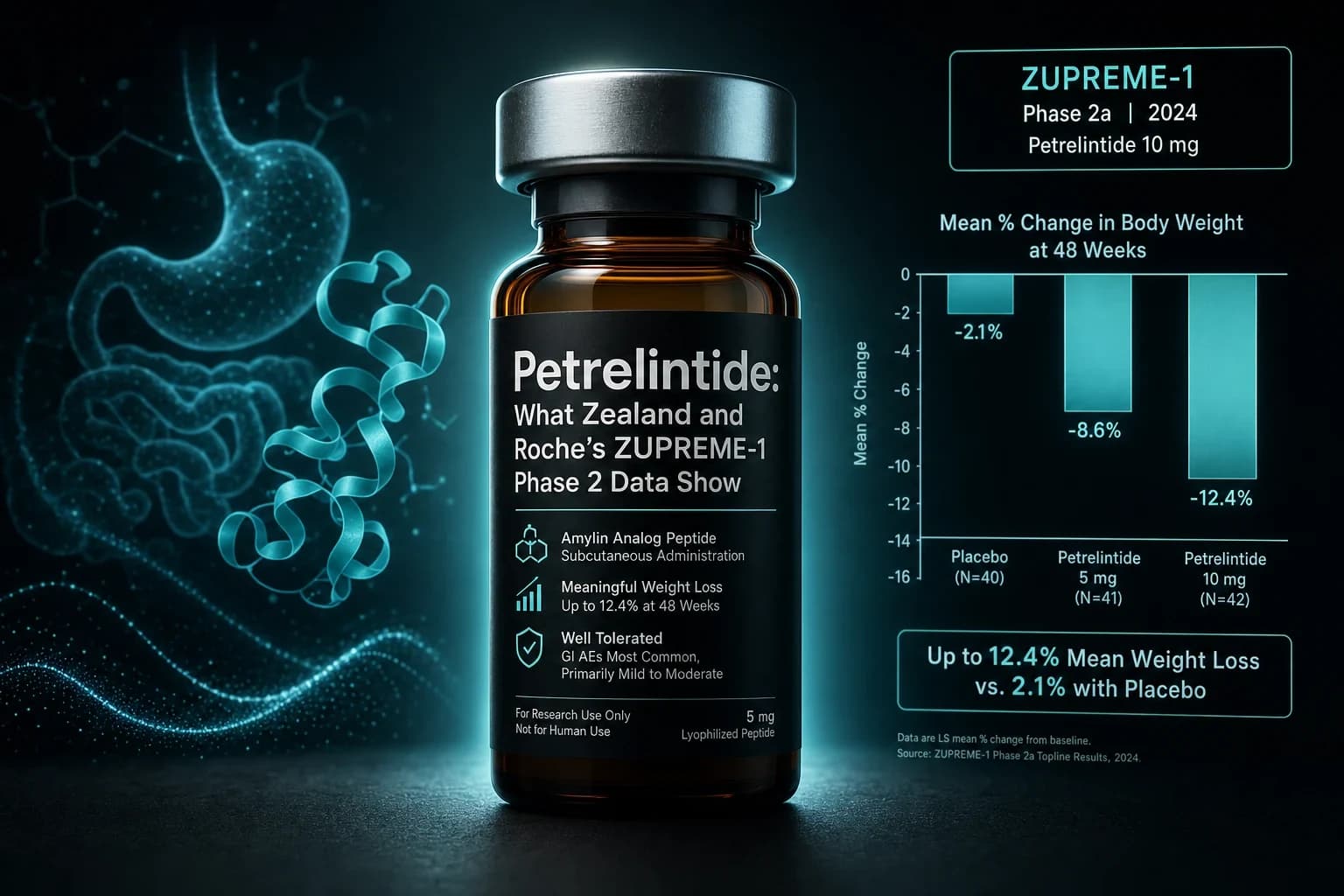
ZUPREME-1 randomised 493 adults with overweight or obesity (mean BMI 37 kg/m², gender-balanced) to five doses of once-weekly subcutaneous petrelintide or placebo, on top of a reduced-calorie diet and increased physical activity. The dose-escalation period ran up to 16 weeks (escalation every fourth week), followed by a maintenance period through week 42. The primary endpoint was percentage change in body weight from baseline at 28 weeks. Topline results were released in March 2026 (Roche press release, March 5, 2026); the full 42-week dataset was presented at the American Diabetes Association 2026 Scientific Sessions in June (Zealand Pharma press release, June 5, 2026).
Weight change at 42 weeks
| Arm | Mean weight change (efficacy estimand) |
|---|---|
| Placebo | -1.7% |
| Petrelintide (top dose) | -10.7% |
| All active arms | Statistically significant vs placebo |
All five active arms met the primary endpoint at 28 weeks. Weight reduction continued through the 42-week maintenance period, with the top dose reaching 10.7% mean reduction. Lower doses produced graded weight loss, with the dose-response curve not yet flat, suggesting Phase 3 has room to explore higher doses or longer durations.
For context, semaglutide 2.4 mg in STEP 1 produced approximately -10% at 42 weeks, on its way to -14.9% at the 68-week endpoint. Petrelintide at matched duration is at parity with semaglutide on a different receptor system, which is the first credible evidence that amylin can carry weight loss without the GLP-1 component.
Tolerability
The GI profile is where ZUPREME-1 separated from the GLP-1 class.
| Adverse event | Petrelintide | Placebo |
|---|---|---|
| Nausea (any) | 19.6% | 6.2% |
| Vomiting (any) | 3.0% | 6.2% |
| Discontinuation for AEs | Low across arms | Low across arms |
Vomiting was less frequent on petrelintide than on placebo. This is unusual for any incretin-class weight-loss compound at 10% weight loss. Nausea was elevated above placebo but the rate (19.6%) sits well below the 40 to 70% nausea rates that GLP-1 monotherapy produces in matched-duration trials. The mechanism explanation is that amylin's satiety signal does not engage the GLP-1 receptor pathway in the area postrema and nucleus tractus solitarius that drives most of the GI burden in the GLP-1 class.
Roche reported that 98% of trial participants in the top-dose cohort reached the maintenance dose, indicating that titration was not severely limited by side effects (Roche press release, March 5, 2026).
Bottom line: ZUPREME-1 hit 10.7% mean weight loss at 42 weeks on the top dose, with vomiting at placebo levels and nausea at roughly one-third of GLP-1 monotherapy rates. Phase 3 will determine whether both findings hold at scale.
How amylin works in obesity (and what the leptin angle adds)
Amylin's anorectic action is well characterised in preclinical and clinical work. Pramlintide, the legacy thrice-daily amylin analogue approved in 2005 as an insulin adjunct for type 1 and type 2 diabetes, produced 3.7% placebo-corrected body weight reduction at 16 weeks in obese non-diabetic adults at the maximum 240 micrograms dose (Smith et al., J Clin Endocrinol Metab 2007, PMID 17504894), and approximately 3.5 kg sustained reduction at 12 months in a separate trial (Smith et al., Diabetes Care 2008, PMID 18753666). Those numbers established that amylin agonism produces real weight loss, but the magnitude was limited by short half-life, thrice-daily dosing, and a steep titration ceiling. Petrelintide is the long-acting answer to those limits.
The mechanism extends beyond direct satiety. A widely cited preclinical and clinical proof-of-concept study from Roth and colleagues demonstrated that amylin agonism restores leptin responsiveness in diet-induced obesity, and that co-administration of the amylin analogue pramlintide with recombinant human leptin produced 12.7% mean weight loss at 24 weeks in overweight and obese adults, significantly more than either treatment alone (Roth et al., Proc Natl Acad Sci USA 2008, PMID 18458326). The proposed mechanism is that long-acting amylin signalling resensitizes hypothalamic neurons to circulating leptin, which is functionally blunted in chronic obesity.
Whether the leptin-resensitization mechanism translates to durable weight maintenance after stopping petrelintide is an open question. No published trial has tested petrelintide discontinuation against placebo through a maintenance phase. The mechanism is suggestive of better off-treatment durability than GLP-1 monotherapy, but the trial design that would prove that has not been run. The stopping GLP-1 weight regain research covers the GLP-1 discontinuation baseline.
Petrelintide vs the other amylin candidates
Three amylin candidates are in late-stage obesity development as of mid-2026. Each makes a different bet on receptor pharmacology, half-life, and combination strategy.
| Compound | Sponsor | Selectivity | Half-life | Top Phase 2 weight loss | Status |
|---|---|---|---|---|---|
| Cagrilintide | Novo Nordisk | Dual AMY / calcitonin | ~7 days | -10.8% at 26 wk (4.5 mg) | Filed as part of CagriSema |
| Petrelintide | Zealand / Roche | Dual AMY / calcitonin | ~10 days | -10.7% at 42 wk (top dose) | Phase 3 announced April 2026 |
| Eloralintide | Eli Lilly | AMY1R-selective (~12x) | ~14 days | -20.1% at 48 wk (9 mg) | Phase 3 enrolling (ENLIGHTEN) |
A few honest observations on this comparison:
Cross-trial Phase 2 numbers are not directly comparable. Different durations, different dose ladders, different populations. Eloralintide reached 20.1% at 48 weeks on a 9 mg dose with no clear plateau; petrelintide reached 10.7% at 42 weeks with the published dose range. Whether petrelintide's dose-response curve continues climbing past the ZUPREME-1 top dose is not known.
The tolerability comparison is where petrelintide has the cleanest published story. Vomiting at 3% on petrelintide vs 6.2% on placebo is a notable result. Eloralintide's Phase 2 reported a favorable GI profile but did not show vomiting below placebo rates. Cagrilintide's GI profile sits between the two, with cagrilintide monotherapy producing 17.0% nausea and 5.3% vomiting at 4.5 mg in the dose-finding Phase 2 (Lau et al., Lancet 2021, PMID 34798060).
The Roche commercial backing matters. Petrelintide is the first amylin-pathway candidate with a top-three obesity pharma partner driving development. Lilly is running eloralintide in-house alongside tirzepatide. Novo is running cagrilintide as part of CagriSema. Roche is new to the obesity space, and petrelintide is its lead anti-obesity asset.
For the unimolecular GLP-1 + amylin alternative, see our amycretin Phase 1 evidence article. For the cagrilintide-semaglutide combination context, see the CagriSema REDEFINE Phase 3 guide. The full class context is in our GLP-1 + amylin combination pipeline 2026 guide.
Petrelintide vs GLP-1 and dual agonists
The rough cross-trial comparison matters for understanding where petrelintide sits relative to the established weight-loss class.
| Drug | Class | Top published weight loss | Trial | Duration |
|---|---|---|---|---|
| Semaglutide 2.4 mg | GLP-1 | -14.9% | STEP 1 | 68 wk |
| Tirzepatide 15 mg | GIP + GLP-1 | -22.5% | SURMOUNT-1 | 72 wk |
| CagriSema 2.4/2.4 mg | GLP-1 + amylin | -22.7% | REDEFINE 1 | 68 wk |
| Eloralintide 9 mg | Amylin monotherapy (AMY1R-selective) | -20.1% | Phase 2 | 48 wk |
| Petrelintide top dose | Amylin monotherapy (dual AMY/calcitonin) | -10.7% | ZUPREME-1 | 42 wk |
Petrelintide produces less weight loss than the dual and triple agonists or the GLP-1 + amylin combinations, but it carries no GLP-1 component, which is the entire reason its tolerability story matters. The strategic position is patients who cannot tolerate GLP-1 monotherapy, patients who plateau on combination therapy, and the long-term maintenance question where the leptin-resensitization mechanism could matter.
For the broader head-to-head context, the tirzepatide vs semaglutide SURMOUNT-5 evidence covers the dual-agonist comparison, the retatrutide TRIUMPH-1 Phase 3 topline covers the triple agonist, the CagriSema REDEFINE Phase 3 guide covers the GLP-1 + amylin combination peak (Garvey et al., NEJM 2025, PMID 40544433), and the GLP-1 dosing comparison 2026 holds the full dose-response context.
ZUPREME-2 and the type 2 diabetes program
The Phase 2b ZUPREME-2 trial began enrollment in April 2025 to evaluate petrelintide in adults with overweight or obesity and type 2 diabetes. The primary endpoint is percentage change in body weight from baseline at 28 weeks (NCT06926842 on ClinicalTrials.gov). Secondary endpoints include the proportion of participants achieving 5% and 10% weight loss, change in waist circumference, change in HbA1c, change in fasting glucose, and change in fasting lipids. Topline results are expected in the second half of 2026.
The T2D population is the most demanding tolerability and durability test for the amylin monotherapy thesis. GLP-1 monotherapy in T2D typically produces 30 to 40% less weight loss than in obesity without diabetes, and tolerability is more limiting because of the dose ceiling required for HbA1c targets. If petrelintide holds its GI profile and produces clinically meaningful weight loss in T2D, the indication broadens substantially. If the T2D effect is muted, petrelintide stays a pure obesity asset.
Phase 3 was announced April 29, 2026 by Roche and Zealand. The Phase 3 program is expected to include large randomised trials in obesity, T2D, and obesity with weight-related comorbidities. Detailed Phase 3 trial designs have not been released as of June 2026.
Note: Phase 3 readouts are not expected before 2028. FDA approval, if Phase 3 succeeds, is unlikely before 2028 to 2029.
What is still unknown
Five open questions through 2028:
-
Does the dose-response curve keep climbing? ZUPREME-1's top dose produced 10.7% at 42 weeks, and Roche has not indicated whether the curve has plateaued at that dose. Phase 3 will test higher doses if Phase 2 data justify the extension.
-
Does the vomiting-below-placebo result hold at scale? A 3% vomiting rate vs 6.2% on placebo in a 493-patient trial is striking but not yet population-scale. Phase 3 with thousands of patients on multiple doses over 68+ weeks will determine whether the tolerability advantage survives. If yes, that is the defining advantage of the class.
-
What does discontinuation look like? GLP-1 discontinuation produces meaningful weight regain in most patients within a year. The amylin mechanism plausibly translates to better off-treatment durability via the leptin-resensitization pathway (Roth et al. PNAS 2008, PMID 18458326), but no trial has yet measured petrelintide discontinuation against placebo through a maintenance phase.
-
How does petrelintide perform in T2D? ZUPREME-2 reports later this year. The T2D population is where the GLP-1 class produces its most attenuated weight loss and where amylin monotherapy could differentiate.
-
Does Roche pursue combinations? Roche has not announced a petrelintide + GLP-1 program. Mechanistically the combination should produce CagriSema-class weight loss, but the commercial dynamics (Roche, Novo, and Lilly all running separate amylin assets) make it unlikely any sponsor pursues a cross-company combination.
Sourcing notes
Petrelintide is not available as a research-grade compound as of June 2026. It is in active Zealand Pharma and Roche clinical development with sponsor exclusivity, and no research peptide vendor produces or distributes it.
For researchers working with the closest available compound in the amylin class, cagrilintide is available from Ascension Peptides with per-batch COAs and 50% off using code ENHANCED. For the GLP-1 mechanism comparison work, semaglutide and tirzepatide are also available from Ascension with the same code. The reconstitution calculator handles dose math for either compound.
FAQ
How does petrelintide compare to semaglutide?
At 42 weeks, petrelintide top dose produced 10.7% mean weight loss in ZUPREME-1. Semaglutide 2.4 mg at the matched 42-week interim in STEP 1 was approximately -10%, on its way to -14.9% at 68 weeks. Petrelintide is at parity with semaglutide on the same duration. Where petrelintide differs is mechanism (amylin vs GLP-1, no receptor overlap) and tolerability (vomiting 3% vs 6.2% on placebo in petrelintide, compared with much higher vomiting rates in GLP-1 monotherapy trials).
Is petrelintide approved by the FDA?
No. As of June 2026, petrelintide is preparing to enter Phase 3 following the ZUPREME-1 Phase 2 readout in March 2026 and the ADA 2026 full data presentation in June. Phase 3 was announced April 29, 2026 by Roche and Zealand. FDA approval, if Phase 3 succeeds, is unlikely before 2028 to 2029.
What is the difference between petrelintide and cagrilintide?
Both are long-acting amylin analogues with balanced dual agonism at the amylin and calcitonin receptors. Cagrilintide has a half-life of approximately 7 days and is being developed as part of CagriSema (cagrilintide + semaglutide). Petrelintide has a half-life of approximately 10 days and is being developed as monotherapy by Zealand and Roche. The Phase 2 top weight loss is similar (10.7% petrelintide vs 10.8% cagrilintide monotherapy, on different durations). Tolerability has been the differentiating story for petrelintide so far.
What is the difference between petrelintide and eloralintide?
Petrelintide is a balanced dual amylin and calcitonin receptor agonist. Eloralintide is selective for the amylin 1 receptor (AMY1R) by approximately 12-fold over the calcitonin receptor. Eloralintide produced 20.1% weight loss at 48 weeks on 9 mg in Phase 2, the highest published amylin monotherapy result. Petrelintide produced 10.7% at 42 weeks. The tolerability comparison favors petrelintide on vomiting; the efficacy comparison favors eloralintide on top-line weight loss. See the eloralintide Phase 2 evidence write-up for the Lilly program details.
Does petrelintide cause nausea?
ZUPREME-1 reported nausea in 19.6% of petrelintide participants vs 6.2% on placebo. Most events were mild. Vomiting was 3.0% on petrelintide vs 6.2% on placebo, meaning vomiting was less frequent than placebo rates. The 19.6% nausea rate is substantially lower than GLP-1 monotherapy nausea rates at matched weight-loss magnitudes, but Phase 3 with thousands of patients on longer durations will determine whether the favorable profile holds.
Can petrelintide be combined with semaglutide or tirzepatide?
Mechanistically yes; the combination would replicate the CagriSema mechanism using different molecules. There is no published trial of petrelintide combined with any GLP-1 or GIP+GLP-1 agonist. Roche, Novo Nordisk, and Eli Lilly are separate commercial sponsors with their own in-house amylin assets, so cross-company combinations are not part of the current pipeline.
This article is for educational and research purposes only. It summarizes Phase 1 and Phase 2 clinical trial data and pre-clinical pharmacology for an investigational compound. Petrelintide (ZP8396) is not FDA-approved, not EMA-approved, and not available outside of clinical trials as of June 2026. Trial results described here reflect what was measured under controlled conditions and do not establish efficacy or safety for any individual outside of those trials. Long-term safety, durability after discontinuation, and outcomes in populations excluded from Phase 2 (active type 2 diabetes outside of ZUPREME-2, severe psychiatric illness, pregnancy) are not yet characterized. Doses described here are what the published literature tested, not protocols or recommendations.