At a glance
- Core Peptides is an established US research-peptide vendor with years of operation
- It claims over 99% purity with third-party COAs
- COA transparency is the weak spot: independent verification is limited
- Always match the lot number on the COA to the vial you receive
- For per-lot COA data across vendors, check the lab-test database
Core Peptides comes up constantly in vendor searches, and the recurring question is whether the quality claims hold up. Here is a straight assessment: what the company does well, where its documentation is thin, and how it compares to vendors that publish per-lot certificates.
What Core Peptides is
Core Peptides is a US-based research-peptide supplier with a multi-year operating history and a recognized name in the research community. The catalog covers the research staples: BPC-157, studied for angiogenesis and tissue repair (Chang et al., 2011); TB-500, the actin-regulating thymosin beta-4 (Goldstein et al., 2005); and GHK-Cu, the copper repair peptide (Pickart and Margolina, 2015). It ships domestically and has a reputation for responsive customer service. On the basics (real company, real logistics, real catalog) it checks out.
The purity claim and the COA gap
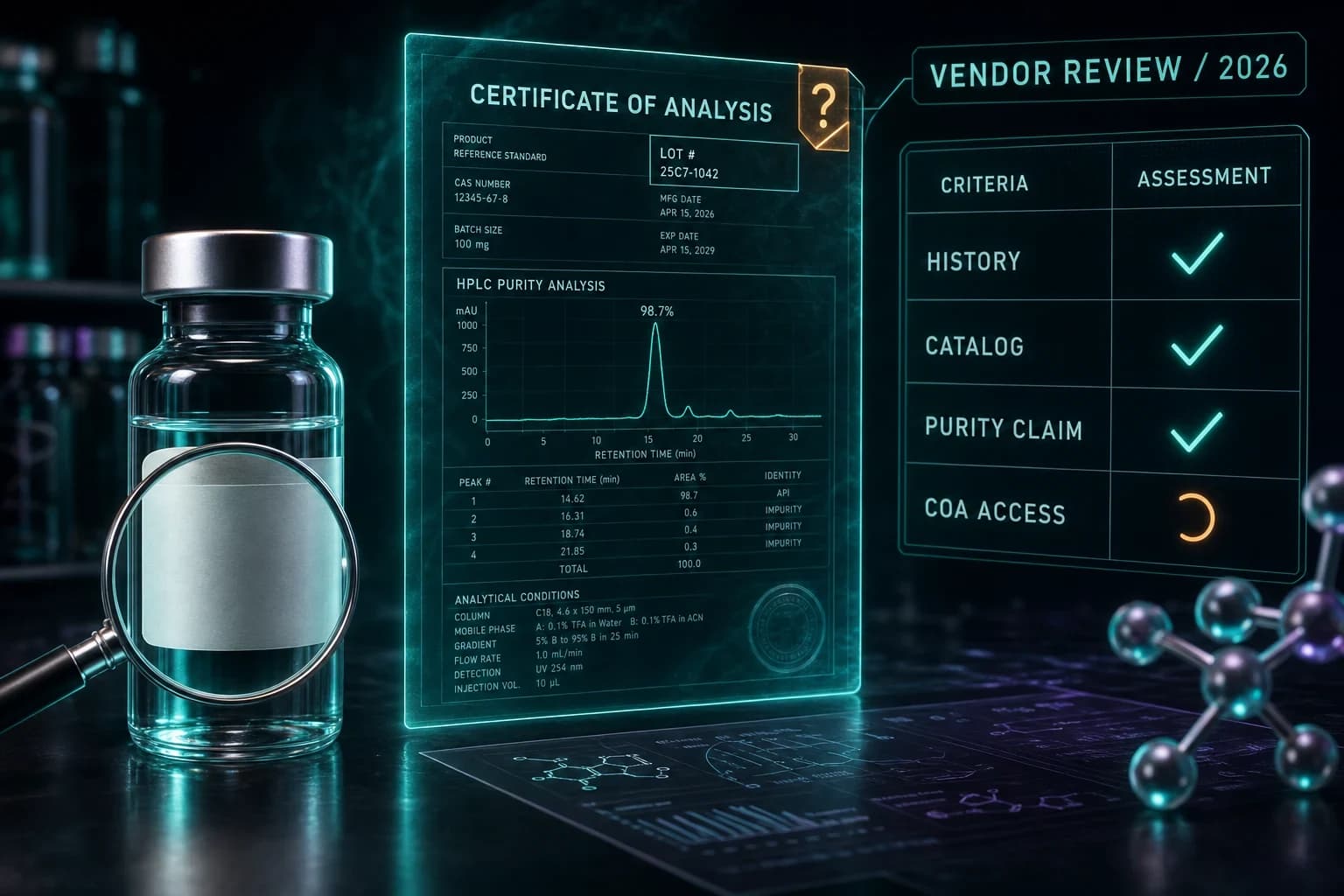
Core Peptides advertises over 99 percent purity verified by third-party laboratory testing, with certificates of analysis from independent labs. That is the right claim to make. The weak spot is verification: independent analyses have found the publicly accessible COA documentation limited, and automated COA checks could not fully confirm the third-party testing claims. The company also does not consistently name which labs run the analysis, which would strengthen the claim.
Warning: A purity number on a marketing page is a specification, not proof. The trust anchor is a per-lot certificate with a lot number you can match to your vial. When a vendor's COA library is hard to access, that is a reason to ask for the batch-specific document before you buy.
How to think about it
| Signal | Core Peptides | What to look for |
|---|---|---|
| Operating history | Solid | Years, not months |
| Catalog breadth | Broad | Covers your compound |
| Purity claim | Over 99% | Stated clearly |
| Per-lot COA access | Limited | Lot-matched documents |
| Lab named | Inconsistent | Specific third-party lab |
For a side-by-side of who actually publishes per-lot HPLC data, our lab test database tracks certificates across vendors, which is the fastest way to see the difference between a marketed spec and a batch-specific document.
The alternative we recommend
If per-lot COA transparency is your priority, Ascension Peptides publishes a certificate for every batch with lot number, purity, and test date, and it is our vetted partner with 50% off using code ENHANCED. See our full Ascension Peptides review for the breakdown, and the BPC-157 research page and dosage chart for the most-requested compound.
Bottom line: Core Peptides is a legitimate, established vendor, not a scam. Its gap is COA transparency, so request the lot-specific certificate before buying, or choose a vendor that publishes per-lot documents by default.
This article is for research and educational purposes only. Research peptides are not approved for human use. It is not medical advice.