At a glance
- Shelton, Connecticut vendor from 2019, not UK as some older write-ups state.
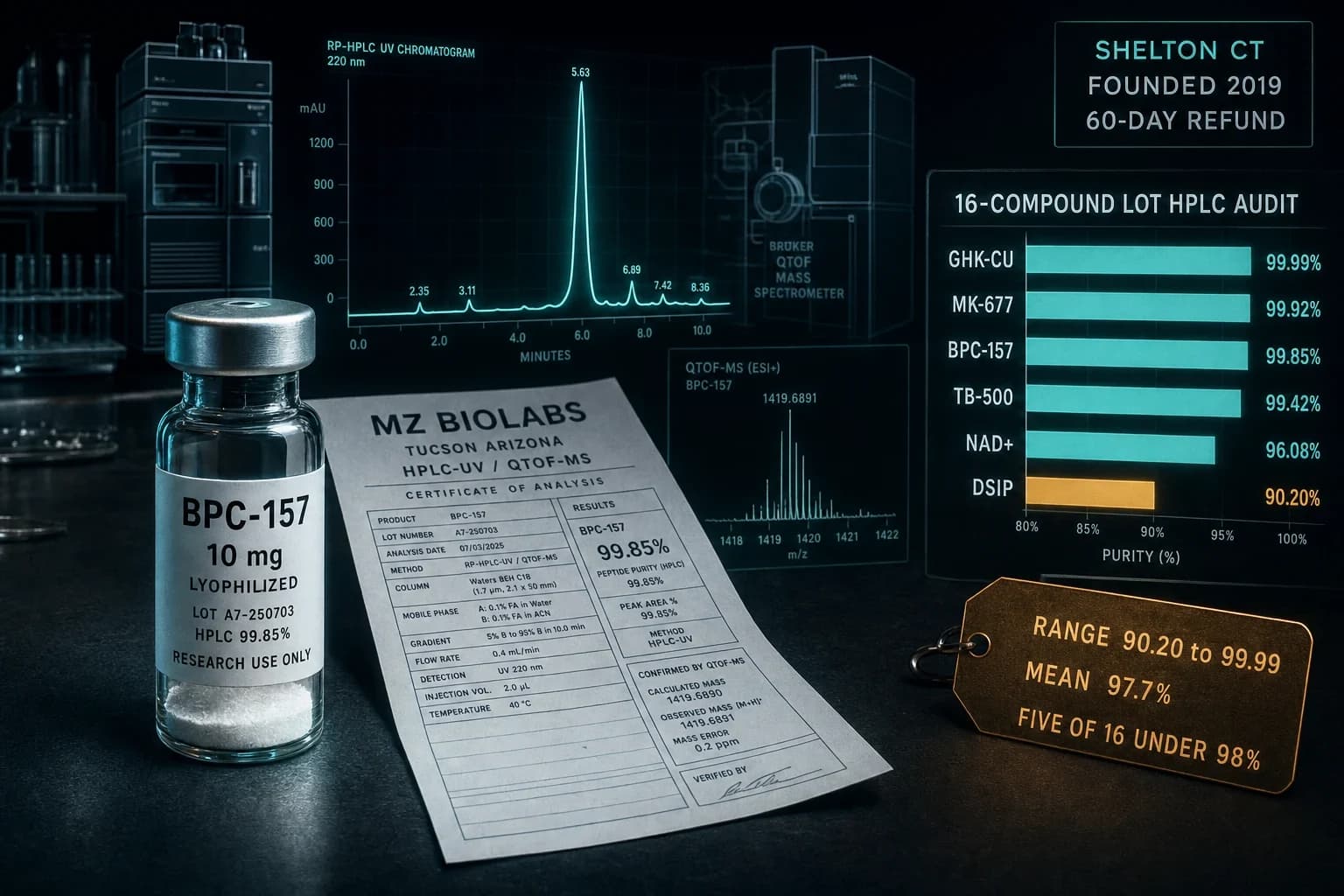
- Public /coa/ page lists per-lot HPLC from MZ Biolabs in Tucson, Arizona.
- Across 16 compounds we index, HPLC spans 90.2% (DSIP) to 99.99% (GHK-Cu).
- Five of 16 lots sit under 98%, so the per-batch sheet is non-optional.
- Fine as a Tier 1 pick. US buyers still get more vials per dollar on Ascension.
The pretty average across Sports Technology Labs' public lot sheets is 98.0% HPLC. The worst row is 90.2%.
If you only read the hero number on their /coa/ page, you buy the vendor. If you open the per-compound certificates, you buy the batch. Those are not the same decision, and this review is about why.
sportstechnologylabs.com is a Connecticut-registered research shop that has published per-lot certificates from MZ Biolabs in Tucson for several years. Some older vendor write-ups, including an earlier version of our own, listed them as UK-based. They are not. The storefront ships from Shelton, Connecticut, and that matters for US transit, customs posture, and refund law.
Bottom line: Sports Technology Labs clears the only hard test that matters for a research vendor: a per-lot certificate from a named third-party lab, free to open before checkout. The paperwork is real. Variance is also real, with five of our indexed lots under 98% and DSIP at 90.2%. Use STL when you will match the printed lot to the MZ Biolabs sheet and you are not time-sensitive on US shipping. For a lot-matched US catalog with a permanent 50% off, the Ascension Peptides review is the comparison. Code ENHANCED is 50% off injectables.
Shelton, Connecticut, not Birmingham
Terms and privacy pages on sportstechnologylabs.com name the operating entity and a US address: 494 Bridgeport Avenue, Shelton, Connecticut. The domain has operated since 2019 under the same brand. The shop started as a SARMs retailer and expanded into a curated peptide catalog of roughly 24 lyophilized SKUs by 2026.
Multiple third-party trackers (peptideprotocolwiki, peptidedossier, pocketdentistry) all name the Shelton address. Our own earlier write-up in the best legit peptide vendors 2026 ranking carried a UK label we have not been able to confirm from primary sources, and the storefront's returns, shipping, and payment copy read as US domestic.
Shipping policy: US domestic, free over $149, 10% off when paying with cryptocurrency, 60-day money-back guarantee. Catalog breadth is intentionally narrow. BPC-157, TB-500, CJC-1295 with and without DAC, sermorelin, MK-677, GHK-Cu, PT-141, kisspeptin-10, KPV, MOTS-c, epitalon, DSIP, AOD-9604, melanotan II, NAD+, selank. SARMs sit on a parallel page under research-use framing.
Standard RUO disclaimers are in place: laboratory use only, 21-plus age gate, not a compounding pharmacy, not for human consumption. That is not a legal shield. It is a license posture. Treat it as such and open the certificate before you open the vial.
The /coa/ page, and what it does not do for you
STL publishes HPLC and mass spectrometry certificates on a public /coa/ index page, with MZ Biolabs named as the testing lab. MZ Biolabs operates a DEA-licensed GLP-standard analytical facility in Tucson, Arizona, and runs purity on a Waters Acquity UPLC with high-resolution Bruker QTOF mass spectrometry for identity confirmation. Industry pricing for an outside peptide COA from MZ sits near $150 to $250 per compound, which rules out the "fake test receipt" failure mode: vendors paying real lab fees usually publish real documents.
This is already Tier 1. The second criterion for Tier 1 is that the certificate on the website matches the lot code printed on the vial in your hand. The STL /coa/ index publishes certificates by compound, dated, with the lab's accession number. What it does not do, as of our last pass, is pin a single certificate to a single production lot code on each product page.
That gap is where the per-vial purity number stops being a vendor average and starts being an item in a specific box. If the vial carries lot code A2 and the posted certificate was pulled from lot C7, you have a lab-paper trail for the vendor, not for your material. Message support and ask them to send the sheet matching the printed lot. A responsive vendor will do it. A silent one is a tell.
The 16-compound audit
Our lab-tests library indexes the per-lot certificates STL has published across their catalog. Every row below came off an opened certificate during our tracking passes:
| Compound | HPLC purity | Test date | Our page |
|---|---|---|---|
| BPC-157 | 99.85% | 2025-07-03 | lot indexed |
| TB-500 | 99.42% | 2025-03-27 | lot indexed |
| CJC-1295 with DAC | 98.96% | 2025-07-03 | lot indexed |
| Sermorelin | 98.96% | 2025-09-02 | lot indexed |
| MK-677 | 99.92% | 2025-11-17 | lot indexed |
| GHK-Cu | 99.99% | 2025-06-03 | lot indexed |
| Selank | 96.80% | 2025-10-17 | lot indexed |
| PT-141 | 99.45% | 2025-10-01 | lot indexed |
| Kisspeptin-10 | 99.30% | 2025-10-17 | lot indexed |
| KPV 5mg | 98.38% | 2024-10-24 | lot indexed |
| MOTS-c | 99.50% | 2025-10-17 | lot indexed |
| Epitalon | 94.39% | 2025-04-22 | lot indexed |
| DSIP | 90.20% | 2025-10-17 | lot indexed |
| AOD-9604 | 99.43% | 2025-03-24 | lot indexed |
| Melanotan II | 97.21% | 2025-10-17 | lot indexed |
| NAD+ | 96.08% | 2025-03-27 | lot indexed |
Range: 90.20% to 99.99%. Compound-weighted mean across these 16 lots: roughly 98.0%. Five of 16 sit under 98% (DSIP, Epitalon, Selank, NAD+, Melanotan II). None of this makes STL dishonest. It means a one-number headline is not a protocol input. If you are running BPC-157 dosing or the reconstitution calculator, the 99.85% row above is the number that lets you treat the printed mass as the mass in the vial. If you are running DSIP at 90.2%, you are 9.8% high on every unit of material and roughly 10% low on everything else you were buying when you paid for a 5 mg vial.
The vendor-average thinking is specifically what the peptide-impurity literature keeps warning about. A review of related impurities in peptide medicines by the De Spiegeleer group cataloged the failure modes that route through solid-phase synthesis itself: deletion and insertion sequences, racemization at Fmoc-deprotection, side-chain oxidation, dimerization, and residual counter-ions, each of which can slip past a vendor's single-channel HPLC readout (D'Hondt et al., 2014). An NMR audit of two custom synthetic peptides pulled commercially from a US supplier found undeclared mannitol at 20% and 43% by weight, invisible to the same vendor's HPLC trace (Choules et al., 2020). A multifactor JMIR analysis of online semaglutide sold without a prescription in 2024 measured samples at 7.7% to 14.4% of label content against a stated 99% purity (Ashraf et al., 2024).
Note: A per-lot HPLC trace from a named third-party lab is still the single most predictive quality signal available to a research buyer. The point of the audit above is that "they publish COAs" is not the same claim as "every lot of every SKU on their shelf cleared 99%."
What MZ Biolabs catches, and what it does not
MZ Biolabs runs reverse-phase HPLC for purity and QTOF mass spectrometry for identity. That stack catches the main failure modes you worry about on a research vial: wrong peptide, missing residues, oxidized side chains, truncated sequences. Identity passes on an MZ sheet reliably mean the molecule in the lab's reference matches the molecule in the submitted sample.
Where even a thorough peptide HPLC can miss something is the undeclared bulking agent problem Choules et al. flagged. Mannitol is a common isotonicity agent in parenteral peptide formulations and crystallizes out predictably during production, which is why the FDA has repeatedly tagged it as a compounding and packaging hazard. If a vial reads 99% peptide on HPLC and 20% of the lyophilized mass is actually mannitol you paid peptide prices for, the chromatogram is still correct and the dollars per real milligram still move.
Falsified Belgian peptide seizures measured 5% to 75% HPLC on cysteine-containing peptides, with arsenic and lead above parenteral limits in some samples (Janvier et al., 2018). STL is a different animal from an illegal pharmacy seizure, and nothing in their public record puts them anywhere near that end of the distribution. What the paper is actually useful for is the baseline it sets: inside a legitimate research market, 97% HPLC is good; inside the broader online peptide market, 50% is on the table. A per-lot certificate from a US-licensed analytical lab is what moves STL out of the second bucket.
Compounded GLP-1 analysis in 2026 added a separate dimension: impurity-driven immunogenicity (Kopp et al., 2026). The paper argues that purity, degradation, and immunogenicity are properties of a specific preparation from a specific facility, not of the active molecule. That is the generalized version of the specific advice above. Match the lot. The literature keeps saying this because the literature keeps measuring surprises.
The SARMs line, briefly
STL's SARMs catalog predates its peptide catalog and informs how to read its COA posture overall. The JAMA audit of 44 internet-sold SARMs products found 23 actually contained the labeled SARM, 11 contained the compound at the wrong dose, and 8 contained no SARM at all (Van Wagoner et al., 2017). A 2020 UK Drug Testing and Analysis replication reached a similar split and added undeclared prohibited analytes (Leaney et al., 2020). Those studies are why "do you publish third-party COAs" is the right first question to a SARMs vendor, and why STL's MZ Biolabs trail is the reason to put them in a different bucket from the two cohorts above. Those studies are also the reason not to assume a non-COA-publishing competitor is "basically the same."
STL versus the lot-matched bar
| Check | Sports Technology Labs | Ascension Peptides |
|---|---|---|
| Legal identity | Shelton, CT, US; operating since 2019 | US research vendor with multi-year storefront |
| Testing lab | MZ Biolabs (Tucson, AZ), DEA-licensed | US-based independent HPLC lab |
| Per-lot COAs | Published on /coa/ by compound and date | Lot code on the vial matches a dated certificate |
| Catalog breadth | ~24 peptide SKUs plus SARMs | Full injectable peptide + stacks catalog |
| Payment | Card and crypto (10% off crypto) | Card checkout |
| Shipping | US domestic, free over $149 | US domestic |
| Discount posture | Occasional promotions, crypto 10% | Permanent 50% off with code ENHANCED |
| Our indexed low | DSIP 90.20% (2025-10-17) | See lab-tests library |
| Our indexed high | GHK-Cu 99.99% (2025-06-03) | See lab-tests library |
STL belongs in the same tier as our partner by the hard criterion. The deciding factor for a US buyer is not whether STL is legitimate (it is), but whether a permanent 50% off a lot-matched catalog beats variable promotions on a narrower one. In that specific trade, the dollar math favors Ascension at the point of checkout. The buyer-side verification math is the same on both: open the sheet, match the lot, do the reconstitution math off the measured mass, not the printed label.
If you are deciding which vendor to run on a repeat protocol, read the what a peptide COA actually is explainer first, then compare your top two against the full lab-tests index.
Who should buy at STL, who should walk
Tip: Buy at Sports Technology Labs when you will message support for the lot-matched MZ Biolabs sheet before you reconstitute, you want a short, curated peptide list rather than a sprawling catalog, and you prefer the crypto-pay 10% discount lane. Their BPC-157, TB-500, MK-677, PT-141, and GHK-Cu lots are the strongest in our indexed set.
Warning: Walk if you were sourcing DSIP, Epitalon, Selank, or NAD+ and expected a 99% starting point without doing your own dilution math. Walk if you were about to reconstitute from the printed label without opening the sheet for your actual lot. Walk if you need a vial on your bench this week and are shipping to a US coast where Ascension's domestic transit is faster. Walk if the ad that sent you here used a cousin domain. The official storefront is sportstechnologylabs.com.
For a US research protocol you expect to repeat, our partner catalog is the reflex pick. Code ENHANCED is 50% off injectables through the Ascension Peptides review page. Our full vendor ranking lives at best legit peptide vendors 2026, and specific vendor audits in the same template cover Penguin Peptides, EZ Peptides, Ion Peptides, Direct Peptides, and Peptide Crafters.
This article is for research and educational purposes only. Research peptides are not approved drugs or dietary supplements. Sports Technology Labs, MZ Biolabs, Janoshik, Finnrick, and Ascension Peptides are independent parties. We have an affiliate relationship with Ascension Peptides and disclose it. Nothing here is medical advice or an instruction to self-administer.