At a glance
- FDA approved Lipfendra (enlicitide) 20 mg tablets on July 16, 2026, the first oral PCSK9 inhibitor
- CORALreef Lipids Phase 3: 57% LDL-C drop at 24 weeks vs placebo (Navar et al. NEJM 2026, PMID 41879224)
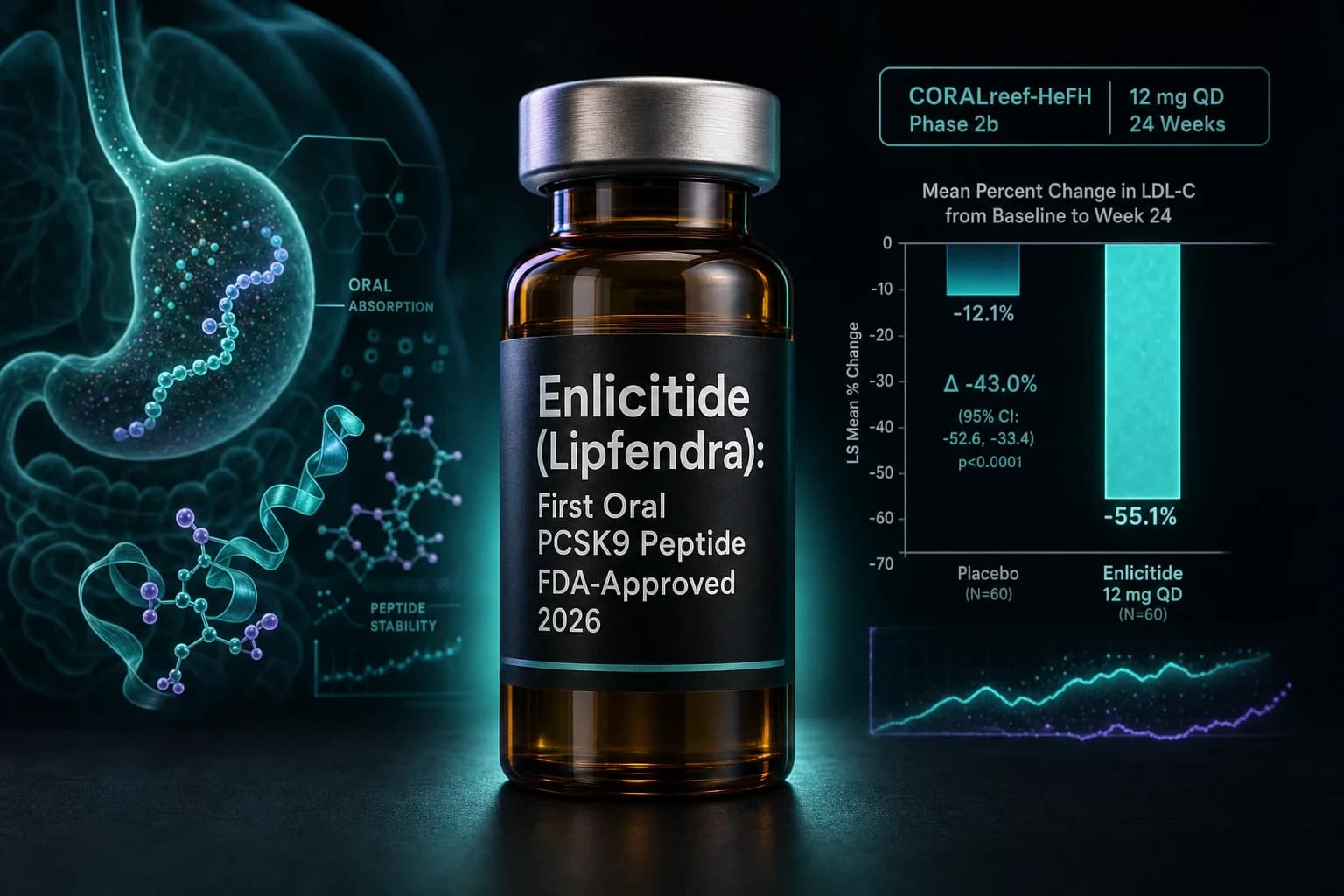
- CORALreef HeFH Phase 3: significant LDL-C reduction in heterozygous FH on statins (Ballantyne, JAMA 2026, PMID 41206969)
- CORALreef AddOn Phase 3: 64.6% LDL-C drop vs bempedoic acid, ezetimibe, or both (Catapano, JACC 2026, PMID 42017875)
- The molecule is a macrocyclic peptide from mRNA display screening, decanoate salt for oral bioavailability
The approval that broke a 20-year wait
On July 16, 2026, the FDA cleared Merck's Lipfendra (enlicitide decanoate) 20 mg tablets as a once-daily oral treatment for adults with hypercholesterolemia, including heterozygous familial hypercholesterolemia (HeFH). It is the first oral PCSK9 inhibitor approved anywhere in the world.
That last sentence is what actually matters. PCSK9 inhibition is not new. Alirocumab (Praluent) and evolocumab (Repatha) were approved in 2015 as injectable monoclonal antibodies, and inclisiran (Leqvio) landed in 2021 as a twice-yearly siRNA injection. All three cut LDL cholesterol by 50 to 60 percent. All three cost a fortune in payer negotiation and require a clinic visit or a self-injection every two to twelve weeks. Merck spent close to a decade trying to make the same mechanism swallowable, and until CORALreef Lipids hit its primary endpoint, most industry analysts assumed it would not happen.
Enlicitide got past that wall because it is a macrocyclic peptide: a cyclized 15-residue peptide with unnatural amino acids, discovered through mRNA display screening and formulated with a decanoate salt to survive the gut and cross the enterocyte membrane. For the peptides field the mechanism matters more than the LDL number. An oral cyclic peptide with monoclonal-antibody-class efficacy has been sitting in the "impossible bioavailability" bucket since the industry started paying attention to peptides. Enlicitide is the first drug to walk out of that bucket into a lipid-lowering approval.
Bottom line: Lipfendra is the first drug in history to deliver injectable-antibody-class LDL-C reduction from a once-daily pill, and the enabling technology (macrocyclic peptides from mRNA display) is a generalizable platform, not a one-off.
What Merck actually got approved
The label is narrow, at least for now:
- Indication. Adjunct to diet and, when indicated, other LDL-lowering therapies in adults with primary hyperlipidemia, including HeFH, to reduce LDL-C.
- Dose. 20 mg once daily, taken with or without food. No fasting requirement.
- Formulation. Immediate-release film-coated tablet of enlicitide decanoate. The decanoate salt is not a pro-drug; it is a permeation-enhancing counterion that improves the compound's low intrinsic oral bioavailability (roughly 2%) enough to reach therapeutic plasma exposure at a 20 mg dose.
- Mechanism. Binds a flat surface on the non-catalytic domain of PCSK9, preventing PCSK9 from docking onto the LDL receptor. LDL receptors are no longer marked for lysosomal degradation, so hepatocyte surface LDLR density rises and plasma LDL-C falls.
Cardiovascular outcomes have not yet been established. The CORALreef Outcomes trial (NCT06008756) is enrolling roughly 14,500 participants with a primary composite endpoint of MACE and is expected to read out in 2029 to 2030. Until then, the approval is a lipid-lowering approval, not a cardiovascular-event-reduction approval.
The Phase 3 evidence that got it there
Merck ran three registrational trials under the CORALreef umbrella. All three met their primary endpoint. Two are already published; the third is out in JACC as a full paper. The table below is the honest summary before you read anyone's marketing copy.
| Trial | N | Population | Comparator | LDL-C change vs comparator | Duration | Citation |
|---|---|---|---|---|---|---|
| CORALreef Lipids | 2,912 | ASCVD or high risk, on statins | Placebo | Approx. -55.8 pp at 24 wks, sustained to 52 wks | 52 wks | Navar 2026 NEJM |
| CORALreef HeFH | ~300 | Heterozygous familial hypercholesterolemia on statins | Placebo | Significant reduction (primary met) | 24 wks | Ballantyne 2026 JAMA |
| CORALreef AddOn | 301 | Statin-treated, LDL-C above goal | Ezetimibe, bempedoic acid, or both | -64.6% enlicitide vs -6.3% (bempedoic), -27.8% (ezetimibe), -36.5% (combo) | 56 days | Catapano 2026 JACC |
A few things worth pulling out of that table.
CORALreef Lipids is the study that anchored the approval. Participants had established atherosclerotic cardiovascular disease or were at high risk for a first event, were already on background statin therapy, and had LDL-C above 55 or 70 mg/dL depending on their risk profile. Randomization was 2:1 to enlicitide 20 mg or placebo, and the primary endpoint was mean percent change in LDL-C at week 24. Placebo-adjusted reduction was in the mid-50s (Navar et al., NEJM 2026). The effect held to week 52.
The AddOn trial is the more interesting one for practicing clinicians. It answered a specific question: if you have a statin-treated patient who is still above LDL goal, does enlicitide beat the current oral options? The comparators were the two therapies most guidelines recommend before you escalate to an injectable: ezetimibe and bempedoic acid, alone or together. Enlicitide dropped LDL-C by 64.6 percent. Bempedoic acid alone managed 6.3 percent. Ezetimibe alone managed 27.8 percent. Even the combination stopped at 36.5 percent (Catapano et al., JACC 2026). Not a close race.
Heterozygous FH is a narrower population and a harder problem. It is a monogenic condition in which one bad LDLR allele produces lifelong LDL exposure and early ASCVD, and most patients need something on top of high-intensity statin. In CORALreef HeFH, enlicitide reduced LDL-C significantly in this group, and the safety profile matched what the broader trial showed (Ballantyne et al., JAMA 2026).
How it stacks up against the injectables
This is the number most people care about. The injectable PCSK9 antibodies set the benchmark: 50 to 60 percent LDL-C reduction, once-every-two-weeks or once-monthly subcutaneous dosing, monoclonal antibody price tags. Enlicitide is competing on the biology, not just on the format.
| Agent | Class | Route | Dosing | Typical LDL-C reduction | Notes |
|---|---|---|---|---|---|
| Enlicitide (Lipfendra) | Macrocyclic peptide | Oral tablet | 20 mg once daily | ~55 to 60% vs placebo | First-in-class oral, FDA 07/2026 |
| Alirocumab (Praluent) | Monoclonal antibody | Subcutaneous | 75 to 150 mg every 2 weeks | ~50 to 60% | Approved 2015 |
| Evolocumab (Repatha) | Monoclonal antibody | Subcutaneous | 140 mg every 2 weeks or 420 mg monthly | ~55 to 60% | Approved 2015 |
| Inclisiran (Leqvio) | siRNA | Subcutaneous | 284 mg on day 1, month 3, then every 6 months | ~50% | Approved 2021 |
| Bempedoic acid | Small molecule ACLY inhibitor | Oral | 180 mg daily | ~15 to 25% | Alternative for statin-intolerant |
| Ezetimibe | Small molecule NPC1L1 inhibitor | Oral | 10 mg daily | ~15 to 25% | Cheap generic; often first oral add-on |
On raw LDL-lowering, enlicitide sits alongside the injectable antibodies rather than the oral add-ons. AJMC and TCTMD analyses of the Phase 3 data have flagged the reduction as numerically superior to inclisiran and comparable to alirocumab and evolocumab. The daily-versus-monthly dosing frequency is a genuine tradeoff: injectable antibodies win on adherence math (fewer decisions), oral pills win on onboarding friction (no needle, no cold-chain shipping).
Note: Enlicitide's mechanism is competitive PCSK9 binding, identical in target to alirocumab and evolocumab. Inclisiran is different: it silences PCSK9 mRNA in hepatocytes. If enlicitide is discontinued, effect washes out within days to weeks. If inclisiran is discontinued, effect persists for months. That matters for pill-skipping patients and for surgical planning.
Why the peptides field should care
Two decades of pharmaceutical work has repeated the same finding: peptides do not survive oral dosing. Gastric acid hydrolyzes them, proteases cleave them, and the ones that make it intact do not cross the enterocyte tight junction. The workarounds have been narrow. Oral semaglutide (Rybelsus) reaches ~1% bioavailability using the SNAC permeation enhancer and only if the patient takes it fasted with water and waits 30 minutes. Octreotide and desmopressin have oral formulations that require careful dosing. Nothing at monoclonal-antibody-class potency had crossed the line.
Enlicitide clears that line by engineering three things simultaneously. First, structural rigidity from cyclization stabilizes the peptide against gut proteases and lowers the entropic penalty of binding PCSK9. Second, unnatural amino acids installed at protease-susceptible sites remove the recognition motifs that trypsin, chymotrypsin, and elastase depend on. Third, the decanoate salt acts as a permeation enhancer at the enterocyte membrane, bumping oral bioavailability from a fraction of a percent to about 2 percent, enough to reach the required plasma exposure at 20 mg (Johns et al., Circulation 2023).
Merck's discovery paper credits mRNA display for the starting point. The technique lets you screen libraries of 10^12 or more cyclic peptides in vitro against a target and pull out the sub-nanomolar binders in a single afternoon. The hits get iterated through structure-based drug design, but the initial screen is what let them find a peptide capable of blocking a large flat protein-protein interface (PCSK9 to LDLR) that had defeated small-molecule campaigns for years. That is a platform, not a molecule. Expect other macrocyclic peptides on that platform to move through the clinic in the next five years: IL-17R, GLP-1R, and viral fusion targets are all being worked in this direction.
For the broader peptides space, this is the moment the "oral peptide" category stopped being a marketing bullet and started being a therapeutic modality. It also puts pressure on the injectable peptide model. Once a formulation team knows that macrocyclization plus mRNA display plus a permeation-enhancing counterion can move a peptide across the gut, the default answer to "does this need to be an injectable?" gets weaker every year. For a fuller sense of where oral peptide chemistry stands today, we cover the tradeoffs in injectable vs oral peptide bioavailability.
Where enlicitide will fit in practice
The Phase 3 data narrows the question but does not answer it. Cost, coverage, and cardiovascular outcomes data will decide the actual prescribing pattern. A rough decision map based on the current label and evidence:
| Patient profile | Likely first non-statin | Likely enlicitide fit |
|---|---|---|
| ASCVD, LDL-C above goal on max statin | Ezetimibe (cheap, familiar) | Escalate if LDL-C remains above goal after ezetimibe |
| HeFH, LDL-C above goal on max statin | Ezetimibe plus PCSK9 antibody today | Reasonable alternative to injectable PCSK9 if oral preferred |
| Statin-intolerant, LDL-C above goal | Bempedoic acid or ezetimibe | Strong case if 60% reduction actually needed |
| Needle-averse on injectable PCSK9 | Alirocumab or evolocumab | Straight switch, same target |
| Rate control priority, adherent to injections | Inclisiran (2x/yr) | Weak case; adherence already handled |
| Pediatric HeFH | Statin plus ezetimibe | Not currently indicated; label is adults only |
Three variables make or break the real-world impact.
Price and payer position. Merck has not published pricing at this writing, and the payer negotiations for an oral first-in-class agent competing with two established injectable antibodies will define the prescribing floor. If Lipfendra prices at or below the current PCSK9 antibody net cost, it takes share immediately. If it prices well above ezetimibe generic, it stays in the specialist channel.
Cardiovascular outcomes. CORALreef Outcomes will not read out for years. Until it does, cardiologists treating primary prevention patients will make a Bayesian bet: PCSK9 antibody CVOTs (FOURIER for evolocumab, ODYSSEY for alirocumab) showed roughly 15 percent relative MACE reduction. The mechanism is identical. The bet is that enlicitide inherits the outcome benefit. That bet is reasonable but not proven.
Adherence. Daily pills lose to biweekly or monthly injections in most adherence studies of chronic disease. But daily oral is a familiar dosing pattern for statin patients, and enlicitide is being layered onto a statin they are already taking daily. Whether adherence to enlicitide matches or beats injectable PCSK9 adherence is an open question that will get answered by real-world evidence in the first two years post-approval.
What we still do not know
Fair to publish, fair to say aloud in a clinic room:
- CV event reduction. Not established. Inferred from mechanism and comparator antibody CVOTs, but not directly demonstrated for enlicitide.
- Long-term safety. The Phase 3 program has approximately one year of follow-up on the primary cohort. Antibody PCSK9 inhibitors have accumulated close to a decade of safety data with no clinically meaningful signal at the mechanism level. Enlicitide is a peptide, not an antibody, and long-tail immunogenicity of a decanoate-formulated cyclic peptide is a live question that only postmarketing data will answer.
- Pregnancy, lactation, pediatrics. Not in the label.
- Interaction with cytochrome P450 substrates. Enlicitide is not a small molecule and does not appear to have the typical CYP-mediated interaction profile, but the full drug interaction package will land with the prescribing information.
- Compounded versions. Do not expect any. Enlicitide is a proprietary macrocyclic peptide with a synthesis pathway that Merck has been publishing incrementally, and the raw-material supply chain does not exist outside the sponsor for the foreseeable future. This is not a compound like tirzepatide or semaglutide where a gray market of research chemical suppliers exists.
For readers who follow the research peptide side of the market and are trying to distinguish credible vendors from noise, our Ascension Peptides review covers the vendor evaluation framework we use. Enlicitide itself is not a research peptide and will not appear from research chemical suppliers; treat any listing as a red flag for the entire supplier's catalog.
Bottom line
Lipfendra is the LDL story of 2026. It is also the largest oral peptide milestone since the 2019 Rybelsus approval. Merck delivered antibody-class LDL-C reduction from a once-daily pill, using a discovery platform (mRNA display plus macrocyclic peptide chemistry plus permeation-enhancing salt formulation) that generalizes to other protein-protein interaction targets. For patients above LDL goal on maximum-tolerated statin plus ezetimibe, enlicitide is a real alternative to injectable PCSK9 antibodies with comparable efficacy and different tradeoffs on dosing frequency, offset time, and (still to be settled) price. For the peptide field, the day this compound became a pill is the day the modality stopped being defined by injection.
The remaining work is on cardiovascular outcomes and postmarketing safety. Neither will land soon. In the meantime the label is what it is, the price will be what payers negotiate, and the CORALreef data speak clearly enough that "should this patient be on a PCSK9 inhibitor" is now a question about drug access, not needle preference.
References and further reading
- Johns DG et al. Orally Bioavailable Macrocyclic Peptide That Inhibits Binding of PCSK9 to the Low Density Lipoprotein Receptor. Circulation 2023;148:144-158. PMID 37125593
- Ballantyne CM et al. Phase 2b Randomized Trial of the Oral PCSK9 Inhibitor MK-0616. J Am Coll Cardiol 2023. PMID 36889610
- Navar AM et al. A Placebo-Controlled Trial of the Oral PCSK9 Inhibitor Enlicitide. N Engl J Med 2026;394(6):529-539. PMID 41879224
- Ballantyne CM et al. Efficacy and Safety of Oral PCSK9 Inhibitor Enlicitide in Adults With Heterozygous Familial Hypercholesterolemia. JAMA 2026;335(2):129-139. PMID 41206969
- Catapano AL et al. Oral PCSK9 Inhibitor Enlicitide Versus Oral Nonstatin Therapies: A Phase 3 Randomized Clinical Trial. J Am Coll Cardiol 2026. PMID 42017875
Related reading on this site:
- Aleniglipron ACCESS Phase 2b Oral GLP-1 Evidence Review
- Oral Semaglutide (Rybelsus) vs Orforglipron: Oral GLP-1 Comparison
- Injectable vs Oral Peptide Bioavailability Guide
- Semaglutide profile
- Tirzepatide profile
- Peptide reconstitution calculator
Disclaimer: This article is for research and educational purposes only. It is not medical advice and does not establish a clinician-patient relationship. Enlicitide (Lipfendra) is a prescription medication. Lipid-lowering therapy decisions should be made with a licensed clinician who can evaluate your cardiovascular risk, medications, and lab values.