At a glance
- ACCESS Phase 2b (36 wks): -11.3% placebo-adjusted weight loss at 120 mg (Rosenstock 2026, PMID 42249138)
- Open-label extension (56 wks): -16.2% total weight loss in the 90 mg arm, no plateau observed
- ACCESS II Phase 2 (44 wks): -16.3% at 180 mg and -16.0% at 240 mg, placebo-adjusted (topline March 2026)
- Fully Gs-biased small-molecule oral GLP-1 with near-zero beta-arrestin recruitment
- Phase 3 program planned Q3/Q4 2026 with a 2.5 mg titration start to improve GI tolerability
The 36-week readout
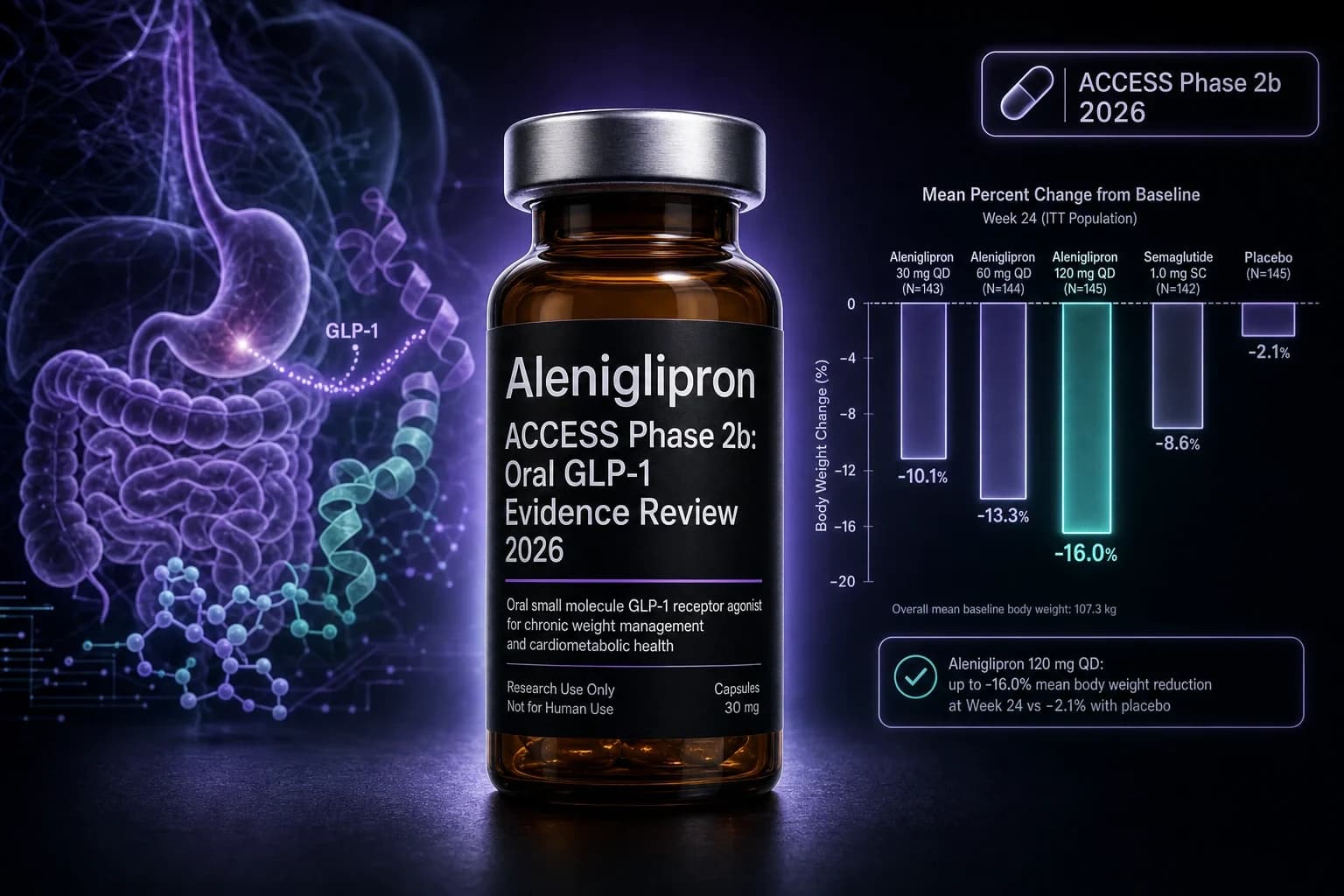
On June 5, 2026, Nature Medicine published the full ACCESS Phase 2b results for aleniglipron (development code GSBR-1290), Structure Therapeutics' once-daily oral small-molecule GLP-1 receptor agonist. The data had already been presented three weeks earlier at the ADA 86th Scientific Sessions in New Orleans by Julio Rosenstock of the Dallas Diabetes Research Center.
The headline number: -11.3% placebo-adjusted body weight change at week 36 at the 120 mg dose, with a 45/90/120 mg dose-response curve and no plateau at the primary endpoint (Rosenstock et al., Nat Med 2026, PMID 42249138). The open-label extension pushed the total weight loss from randomization to -16.2% at week 56 in the 90 mg arm.
Two things make this readout interesting beyond the numbers. First, aleniglipron is a fully G-protein-biased agonist with near-zero beta-arrestin recruitment, a more selective signaling profile than orforglipron. Second, ACCESS is not the ceiling. Structure Therapeutics reported topline data from a companion Phase 2 trial (ACCESS II) at higher doses in March 2026, hitting placebo-adjusted weight loss of -16.3% at 180 mg and -16.0% at 240 mg at 44 weeks.
Bottom line: ACCESS Phase 2b puts aleniglipron in a credible efficacy tier next to orforglipron on the ACCESS dose range, and the ACCESS II higher-dose readout closes the gap toward semaglutide-class injectable numbers on an oral small molecule.
What aleniglipron actually is
Aleniglipron is a non-peptide, oral small-molecule GLP-1 receptor agonist. Chemically it has nothing in common with semaglutide, tirzepatide, or the other peptide analogs. Structure Therapeutics designed it as a G-protein-biased agonist, meaning it activates the Gαs cAMP signaling arm of the GLP-1R with high potency while producing negligible beta-arrestin recruitment.
That distinction matters mechanistically. Peptide GLP-1 agonists engage both signaling arms; beta-arrestin engagement drives receptor internalization and desensitization, and preclinical work has argued it contributes to GI side effects and metabolic tolerance. Aleniglipron is closer to the pure Gs-biased end of the spectrum than orforglipron, which has partial bias but still recruits some beta-arrestin. Structural work indicates aleniglipron binds a deep orthosteric cavity within the transmembrane domain (TM1, TM2, TM7) without engaging the receptor's extracellular domain, which is the structural basis for the selective coupling.
Practically, the profile has three implications:
- Once-daily oral dosing, with no fasting requirement and no fluid restriction. Unlike oral semaglutide (Rybelsus), which requires a fasted stomach and a 30-minute wait before food, aleniglipron is dosed like any conventional pill.
- No injection, which is the entire commercial thesis for small-molecule oral GLP-1s. Compared to weekly semaglutide or tirzepatide injections, a daily pill removes the sharps, the refrigeration hassle, and the needle barrier.
- Higher achievable exposure. Peptide oral GLP-1s cap out on absorption because the SNAC enhancer and the peptide itself are the bottleneck. Small molecules with passive absorption can be titrated to higher plasma exposure, which is exactly what ACCESS II tested with the 180 and 240 mg arms.
For a broader mechanistic frame on where small-molecule oral GLP-1s fit against peptides, see injectable vs oral peptide bioavailability.
ACCESS Phase 2b: the primary endpoint data
The ACCESS Phase 2b study (ClinicalTrials.gov NCT06693843) randomized 230 adults with obesity or overweight and at least one weight-related comorbidity, mean BMI 39.5 kg/m², 54% female. Participants were randomized to placebo or aleniglipron escalated every 4 weeks to a target maintenance dose of 45, 90, or 120 mg once daily. The primary endpoint was percent change in body weight from baseline at week 36 (Rosenstock et al., Nat Med 2026, PMID 42249138).
The efficacy readout:
| Dose | Week 36 placebo-adjusted weight change | P value |
|---|---|---|
| Aleniglipron 45 mg | -8.2% | <0.0001 |
| Aleniglipron 90 mg | -9.8% | <0.0001 |
| Aleniglipron 120 mg | -11.3% | <0.0001 |
Three details worth pulling out of the table:
- The dose-response is monotonic through 120 mg. There is no efficacy inversion at the top dose, which is not always true for oral GLP-1s with tolerability-limited dose ranges.
- No plateau at week 36. The weight loss curves for all three active arms were still declining when the primary endpoint hit. That is consistent with the Phase 2b/Phase 3 pattern for tirzepatide SURMOUNT-1 and retatrutide TRIUMPH-1, where the 68 to 72-week endpoint was materially larger than the 36-week point.
- Sample size was 230, which is smaller than the 310 participants in AstraZeneca's elecoglipron VISTA. Phase 2b sample size does not typically move the efficacy point estimate much, but it does affect the confidence bands. Phase 3 sample sizes for ATTAIN-1 (orforglipron) were 3,127.
The 56-week extension: no plateau yet
The ACCESS Phase 2b protocol included an open-label extension. Participants who completed the double-blind 36 weeks continued on their randomized aleniglipron dose. An interim analysis after a median 20 additional weeks (week 56 from randomization) reported total weight loss from baseline of:
| Dose | Week 56 total weight loss (open-label extension interim) |
|---|---|
| Aleniglipron 45 mg | -13.3% |
| Aleniglipron 90 mg | -16.2% |
| Aleniglipron 120 mg | -15.3% |
The extension data confirm that the weight loss curve is still moving at week 56 across all three doses. The 90 mg arm coming in above 120 mg at 56 weeks is not unusual for an open-label extension in a study of this size, since a small number of dropouts or GI-driven dose reductions in the 120 mg arm are enough to invert the ordering in a subset that size. What matters for the Phase 3 read is the trajectory, not the ordering.
For context, Wegovy's STEP-1 hit -14.9% at week 68 on subcutaneous semaglutide 2.4 mg. If aleniglipron's 90 mg extension curve holds slope through Phase 3, the compound will land within striking distance of semaglutide-class injectable efficacy on an oral pill, without the food/fluid timing constraint of Rybelsus.
ACCESS II: pushing the dose higher
ACCESS II is a separate Phase 2 study of aleniglipron at 180 mg and 240 mg once daily. Structure Therapeutics reported 44-week topline data in a March 16, 2026 press release:
| Dose | Week 44 placebo-adjusted weight change | P value |
|---|---|---|
| Aleniglipron 180 mg | -16.3% (39 lb absolute) | <0.0001 |
| Aleniglipron 240 mg | -16.0% (37 lb absolute) | <0.0001 |
Three implications:
- The dose-response has flattened between 180 and 240 mg. Getting -16.3% at 180 mg and -16.0% at 240 mg is essentially the same number, which means aleniglipron's efficacy ceiling on this trial design is likely near 180 mg. Phase 3 will almost certainly land on 180 mg or below as the maintenance target.
- 44-week efficacy at 180 mg matches 56-week efficacy at 90 mg in the ACCESS extension. That is either time or dose scaling. Higher-dose Phase 3 with a longer duration is what would settle whether these curves converge or diverge.
- The AE-related discontinuation rate in the ACCESS II open-label extension was 2%, with 3.4% in the body composition sub-study. Those are low numbers for a GLP-1 program at this dose and duration, which is the second-most important observation in the ACCESS II readout after the efficacy number.
The full peer-reviewed ACCESS II manuscript has not yet been published as of July 2026. Topline press-release numbers are not the same evidence tier as the peer-reviewed Nature Medicine ACCESS Phase 2b paper, and readers should treat them as pre-print grade until the manuscript arrives. Historically, Structure Therapeutics topline numbers have held up in publication.
The 2.5 mg slow-titration study
Alongside ACCESS and ACCESS II, Structure Therapeutics ran a smaller body-composition study using a more conservative titration schedule: start at 2.5 mg once daily, escalate monthly toward 120 mg. Interim analysis at 20 weeks reported 6.8% weight loss with manageable tolerability and no reported AE-related discontinuations at the pre-specified analysis point.
The 2.5 mg starting dose is what Structure Therapeutics has said Phase 3 will use. That matters because tolerability at initiation is the single largest driver of real-world GLP-1 discontinuation, and a slow ramp is what separated tirzepatide from earlier GLP-1s on adherence. Aleniglipron Phase 3 is designed around the tolerability lesson, alongside the efficacy peak.
Tip: The 2.5 mg to 120 mg monthly titration mirrors the strategy tirzepatide used to get through Phase 3. If Structure Therapeutics holds this schedule, expect first-month GI events to look meaningfully lower than the ACCESS Phase 2b numbers, which used a faster ramp.
Safety and tolerability: what actually happened
Small-molecule oral GLP-1s have had two safety questions haunting the category. Pfizer's danuglipron program was shut down in April 2025 after a single case of drug-induced liver injury in dose optimization (Pfizer press release). The GI-tolerability question has been a persistent limiter for the whole class.
Aleniglipron's ACCESS Phase 2b safety profile:
- AE-related discontinuation: 10.4% in the double-blind period. That is higher than orforglipron ATTAIN-1 (roughly 8%) but in the same range as most Phase 2b GLP-1 obesity trials. The ACCESS II open-label extension discontinuation rate dropped to 2%, likely reflecting selection of tolerant participants and a slower titration.
- GI adverse events typical of the class: nausea, vomiting, diarrhea, constipation, mostly mild-to-moderate. Structure Therapeutics has not published event-level rates in the topline, and the Nature Medicine paper is the definitive source.
- No liver safety signal in the ACCESS Phase 2b or ACCESS II readouts. This is the danuglipron shadow, and aleniglipron has passed it at Phase 2b exposure. Phase 3 sample size will determine whether that holds through several thousand participants.
- No off-target events flagged in the ACCESS II March 2026 announcement.
Warning: Phase 2b trials are not powered to detect rare safety signals. Danuglipron's liver injury case appeared in dose-optimization work, not in early Phase 2b weight readouts. Phase 3 aleniglipron data, particularly across the 180 mg arm and the longer exposure, should be the gating event for safety conclusions.
How aleniglipron stacks up in the oral GLP-1 field
There are now five oral GLP-1 receptor agonists with credible human data. Aleniglipron sits in a specific tier defined by its higher-dose efficacy and its biased-agonist mechanism.
| Compound | Sponsor | Type | Status | Best weight loss readout |
|---|---|---|---|---|
| Oral semaglutide (Rybelsus) 50 mg | Novo Nordisk | Peptide + SNAC enhancer | Approved T2D; weight management filed | ~15.1% at 68 wks (OASIS-1) |
| Orforglipron | Eli Lilly | Small molecule, partial Gs bias | FDA approved Apr 2026 (weight management) | ~12.4% at 72 wks (ATTAIN-1, PMID 40960239) |
| Elecoglipron (AZD5004) | AstraZeneca / Eccogene | Small molecule, Gs-biased | Phase 2 complete; Phase 3 starting | 11.8% at 36 wks (VISTA) |
| Aleniglipron (GSBR-1290) | Structure Therapeutics | Small molecule, fully Gs-biased | Phase 2/2b complete; Phase 3 late 2026 | -11.3% (36 wks, 120 mg); -16.3% (44 wks, 180 mg) |
| Ecnoglutide | Sciwind | Peptide, biased | Phase 3 topline | ~15.0% at 40 wks (SCIRIO-1) |
| Danuglipron | Pfizer | Small molecule | Discontinued Apr 2025 | Discontinued (liver signal) |
A few reads on this table:
- On the ACCESS core dose range (45 to 120 mg), aleniglipron and orforglipron produce broadly comparable weight loss at the same time point. On the ACCESS II range (180 to 240 mg), aleniglipron is above orforglipron's approved 36 mg efficacy ceiling. The Phase 3 target dose is the next fork in the road.
- Oral semaglutide 50 mg still leads on absolute Phase 3 efficacy in the OASIS trials, but with the fasting-and-fluid-timing constraint. Aleniglipron's practical dosing convenience is a real advantage if it can hold the higher-dose curves in Phase 3.
- Ecnoglutide is a peptide, not a small molecule, and its biased-agonist story is a related but distinct mechanism.
- The Danuglipron row is the reason regulators will read the aleniglipron Phase 3 safety data carefully, not because they are the same drug but because they are the same category.
For the broader pipeline map, see GLP-1 amylin combination pipeline 2026, VK2735 oral/subcutaneous Phase 2, and the glp-1 dosing comparison 2026.
The biased-agonism story, honestly
Structure Therapeutics has leaned hard on aleniglipron's near-complete G-protein bias in investor materials and scientific presentations. The pitch is that avoiding beta-arrestin recruitment produces a cleaner receptor engagement, less internalization, less desensitization, and (theoretically) better GI tolerance and metabolic durability.
Here is the honest read on that story:
- The receptor pharmacology is real. In vitro assays consistently show aleniglipron activates cAMP with high potency while producing negligible beta-arrestin recruitment, which is a different profile than orforglipron's partial bias.
- The clinical translation of biased signaling is not established. Preclinical mouse work has argued that abolishing beta-arrestin engagement improves anti-hyperglycemic effect (Hinds et al., Diabetes Obes Metab 2024), but no head-to-head clinical trial has isolated bias as the variable. ACCESS Phase 2b did not clinically distinguish aleniglipron from orforglipron on tolerability in a way that requires the bias explanation.
- The commercial reason bias matters is the manufacturing. Small-molecule oral GLP-1s with tight receptor selectivity are patentable in ways that peptide analogs are not. Bias is part of the differentiation story, but it is not proven to be the reason the drug works clinically.
The right way to read the aleniglipron biased-agonism angle is that it is a promising mechanistic hypothesis that has not been clinically isolated. It may or may not translate into a durability or tolerance advantage. The efficacy numbers stand on their own without it.
For a parallel story on biased signaling in a peptide GLP-1, see ecnoglutide, the biased-agonist Phase 3.
Phase 3 timeline and what to watch
Structure Therapeutics has confirmed an End of Phase 2 meeting with the FDA in Q2 2026 and Phase 3 initiation in 2H 2026, using a 2.5 mg starting dose with monthly titration. Based on typical timelines, first patient dosing would land in late Q3 or Q4 2026, with a 68 to 72 week primary endpoint and readouts likely in 2028 to 2029. FDA filing on positive data would push approval to 2029 or 2030 at earliest.
Three specific milestones worth watching:
- The Phase 3 target maintenance dose. If it is 120 mg or below, Structure Therapeutics is playing the tolerability side of the tradeoff. If it is 180 mg, they are chasing the ACCESS II ceiling.
- The Phase 3 comparator design. An active comparator against orforglipron would be the most informative trial, but it would require Lilly's cooperation. A comparator against oral semaglutide is more likely and would benchmark against the currently-marketed oral standard.
- The cardiovascular outcomes program. Orforglipron ATTAIN-CVOT, semaglutide SELECT, and tirzepatide SURPASS-CVOT have all set a cardiovascular-outcomes bar for the class. Aleniglipron will need to plan its own outcomes program in parallel to Phase 3, not after.
What this readout actually changes today
For the people who read this site to research peptide options, aleniglipron does two practical things today:
It tightens the oral GLP-1 competitive map. Orforglipron was already approved, elecoglipron has cleared Phase 2, and now aleniglipron has two Phase 2 readouts with 44 to 56 week durability. By 2029 to 2030 the oral GLP-1 category is likely to have three approved competitors, plus oral semaglutide already in market. Price pressure and access should improve substantially versus the current mostly-injectable category.
It does not change what is buyable today. Aleniglipron is investigational. It is not sold anywhere as a compounded prescription, an off-label vial, or a research chemical. Anyone trying to sell aleniglipron in 2026 is selling something that either is not what it claims to be, or is upstream of an approved drug and off-label at best.
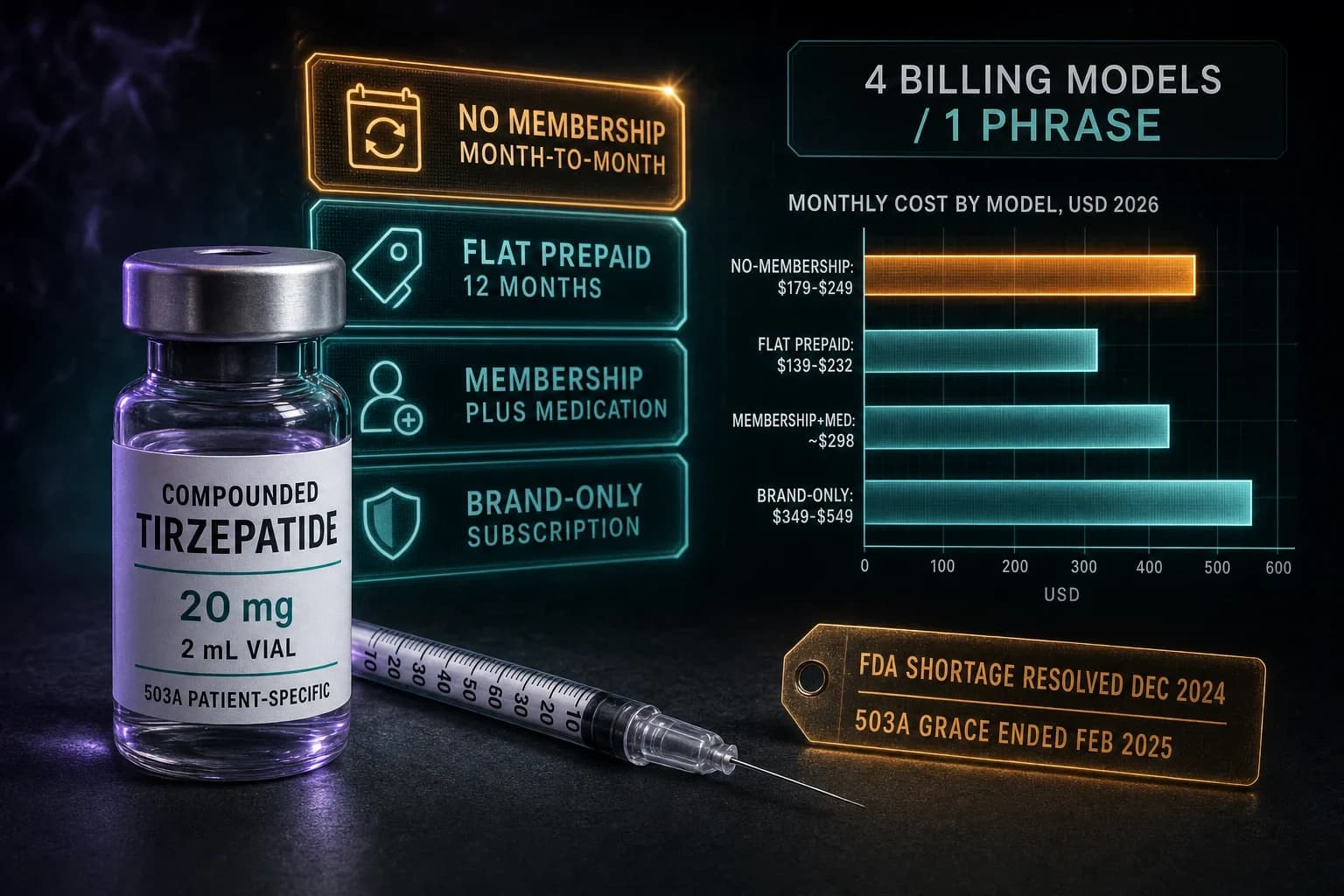
If you want the currently-available compounded GLP-1 pathway, telehealth providers like Yucca Health prescribe compounded tirzepatide through licensed clinicians. If price is the primary constraint, the cheapest GLP-1 comparison shows where entry pricing lands across the category. If you are researching the injectable-vial side of GLP-1s, Ascension Peptides is our reviewed vendor for research-grade semaglutide, tirzepatide, and retatrutide with 50% off using code ENHANCED. Aleniglipron itself is years from any legitimate consumer channel.
How to track aleniglipron from here
The next data drop is likely to be either an extended ACCESS II analysis at EASD 2026 (September) or AHA Scientific Sessions (November), or the ACCESS II full manuscript publication in a peer-reviewed journal. Structure Therapeutics has historically published within 6 to 12 months of topline release, which would put the ACCESS II paper in Q3 to Q4 2026.
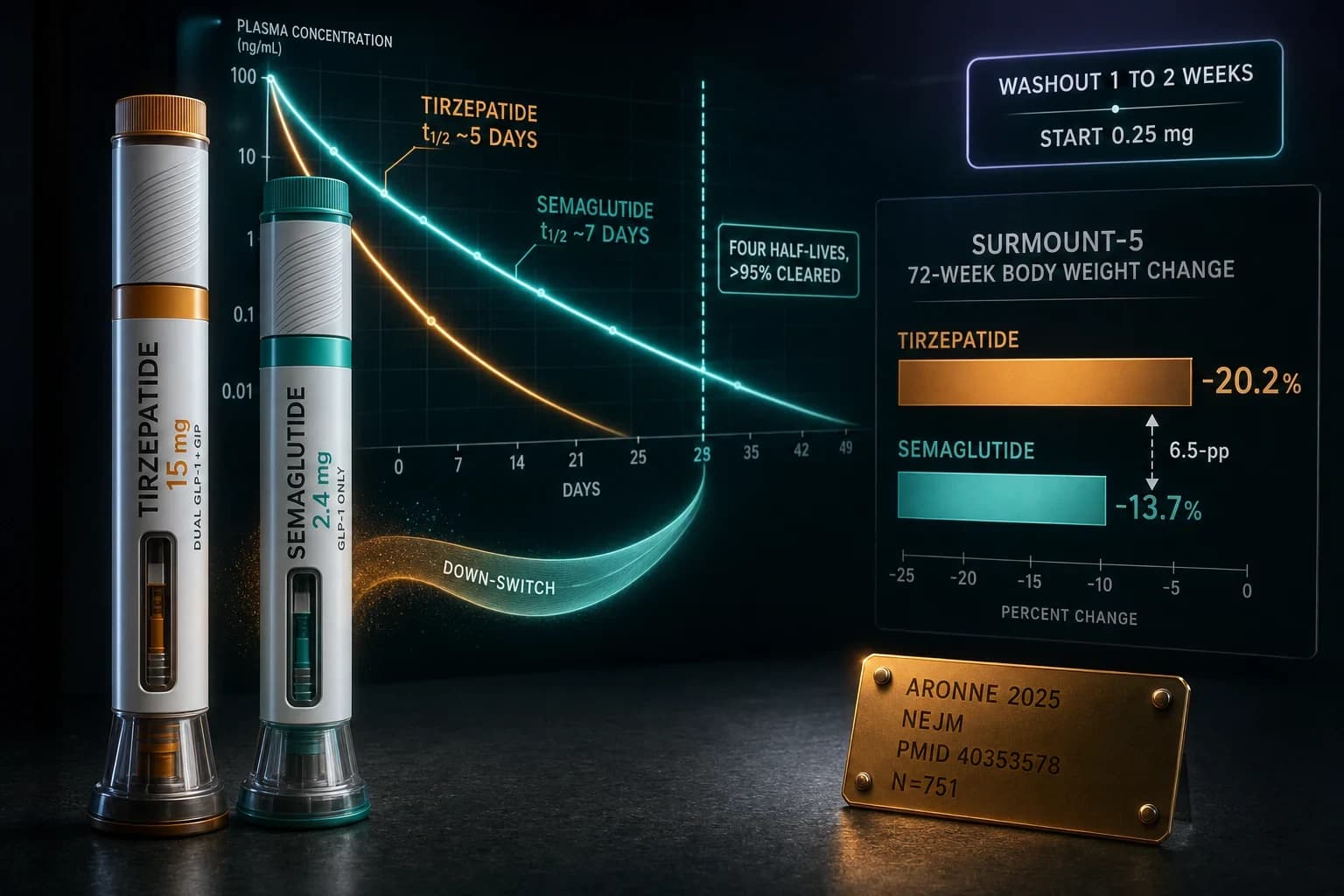
For broader GLP-1 pipeline tracking, see the retatrutide TRIUMPH-1 Phase 3 topline coverage, the tirzepatide SURMOUNT-5 head-to-head data, and the maridebart cafraglutide Phase 2 evidence. Together they map the four competitive vectors on the near horizon: triple agonists, monthly long-acting peptides, small-molecule oral agonists, and dual GLP-1/amylin combinations.
Bottom line: Aleniglipron ACCESS Phase 2b is the strongest Phase 2b readout to date for a fully G-protein-biased small-molecule oral GLP-1. The 45 to 120 mg range is competitive with orforglipron and elecoglipron; the 180 to 240 mg ACCESS II range closes toward semaglutide-class injectable efficacy on an oral pill. Phase 3 target dose selection and long-duration safety are the two Phase 3 milestones that matter.
This article is for research and educational purposes. Aleniglipron is an investigational compound and is not approved for clinical use in any country. Phase 2 trial results do not establish clinical efficacy or safety for any patient population. Cited studies are linked directly to PubMed or publisher pages. None of the content here constitutes medical advice. Consult a licensed physician for any individual treatment decision.