At a glance
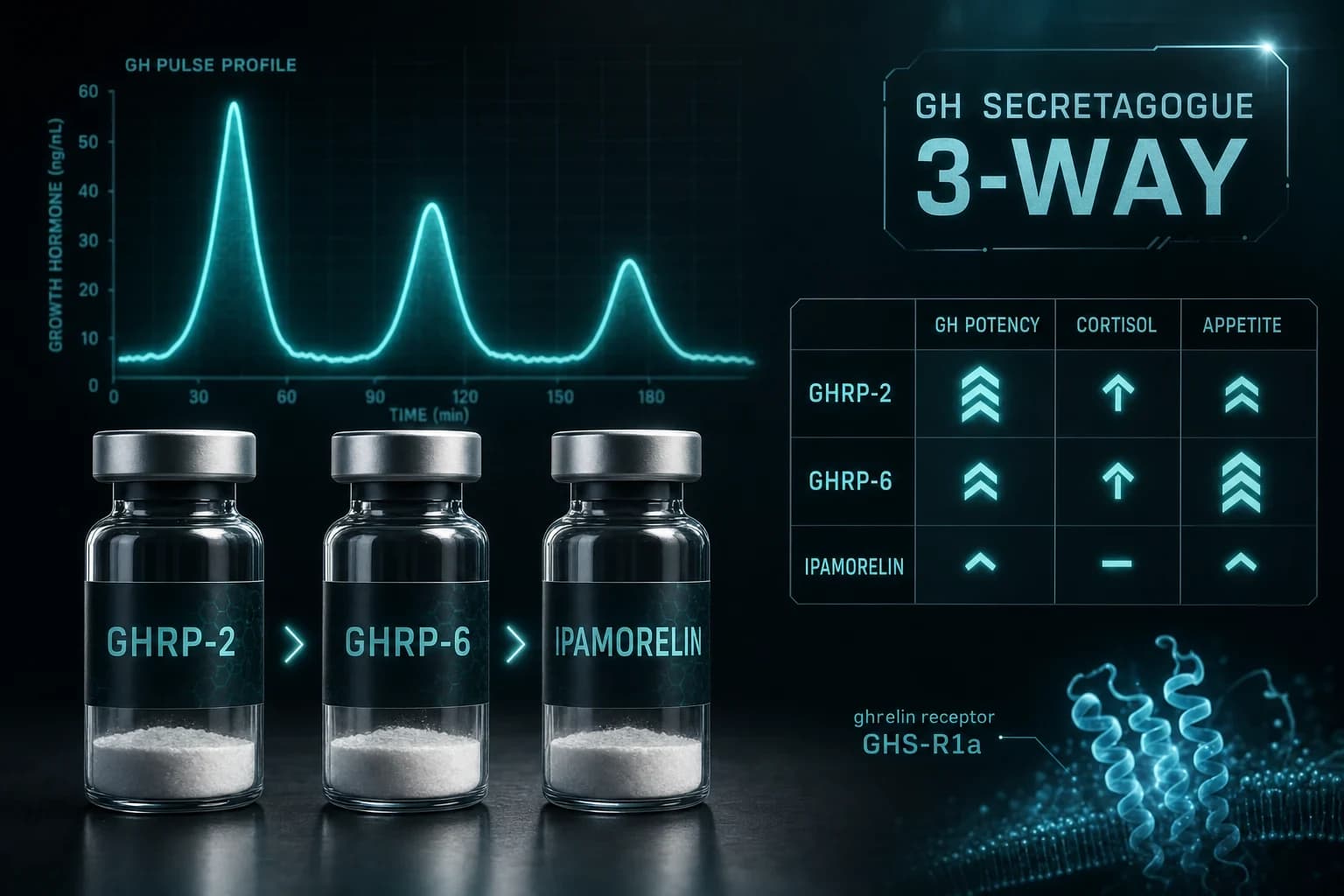
- All three activate the ghrelin receptor (GHS-R1a); GHRP-2 is the most potent (swine ED50 ~0.6 nmol/kg)
- GHRP-2 raised food intake 35.9% in healthy men (Laferrère 2005); GHRP-6 drives the strongest hunger
- Ipamorelin releases GH with no cortisol or ACTH rise, even at 200x its GH ED50 (Raun 1998)
- Half-lives are short: GHRP-2 ~30 min, ipamorelin ~2 h; all dosed around 100 mcg in research
- Pairing any GHRP with CJC-1295 (a GHRH analog) drives synergistic GH release (Bowers 1990)
Three peptides, one receptor, three very different outcomes
GHRP-2, GHRP-6, and Ipamorelin all lock onto the same target: the growth hormone secretagogue receptor (GHS-R1a), better known as the ghrelin receptor. Bind it, and the pituitary releases a pulse of growth hormone. So why does half the internet treat these three as interchangeable when the published pharmacology says they clearly are not?
The differences are not cosmetic. One of them makes research subjects ravenously hungry inside 20 minutes. One reliably bumps cortisol and ACTH. One does neither and barely moves anything except GH. Choose the wrong peptide for your research question and you inherit a confound you never wanted, or a side effect you cannot explain away.
Here is the short version, then the data underneath it.
If you want the cleanest GH pulse with the fewest moving parts, Ipamorelin is the answer. If you want the biggest single GH spike per microgram, GHRP-2 wins. If you are studying appetite or ghrelin signaling itself, GHRP-6 is the tool built for exactly that. Everything below explains why.
They share a mechanism, not a personality
All three are synthetic ghrelin mimetics. GHRP-6 came first (a hexapeptide, His-D-Trp-Ala-Trp-D-Phe-Lys), GHRP-2 followed as a more potent hexapeptide, and Ipamorelin arrived as a redesigned pentapeptide engineered specifically to strip out the off-target effects.
Each one binds GHS-R1a on the pituitary somatotroph and triggers GH release through the phospholipase C / IP3 / calcium cascade. That pathway is distinct from the cAMP route used by growth hormone releasing hormone (GHRH), which is why GHRPs and GHRH analogs like CJC-1295 stack so well (more on that later).
The catch is that GHS-R1a is not confined to the pituitary. It also sits in the hypothalamic arcuate nucleus, where ghrelin drives hunger, and it has crosstalk with the hypothalamic-pituitary-adrenal (HPA) axis. GHRP-6 and GHRP-2 activate all of it. Ipamorelin was designed to activate only the part you want.
The three-way comparison at a glance
| Property | GHRP-2 | GHRP-6 | Ipamorelin |
|---|---|---|---|
| Peptide class | Hexapeptide | Hexapeptide (the original GHRP) | Pentapeptide |
| GH potency (swine ED50) | ~0.6 nmol/kg (highest) | ~3.9 nmol/kg | ~2.3 nmol/kg |
| Appetite | Moderate (+35.9% food intake) | Strongest hunger of the three | Minimal to none |
| Cortisol / ACTH / prolactin | Elevated | Elevated | No significant change |
| Terminal half-life | ~30 min | Short (~15-60 min) | ~2 h |
| GH peak after dose | ~30-45 min | ~30-45 min | ~40 min |
| Typical research dose | ~100 mcg | ~100 mcg | ~100 mcg |
| Best research use | Maximum GH pulse | Appetite / ghrelin models | Clean GH, longer cycles |
The ED50 values come straight from the head-to-head swine work in Raun et al. (1998), the paper that introduced Ipamorelin. Read the potency row carefully, because it upends the usual assumption.
GH potency: GHRP-2 wins on paper
The counterintuitive part first. GHRP-2 is the most potent of the three on a molar basis. In conscious swine, Raun et al. (1998) measured a GH ED50 of roughly 0.6 nmol/kg for GHRP-2, versus 3.9 nmol/kg for GHRP-6 and 2.3 nmol/kg for Ipamorelin. Lower ED50 means less peptide to hit the half-maximal response. GHRP-2 gets there with the least material.
That is why GHRP-2 has a reputation as a "3x GHRH" secretagogue and why it was studied as a diagnostic GH stimulation agent and even as a pediatric short-stature therapy in some countries. It is a serious GH releaser.
Ipamorelin lands in the middle on potency, but with an important footnote from the same study: its maximal GH response (Emax) in swine was essentially equal to GHRP-6, around 65 versus 74 ng/mL. So Ipamorelin is not a weak peptide. It reaches a comparable ceiling; it just needs a bit more to get there than GHRP-2 does.
GHRP-6 is the least potent per microgram of the three. Its historical value was never raw potency. It was the appetite effect.
Bottom line: On pure GH-per-microgram, the ranking is GHRP-2 > Ipamorelin > GHRP-6. But potency alone is the wrong way to choose, because the side effects diverge far more than the GH output does.
Appetite: GHRP-6 is the hunger switch
This is where the three peptides split hardest.
GHRP-6 is the closest thing to injectable ghrelin. It hits the arcuate nucleus, activates the NPY/AgRP orexigenic neurons, and produces intense hunger 15 to 30 minutes after a dose. In animal models GHRP-6 reliably drives food intake and fat accrual, and Granado et al. (2010) showed the weight-gain effect is potentiated by insulin, with GHRP-6 and insulin acting additively on visceral fat accrual in diabetic rats. If your research question is about appetite, ghrelin signaling, or cachexia models, that "side effect" is the entire point.
GHRP-2 is hungry too, just less relentlessly. In one of the few clean human datasets, Laferrère et al. (2005) infused GHRP-2 into healthy men and measured a 35.9% increase in food intake at a buffet meal versus saline, with subjects self-reporting greater hunger. That is a large, quantified, human-confirmed appetite effect, comparable in magnitude to ghrelin itself.
Ipamorelin is the outlier. At GH-releasing doses it produces little to no appetite response. This is the practical reason so many recovery, sleep, and body-composition protocols default to Ipamorelin: nobody wants a 35% appetite spike before bed.
Cortisol and prolactin: why Ipamorelin earns "the clean one"
The single biggest reason to reach for Ipamorelin over the older GHRPs is the HPA axis.
Both GHRP-2 and GHRP-6 raise ACTH and cortisol. Raun et al. (1998) stated it plainly: administration of GHRP-6 and GHRP-2 increased plasma ACTH and cortisol, while Ipamorelin did not. The clinical literature backs this up. Oliveira et al. (2003) used GHRP-6 specifically because it stimulates ACTH and cortisol release, testing it as a diagnostic probe in Cushing's disease. A peptide reliable enough to diagnose adrenal pathology is not one you want raising cortisol by accident.
Ipamorelin's selectivity is not marginal. In the Raun work, Ipamorelin failed to move ACTH or cortisol above GHRH-equivalent levels even at doses more than 200 times its GH ED50. The authors called it "the first selective growth hormone secretagogue," with a selectivity profile resembling GHRH rather than the older GHRPs. Prolactin follows the same pattern: elevated with GHRP-2 and GHRP-6, flat with Ipamorelin.
Why does this matter for a research protocol? Chronically elevated cortisol works against most of the reasons someone studies GH secretagogues in the first place. It is catabolic to muscle, it degrades sleep quality, and it promotes central fat storage. Running GHRP-6 daily for the GH and quietly getting a cortisol bump alongside it is working at cross purposes.
Note: These hormonal readouts come from animal and clinical-population studies, not from healthy-adult daily-use trials. There is no long-term human safety dataset for any of these three peptides used the way the research community actually uses them.
Half-life and dosing: all short, all around 100 mcg
None of these peptides linger. Short half-lives are a feature here, because a sharp on/off pulse mimics natural GH physiology better than a flat, sustained level.
GHRP-2 clears fastest. A phase I pharmacokinetic study in children, Pihoker et al. (1998), fit GHRP-2 disposition to a biexponential model with a terminal half-life of 0.55 hours, roughly 33 minutes. Ipamorelin sits a bit longer. Gobburu et al. (1999) modeled it in human volunteers and reported a terminal half-life near 2 hours with the GH peak around 40 minutes (0.67 h) post-dose. GHRP-6 is also short-acting, on the order of 15 to 60 minutes.
The practical research dose converges for all three at approximately 100 mcg per administration, often timed to a fasted window because elevated insulin and free fatty acids blunt the GH response. The saturating dose (the point past which more peptide adds little extra GH) is commonly cited near 100 mcg, which is why higher doses mostly buy more side effects rather than more GH. Getting from a milligram vial to a 100 mcg draw is pure dilution math, and the reconstitution calculator handles the bacteriostatic-water ratios so you are not eyeballing units.
The real move: pair a GHRP with CJC-1295
Here is the part experienced researchers already know. You rarely run a GHRP alone.
GHRPs and GHRH analogs activate two different receptor systems, and combined they release far more GH than either does solo. Bowers et al. (1990) demonstrated this in normal men decades ago: submaximal doses of GHRP plus GHRH stimulated GH release synergistically, not just additively. GHRH (or its long-acting analog CJC-1295) primes the somatotroph through the cAMP pathway; the GHRP triggers release through the calcium pathway. Prime plus trigger beats either signal alone.
That is why the classic pairing is a GHRP with CJC-1295, most often the no-DAC form for a discrete pulse. Ipamorelin is the usual partner precisely because of its clean profile: you get the GHRH-plus-ghrelin synergy without dragging cortisol and appetite along for the ride. Swap in GHRP-2 and you trade a little cleanliness for a bigger peak; swap in GHRP-6 and you are essentially adding an appetite stimulant to your GH protocol.
So which one should you use?
Match the peptide to the research endpoint, not to a forum ranking.
Choose Ipamorelin if you want GH release with the fewest confounds: no cortisol bump, no prolactin, no appetite surge. It is the right default for longer cycles and for anyone stacking with CJC-1295, because the selectivity that Raun measured is real and reproducible.
Choose GHRP-2 if the goal is the largest GH pulse per microgram and you can tolerate a modest cortisol and appetite response. It is the most potent GH releaser of the three and the one with the most human GH-stimulation history.
Choose GHRP-6 if appetite or ghrelin biology is the actual subject of study. Its strong, ghrelin-like hunger effect is a liability for a lean-out protocol and an asset for a cachexia or feeding-behavior model.
Honesty check: all three are research compounds. The human data is thin, dominated by acute single-dose studies, diagnostic-probe work, and pediatric or clinical-population trials rather than the healthy-adult daily-use context in which they are typically discussed. The animal pharmacology is solid; the long-term human safety picture is not filled in. Treat the numbers here as mechanistic evidence, not a green light.
For side-by-side depth on each compound, the individual guides go further: GHRP-2, GHRP-6, and Ipamorelin.
Bottom line: GHRP-2 for the biggest pulse, GHRP-6 for appetite research, Ipamorelin for a clean pulse with no cortisol or hunger. Most researchers land on Ipamorelin plus CJC-1295 because it captures the GH synergy without the baggage.
Injectable research peptides, including Ipamorelin, GHRP-2, GHRP-6, and CJC-1295, are available from Ascension Peptides with 50% off using code ENHANCED. Cross-check HPLC in the lab-tests library.
Disclaimer
This article is for research and educational purposes only. It is not medical advice. GHRP-2, GHRP-6, and Ipamorelin are research compounds and are not approved for human therapeutic use in most jurisdictions. Nothing here is a recommendation to administer any peptide. Consult a qualified physician before making any health decision, and comply with all applicable laws and regulations governing research chemicals.