At a glance
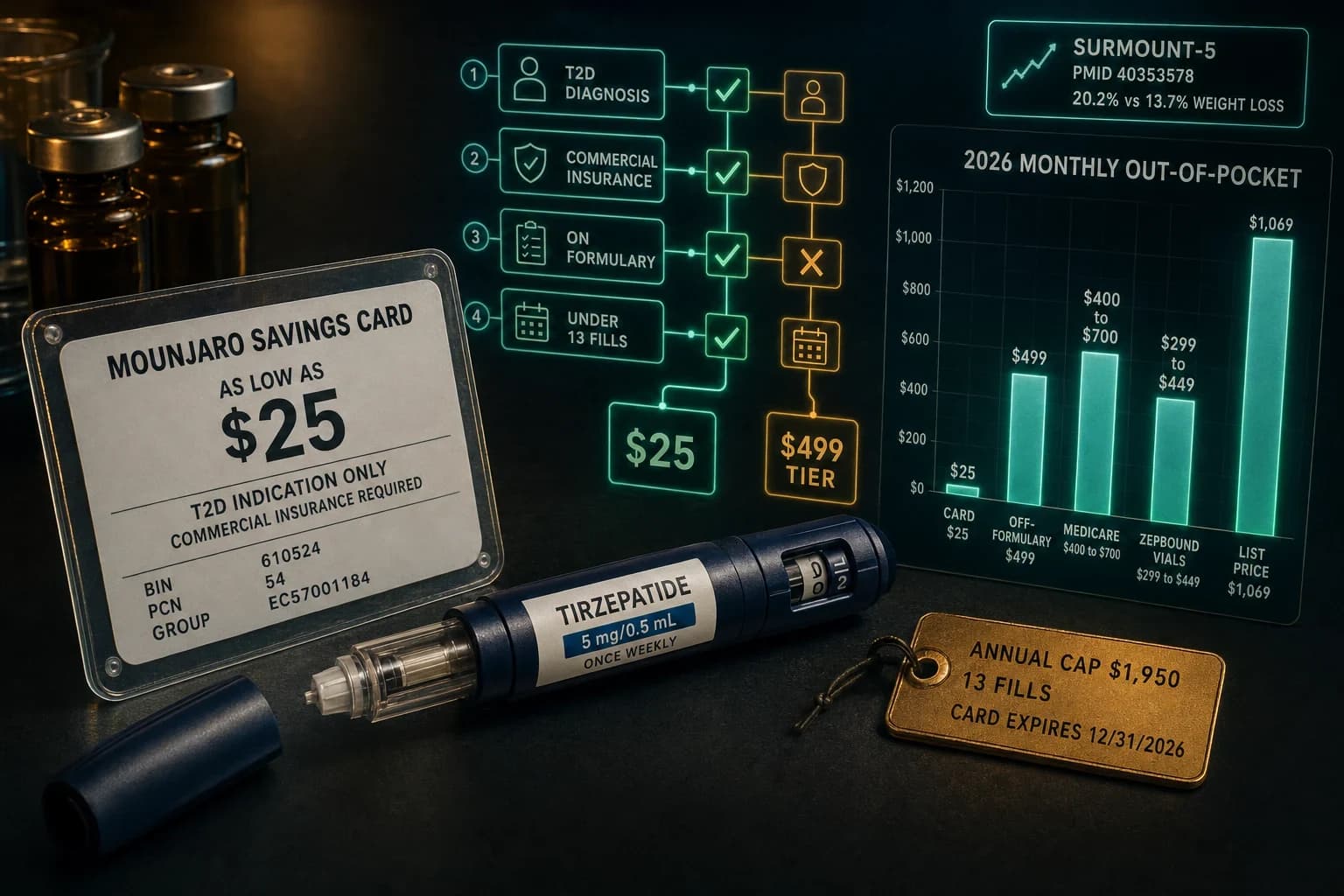
- The $25 Mounjaro Savings Card only applies to T2D-coded fills with commercial insurance that lists Mounjaro on formulary.
- If your commercial plan does not cover Mounjaro, the card drops the price to $499 for a 1-month fill, not $25.
- Weight-loss users, Medicare, Medicaid, VA, and uninsured patients get $0 off the Mounjaro savings card. The weight-loss equivalent is Zepbound, not Mounjaro.
- The card caps at $1,950 in savings per calendar year, with up to 13 covered fills, and expires 12/31/2026.
- Compounded tirzepatide ended on 03/19/2025 after the FDA shortage closure; the sub-$300 cash paths now run through LillyDirect Zepbound vials or legitimate GLP-1 telehealth, not research-chem vendors.
Most Mounjaro coupon pages lead with a $25 number and never tell you which patient actually pays it. The honest answer in 2026 is narrower than the headline suggests. The $25 is a Lilly manufacturer card and it has four hard walls: the fill must be for type 2 diabetes, not weight loss; you must carry commercial drug insurance, not Medicare, Medicaid, VA, or TRICARE; your commercial plan must list Mounjaro on its formulary; and the annual savings cap is $1,950 across a maximum of 13 fills before the card stops reducing anything. If you miss any of those walls, the card either drops to a $499 tier or does nothing at all.
That matters because searchers typing "mounjaro $25 coupon" fall into very different buckets, and only one of them lands on $25. This guide walks every bucket at its actual 2026 price, then shows the honest cash paths for the ones who do not qualify, including LillyDirect single-dose vials, legitimate telehealth programs, and why the compounded tirzepatide path closed in March 2025. Clinical context for the molecule itself lives in our tirzepatide guide and the tirzepatide dosage chart; this page is strictly the cost side.
Bottom line: The $25 price is real for commercially insured type 2 diabetes patients whose plans cover Mounjaro, with a 13-fill, $1,950 annual cap. Everyone else either pays the $499 off-formulary tier or walks a different path entirely. The cheapest honest path for weight-loss users is now LillyDirect Zepbound vials at $299 to $449 per month, not a Mounjaro coupon.
The $25 price has four walls
Lilly's Mounjaro Savings Card is a copay-reduction program for commercially insured patients, not a universal coupon. The four eligibility walls below are stacked, not alternatives. Missing any one of them changes what you pay.
| Wall | What it means | What breaks it |
|---|---|---|
| Indication | Prescription must be written for type 2 diabetes. Mounjaro is only FDA-approved for T2D glycemic control. | A weight-loss prescription is Zepbound territory. Mounjaro for weight loss is off-label and the card refuses it. |
| Insurance type | You must have commercial drug insurance (employer or marketplace). | Medicare Part D, Medicare Advantage, Medicaid, VA, TRICARE, cash-pay, and ChampVA all disqualify. |
| Formulary | Your commercial plan must list Mounjaro as a covered drug. | Off-formulary plans drop you into the $499 cash tier instead of $25. |
| Caps | $1,950 total savings per calendar year, maximum 13 fills, card expires 12/31/2026. | After the 13th fill or $1,950 ceiling, you pay the full plan copay. |
The savings-card program is covered in Lilly's investor materials announcing the LillyDirect self-pay vials and the broader copay structure (Lilly investor release, 2024). The $499 off-formulary floor and the $1,950 annual cap are specific to the current card and have changed twice since 2023, so verify the terms directly before enrolling.
The $25 vs $499 split, and the arithmetic underneath it
The card has two tiers. Both require commercial insurance. The difference is whether your plan covers the drug at all.
- Covered on formulary. You pay as little as $25 per 1-month fill. The card absorbs up to $150 per month of your plan copay. If your plan copay is $80, the card pays $80 and you pay $25. If your plan copay is $175, the card pays $150 and you pay $25. If your plan copay is $300, the card pays its $150 and you pay $150, which breaks the $25 floor.
- Off-formulary. The card drops the cash price to $499 per 1-month fill. That is 42 to 49% below Lilly's list price (roughly $1,069 for all strengths in 2026) but far from $25.
A 2026 fill cycle for a covered-on-formulary patient with a $150 plan copay works out like this: $25 x 13 fills = $325 out of pocket for the year, with $1,950 of card savings. After the thirteenth fill, the card stops reducing anything and you pay your full $150 copay for any remaining fills that calendar year.
For the off-formulary tier, the arithmetic is simpler and less friendly: $499 x 12 months = $5,988 for the year, and the $1,950 annual cap is irrelevant because the card is treating this as a cash transaction, not a copay reduction.
Note: Lilly's investor filing frames the card as a tool to defend diabetes market share against the compounded and generic erosion the FDA closure triggered. The $25 tier was never designed as a weight-loss discount. Treating it as one is the single most common reason searchers end up disappointed at the pharmacy counter.
The three buckets the $25 does not help
Three groups search "mounjaro $25 coupon 2026" and get nothing from the card. The honest answer is different for each.
1. You are using Mounjaro for weight loss
The card refuses it. Not because Lilly is strict about enforcement, but because the pharmacy adjudication layer reads the ICD-10 code attached to your prescription. A weight-loss code (E66.x) will not clear the T2D-only savings program. Clinically there is nothing wrong with tirzepatide for weight loss. Jastreboff and colleagues' SURMOUNT-1 trial showed up to 20.9% body-weight reduction at 72 weeks on 15 mg weekly (Jastreboff et al. 2022, NEJM, PMID 35658024). Head-to-head against semaglutide at 72 weeks, SURMOUNT-5 showed tirzepatide at 20.2% vs semaglutide at 13.7% (Aronne et al. 2025, NEJM, PMID 40353578). The molecule works. But Mounjaro is the T2D label; Zepbound is the obesity label, and the pricing programs follow the labels.
If this is you, the honest 2026 paths are:
- LillyDirect Zepbound self-pay vials. $299 for 2.5 mg, $399 for 5 mg, and $449 for 7.5 mg and higher. Vials and KwikPens price identically as of February 2026, and higher doses require a refill within 45 days or the price resets. Our cheapest Zepbound guide walks the full LillyDirect flow and the three alternative Zepbound paths at their current rates.
- Legitimate telehealth with brand Zepbound. Hers, Noom, and similar brand-only programs price Zepbound inside a membership. See our Hers tirzepatide cost breakdown for the real monthly math there.
- GLP-1 telehealth clinic programs. For a prescriber-side clinic with a transparent monthly fee that covers the visit and the prescription, our Bodybuilding Health+ review and the Yucca Health review are the two we recommend first. See the cheapest GLP-1 paths roundup for cross-comparison.
2. You have Medicare, Medicaid, VA, or TRICARE
Federal law bars manufacturer copay cards from applying to government-funded prescriptions. Lilly's card explicitly excludes them. Your path:
- Medicare Part D plans with Mounjaro on formulary. Negotiated price, often $400 to $700 before coverage gap, $25 to $100 after reaching catastrophic coverage in 2026 (the $2,000 annual out-of-pocket cap under the Inflation Reduction Act). Our Medicare GLP-1 bridge guide covers the dual-eligible and bridge-pricing specifics.
- Medicaid. Covered in most states for T2D with prior authorization. The cost is the state Medicaid copay, usually $1 to $4.
- VA / TRICARE. Mounjaro is on the VA formulary for T2D with step-therapy requirements. TRICARE tier 3, non-formulary, requires prior authorization.
- Not for weight loss. No federal payer currently covers Mounjaro or Zepbound for a weight-loss-only indication.
3. You are uninsured, or your commercial plan drops Mounjaro
Both ends of the "no insurance that covers Mounjaro" spectrum share one truth: the Lilly card does not help you. The compounded tirzepatide path that filled this gap through 2024 ended on 03/19/2025, when the FDA's 503B grace period expired and the Northern District of Texas upheld the FDA's declaration that the tirzepatide shortage was resolved. Legitimate compounded tirzepatide is no longer available (FDA letter to compounding pharmacies, 2025).
Real paths that still work in late 2026:
- LillyDirect Zepbound vials for off-label weight-loss or glycemic use. $299 to $449 per month with no insurance required, but the prescription is Zepbound, not Mounjaro.
- Compounded tirzepatide-adjacent (not tirzepatide). Some clinics offer compounded retatrutide or semaglutide where the shortage status still permits. Verify the molecule and the compounding pharmacy's 503A or 503B license. See the compounded tirzepatide 2026 legal access guide for current standing.
- Per-mg cash pricing. Our how much is tirzepatide without insurance article shows the per-mg math across every legitimate 2026 path.
2026 Mounjaro all-in cost table by bucket
| Bucket | What you qualify for | Monthly out-of-pocket | Annual estimate |
|---|---|---|---|
| T2D, commercial, on formulary | $25 Savings Card tier | $25 | $325 (card caps after 13 fills) |
| T2D, commercial, off formulary | $499 Savings Card tier | $499 | $5,988 |
| T2D, Medicare Part D on formulary | Plan copay plus IRA $2,000 cap | $400-$700 early, less after cap | $2,000 maximum |
| T2D, Medicaid | State Medicaid copay | $1-$4 | $12-$48 |
| Weight-loss, any payer | None. Switch to Zepbound. | LillyDirect $299-$449 | $3,588-$5,388 |
| Uninsured, T2D | Full cash | List price ~$1,069 | ~$12,828 |
| Uninsured, weight loss | LillyDirect Zepbound vials | $299-$449 | $3,588-$5,388 |
The gap between the $325 best case and the $12,828 worst case is why these distinctions are not pedantic. They are the entire buying decision.
Why Mounjaro has two savings tiers at all
The two-tier structure exists because tirzepatide works harder in trials than any competitor at its own price point. Rosenstock and colleagues' SURPASS-1 showed 2.07% HbA1c reduction and 9.5 kg weight reduction at 15 mg weekly as monotherapy (Rosenstock et al. 2021, Lancet, PMID 34186022). SURPASS-2 then showed tirzepatide beating semaglutide 1 mg on both HbA1c (minus 2.3% vs 1.86%) and weight (12.4 kg vs 6.2 kg) over 40 weeks on background metformin (Frías et al. 2021, NEJM, PMID 34170647). Those results give Lilly room to defend a brand price near $1,069 against formulary pushback. The $25 tier buys formulary wins; the $499 tier is a defensive floor for commercial plans that drop the drug.
That is also why the card excludes weight-loss indications. Zepbound is the second shoe for the obesity market. Lilly priced Zepbound vials at $299 to $449 self-pay precisely so the brand had an answer to the sub-$300 compounded cash market that existed before the shortage closure. Mounjaro's $25 card is for the T2D defensive line. Zepbound vials are for the weight-loss offensive line. Mixing them at the pharmacy counter is where searchers get the wrong number.
How to actually activate the $25 card
If you clear all four walls (T2D indication, commercial insurance, on formulary, within the 13-fill annual cap), activation takes three steps:
- Enroll online. Lilly's site hosts the card registration under mounjaro.com. Enrollment is free, no household-income verification, no credit check. The card is a BIN/PCN/GROUP triplet pharmacies run alongside your insurance.
- Confirm formulary. Call your pharmacy benefit manager (PBM, printed on your insurance card) and ask whether Mounjaro is on your plan's formulary and what tier it sits at. Off-formulary drops you to the $499 tier automatically.
- Present at pickup. Hand the pharmacist the card alongside your insurance card. The $25 price shows up in the pharmacy's system; if it does not, the fill has silently defaulted to the off-formulary $499 tier and you should decline and call Lilly before paying.
Prior authorization adds a timing wrinkle. Many commercial plans require your prescriber to document a failed metformin trial, an A1c above a threshold, or step-therapy through older GLP-1 agonists before approving Mounjaro. Approval is good for 6 to 12 months and must be renewed. A denied PA kicks you into the off-formulary tier even with the card.
Tip: If the pharmacy quotes anything between $25 and $499, something is off. The card has exactly two prices for commercially insured patients. Decline the fill, call Lilly savings-card support at the number on your card, and clear the issue before paying. Overpaying once by $200 at pickup eats three normal months of card savings.
The compounded tirzepatide gap closed. The LillyDirect gap filled it.
Through 2024, the sub-$300 cash market for tirzepatide ran through compounded tirzepatide shipped by telehealth clinics operating under the FDA's shortage-era enforcement discretion. That path is closed. The FDA formally resolved the shortage in December 2024, with 503A compounding ending 02/18/2025 and 503B bulk compounding ending 03/19/2025. As of December 2024, FAERS had logged over 320 adverse events tied to compounded tirzepatide, several from dosing errors on multidose vials and one documented impurity cluster from compounded tirzepatide-B12 formulations.
The replacement is LillyDirect's self-pay Zepbound vials. $299 for the 2.5 mg starting dose, $399 for 5 mg, $449 for 7.5 mg through 15 mg, with a 45-day refill window at the higher doses. No insurance required, no prior authorization. The prescription is Zepbound (same molecule, obesity label), not Mounjaro. For glycemic control in T2D specifically, the Zepbound vials are off-label but prescribers routinely write them for patients whose commercial plans refuse Mounjaro.
The implication for anyone searching "mounjaro $25 coupon" with no T2D diagnosis and no commercial insurance: your real option is LillyDirect Zepbound vials. The number to compare is $299 to $449, not $25.
FAQ, the short answers
Does the $25 Mounjaro coupon work for weight loss? No. The card is written against the T2D indication. Weight loss means Zepbound, which has its own LillyDirect self-pay program at $299 to $449.
Can I use the card with Medicare? No. Federal law prohibits manufacturer copay cards on government-funded prescriptions. Medicare Part D patients hit the $2,000 Inflation Reduction Act annual out-of-pocket cap and get different math.
What happens on the 14th fill? The card stops reducing anything. You pay your plan's full copay, which is typically $150 to $300 depending on tier. The counter resets 01/01/2027.
Does the card expire? Yes. Current terms end 12/31/2026. Lilly has renewed it twice; whether 2027 keeps the same two-tier structure is unknown as of this writing.
Is there a Mounjaro $25 cash-pay path? No. Lilly has no cash-pay program for Mounjaro. The $25 is a copay reduction on top of commercial insurance. Cash-pay patients land on LillyDirect Zepbound vials or legitimate telehealth; see our cheapest GLP-1 paths roundup.
What about compounded tirzepatide? Legitimately available compounded tirzepatide ended on 03/19/2025. Any vendor still selling compounded tirzepatide as a drug product in late 2026 is operating outside the FDA's resolved-shortage framework. See the compounded tirzepatide 2026 access guide for the current legal picture.
Does Hers or another telehealth clinic get me a lower Mounjaro price? No telehealth program lowers Mounjaro below the Lilly card tiers; the card ignores where the prescription came from. What a brand-focused clinic like Hers does is bundle Zepbound (not Mounjaro) with a membership. The Hers tirzepatide cost breakdown walks that math.
Is the $25 coupon different from the Lilly Cares patient-assistance program? Yes. The savings card is for commercially insured patients. Lilly Cares is a separate income-based patient-assistance program for uninsured and underinsured patients that provides Mounjaro at $0 after an income verification. Household income must sit at or below 500% of the federal poverty level, and documentation requirements are heavier than the savings card.
Can I use the card on the LillyDirect $299 Zepbound vial path? No. The $299 vial price is already the self-pay rate. The Mounjaro savings card does not stack with it, and Zepbound has its own separate savings card for commercially insured obesity patients with similar tier structure.
What to actually do next
Pick your bucket from the 2026 cost table above and follow the path that matches. If you are a commercially insured T2D patient whose plan covers Mounjaro, enroll in the savings card, confirm formulary with your PBM, and your real monthly cost is $25 until the 13-fill cap. If any wall of that four-wall structure is missing, do not waste a pharmacy run on the card. For weight loss or uninsured T2D, the honest cheapest paths now live at LillyDirect Zepbound vials, compounded alternatives still legally available, or a telehealth clinic that quotes the drug cost up front. The cheapest GLP-1 paths guide is the single starting point we recommend for picking between them.
For the molecule itself, dosing, titration, side-effect profile, and the trial-level evidence base, our tirzepatide guide, the tirzepatide dosage chart, and the Zepbound vs Mounjaro comparison are the right next reads.
Disclaimer: Pricing programs change frequently. The savings-card terms, LillyDirect vial prices, and FDA compounding status cited above reflect published terms as of October 2026 and should be re-verified against the manufacturer and FDA sources before enrollment. This article is for educational purposes only and is not medical, legal, or financial advice. Nothing in it establishes a prescriber-patient relationship, and nothing in it should be construed as a recommendation to self-administer tirzepatide outside a licensed prescriber's care.