At a glance
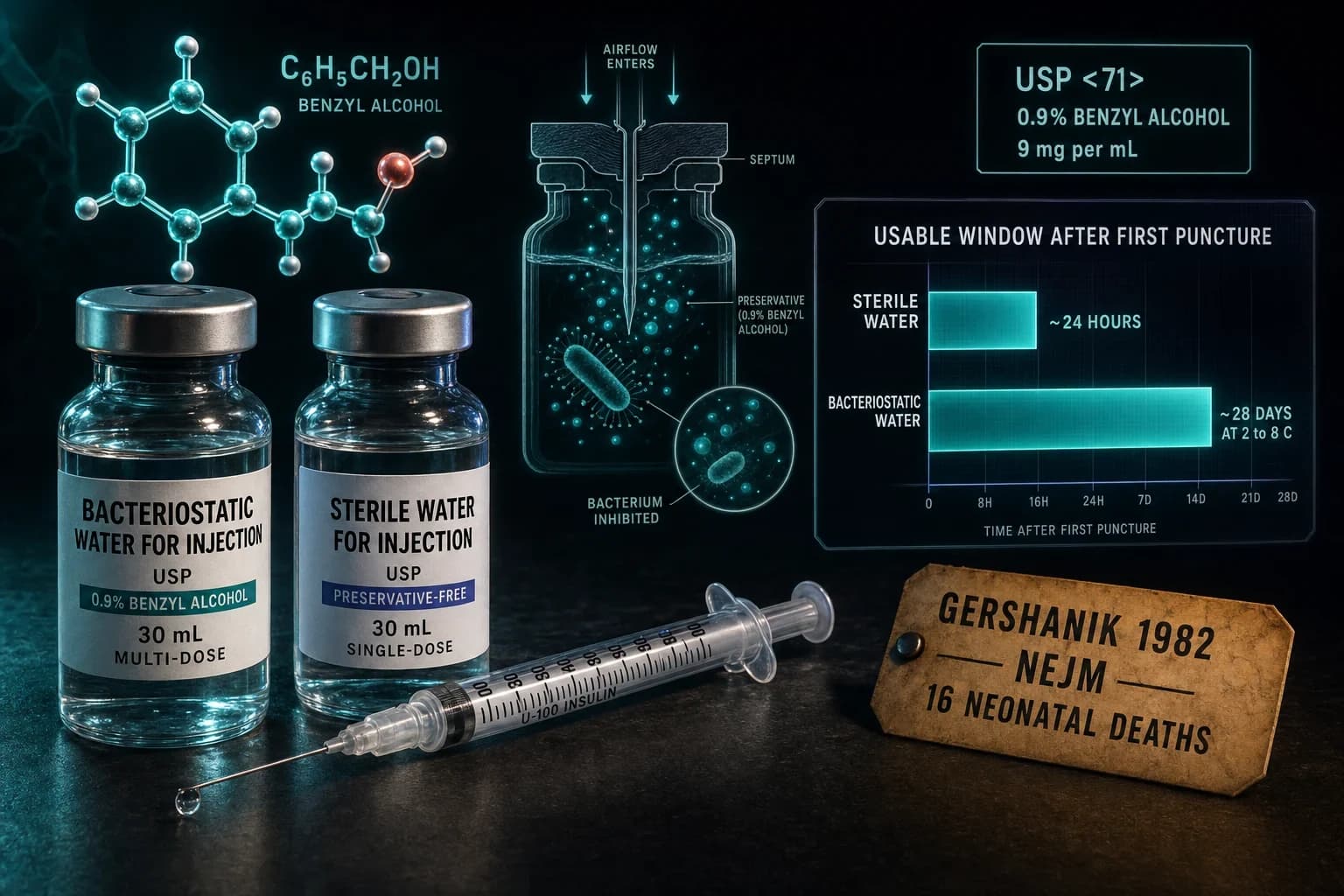
- The only chemical difference is 0.9% benzyl alcohol (9 mg/mL), added to bacteriostatic water as a preservative.
- That preservative extends usable vial life from about 24 hours (sterile) to about 28 days at 2 to 8 degrees C (bacteriostatic).
- Benzyl alcohol is the industry standard preservative in licensed peptide and protein injectables (Meyer 2007, PMID 17722087).
- It is contraindicated in neonates due to gasping syndrome (Gershanik 1982, NEJM, PMID 7133084); adult IV tolerance is high.
- For every multi-dose peptide vial you plan to draw from across a week or more, use bacteriostatic water.
The only thing that separates them is 9 milligrams of benzyl alcohol per milliliter
Bacteriostatic water for injection is sterile water for injection with 0.9% (9 mg/mL) benzyl alcohol added as a preservative. That is the whole chemical difference. Everything else you have read about their behavior downstream, the 28-day vial life, the neonatal warning, the occasional peptide-aggregation caveat, flows from that one excipient.
If you research injectable peptides at home, the practical translation is straightforward: use bacteriostatic water for anything you plan to draw from more than once, and use sterile water only when you will finish the reconstituted vial the same day. That is the answer most researchers actually need. The rest of this piece explains why the pharmaceutical literature backs it, where the edges of that rule get interesting, and how to spot the (small) subset of cases where the default flips.
What the two USP monographs actually say
Sterile Water for Injection, USP is a preparation of highly purified water rendered sterile and non-pyrogenic. It contains no added preservative, antimicrobial agent, or buffer. Its pH typically sits between 5.0 and 7.0 depending on the manufacturer. It is supplied for single-dose use, because once the vial is punctured there is nothing in solution to slow microbial growth if the drawing needle picks up an organism.
Bacteriostatic Water for Injection, USP is that same sterile, non-pyrogenic water plus 9 mg/mL benzyl alcohol as a bacteriostatic agent. The Pfizer package insert notes a pH range of 4.5 to 7.0 (typical 5.7). It is supplied specifically as a multi-dose container from which repeated withdrawals may be made to dilute or dissolve drugs for injection.
At the 0.9% concentration used in the USP preparation, benzyl alcohol functions as a bacteriostatic agent, meaning it inhibits proliferation of many common microorganisms rather than actively sterilizing an already-contaminated solution. That distinction matters more than it sounds. A punctured vial that gets contaminated on day 10 is not sterilized by the preservative; the preservative just makes the initial contamination event much less likely to escalate.
For a step-by-step walkthrough of drawing bacteriostatic water into a vial and shaking versus swirling, our peptide reconstitution complete guide covers the mechanical side. This article is the "why" behind the reagent choice.
Why the preservative matters more than the "sterility" label
Both waters ship sterile. The difference is what happens after you break the seal.
USP General Chapter <71> defines the sterility test that every parenteral water lot must pass before release, so an unopened vial of either is equally sterile from the manufacturer. Once a needle enters the vial, the seal is broken and the internal atmosphere is now sharing airflow with your work surface. Skin flora, particulate airborne organisms, and biofilm shed from the needle tip can all enter. With sterile water, any organism that lands has an open, buffer-free growth medium. With bacteriostatic water, benzyl alcohol at 9 mg/mL is present at every draw and inhibits most of the common organisms clinically documented in preservative efficacy studies.
The industry consensus on which preservatives to reach for is not casual. Meyer et al. 2007, a J Pharm Sci review of every licensed parenteral product then on the US market, found that phenol and benzyl alcohol are the two most common antimicrobial preservatives used in peptide and protein products, with benzyl alcohol favored in small-molecule parenterals (Meyer et al. (2007)). Regulators picked benzyl alcohol for licensed products because it works and because its safety envelope in adults is well characterized. That is the same reagent inside the multi-dose vial you would use to reconstitute a research peptide.
Practical shelf-life numbers that follow from this are:
| Water type | Preservative | Sterility test (USP <71>) | Approx. usable window after first puncture |
|---|---|---|---|
| Sterile Water for Injection, USP | None | Sterile at release | ~24 hours (single-use rated) |
| Bacteriostatic Water for Injection, USP | 0.9% benzyl alcohol | Sterile at release | ~28 days at 2 to 8 degrees C |
Peptide-specific reconstituted shelf life sits on top of that window, not underneath it. For BPC-157, that reconstituted-solution shelf life is roughly 28 days at 2 to 8 degrees C when the diluent is bacteriostatic water, and drops to about 24 hours with plain sterile water. How long does bacteriostatic water last walks through the storage-temperature interaction in more depth.
Adult safety math for a real peptide vial
The most common worry researchers voice about bacteriostatic water is the same one that generated the FDA neonatal warning. Some of that worry is well founded. Most of it does not apply to adult research use.
Do the actual math on a typical 10 mg BPC-157 vial reconstituted with 2 mL bacteriostatic water: that is 2 mL x 9 mg/mL = 18 mg of benzyl alcohol total in the finished vial. Split across a 28-day protocol at typical research doses, the daily exposure is under 1 mg. Compare that to the FDA GRAS threshold, which accepts benzyl alcohol at concentrations up to 5% in adult topical and injected products, or to the World Health Organization ADI of 5 mg/kg for benzyl alcohol, benzoic acid, and sodium benzoate combined. A 70 kg adult would need to receive 350 mg per day to reach that ADI. A whole reconstituted peptide vial does not get you anywhere close.
The animal data lines up. McCloskey et al. 1986 measured LD50 of benzyl alcohol at 1000 mg/kg in adult CD-1 mice on same-day observation, dropping to 650 mg/kg on day 7 after single-dose intraperitoneal exposure (McCloskey et al. (1986)). Metabolism in adults runs cleanly: benzyl alcohol is oxidized to benzoic acid, conjugated with glycine in the liver, and excreted in urine as hippuric acid, with 75 to 100% of a dose cleared within six hours. In dogs and monkeys, 1 mL/kg of 0.9% benzyl alcohol IV produced no measurable changes in blood pressure, heart rate, respiration, or ECG.
FDA-cleared adult tolerance in the Pfizer bacteriostatic water labeling is more permissive than most researchers realize: "an estimated intravenous dose up to 30 mL may be safely given to an adult without toxic effects" (that is 270 mg of benzyl alcohol in a single administration). A subcutaneous peptide injection uses a fraction of a milliliter.
Bottom line: For adult research peptide reconstitution at standard vial sizes, the benzyl alcohol dose is well below any threshold associated with adverse effects, and the contamination-control benefit is measurable rather than theoretical.
The neonatal exception is real, and does not apply to adult research
The label warning exists because of a specific, documented cluster of infant deaths that ended in an FDA bulletin.
Gershanik et al. 1982 in the New England Journal of Medicine identified benzyl alcohol as the cause of a syndrome affecting 16 low-birthweight neonates in intensive care: severe metabolic acidosis, encephalopathy, respiratory depression with characteristic gasping, and death (Gershanik et al. (1982)). The exposure route was benzyl alcohol-preserved intravascular flush solutions running continuously into neonates who could not metabolize benzoic acid at adult rates. Following the FDA warning that same year, no gasping syndrome deaths have been reported.
LeBel et al. 1988 later mapped the underlying mechanism in 14 term and 9 preterm neonates receiving phenobarbital loading doses in benzyl alcohol vehicle: preterm neonates accumulate benzoic acid in serum because hippuric acid formation, the glycine conjugation step, is not yet mature (LeBel et al. (1988)). That is a pharmacokinetic developmental deficit, not a pharmacology of benzyl alcohol itself. In an adult with a functioning liver, hippuric acid is the terminal metabolite and it clears in hours.
If you are conducting research on neonatal or very young pediatric models, sterile water for injection remains the appropriate diluent and the manufacturer's package insert should be re-read. In every other adult research context, the gasping-syndrome finding is educational rather than restrictive.
Where benzyl alcohol actually causes trouble: aggregation, not toxicity
The one legitimate, peptide-specific reason to reach for sterile water instead of bacteriostatic water has nothing to do with benzyl alcohol's safety and everything to do with how it interacts with certain peptide structures.
Rodríguez-Martínez et al. 2011 showed that alpha-chymotrypsinogen A reconstituted in buffer containing 0.9% benzyl alcohol formed more than 10% insoluble aggregates within 24 hours, and PEGylation (attaching poly(ethylene glycol) chains) prevented that aggregation completely (Rodríguez-Martínez et al. (2011)). That was a protein many times larger than the peptides typically studied by home researchers, but it demonstrated the mechanism.
Heljo et al. 2015 (published in Pharmaceutical Research) evaluated a model peptide with three of the most common parenteral preservatives (benzyl alcohol, phenol, and m-cresol) using SEC-MALS, DLS, and NMR. The hydrodynamic radius and molar mass of peptide oligomers increased in all three, with m-cresol producing the largest shift and benzyl alcohol the smallest (Heljo et al. (2015)). The formulation-scientist takeaway: benzyl alcohol is the least aggregation-promoting of the three common preservatives, but it is not entirely neutral.
Li et al. 2022 in Molecular Pharmaceutics extended the same picture to a 31-residue acylated peptide (an approximation of the GLP-1 analogue class), showing that both benzyl alcohol and m-cresol can push soluble octamers toward higher-order dimers and trimers of octamers and eventually insoluble aggregates, depending on peptide concentration and pH (Li et al. (2022)). That has practical implications for a home researcher only in one situation: if a peptide is delivered at very high concentration in a formulation that already sits near an aggregation threshold, adding a preservative can nudge it over.
For the peptides most commonly reconstituted in research settings, BPC-157, TB-500, ipamorelin, tesamorelin, and CJC-1295, the manufacturer-recommended diluent is bacteriostatic water and the empirical shelf-life data support the standard 28-day window. For semaglutide and tirzepatide, the branded products use phenol or m-cresol respectively as the licensed preservative, and compounded versions typically reconstitute in bacteriostatic water without aggregation issues at clinical concentrations.
Decision matrix
| Scenario | Recommended diluent | Why |
|---|---|---|
| Multi-dose research peptide vial, weeks of use | Bacteriostatic water | 28-day shelf life; contamination control |
| Single-use vial, injected same day | Either works | Sterile water is cheaper; no logistics gain from preservative |
| Neonatal or pediatric research model | Sterile water | Gasping syndrome literature; preterm hippuric acid pathway immature |
| Intrathecal or intra-articular research route | Sterile water | Preservative-free required per most institutional protocols |
| Highly aggregation-prone or high-concentration peptide (>10 mg/mL) with published stability signal | Sterile water + immediate use | Rodríguez-Martínez, Li aggregation literature |
| Peptide with a stated compounder or manufacturer BAC water shelf life | Bacteriostatic water | Follow the label; the stability data is already there |
Sourcing and quality controls
Both waters are prescription-only in the US when sold explicitly for injection, though bacteriostatic water is widely available through veterinary and research supply channels. What matters more than the paperwork is:
- USP-grade only. The specification enforces endotoxin limits, sterility, and preservative-content assay for bacteriostatic water. Anything sold without the USP designation is not a substitute.
- Multi-dose vials of 10 mL or 30 mL are the standard research sizes. A 30 mL vial reconstituted through repeated 1 to 2 mL draws over its 28-day window is the most cost-efficient format.
- Look for a matching COA on both the water and the peptide it will reconstitute. Our COA library at /lab-tests is one way to cross-check peptide identity and purity independent of the vendor's own paperwork. The methodology piece what is a COA (Certificate of Analysis) walks through how to read one without being fooled by cosmetic detail.
- Vendor trust extends to the diluent. A research peptide vendor that ships bacteriostatic water alongside its vials should be able to document both. Our Ascension Peptides review covers how we assess a vendor's full supply chain, including reconstitution consumables (code ENHANCED gives 50% off if you decide to source from them).
Dosing math is the same, storage math is different
The reconstitution math itself does not depend on whether you use bacteriostatic or sterile water. If you draw 2 mL of diluent into a 10 mg peptide vial, the concentration is 5 mg/mL either way. The reconstitution calculator will not ask which water you used, because it does not need to.
What does depend on the diluent choice is the storage protocol. With bacteriostatic water at 2 to 8 degrees C, the reconstituted solution is generally usable for about 28 days, subject to the individual peptide's stability profile. With sterile water, the equivalent window shrinks to about 24 hours and you should treat the vial as effectively single-use. That is a logistics decision, not a sterility one.
For BPC-157 specifically, the dilution ratio that returns the cleanest dosing math is covered in how much bacteriostatic water for 10 mg BPC-157, which is the reference researchers commonly land on when they are trying to hit 250 mcg per draw without fractional insulin-syringe units.
Misconceptions worth naming
- "Sterile water is more sterile than bacteriostatic water." No. Both meet USP <71> at release. Bacteriostatic water is arguably safer once the seal is broken because the preservative buys margin against contamination.
- "Benzyl alcohol kills bacteria in the vial." Also no. It is bacteriostatic, not bactericidal. It inhibits growth; it does not sterilize a contaminated solution. If contamination is suspected, discard the vial.
- "Boiled tap water in a pinch works." It does not. Sterility, endotoxin control, and preservative content are all required for parenteral use, and boiling addresses none of them properly.
- "Any water labeled sterile is fine." Sterile water for irrigation is not the same as sterile water for injection. The USP monographs are separate, and irrigation-grade is not qualified for parenteral administration.
- "Bacteriostatic saline works too." It contains 0.9% sodium chloride in addition to benzyl alcohol, which is fine for most peptides but changes the tonicity of the reconstituted solution. Peptide package inserts specify bacteriostatic water unless saline is listed.
Bottom line
Bottom line: For adult research peptide reconstitution, bacteriostatic water is the default. The 0.9% benzyl alcohol dose is far below any adult-toxicity threshold, buys roughly 28 days of usable vial life instead of 24 hours, and matches the diluent standard used across licensed peptide and protein injectables. Sterile water for injection belongs in three specific cases: single-day reconstitution with immediate use, neonatal or pediatric research models, and the rare peptide formulation where published stability data flag preservative-induced aggregation.
The choice is smaller than most peptide guides make it sound. The chemistry is one excipient. The consequences downstream (multi-dose logistics, adult safety envelope, and the narrow set of aggregation-prone edge cases) are all traceable back to that one preservative and how it interacts with the specific peptide in front of you.
Research use only. This article summarizes published pharmaceutical literature and USP monograph specifications for informational purposes. It is not medical advice, is not a substitute for a licensed clinician, and does not endorse any specific research protocol. Peptides discussed are for laboratory research and are not approved for human therapeutic use in the United States unless specified in an FDA label.