At a glance
- Peptide Crafters is US-based, ships from Arizona, and posts batch-linked COAs from MZ Biolabs.
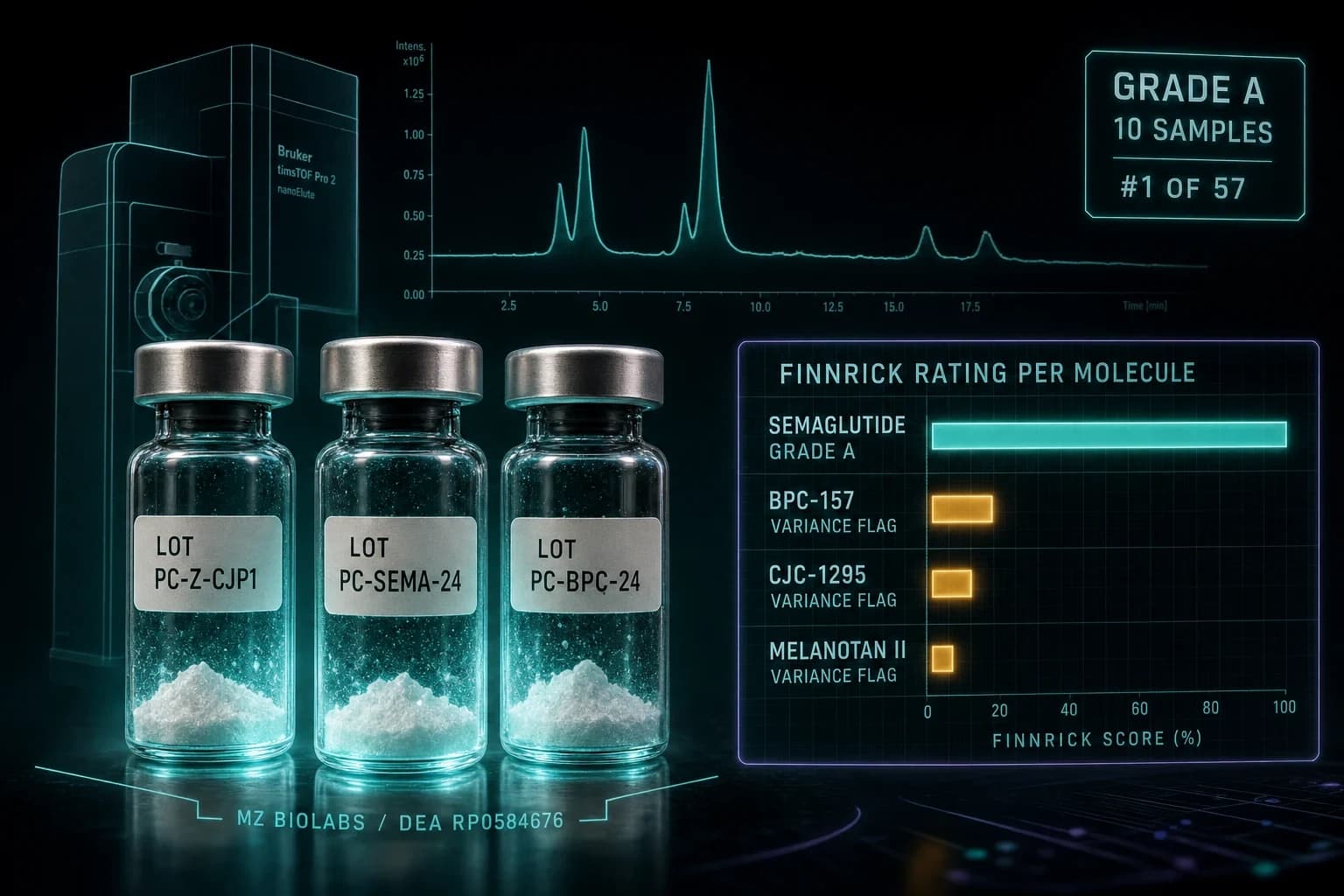
- Finnrick data rates their semaglutide #1 of 57 vendors; BPC-157 and CJC-1295 tested weaker.
- Trustpilot: about 4 stars across roughly 43 reviews as of mid-2026 (thin sample, mostly positive).
- Ownership is anonymous. Catalog runs about 80 peptides. US-only shipping, free above $150.
- Prices sit mid-market: BPC-157 10 mg at $55, semaglutide 10 mg at $90, tirzepatide 35 mg at $205 on sale.
Peptide Crafters ranks as the best semaglutide source across 57 vendors in Finnrick's independent testing database, and the same tracker flags weakness clusters on their BPC-157, CJC-1295, and Melanotan II. That gap is the whole story. Most peptide crafters reviews on the SERP collapse it into a five-star recommendation or a scam warning. Neither read is right.
This review pulls the receipts from the vendor's COA workflow, the compound-level test data from Finnrick, the complaint pattern from Trustpilot, and the actual price per milligram against the mid-market. It routes buyers toward or away from Peptide Crafters based on the compound they plan to run, not on the store's own marketing.
Bottom line up front: Legit US-based operation, A-grade semaglutide, softer independent test signal on shorter peptides, small Trustpilot sample, anonymous ownership. Good pick for GLP-1 research; check Ascension Peptides with code ENHANCED before ordering BPC-157, CJC-1295, or Melanotan II.
What Peptide Crafters is
Peptide Crafters (peptidecrafters.com) is a US-based research peptide vendor with a catalog of roughly 80 compounds spanning GLP-1 analogs, healing peptides, growth hormone secretagogues, cognitive peptides, and pigmentation compounds. Orders ship from within the United States, US only, with free shipping on carts above $150.
Ownership is not publicly disclosed. The domain is registered privately through Porkbun, and no named founders, business entity, or executives appear on the site. The store surfaces a contact form rather than a phone number and states an intended 24-hour response window.
Store-level compliance framing is research-use-only. The storefront copy is explicit that products are for in-vitro laboratory research and not for human use. That aligns with the regulatory framing every legitimate vendor uses, and it puts Peptide Crafters in the same operating lane as our own Ascension review covers. For the broader picture of how this category actually works, see our gray-market sourcing guide.
The testing story, unfiltered
Independent testing is where a vendor review has to earn its keep, because a vendor's own COAs cannot be marked against themselves. Two independent trackers matter here: Finnrick, which publishes batch-level test scores across vendors; and MZ Biolabs, the DEA-registered analytical lab Peptide Crafters uses for its published certificates.
Finnrick: strong on GLP-1s, mixed on shorter peptides
Finnrick's public data set on Peptide Crafters covers 7 peptides across 41 individual tests. The pattern is not uniform.
| Compound family | Finnrick call | Sample notes |
|---|---|---|
| Semaglutide | Grade A, ranked #1 of 57 vendors | 10 samples between Dec 2024 and Mar 2025, average score above 7, no result below 6 |
| BPC-157 | Weakness cluster flagged | Results dispersed across batches, consistency uncertain |
| CJC-1295 | Weakness cluster flagged | Purity variance across submitted lots |
| Melanotan II | Weakness cluster flagged | Similar variance signal |
That is a lopsided profile, and it tracks with operational reality. GLP-1 analog synthesis at 30-plus residues is a different problem than making a 15-residue peptide like BPC-157, and vendors that lean on a high-purity source for a headline SKU do not always run the same discipline across the back catalog. Read the raw numbers on Finnrick's Peptide Crafters vendor page before committing to a specific compound.
MZ Biolabs: the COA workflow that actually verifies
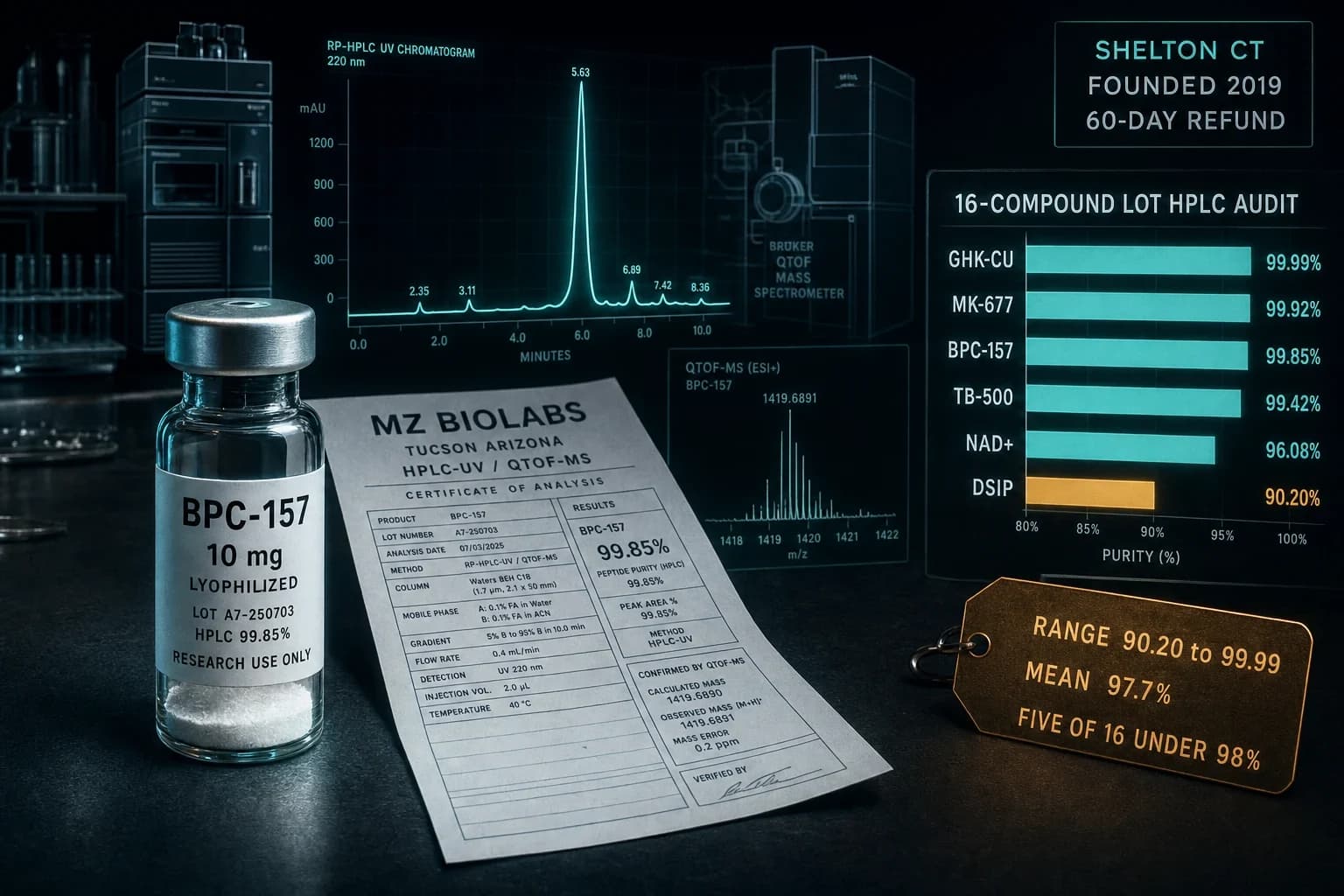
Every Peptide Crafters batch ships with a certificate of analysis from MZ Biolabs, an ISO-certified, DEA-registered lab at 2102 N Country Club Rd, Tucson AZ (DEA registration RP0584676). MZ Biolabs runs a Bruker Compact QTOF mass spectrometer for identity and purity and a Waters Acquity UPLC for the chromatographic pass. The lab appears on COAs from multiple credible vendors and is a real analytical setup, not a paper mill.
The verification workflow is what turns this into something more than a "we tested it, trust us" claim. Every vial ships with a lot number printed on the label, and the buyer enters that lot at peptidecrafters.com/coa-verification to pull the specific report for that batch. Published lots from 2024 have shown purity above 99.5 percent, with one example CJC-1295/Ipamorelin blend (Lot PC-Z-CJP1) reporting 99.88 percent purity. That is the format a real COA should take. Our full certificate of analysis explainer walks through how to read one, and our lab-tests library tracks independent purity data across the vendors we cover.
Reading the two data sets together is what most peptide crafters reviews miss. The MZ Biolabs COA is a single-batch snapshot, and the Finnrick tracker is a multi-batch history. A vendor can consistently ship above-99 percent purity on one representative lot and still show real variance across the full production run of a different peptide, which is exactly what the two data sets together are describing. Treat vendor-supplied COAs as necessary but not sufficient. The Finnrick historical view is the harder test.
The Trustpilot read
Peptide Crafters holds roughly a 4-star Trustpilot average across approximately 43 customer reviews as of mid-2026. Snapshots earlier in the year showed 28 reviews at 4.4/5; later counts show 42 reviews at a similar star average.
Two things about that number:
- The sample is small. For context, GLP-1 telehealth clinic Medvi holds a 4.4/5 across more than 12,000 reviews. A rating built on 43 reviews is a signal, not a statistically robust reputation, and a few loud complaints can move the average.
- The complaint pattern is operational, not clinical. Recurring negative themes are a condescending customer-service response in at least one case and a promo-code mismatch where the advertised discount did not apply cleanly at checkout. Recurring positive themes are shipping speed, packaging clarity, and satisfaction with COA transparency. Nothing in the review corpus flags a "fake product" pattern.
Absence of a fake-product complaint pattern is more reassuring than absence of every complaint, and it lines up with the MZ Biolabs COA infrastructure. Anonymous ownership is the offsetting risk: if something goes wrong, the buyer has a contact form and a Porkbun WHOIS record to work with, which is a thinner accountability trail than a named LLC.
Pricing, per milligram
Peptide Crafters prices sit mid-market rather than lowest-in-class. A quick per-mg read for the compounds most buyers actually compare:
| Compound | List | Per mg | Where it sits |
|---|---|---|---|
| BPC-157 10 mg | $55 | $5.50 | Above cheapest listings (near $2.50/mg on aggregator trackers) |
| Semaglutide 10 mg | $90 | $9.00 | Above the $2.75/mg market floor, matches the A-grade positioning |
| Tirzepatide 35 mg | $205 sale | $5.85 | Above the $3.09/mg market floor |
| CJC-1295 blends | Varies | Not cheapest | Weaker Finnrick data offsets any price advantage |
Two things drive the premium. The A-grade Finnrick semaglutide history gives Peptide Crafters real pricing power on that specific SKU. The catalog-wide MZ Biolabs testing and lot-linked COA lookup are not free to run, and vendors that skip both often price 30 to 50 percent lower. Whether the premium is worth paying depends on the compound. On semaglutide it is easy to defend. On BPC-157 it is a harder sell against a vendor with stronger Finnrick history on the same molecule.
Shipping, payment, ownership
- Shipping: US-only, free above $150, typical arrival within about a week
- Payment: Standard card checkout via the storefront; specific processor rotates for research peptide vendors and can change without notice
- Ownership: Anonymous; WHOIS via Porkbun does not name a principal
- Framing: Products labeled "in-vitro research use only," no dosing or human-use guidance provided
- Contact: Contact form, 24-hour response goal, no phone number listed
None of those items is disqualifying for a research peptide vendor. Anonymous ownership is common in the category and is precisely why independent test data (Finnrick) and named-lab COAs (MZ Biolabs) exist. The point is not to trust the store; the point is to verify the batch.
The compound-by-compound verdict
Peptide Crafters is a defensible pick on compounds where independent testing backs the vendor's price, and a weaker pick where the independent read gets softer.
- Semaglutide and GLP-1 analogs: Yes. This is where the vendor's Finnrick record is strongest and where the mid-market price is worth paying. Compounded GLP-1 quality varies widely in the broader market: a peer-reviewed analysis of 16 injectable semaglutide follow-on products against the originator identified new impurities including high-molecular-weight proteins, trace metals, and anions in the follow-on drug substances (Peng et al., Pharm Res 2024, PMID 39379664). Sourcing from a vendor with an A-grade batch history is not paranoia; it is the correct response to that data.
- Tirzepatide: Reasonable. Same GLP-1 quality argument, one molecule further along. Efficacy of the underlying compound at commercial dosing is well established (Jastreboff et al., NEJM 2022, PMID 35658024; head-to-head against semaglutide in Aronne et al., NEJM 2025, PMID 40353578). The vendor question is only about purity.
- BPC-157: Weaker pick here. BPC-157's development story explains why batch consistency matters more than list price: the compound has 30-plus years of preclinical evidence for tendon healing and cytoprotection (Chang et al., J Appl Physiol 2011, PMID 21030672) but no completed Phase II human trial and no validated pharmaceutical formulation, which pushes all real-world sourcing to research peptide vendors (BPC-157 biopharmaceutical review, PMID 42198317). If a vendor's independent record on the molecule is soft, the researcher inherits that variance. Consider a vendor with a stronger Finnrick BPC-157 history.
- CJC-1295 and Melanotan II: Same logic as BPC-157. Fine for a one-off, worth a second look if either will be a repeat-buy compound.
How it compares to Ascension
Ascension Peptides sits in the same category as Peptide Crafters: a US-based research peptide vendor with third-party lab testing, competing for the same buyer. Two operational differences matter for the decision.
Discount code. Ascension runs a permanent 50 percent off with code ENHANCED. Peptide Crafters' promotional structure is variable, and the Trustpilot complaint pattern includes users saying an advertised code did not apply as expected at checkout. For anyone who plans to run more than one compound over several months, the compounded effect of a 50 percent code is not trivial.
Catalog scope. Ascension carries injectable research peptides and multi-peptide stacks (Wolverine, GLOW, KLOW, and others), which is a workflow advantage when a research plan calls for combining compounds rather than running them in isolation. Peptide Crafters' catalog is longer on individual SKUs, shorter on pre-formulated stacks.
Both vendors publish batch-linked COAs from named third-party labs. Both are US-based. Both operate in the same regulatory framing. The narrower question is where the compound-level independent test history is stronger, and whether the discount and stacks meaningfully affect the buyer's total spend. Our Ascension revisit for 2026 covers the second vendor in the same format. See the best legit peptide vendors list for the wider ranking with lab-test verification, and the lab-tests library for compound-by-compound purity data across the vendors we cover.
Tip: If a research plan spans multiple compounds, put the vendors head to head compound by compound rather than picking one for the whole plan. There is nothing wrong with sourcing semaglutide from Peptide Crafters and BPC-157 from Ascension in the same month. The reconstitution calculator will size doses correctly regardless of source.
The verdict
Peptide Crafters is a legitimate US research peptide vendor with a real testing infrastructure, an A-grade semaglutide history that ranks #1 of 57 vendors on Finnrick, and softer independent data on BPC-157, CJC-1295, and Melanotan II. Ownership is anonymous, the Trustpilot sample is thin but the complaint pattern is operational rather than clinical, and prices sit mid-market rather than at the market floor.
Buy from them for semaglutide and tirzepatide with confidence, and cross-check the specific batch's Finnrick history before ordering BPC-157, CJC-1295, or Melanotan II. For research plans that call for injectable peptides plus stacks and a permanent discount, Ascension Peptides is the sharper default at 50 percent off with code ENHANCED.
Bottom line: Peptide Crafters is a real vendor with a lopsided test record. Strong on GLP-1s, thinner on shorter peptides, small Trustpilot sample, anonymous ownership offset by a named-lab COA workflow. Route the buy compound by compound rather than by vendor.
This article is for research and educational purposes only. It is not medical advice. Research peptides are not FDA-approved and are not for human use. Consult a licensed clinician about any therapeutic decisions. We may earn a commission from affiliate links; our assessment would be the same without it.