At a glance
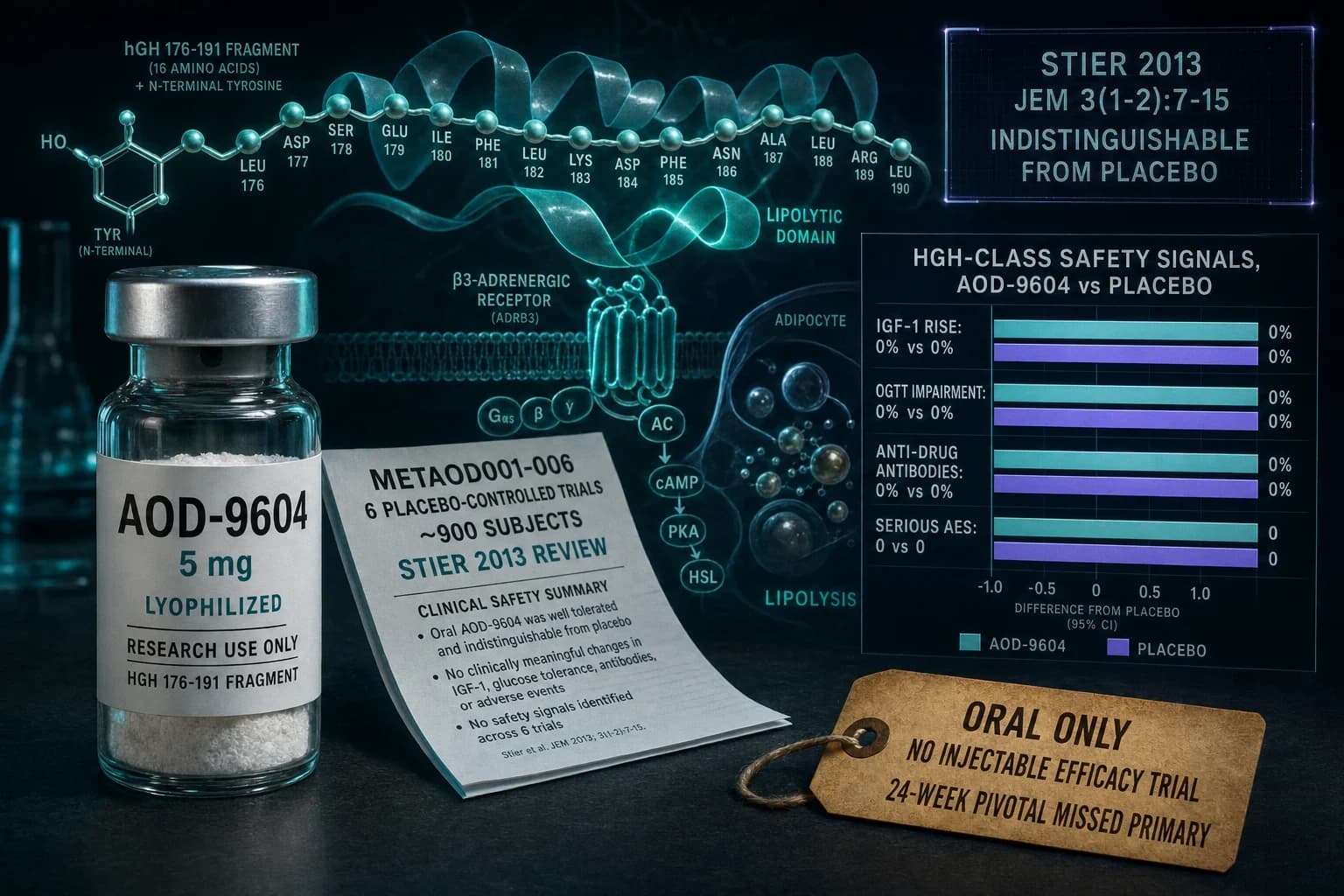
- Six placebo-controlled human trials (~900 subjects) reported no serious adverse events linked to AOD-9604 (Stier 2013).
- IGF-1 did not rise in any human study, which separates the drug's safety profile from full-length hGH (Heffernan et al. 2001).
- Oral glucose tolerance was unchanged versus placebo, so the main hGH-class metabolic risk did not appear in trials.
- Vendor side-effect lists citing exact frequencies (nausea 10 to 30 percent, injection-site reactions, and so on) do not trace to the published trial data.
- AOD-9604 is not on the FDA 503A bulks list. The December 2024 PCAC briefing proposed against adding it.
AOD-9604's reputation online is "safe." The reality in the trial record is narrower, and the gap between the two matters when a buyer is reading a product page. Six placebo-controlled human studies enrolled roughly 900 subjects between 2000 and 2007. Across all of them, no serious adverse event was attributed to the drug, IGF-1 stayed flat, and glucose tolerance did not budge (Stier et al. 2013). That is the published safety record. It is also oral-only, short, and sponsor-funded.
If you came in expecting a long list of "common side effects" with percentages, you will not find it in the papers. The frequencies that circulate on vendor and clinic pages are not in the primary literature we could locate, and some of them do not even match the route of administration the trials used. This article walks the trial record first, then explains where the vendor language goes beyond it.
Bottom line: AOD-9604's published human safety record is clean on the hGH-class signals that would normally worry you (IGF-1, glucose, antibodies). It is also short, oral, and run by the compound's sponsor. Everything beyond that, including injectable adverse event rates, long-term safety, pregnancy data, and interactions, is extrapolation.
The published human safety record, in one table
Six placebo-controlled trials, pooled in the 2013 safety review by Stier, Vos, and Kenley, carry the entire human safety record for this molecule. Every efficacy trial used oral tablets or capsules. The sponsor was Metabolic Pharmaceuticals (later Calzada), and the study pool spanned 2000 to 2007.
| Trial code | Design | n | Route and dose | Safety summary |
|---|---|---|---|---|
| METAOD001 | Phase I single IV dose | 32 lean males | IV, 25 to 400 mcg/kg | No serious adverse events, no IGF-1 rise |
| METAOD002 | Phase IIa single IV, 4x4 Latin Square | 23 obese males (BMI ≥35) | IV, 25 to 100 mcg/kg | Well tolerated, no antibody formation |
| METAOD003 | Phase IIa single oral, 4x4 Latin Square | 17 obese males (BMI ≥35) | Oral capsule, 9 to 54 mg | Well tolerated, acute fat oxidation signal |
| METAOD004 | Phase IIa multiple-dose oral | 36 obese males | Oral capsule, 7 days | No safety signal, no OGTT change |
| METAOD005 | Phase IIb oral, 12 weeks | ~300 obese adults | Oral tablet, 0.25 to 1 mg daily | 2.6 kg weight loss at 1 mg vs 0.8 kg placebo; adverse events similar to placebo |
| METAOD006 | Phase IIb oral, 24 weeks (OPTIONS) | 536 obese adults | Oral tablet, 0.25 to 1 mg daily | Missed primary endpoint; safety profile similar to placebo |
The review's own words: AOD-9604 displayed "a safety and tolerability profile indistinguishable from placebo." Two things to notice before reading on.
First, the sponsor funded the review. The three authors are tied to the development program. Peer-reviewed, open-access, but not independent.
Second, every efficacy trial used oral dosing. No one has published a placebo-controlled trial of injectable AOD-9604 for weight loss. If you are evaluating a 5 mg vial reconstituted for subcutaneous use, you are extrapolating from oral absolute bioavailability data (modest) and a different exposure curve. The AOD-9604 dosage guide covers that extrapolation in detail; this article stays on the safety side.
What specifically did the trials rule out
The hGH family has a predictable adverse-event profile: raised IGF-1, insulin resistance, impaired glucose tolerance, fluid retention, carpal tunnel. The trial program was designed specifically to screen for these, because the compound's commercial pitch depended on avoiding them.
IGF-1 did not rise
Serum IGF-1 was measured in every arm. It did not change versus baseline or placebo, which the authors took as mechanistic confirmation that the fragment does not activate the GH receptor the way intact hGH does (Stier 2013). That matches the preclinical story: AOD-9604 corresponds to amino acids 176 to 191 of human growth hormone with an added N-terminal tyrosine, and that segment carries the lipolytic activity without the somatogenic signaling.
If you have come across HGH fragment articles, this is the central safety claim. The HGH Fragment 176-191 compound page explains the sequence basis, and the broader HGH 191aa explainer covers why the GH-vs-fragment distinction matters.
Glucose tolerance was unchanged
Oral glucose tolerance testing was part of the Phase IIa and IIb protocols. Across trials, AOD-9604 did not impair glucose tolerance versus placebo, in contrast with hGH, where chronic dosing commonly worsens it (Stier 2013). The original rat work established the same pattern. In obese Zucker rats, 19 days of 500 mcg/kg oral AOD-9604 cut body weight gain by more than 50 percent without the insulin sensitivity decline that intact hGH produced on euglycemic clamp (Ng et al. 2000).
Rodent data do not automatically transfer. In this case, they predicted the human finding, which is useful.
No anti-drug antibodies
Antibody testing on selected trial participants returned no detectable anti-AOD-9604 antibodies (Stier 2013). For a 16-amino-acid synthetic peptide, immunogenicity is a reasonable concern. The trial program did not see it, at least over 24 weeks. Longer dosing could still generate a response; no one has published a trial past 24 weeks.
No "false positive" on hGH anti-doping assays
Separate from the clinical safety file, a Cologne lab tested whether AOD-9604 interferes with the WADA hGH isoform immunoassay used in athlete testing. It does not: at tested concentrations, the fragment did not bind the assay antibodies (Orlovius et al. 2013). That is a laboratory point, not a safety one, but it reinforces the mechanistic claim that the fragment does not look like hGH to the receptor machinery or to its antibody tools. WADA still bans the compound.
Where vendor side-effect lists diverge from the trial data
If you compare the Stier review to any product page selling AOD-9604, two patterns show up repeatedly. Both are worth flagging before you draw conclusions from them.
Specific adverse-event frequencies that do not trace to the papers. Several commercial pages list numbers like "nausea 10 to 30 percent," "injection site reactions 10 to 30 percent," "headache 5 to 15 percent." The published trial reports we could locate do not break out these frequencies, and the review states only that AE rates were similar to placebo. Where exactly those percentages came from is unclear. A reasonable guess is that they are generic peptide-class estimates presented as if they were trial findings. Treat them as unverified.
Injection-site reactions on an oral trial program. The only placebo-controlled human efficacy trials used oral dosing. "Injection-site reactions" cannot have been measured there, because nothing was injected for efficacy endpoints. Trials that did use IV dosing (METAOD001, METAOD002) were single-dose or short-course and did not involve the subcutaneous research-market route. The injectable adverse-event profile most buyers care about is simply not in the published literature.
That is not a claim that injection-site reactions do not occur. They are common with virtually every subcutaneous peptide, as the peptide reconstitution guide notes. It is a claim that you cannot cite the Metabolic Pharmaceuticals trials to describe them.
What the preclinical data flagged, and what it did not
Rodent work carries different weight than human trials, but it is where any mechanism-based side effect would show up first. Two preclinical findings are worth knowing.
In the obese ob/ob mouse model, 14 days of chronic intraperitoneal AOD-9604 reduced body weight and body fat, with the lipolytic effect blunted in beta-3 adrenergic receptor knockout animals (Heffernan et al. 2001). The authors concluded the lipolytic signal is not carried directly through beta-3-AR but depends on an intact pathway. Translation to human adverse events: AOD-9604's weight effect appears to be mediated through a receptor system that varies between humans and rodents, which may partly explain why rodent effect sizes did not reproduce in the pivotal human trial.
A rabbit intra-articular study tested AOD-9604 injected directly into osteoarthritic knee joints over four to seven weekly injections. Cartilage histology improved versus saline, and the combination with hyaluronic acid outperformed either agent alone. No adverse joint reactions were reported (Kwon and Park 2015). Sample size was 32 rabbits across four groups, which is small and short. Human intra-articular safety is unknown.
Note: Everything above is research-model data. No published human study has tested AOD-9604 for joint or cartilage endpoints, and no human study has tested the subcutaneous research-market protocol for weight loss. When a product page cites "cartilage support," it is citing rabbits.
Who should not research AOD-9604 at all
The trials screened out obvious high-risk populations. That is standard, but it also means the following groups have no human safety data of any kind:
- Anyone pregnant or breastfeeding. Not tested, not studied.
- People with a current or recent history of cancer. The trials excluded them because the GH-family signaling concern (even a theoretical one for a fragment that does not raise IGF-1) is not something to screen in a weight-loss setting.
- Children and adolescents. No pediatric safety data exist.
- People on insulin or sulfonylureas. The trials did not include subjects with uncontrolled diabetes, so interaction data are thin.
- People with active renal or hepatic impairment. The compound is cleared rapidly by hepatic enzymes in vitro, and no formal PK study has been published in impaired populations.
The absence of data is not evidence of safety. It is evidence that the question has not been asked.
Regulatory status, which affects access safety more than physiology does
AOD-9604 is not an approved pharmaceutical anywhere. The FDA's September 2024 update removed it from Category 2 of the 503A bulks nomination list after sponsors withdrew their nominations. At the December 2024 Pharmacy Compounding Advisory Committee meeting, the briefing document proposed that AOD-9604 free base and AOD-9604 acetate not be added to the 503A bulks list, meaning US compounding pharmacies cannot legally dispense it for human use.
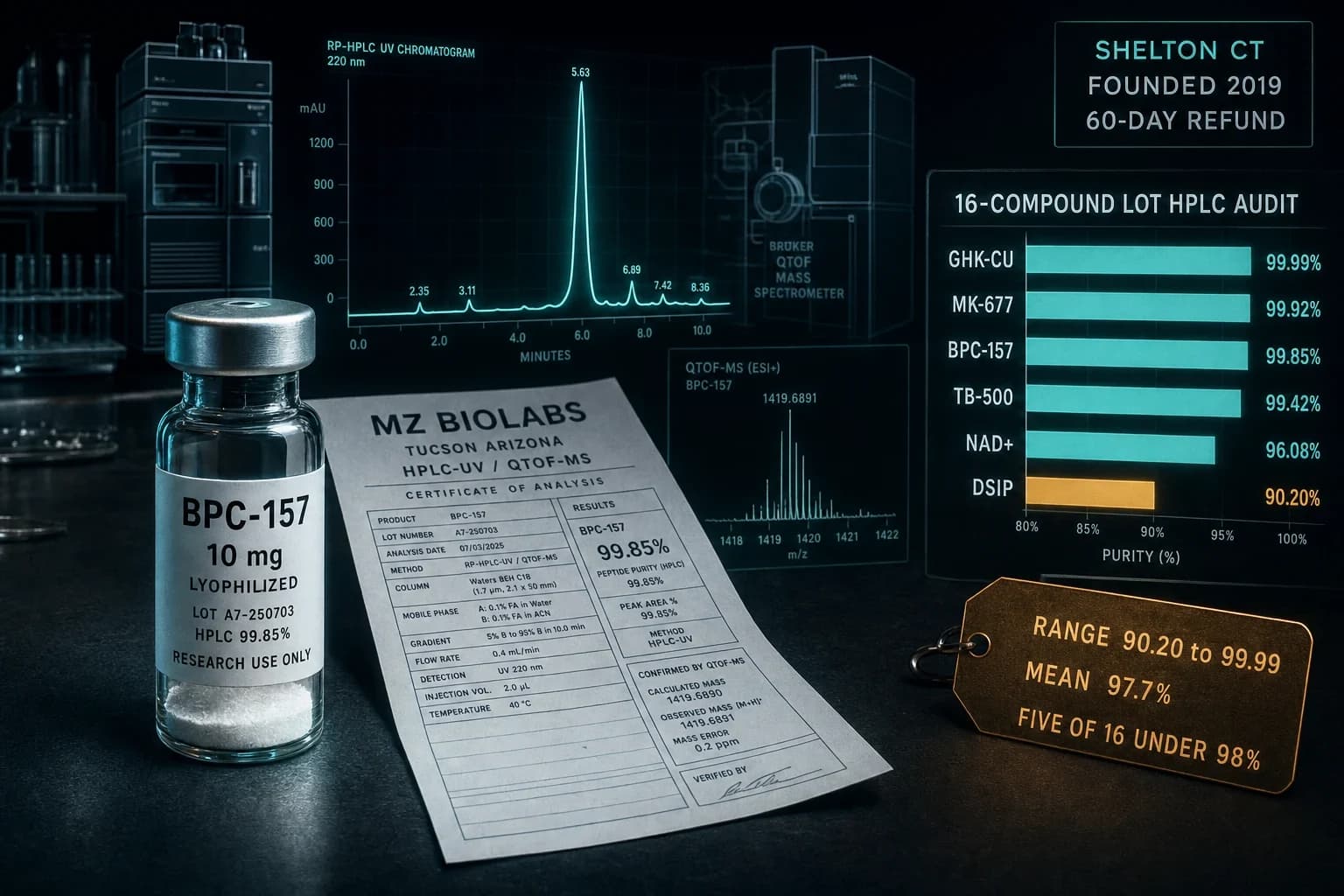
Research-market vendors sell it under research-use-only labeling. The practical safety implication of this is sourcing. Products sold without a certificate of analysis, with ambiguous purity data, or with contamination risk create an adverse-event profile the Metabolic Pharmaceuticals trials never measured, because the trials used pharmaceutical-grade material synthesized to GMP standards. The COA explainer walks through what to look for on third-party HPLC and mass-spec reports, and the lab-tests library carries vendor-level audits for peptides where Metabolic Pharmaceuticals-grade material is unavailable.
If you are researching this compound, the single highest-impact safety decision you can make is not about dose, it is about where the material came from.
Honest comparison with hGH-family alternatives
A reader deciding between AOD-9604 and other research compounds in the growth-hormone family usually wants to know the relative safety profile. The main three to compare are tesamorelin, HGH Fragment 176-191, and intact hGH.
| Compound | IGF-1 rise | Glucose impact | Human trial evidence | Program status |
|---|---|---|---|---|
| AOD-9604 | None in trials | None in trials | 6 trials, ~900 subjects, oral only | Development halted 2007 |
| HGH Fragment 176-191 | Not formally studied in humans | Not formally studied in humans | No placebo-controlled human efficacy trial | Research use only |
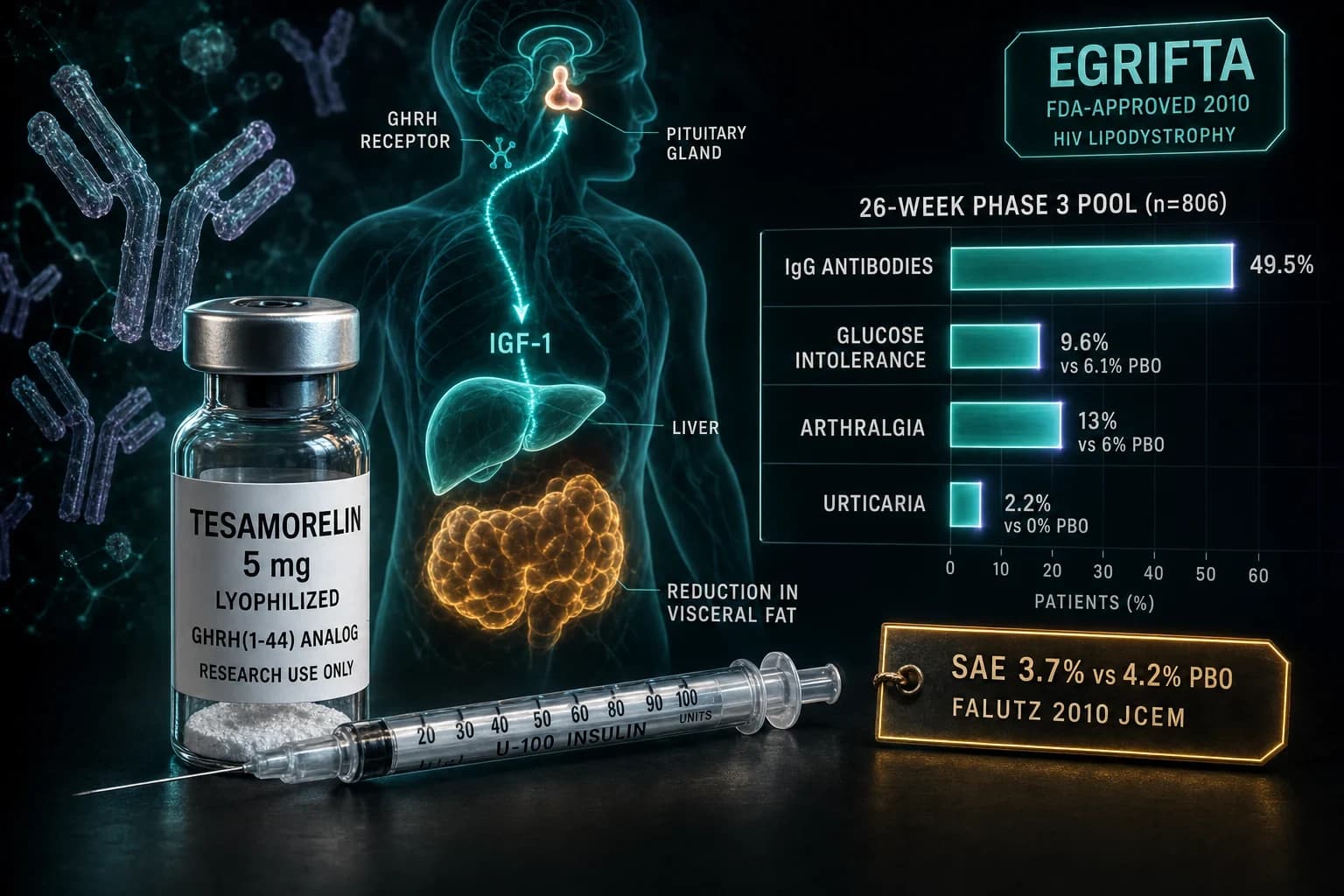
| Tesamorelin | Expected rise (GHRH analog) | Mild, dose-dependent | FDA-approved for HIV lipodystrophy | Approved, prescription |
| Intact hGH | Significant rise | Can impair glucose tolerance | Decades of data | Prescription only |
AOD-9604 is the only one of these with human trial data that specifically rules out IGF-1 and glucose effects at the doses tested. It is also the only one that failed its pivotal efficacy trial. The AOD-9604 before and after article walks the efficacy side of this comparison in detail. For buyers interested in the broader fat-loss category, the best peptides for fat loss roundup covers compounds with stronger human efficacy data and comparable or better safety.
Warning: Clean short-term safety on a compound that did not produce meaningful weight loss in its pivotal trial is a different value proposition than clean short-term safety on a compound that worked. Separate the two questions when you decide what to run.
What a reasonable research protocol does with this evidence
Because the human adverse-event data base is small, oral-only, and 15+ years old, the usable safety advice is procedural rather than physiological:
- Buy from vendors that publish third-party HPLC and mass spec COAs. The best legit peptide vendors list names the current short list, and the Ascension Peptides review covers the one with the longest clean audit record on this site.
- Run the compound at the lowest reasonable research dose, not the highest the vendor page suggests. The AOD-9604 dosage chart sets out the trial-grounded dose range; vendor-suggested 500 mcg daily subcutaneous protocols are not supported by any placebo-controlled human efficacy trial.
- Track glucose at baseline and after four weeks, even though the trials showed no effect. The trials used healthy obese adults; your context may differ.
- Do not stack with GH-raising compounds if the goal is to replicate the fragment's "no IGF-1" profile. Stacking defeats the entire mechanistic rationale.
AOD-9604 is available in the research-market injectable format from Ascension Peptides with code ENHANCED for 50 percent off; the compound page is linked above. Oral tablets at the doses used in the trials are not available anywhere in the research market, because no 503A compounding pharmacy can legally supply them in the US.
The bottom line
The honest reading of the AOD-9604 safety file is narrower than vendor pages suggest and much narrower than critics suggest. In six placebo-controlled trials, the compound did not raise IGF-1, did not impair glucose tolerance, did not provoke an antibody response, and did not produce any serious adverse event the sponsor-funded authors chose to attribute to it. That is a real finding, and it separates AOD-9604 from almost every other GH-family compound.
What that record does not tell you is how injectable AOD-9604 performs over months in anyone who was not in the Metabolic Pharmaceuticals trials, how it interacts with the compounds people typically stack it with, or how it behaves in populations the trials excluded. On those questions, no one has done the work.
If the compound is going to be defensible for research use, it is on the first paragraph of this section. If it is going to disappoint, it is on the last.
Disclaimer: This article is for research and educational purposes only and is not medical advice. AOD-9604 is not approved by the FDA or any comparable regulator for human use. The material sold in the research market is lab-use-only and is not intended for clinical human administration. Nothing here is a promise of results or a treatment recommendation. Consult a qualified healthcare professional before making any health decisions.