At a glance
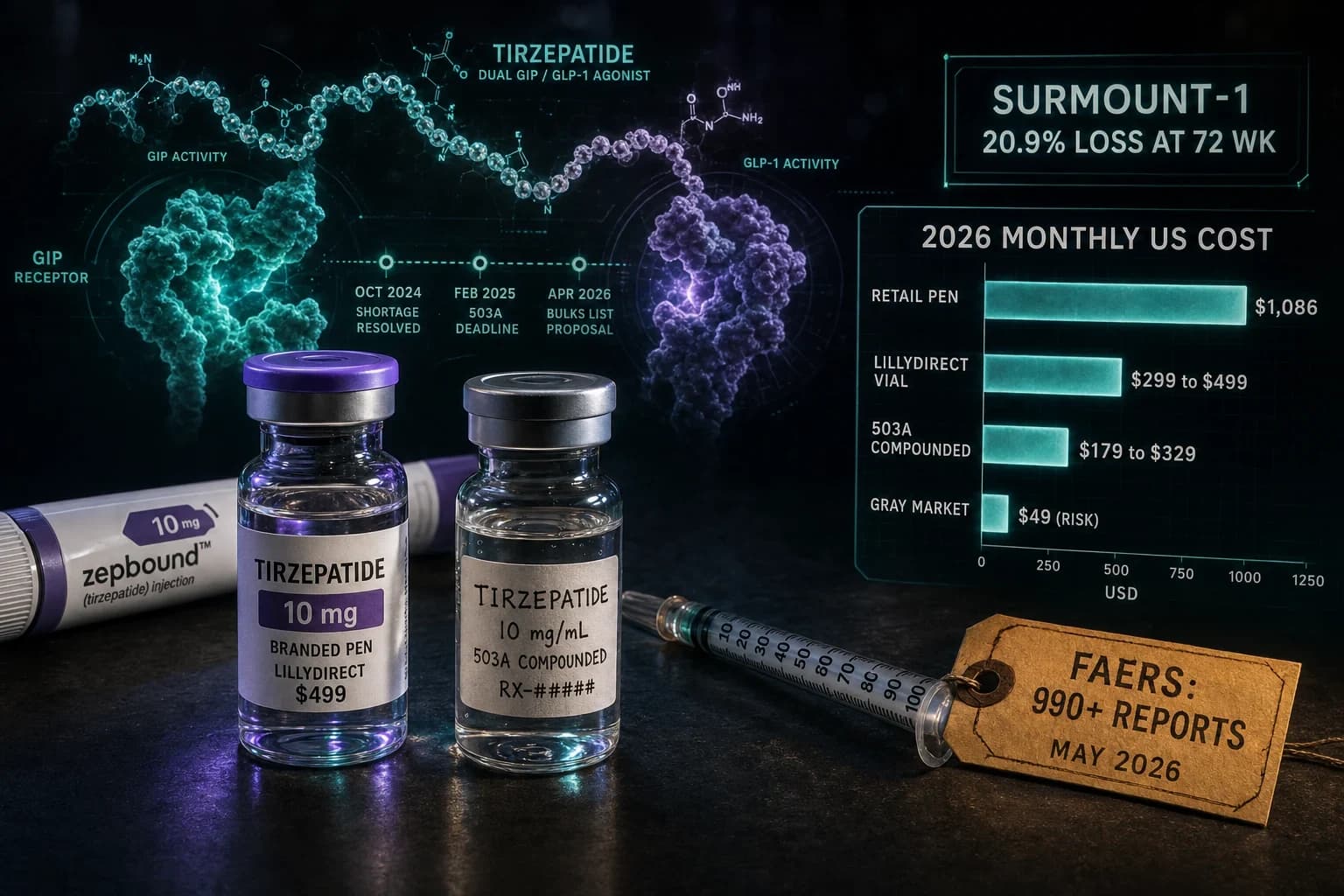
- Retail Zepbound runs about $1,086/mo; LillyDirect vials sit at $299 to $499/mo (2026).
- Legitimate 503A compounded tirzepatide sits near $179 to $329/mo, and the pathway narrowed after the FDA's Feb 2025 enforcement deadline.
- SURMOUNT-1 showed 15.0 to 20.9% weight loss on tirzepatide at 72 weeks; SURMOUNT-5 put it above semaglutide head-to-head.
- By May 2026 the FDA had over 990 adverse-event reports tied to compounded semaglutide or tirzepatide, many from unit-based dosing errors.
- Cheap compounded tirzepatide without documented clinical justification is not the same pathway it was in 2024.
The cheapest legitimate box of compounded tirzepatide right now sits around $179 to $299 a month. A cash-pay box of Zepbound sits closer to $1,086. That gap is real. It is also smaller than it looks once you price in what the FDA changed in 2025, and who is actually allowed to write a compounded tirzepatide prescription in September 2026.
Same active molecule, same GIP and GLP-1 dual-receptor pathway. Different regulatory route, different quality baseline, different legal status, and a genuinely different buyer profile behind each one. This is the head-to-head, updated for the post-shortage rules most cost-comparison pages have not caught up with.
What "compounded tirzepatide" means in September 2026
Pathway first, pricing second. When the FDA declared the tirzepatide shortage resolved in October 2024, the 503A and 503B compounding pathway lost most of its footing. The agency set explicit enforcement deadlines: February 19, 2025 for state-licensed 503A pharmacies and March 19, 2025 for 503B outsourcing facilities (FDA declaratory order). On April 30, 2026, the FDA proposed removing tirzepatide, semaglutide, and liraglutide from the 503B Bulks List entirely, closing the shortage-list and bulks-list pathways at once.
What survives is narrow. Patient-specific 503A compounding remains legal only where a prescriber can document a clinical reason the branded product cannot meet, such as an excipient allergy or a specific dose the commercial pen cannot deliver. Convenience is not a clinical reason. Cost is not a clinical reason. Any telehealth ad selling "compounded tirzepatide" as if the 2024 shortage window is still open is not describing the current legal state.
That framing matters because the cost delta between compounded and branded rests on a pathway the FDA is actively narrowing. The 2026 buyer choice is not "cheap vs expensive". It is "narrow-legal-pathway vs full-legal-pathway", priced accordingly.
For the underlying molecule and mechanism, see the tirzepatide compound page and the tirzepatide dosage chart. For the deeper regulatory timeline, our compounded tirzepatide legal access guide walks the shortage list history in detail.
Zepbound's actual 2026 price, not the sticker
Retail cash-pay Zepbound at a chain pharmacy still lists at $1,000 to $1,200 a month, with Eli Lilly's public list price near $1,086. Almost nobody pays that. Real 2026 access paths for the branded pen and vial:
| Zepbound access path | 2026 monthly cash cost | Who it fits |
|---|---|---|
| Retail cash-pay chain pharmacy pen | $1,000 to $1,200 | Nobody who does the math |
| LillyDirect self-pay vial (2.5 to 12.5 mg) | $299 to $499 | Cash buyer who wants brand only |
| Manufacturer savings card, commercial insurance | $25 to $549 | Insured buyer with prior auth |
| Hims and Hers brand pen program | ~$1,199 plus a $149 membership | Buyer who wants brand plus support |
| Insurance-covered brand pen with prior auth | $25 to $199 copay | Employer plan with obesity coverage |
Two paths inside that table matter. LillyDirect single-dose vials pulled cash-pay branded price down to $299 for 2.5 mg and $499 for higher doses, and the Lilly savings card eligibility expanded in January 2026 from 400 to 500 percent of the federal poverty level, which pulled a wide slice of middle-income commercial-insurance holders into the $25 copay tier. Our cheapest Zepbound guide walks all five of those paths with the current promo codes and eligibility windows. For a specific brand-only telehealth quote, the Hers tirzepatide cost breakdown prices Hers end to end at 2026 rates.
Compounded tirzepatide's real 2026 price, and the pathway attached
Advertised compounded tirzepatide runs roughly $119 to $379 monthly depending on plan length, dose tier, and whether the box is microdose or full strength. Legitimate clinician-supervised programs cluster in the $179 to $329 range once you strip out first-month promotions. A supervised 503A path with real chart notes almost never comes in under $150 monthly on a maintenance dose.
What the price does not include is the compliance footing. Buying compounded tirzepatide legally in September 2026 stacks three requirements together: a licensed clinician who documents a specific clinical reason (allergy to a commercial excipient, a dose the pen cannot deliver, or a similar individual case), a 503A pharmacy operating within its state license, and no reliance on the resolved shortage. If any leg is missing, the "compounded" label is closer to "research chemical relabeled by a middleman" than to legitimate 503A output.
Why the price range widens: a clinician-supervised 503A path with documented rationale tends to sit at $179 to $329 monthly. A "$49 microdose starter" is usually a subtherapeutic dose that ramps into full price within two to three months. Anything much below $100 for a full-dose compounded tirzepatide plan with no clinical documentation is not the pathway it claims to be.
For the transactional comparison side-by-side, the /glp-1/compounded-tirzepatide-online hub lists current telehealth programs, and /glp-1/cheapest sorts them by verified 2026 pricing. Our Bodybuilding Health+ review breaks down the primary GLP-1 telehealth partner in that hub.
Same molecule, different quality baseline
Both products deliver tirzepatide, a GIP and GLP-1 dual receptor agonist. The active ingredient is not in dispute. What differs is what else ends up in the vial.
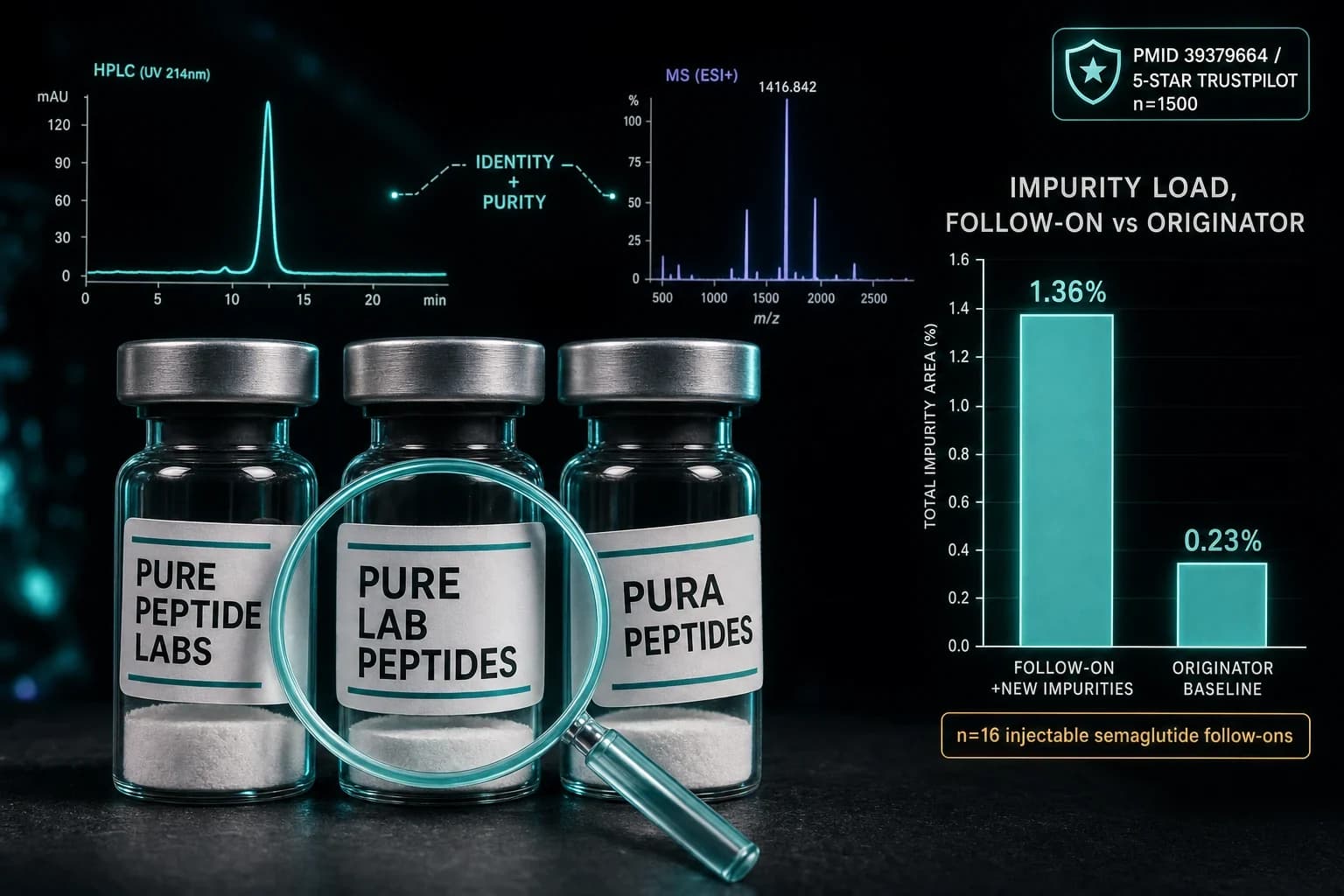
Hach et al. (2024) in the Journal of Pharmaceutical Sciences assessed compounded semaglutide and liraglutide product against originator samples. The compounded batches carried distinct impurity profiles: amino acid deletions and additions, unidentified impurities, and after light exposure a significant disparity in strength, impurity sum, and high-molecular-weight protein levels versus the reference. Tirzepatide was not the specific molecule tested, but it belongs to the same peptide class and faces the same light, temperature, and buffer-stress vulnerabilities during compounding.
The FDA reached the same signal from the clinical side. As of December 2024 the agency's Adverse Event Reporting System held more than 900 cases tied to compounded semaglutide or tirzepatide, including 17 deaths. By May 2026 the count was above 990. Many involved patients measuring doses in "units" from multidose vials at variable concentrations, and administering five to twenty times the intended dose. Some required hospitalization.
Warning: Multidose compounded vials require the patient to convert prescriber instructions into a drawn volume based on the pharmacy's specific concentration. This is where the reported dosing errors cluster. If you are not fluent in a reconstitution math workflow, our reconstitution calculator is worth using before every draw.
Efficacy: does the compounded box match the trial data?
Zepbound rides on genuine published efficacy. Jastreboff et al. (2022) in NEJM (SURMOUNT-1) reported 15.0, 19.5, and 20.9 percent mean weight reduction on 5, 10, and 15 mg tirzepatide at 72 weeks, versus 3.1 percent on placebo. In SURPASS-2 tirzepatide was superior to semaglutide 1 mg on both A1C and weight in adults with type 2 diabetes. SURMOUNT-4 showed that continued treatment maintained a total mean weight loss of about 26 percent from study entry, while withdrawal produced substantial regain. And SURMOUNT-5, the direct head-to-head against semaglutide, put tirzepatide above semaglutide on both body weight and waist circumference reduction at 72 weeks, with fewer GI-driven discontinuations (2.7 vs 5.6 percent).
Compounded tirzepatide has none of that trial data behind it. What it has is the pharmacologic argument that the active molecule is the same, so if the compound is manufactured to comparable purity and reconstituted at the correct concentration, receptor-level activity should approximate the branded product. That argument is defensible in principle. It is also exactly the argument the Hach 2024 findings put pressure on. The active molecule matches. The impurity load, stability profile, and dose consistency are not guaranteed to match.
The buyer decision framework
The pricing table alone will steer most readers wrong. This is the buyer-profile version.
| Buyer profile | Better path | Why |
|---|---|---|
| Commercial insurance covers Zepbound with reasonable prior auth | Brand Zepbound with savings card | A $25 to $199 copay beats every compounded price after chart notes and shipping |
| Cash buyer, wants full trial-backed molecule, brand preference | LillyDirect vial at $299 to $499 | Brand-verified molecule at the lowest legal branded price |
| Cash buyer, allergic to a commercial pen excipient (rare) | 503A compounded with documented clinical reason | Only current pathway where compounded is unambiguously legal |
| Cash buyer with a documented dose-titration case a pen cannot deliver | 503A compounded, microdose or off-cadence dose | Same legal footing as the excipient case |
| Cash buyer looking for the cheapest access, no clinical reason | Reconsider | The 2025 enforcement deadlines closed convenience-based compounding |
| Buyer who would tolerate switching to semaglutide for savings | Compounded semaglutide via Bodybuilding Health+ or Yucca Health | Semaglutide compounding remains constrained, but the price gap to brand is still large |
Cheap compounded tirzepatide as a mass-market cash-pay category is smaller than it was two years ago. Buyers who fit the narrow clinical-justification profile still have a real path. Buyers who do not fit that profile are better served either landing the brand savings card, taking the LillyDirect vial, or pivoting molecule to compounded semaglutide, where the same telehealth partners still route through 503A pharmacies with documented rationale.
Verifying you are buying compounded, not gray-market
Because the pathway narrowed, the difference between a legitimate 503A prescription and a research-peptide reseller labeled as "compounded" is now the whole conversation. A minimum verification checklist for any telehealth quote:
- Pharmacy name and license. A legitimate 503A pharmacy publishes its state license, and you can verify it on that state board of pharmacy website in under two minutes.
- Written clinical justification. Your chart should show a specific reason compounded is being prescribed. Ask to see it.
- Concentration and unit-to-mg conversion, on the label. Multidose vial labels should list mg per mL and a matching insulin unit conversion. If both are absent, the FDA dosing-error pattern is exactly what you are risking.
- Certificate of analysis on request. Legitimate 503A pharmacies produce COAs. If the seller refuses, or the COA has no lab name, it is a research-peptide seller with a marketing wrapper. Our what is a COA guide covers what to look for.
- US-licensed prescribing clinician. Not an "eligibility screener". A named clinician you can look up.
Any seller offering "compounded tirzepatide" without those five is more likely running a research-chemical channel with compounding vocabulary than a legitimate 503A prescription.
Bottom line: In 2026, "compounded vs Zepbound" is a decision framed around clinical justification, not sticker price. If you fit the narrow 503A pathway, a supervised program at $179 to $329 is the right choice. If you do not, LillyDirect's vial and the manufacturer savings card outperform a $99 monthly quote on every axis that matters: legality, purity, dose consistency, and long-term supply continuity.
What to do next
- Verify whether your commercial plan covers Zepbound at a copay you can live with. If yes, pursue that first.
- For cash-pay branded access, price the LillyDirect vial path using our cheapest Zepbound guide.
- If your case fits documented 503A justification, compare supervised programs at /glp-1/compounded-tirzepatide-online.
- If pivoting molecule, Bodybuilding Health+ is the current primary telehealth partner for compounded semaglutide programs.
- For a per-mg tirzepatide breakdown across the generic and compounded market, our tirzepatide cost analysis is the deeper reference.
Both molecules work when the pathway is real. The wrong choice is buying compounded from a channel that does not survive a five-minute pharmacy license check.
This article is for educational and research purposes only. It does not constitute medical advice. Compounded tirzepatide sold outside a state-licensed 503A pathway with documented clinical justification carries legal and quality risks that no cost saving offsets. Consult a licensed clinician for individual questions about GLP-1 therapy.