At a glance
- 1 mL of 100 mg/mL is 100 mg. 1 mL of 200 mg/mL is 200 mg. The volume alone tells you nothing.
- In a 20-week dose-response trial, 25, 50, 125, 300, and 600 mg weekly produced mean testosterone of 253, 306, 542, 1345, and 2370 ng/dL (Bhasin et al. 2001).
- Typical replacement lands near 100 mg weekly, the dose that reproduces mid-normal physiology rather than exceeding it.
- Hemoglobin and hematocrit rise linearly with dose, and more steeply in older men (Coviello et al. 2008).
- Fat-free mass gains were dose-dependent: +3.4, +5.2, and +7.9 kg at 125, 300, and 600 mg weekly.
"Is 1 mL of testosterone a week enough?"
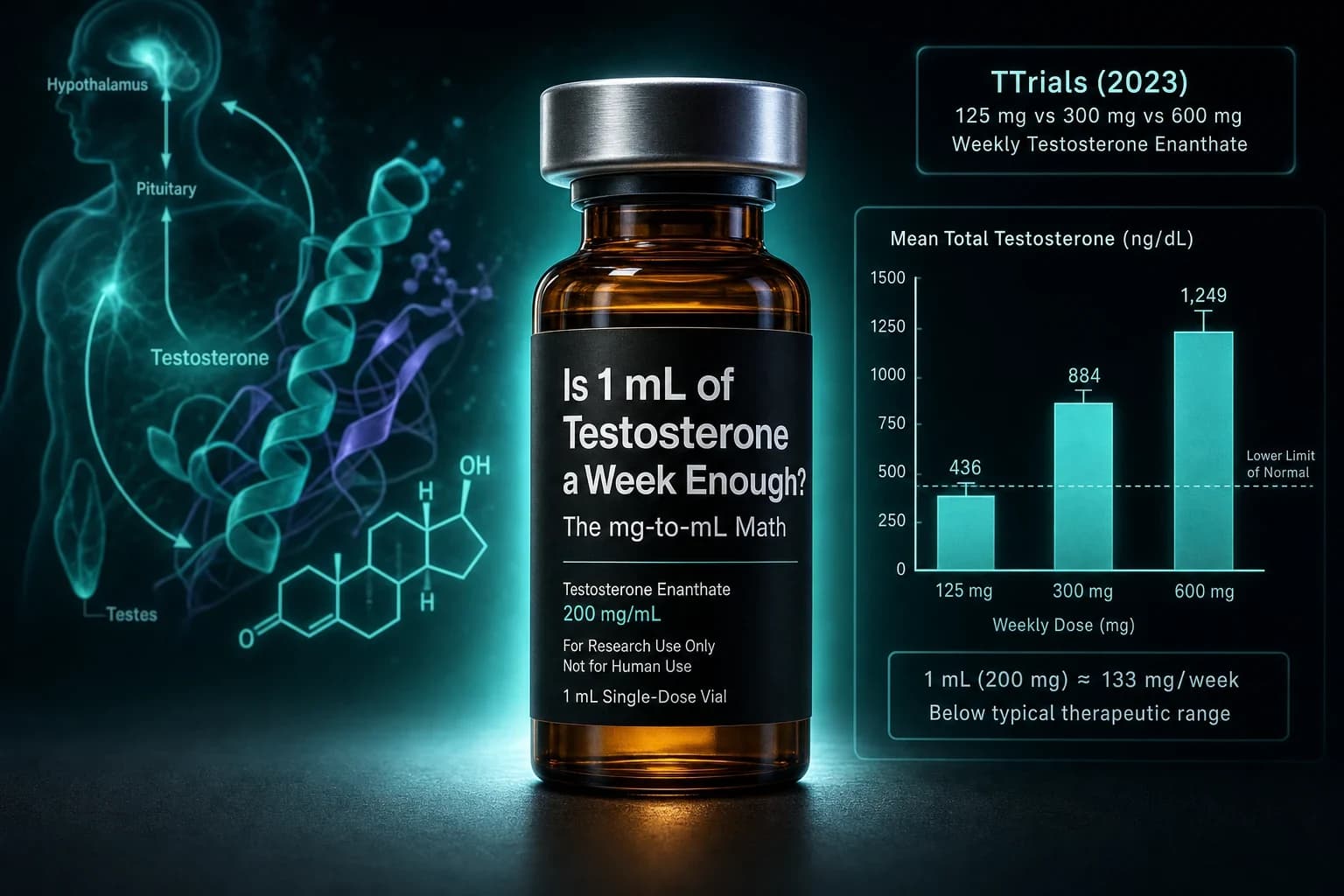
The question cannot be answered as asked, and that is not pedantry. One mL is a volume. Testosterone cypionate is sold at 100 mg/mL and at 200 mg/mL, and compounding pharmacies fill 250 mg/mL. So "1 mL weekly" is anywhere from 100 mg to 250 mg, which spans the entire range from conservative replacement to a dose that produces testosterone levels roughly triple the top of the normal range.
Same syringe. Same volume. Two and a half times the drug.
Check the concentration printed on your vial before anything else in this article is useful to you.
The conversion, once
mg = mL multiplied by the concentration in mg/mL.
| You inject | At 100 mg/mL | At 200 mg/mL | At 250 mg/mL |
|---|---|---|---|
| 0.25 mL | 25 mg | 50 mg | 62.5 mg |
| 0.5 mL | 50 mg | 100 mg | 125 mg |
| 0.75 mL | 75 mg | 150 mg | 187.5 mg |
| 1.0 mL | 100 mg | 200 mg | 250 mg |
Insulin syringes add a second unit and a second chance to be wrong. A 1 mL insulin syringe is marked in 100 units, so 100 units equals 1 mL, and 20 units equals 0.2 mL. At 200 mg/mL, 20 units is 40 mg. If you are converting between mg, mL, and syringe units regularly, our TRT dose calculator does it live, and adds injection splitting and vial duration.
Warning: The most common dosing error is not a wrong protocol. It is drawing to the wrong mark on a syringe measured in units while thinking in mL. A tenfold error here is one decimal place.
What each dose actually produces in blood
This is the part almost no clinic page cites, and it is the single best dataset in the field.
Bhasin and colleagues took 61 healthy men aged 18 to 35, suppressed their natural production with a GnRH agonist so the only testosterone present was what they administered, then gave weekly injections of 25, 50, 125, 300, or 600 mg of testosterone enanthate for 20 weeks with standardized diets (Bhasin et al. Am J Physiol Endocrinol Metab 2001, PMID 11701431).
Because endogenous production was clamped, the resulting levels map cleanly onto dose.
| Weekly dose | Mean testosterone achieved | Where that sits |
|---|---|---|
| 25 mg | 253 ng/dL | Below or at the low end of normal |
| 50 mg | 306 ng/dL | Low-normal |
| 125 mg | 542 ng/dL | Solid mid-normal |
| 300 mg | 1,345 ng/dL | Roughly double the top of normal |
| 600 mg | 2,370 ng/dL | Supraphysiologic |
A typical reference range for total testosterone runs about 300 to 1,000 ng/dL. So 125 mg weekly landed a young man squarely mid-range, and 25 to 50 mg weekly did not reliably clear the bottom of it.
That is why clinical replacement usually starts near 100 mg weekly. It is not a tradition. It is the dose that reproduces normal physiology instead of exceeding it.
What changed at each dose
The same trial tracked body composition and safety markers, and the findings were dose-dependent along a single linear relationship.
Fat-free mass rose 3.4 kg at 125 mg, 5.2 kg at 300 mg, and 7.9 kg at 600 mg weekly. Leg press strength, leg power, thigh and quadriceps muscle volume, hemoglobin, and IGF-1 all correlated positively with testosterone concentration. Fat mass and HDL cholesterol correlated negatively.
Notably, sexual function, visual-spatial cognition, mood, and PSA did not change significantly at any dose in these healthy eugonadal men. Which is worth sitting with, because sexual function is the reason most men start.
The earlier landmark trial in the same lab gives the training context: 600 mg weekly plus supervised lifting produced 6.1 kg of fat-free mass over 10 weeks, and 600 mg weekly without training still beat placebo with training on several measures (Bhasin et al. N Engl J Med 1996, PMID 8637535).
Note: Those are supraphysiologic doses studied in healthy men under medical supervision, not replacement protocols. They are cited here because they define the shape of the dose-response curve, not because 600 mg weekly is a target.
The number that should govern your dose
Hematocrit. Not testosterone.
A secondary analysis of the same dose-response cohort, this time comparing 60 older men aged 60 to 75 against 61 young men, found hemoglobin and hematocrit rose in a linear, dose-dependent fashion in both groups, and the increases were significantly greater in the older men (Coviello et al. J Clin Endocrinol Metab 2008, PMID 18160461). Interestingly, erythropoietin did not explain the effect.
Short-acting injectables carry the highest erythrocytosis incidence of any formulation (Ohlander et al. Sex Med Rev 2018, PMID 28526632). Raised hematocrit thickens blood, and it is the most common reason a well-run clinic will cut your dose regardless of how you feel.
If you are 65 and running 200 mg weekly because 100 mg "did not feel like enough," the dose-limiting variable is on your complete blood count, not your symptom diary.
Injection frequency and why peaks matter
Testosterone cypionate and enanthate have half-lives of roughly 4.5 to 8 days. One weekly injection therefore produces a peak a day or two after the shot and a trough right before the next one, and the swing widens as the per-injection dose grows.
Splitting the same weekly total into two injections narrows that swing without changing the weekly milligrams. Twice-weekly dosing of 50 mg is the same 100 mg per week with roughly half the peak-to-trough amplitude.
Body fat also affects the curve. Body fat content and testosterone pharmacokinetics were found to determine the degree of gonadotropin suppression after intramuscular testosterone administration (Kornmann et al. J Androl 2009, PMID 19342702), which is one reason two men on identical protocols return different labs.
When to draw labs, or your number means nothing
A testosterone result without a timestamp relative to your last injection is uninterpretable, and this single omission generates an enormous amount of unnecessary dose escalation.
On weekly injections, the standard is a trough draw: immediately before your next scheduled shot, when levels are at their lowest. That is the number to titrate against, because it tells you whether you are covered across the full interval. A peak drawn two days post-injection will read high and tempt nobody usefully.
Three practical rules:
- Draw at the same point in the cycle every time. Comparing a trough to a peak across two visits produces a difference that is entirely artifact.
- Draw in the morning. Testosterone has a strong diurnal rhythm, and the diagnostic standard of two low morning readings exists precisely because afternoon values run lower in men who are perfectly normal (Bhasin et al. J Clin Endocrinol Metab 2018, PMID 29562364).
- Get the complete blood count on the same draw. Hematocrit is the ceiling on your dose, and checking it a month later defeats the purpose.
When the number is fine but you feel bad
This is common enough to deserve its own answer, and the reflex to add milligrams is usually wrong.
Check SHBG and free testosterone. Sex hormone binding globulin determines how much of your total is actually available. A man at 700 ng/dL total with very high SHBG can have less free testosterone than a man at 450 with low SHBG. Total alone hides this entirely.
Check the interval, not the dose. Wide peak-to-trough swings on a single weekly injection make some men feel good for three days and flat for four. Splitting the identical weekly milligrams across two injections often fixes this without adding any drug.
Check what else is running. Sleep apnea, iron deficiency, hypothyroidism, and depression all produce fatigue, low mood, and low libido, and all of them coexist happily with a perfectly adequate testosterone level. In the largest placebo-controlled trial available, testosterone produced no significant benefit for vitality even in men who were genuinely deficient (Snyder et al. N Engl J Med 2016, PMID 26886521).
Escalating the dose in response to a symptom that testosterone does not fix buys you hematocrit and nothing else.
A reference table, with the caveat attached
| Weekly dose | Expected range | Typical use |
|---|---|---|
| 50 to 75 mg | Low-normal | Conservative start, or older men managing hematocrit |
| 100 to 125 mg | Mid-normal | The most common clinical replacement window |
| 150 to 200 mg | Upper-normal to above | Requires close hematocrit and estradiol monitoring |
| Above 200 mg | Supraphysiologic | No longer replacement |
The Endocrine Society position is to aim for mid-normal total testosterone and to titrate against symptoms and safety labs rather than chasing a number (Bhasin et al. J Clin Endocrinol Metab 2018, PMID 29562364).
Bottom line: Read the concentration on the vial, convert to mg, and treat your hematocrit as the ceiling. 125 mg weekly put healthy young men at 542 ng/dL in a controlled trial. If you need substantially more than that to feel normal, the problem is usually absorption, timing, thyroid, sleep, or the assay, and rarely the milligrams.
Related
Everything on one page, calculator included, sits in the TRT hub. If you are weighing whether to start at all, our TRT cost breakdown covers what a year actually runs, and what changes and when sets realistic expectations by week. For preserving testicular function alongside a protocol, see hCG and gonadorelin, both available from Ascension Peptides with 50% off using code ENHANCED.
This article is for informational and educational purposes only and is not medical advice. Testosterone is a Schedule III controlled substance in the United States and requires a prescription. Doses cited from clinical trials describe study protocols, not recommendations. Never adjust a prescribed dose without your prescribing clinician.