At a glance
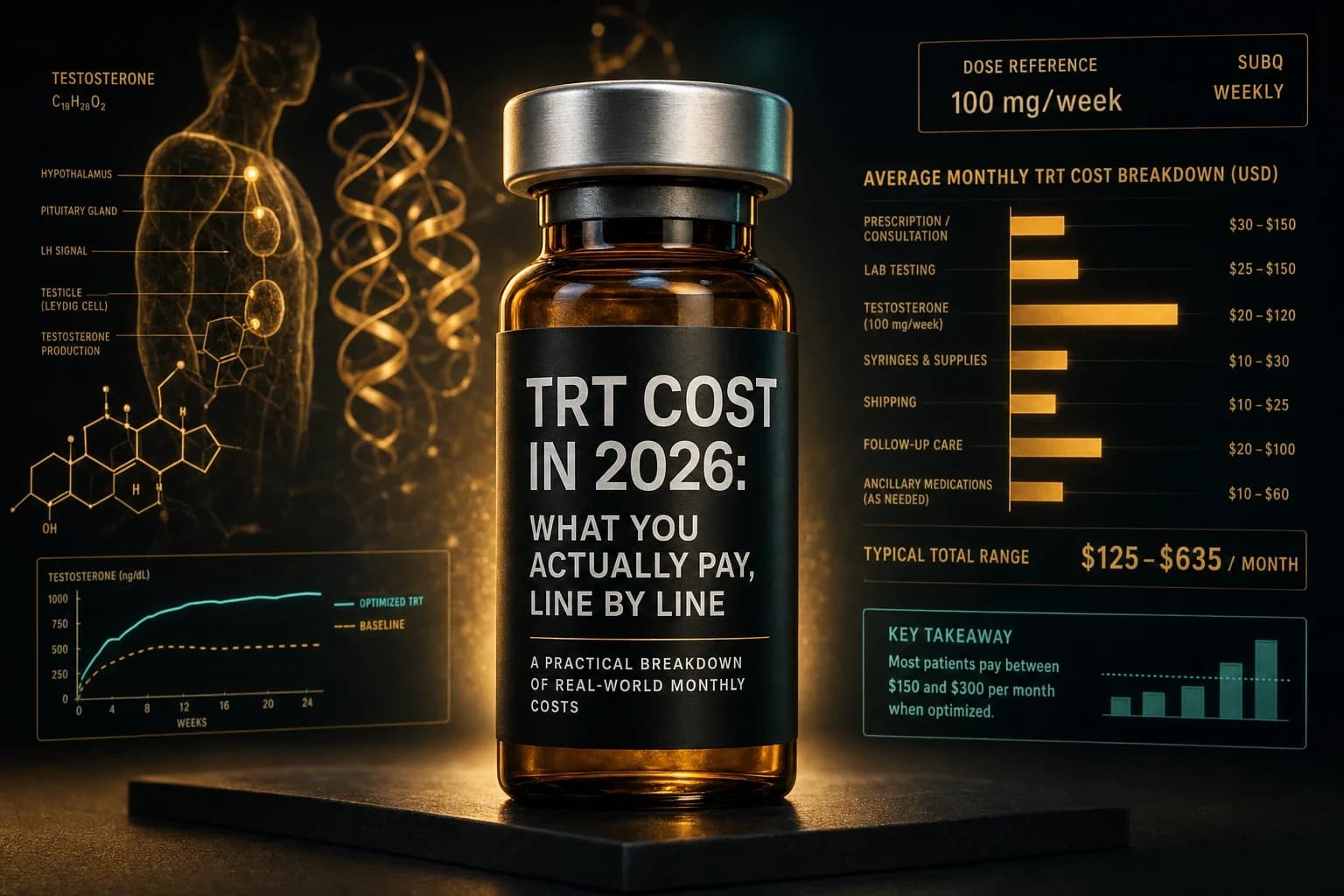
- Generic testosterone cypionate 200 mg/mL runs roughly $30 to $60 cash for a 10 mL vial, which is 10 to 20 weeks of a standard dose.
- Telehealth TRT clinics charge $99 to $250 per month. You are paying for the prescription and monitoring, not the drug.
- Labs are the hidden line item: $75 to $200 every few months unless the clinic bundles them in writing.
- Insurance usually covers testosterone with a documented diagnosis: two low morning readings plus symptoms.
- A $99/mo plan with unbundled labs and ancillaries often costs more per year than a $199/mo all-inclusive one.
The medication is the cheapest part of testosterone replacement therapy. Generic testosterone cypionate at 200 mg/mL costs roughly $30 to $60 cash for a 10 mL vial with a discount card, and a 10 mL vial at a common 100 mg weekly dose is about twenty weeks of treatment.
Twenty weeks. For under sixty dollars.
So when a clinic quotes you $199 a month, understand what you are buying. You are not buying testosterone. You are buying a prescription, a clinician who will monitor you, and someone to adjust the dose when your hematocrit climbs. Whether that is worth $2,400 a year depends entirely on what is actually included, and most price pages are built to keep that vague.
The four line items
Every TRT program in the country is some combination of these. Price any offer by breaking it into these four buckets and nothing else.
| Line item | Typical 2026 range | Notes |
|---|---|---|
| Medication | $30 to $60 per 10 mL vial (cash, generic cypionate) | Brand Depo-Testosterone costs far more for the same molecule |
| Clinician and prescription | $99 to $250/mo bundled, or $75 to $300 per visit | This is the actual product most clinics sell |
| Labs | $75 to $200 per draw, every 3 to 6 months | The most commonly unbundled item |
| Supplies and ancillaries | $10 to $40/mo | Syringes, needles, alcohol pads, plus hCG or an aromatase inhibitor if prescribed |
Retail cash pricing for generic testosterone cypionate is published and easy to verify yourself at GoodRx. Do that before any clinic tells you the medication is why their program costs what it does.
Why the $99 plans are not the cheap ones
Subscription TRT clinics advertise on the monthly headline because that is the number people compare. The spread hides in what sits outside it.
Run the arithmetic on a realistic first year:
| Clinic A ($99/mo, unbundled) | Clinic B ($199/mo, all-in) | |
|---|---|---|
| Subscription, 12 months | $1,188 | $2,388 |
| Baseline labs | $150 | Included |
| Follow-up labs (3 draws) | $450 | Included |
| Supplies | $180 | Included |
| Medication | $120 | Included |
| Year one total | $2,088 | $2,388 |
Clinic A is still cheaper here, but the gap collapsed from $1,200 to $300, and that is with generous lab pricing. Add a fourth draw, an ancillary medication, or a $75 dose-adjustment consult and the order flips.
Tip: Ask one question in writing before you sign anything: "What is my total twelve-month cost including all labs, all consults, all supplies, and all dose adjustments?" A clinic that will not put a number on that is telling you something.
What insurance actually covers
Testosterone is a generic, decades-old drug. Insurers cover it routinely. What they gate is the diagnosis.
The Endocrine Society guideline sets the standard most payers follow: diagnose hypogonadism only in men with consistent symptoms and unequivocally low morning total testosterone on at least two separate occasions, with the low reading confirmed before treatment starts (Bhasin et al. J Clin Endocrinol Metab 2018, PMID 29562364).
Two morning draws. Symptoms. That is the gate.
With that documentation, a covered generic testosterone prescription commonly runs a standard generic copay, often $0 to $30 per fill, and lab work billed through insurance falls under your normal deductible and coinsurance. Which is why the covered path can cost a fraction of any cash clinic.
The reason so many men end up paying cash anyway comes down to three things: their level came back at 340 ng/dL and the payer wants under 300, their symptoms were not documented, or they wanted to skip the six-week wait for an endocrinology appointment. Convenience is a legitimate thing to buy. Just know that is what you are buying.
Note: Cash-pay telehealth clinics are not cheaper than insurance. They are faster and they will treat borderline numbers that a payer will not. Those are different products at different prices.
The labs you are actually paying for
"Labs included" is worth nothing until you know which panel. A cheap program can technically include labs and still only run total testosterone, which tells you almost nothing about whether the protocol is safe.
The panel that justifies a monitoring fee looks like this:
| Test | Why it exists | Roughly when |
|---|---|---|
| Total testosterone | Confirms you are in range | Baseline, then each follow-up |
| Free testosterone or SHBG | Explains men who feel bad at a normal total | Baseline, as needed |
| LH and FSH | Separates primary from secondary hypogonadism | Baseline, before starting |
| Complete blood count (hematocrit) | The actual dose-limiting number | Baseline, 3 to 6 months, then annually |
| Estradiol (sensitive assay) | Aromatization; drives mood and nipple symptoms | Baseline and if symptomatic |
| PSA | Prostate monitoring in older men | Baseline, then per age and risk |
| Lipids and metabolic panel | Testosterone lowers HDL dose-dependently | Baseline, then annually |
LH and FSH at baseline matter more than most patients realize, because once you start exogenous testosterone they are suppressed and that diagnostic window closes for as long as you stay on. A program that starts you without them has skipped the one test that would have told you whether you needed replacement at all.
Tip: If a clinic bundles "labs," ask which analytes. Total testosterone and nothing else is a billing line, not monitoring.
Ancillaries: the costs that appear in month three
Two prescriptions commonly get added after you start, and neither is usually in the headline price.
hCG or gonadorelin, to keep the testes working. Testicular atrophy and suppressed sperm production are expected consequences, not rare ones, and the guideline position is that fertility should be discussed before starting (Bhasin et al. J Clin Endocrinol Metab 2018, PMID 29562364). Expect a meaningful monthly add.
An aromatase inhibitor, sometimes, if estradiol climbs and symptoms follow. Cheap per pill, frequently overprescribed, and worth questioning if it is added reflexively rather than in response to a sensitive-assay result plus actual symptoms.
Budget for both as possibilities. A program that presents itself as all-inclusive and then bills these separately was never all-inclusive.
Route changes the price and the risk profile
| Route | Relative cost | Notes |
|---|---|---|
| Injectable cypionate or enanthate | Lowest | Cheapest per mg by a wide margin; weekly or twice-weekly self-injection |
| Transdermal gel | High | Generic exists but runs well above injectables; daily application, transfer risk to partners and children |
| Oral testosterone undecanoate | Highest | Newest option; restored testosterone to mid-normal range in 87% of patients in phase 3, but was associated with a mean systolic blood pressure rise of 3 to 5 mm Hg (Swerdloff et al. J Clin Endocrinol Metab 2020, PMID 32382745) |
| Pellets | High, lumpy | Paid as a procedure every 3 to 6 months; not adjustable once implanted |
Injectables are also the formulation most associated with erythrocytosis. Short-acting injectable testosterone carries the highest incidence of raised hematocrit compared with other formulations (Ohlander et al. Sex Med Rev 2018, PMID 28526632), which is precisely why the monitoring you are paying the clinic for has value. If nobody is checking your hematocrit two to three times a year, you are paying a subscription for nothing.
The cost nobody prices in
TRT is not a course of treatment. For most men with genuine hypogonadism it is indefinite, and stopping does not return you to baseline on a predictable schedule.
Exogenous testosterone suppresses LH and FSH, and the resulting hypogonadism can persist well after discontinuation depending on dose, duration, and compound (Rahnema et al. Fertil Steril 2014, PMID 24636400). Fertility is the sharpest version of this problem: restoring sperm production after testosterone use typically requires hCG-based combination therapy and averaged 4.6 months to first return in a 49-man series (Wenker et al. J Sex Med 2015, PMID 25904023).
So the honest lifetime figure is not $2,400. It is $2,400 a year for as long as you want the benefit, plus a restart protocol if you ever want to stop or conceive.
That math is why some men look at restoration rather than replacement first, particularly younger men with secondary hypogonadism who have not yet suppressed anything.
Bottom line: Price TRT as a twelve-month all-in number, never a monthly headline. Verify the drug price yourself, get labs and ancillaries in writing, and check whether insurance will cover you before you assume it will not. The medication is $50 a year. Everything above that is service, and service is worth exactly what it delivers in monitoring.
Before you commit to the subscription
Two things worth doing first, and the TRT hub has the calculator for the second. Confirm the diagnosis properly, with two morning draws, because a single afternoon reading is not a diagnosis and testosterone has a strong diurnal rhythm. And understand what the dose actually means, because "1 mL a week" describes a volume, not a dose. Our TRT dosage breakdown covers the mg-to-mL math that trips up most first-year patients.
If your interest is in supporting the axis rather than replacing it, the HPG-axis compounds and hCG are the relevant category, and Ascension Peptides carries them with 50% off using code ENHANCED. For prescription paths, our telehealth partner comparison lays out what each program covers.
This article is for informational purposes only and is not medical advice. Prices are 2026 US market ranges and vary by pharmacy, state, insurer, and clinic; verify current pricing directly before purchasing. Testosterone is a Schedule III controlled substance in the United States and requires a prescription. Consult a licensed physician about diagnosis and treatment.