At a glance
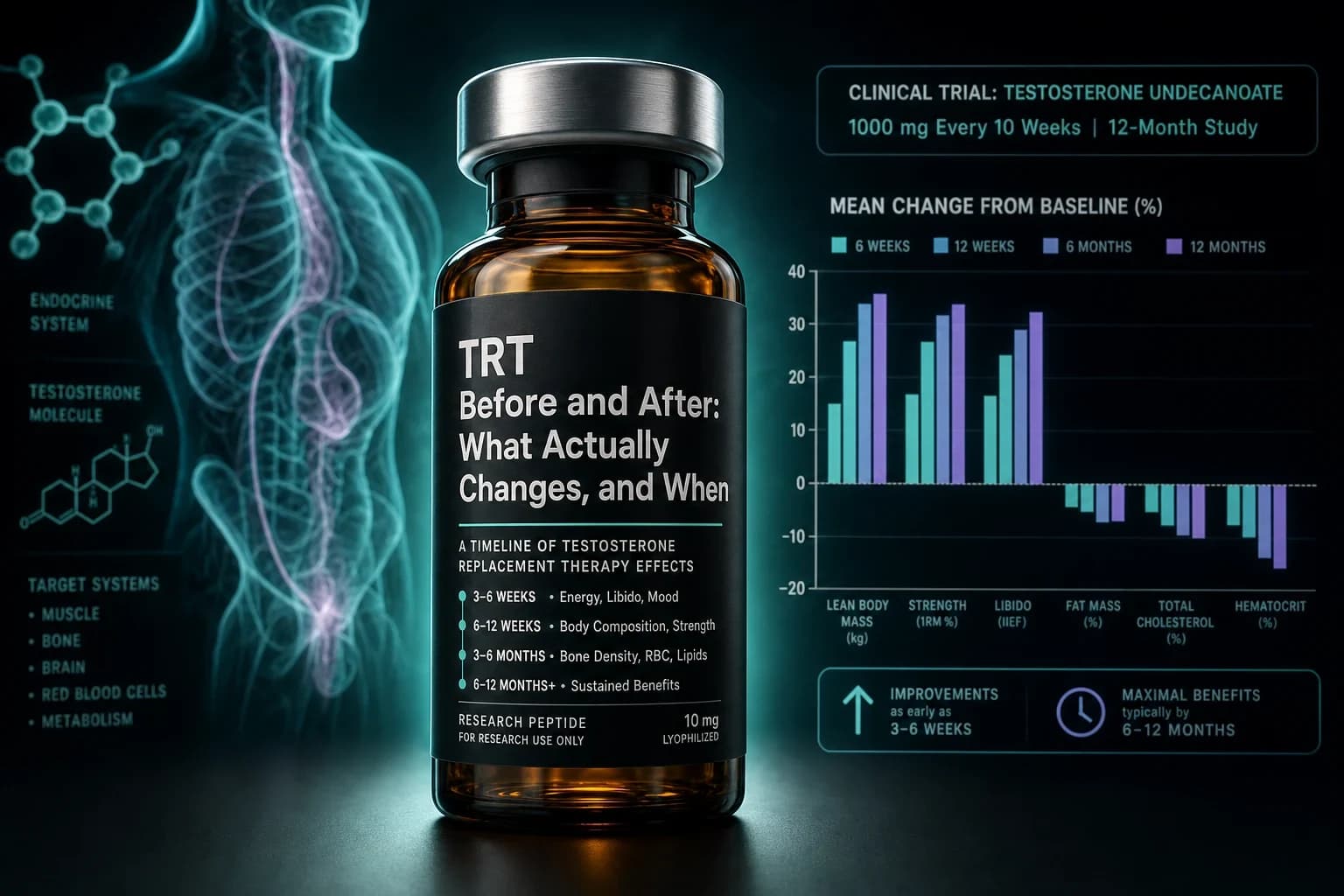
- Sexual interest responds first: detectable at 3 weeks, plateauing around 6 (Saad et al. 2011).
- Erections and ejaculation can take up to 6 months, far longer than libido.
- Body composition changes start at 12 to 16 weeks and stabilize at 6 to 12 months.
- Erythropoiesis is evident by 3 months and peaks at 9 to 12, which is why year-one bloodwork matters most.
- The T-Trials found real sexual function gains but no benefit for vitality or walking distance (Snyder et al. 2016).
Search "TRT before and after" and you get photographs. Two shots, different lighting, different pump, usually different body fat and often a different year.
Photos are the worst possible instrument for this question. They compress an eighteen-month process into two frames and they cannot separate testosterone from the training, sleep, and diet changes that almost always start the same week.
The useful version exists. Researchers have tracked when each effect of testosterone therapy first appears and when it stops improving, and the answer varies enormously by outcome. Libido moves in three weeks. Bone is still improving at three years.
The master timeline
Saad and colleagues reviewed the published literature specifically to map the time course of each effect from first appearance to maximum (Saad et al. Eur J Endocrinol 2011, PMID 21753068). This is the reference table that almost nobody quoting "results" bothers to cite.
| Effect | First detectable | Maximum reached |
|---|---|---|
| Sexual interest and desire | 3 weeks | 6 weeks, no further gain expected |
| Quality of life | 3 to 4 weeks | Longer |
| Depressive mood | 3 to 6 weeks | 18 to 30 weeks |
| Lipids | 4 weeks | 6 to 12 months |
| Insulin sensitivity | Within days | Glycemic control at 3 to 12 months |
| Inflammation markers | 3 to 12 weeks | Varies |
| Erections and ejaculation | Up to 6 months | Later still |
| Fat mass, lean mass, strength | 12 to 16 weeks | 6 to 12 months, marginal gains after |
| Erythropoiesis | 3 months | 9 to 12 months |
| PSA and prostate volume | Marginal rise | Plateau at 12 months |
| Bone density | 6 months | Still improving at 3 years |
Three things fall out of that table immediately.
Desire and function are on different clocks. Libido plateaus at six weeks. Erectile function may need six months. Men who feel their drive return at week four and conclude the treatment "stopped working" on function at week eight are reading a six-month curve at the eight-week mark.
Nothing visible happens in month one. Body composition does not begin moving until week 12. Any before-and-after photo pair spanning four weeks is showing you water, glycogen, and lighting.
The blood work curve is the long one. Erythropoiesis peaks at 9 to 12 months, which is exactly why the first year needs the most monitoring and why men often pass their year-one draw with a hematocrit nobody flagged at month three.
What the best controlled trial found
The Testosterone Trials remain the strongest placebo-controlled evidence in older men. 790 men aged 65 or older, all with testosterone below 275 ng/dL and symptoms, randomized to testosterone gel or placebo gel for one year (Snyder et al. N Engl J Med 2016, PMID 26886521).
What improved:
- Sexual activity, sexual desire, and erectile function all improved significantly (P<0.001 for sexual activity)
- Mood was slightly better and depressive symptoms slightly less severe
- Walking distance improved when all three trials were pooled: 20.5% of testosterone patients gained at least 50 metres versus 12.6% on placebo
What did not:
- Vitality showed no significant benefit. None. Measured on a validated fatigue scale.
- Walking distance did not reach significance in the Physical Function Trial on its own
That vitality result deserves emphasis, because "energy" is the single most common reason men start. In the largest placebo-controlled trial available, in men who were genuinely deficient, testosterone did not beat placebo gel on it.
Note: Placebo gel is a serious comparator. Men who start TRT also start lifting, sleeping better, and paying attention. Some of what gets attributed to testosterone in an uncontrolled before-and-after is the attention itself, and the T-Trials design is what separates the two.
Bone, blood, and cognition at twelve months
Companion trials measured outcomes photographs will never show.
Bone. After one year, testosterone increased spine trabecular volumetric bone density by 7.5% versus 0.8% on placebo, a 6.8% treatment effect, and raised estimated spine trabecular bone strength by 10.8% versus 2.4% (Snyder et al. JAMA Intern Med 2017, PMID 28241231). Larger in trabecular than cortical bone, larger in spine than hip.
Anemia. In the TRAVERSE cohort, anemia corrected in 41.0% of testosterone-treated men versus 27.5% on placebo at 6 months, holding at 45.0% versus 33.9% at 12 months. Among men without anemia, fewer testosterone-treated men developed it. Changes in hemoglobin tracked with changes in reported energy (Pencina et al. JAMA Netw Open 2023, PMID 37889486).
Cognition. Nothing. Among men with age-associated memory impairment, one year of testosterone produced no benefit to delayed paragraph recall or any other cognitive measure versus placebo (Resnick et al. JAMA 2017, PMID 28241356).
About the muscle photos
The dramatic transformation pictures are almost never replacement doses.
At 125 mg weekly, the closest studied dose to clinical replacement, healthy young men gained 3.4 kg of fat-free mass over 20 weeks. At 600 mg weekly they gained 7.9 kg (Bhasin et al. Am J Physiol Endocrinol Metab 2001, PMID 11701431). Add supervised training to 600 mg and the earlier trial recorded 6.1 kg in just 10 weeks (Bhasin et al. N Engl J Med 1996, PMID 8637535).
Roughly three kilos over five months on a replacement dose is real and it is not a transformation photo. If an image looks like 600 mg, it probably was. Our dosage breakdown covers where those lines sit.
A realistic month-by-month
| Timeframe | What to expect | What to check |
|---|---|---|
| Weeks 1 to 4 | Libido stirs around week 3. Mood and quality of life start shifting. No visible change. | Nothing yet |
| Weeks 5 to 12 | Libido plateaus by week 6. Mood continues improving. Lipids shifting. | First follow-up labs: testosterone, hematocrit, estradiol |
| Weeks 12 to 26 | Body composition finally moves. Erectile function may still be improving toward the 6-month mark. | Hematocrit trending up; PSA baseline |
| Months 6 to 12 | Body composition stabilizes. Erythropoiesis peaks at 9 to 12 months. Bone measurably improving. | The most important draw of the entire protocol |
| Year 2 and beyond | Marginal composition gains. Bone still improving out to 3 years. | Ongoing hematocrit, PSA, symptoms |
Warning: If your energy has not improved by month six, the honest reading of the T-Trials is that testosterone may simply not be the lever. Sleep apnea, iron deficiency, thyroid dysfunction, and depression all present as low energy and low testosterone at once, and treating the testosterone leaves the cause running.
Why two men on the same protocol get different results
Identical dose, identical ester, wildly different outcomes. Four variables explain most of the spread, and none of them are effort.
Where you started. The T-Trials enrolled men below 275 ng/dL. A man starting at 180 has far more room to improve than a man starting at 420 who talked his way onto a protocol, and the improvement in symptoms tracks the size of the correction rather than the final number.
SHBG. Sex hormone binding globulin decides how much of your total testosterone is actually free and available to tissue. Two men at the same total can have meaningfully different free levels, which is why one feels the change at week three and the other does not.
Body fat. Adiposity affects both the pharmacokinetics of injected testosterone and the degree of gonadotropin suppression that follows (Kornmann et al. J Androl 2009, PMID 19342702). The same milligrams produce a different curve in different bodies.
Age, specifically for blood. The erythropoietic response to testosterone is linear with dose in both young and older men, but significantly steeper in older men (Coviello et al. J Clin Endocrinol Metab 2008, PMID 18160461). A 68-year-old and a 30-year-old on 120 mg weekly are not running the same protocol from a safety standpoint.
None of this is visible in a photograph, and all of it determines whether yours looks like anyone else's.
The change nobody photographs
Testicular volume falls and sperm production drops, often to zero, and it starts within weeks. That is negative feedback doing exactly what it does, and it is the one before-and-after nobody posts.
Recovery is achievable but slow. In 49 men with azoospermia or severe oligospermia after testosterone use, hCG-based combination therapy restored or improved sperm production in 47, averaging 4.6 months to first return (Wenker et al. J Sex Med 2015, PMID 25904023).
Preserving function during a protocol is easier than restoring it afterward. hCG and gonadorelin are the compounds involved, compared directly in HCG vs gonadorelin, and both are available from Ascension Peptides with 50% off using code ENHANCED, with batch certificates of analysis published.
Bottom line: Give libido 6 weeks, body composition 16, and erectile function 6 months before judging anything. Expect roughly 3 kg of lean mass on a replacement dose, not a transformation. And treat the 9-to-12-month hematocrit peak as the appointment you do not skip.
Related
The TRT hub collects all of this behind one dose calculator. Deciding whether to start at all is mostly a cost and diagnosis question: see what TRT actually costs in 2026 and is TRT a steroid. If you have an intact axis and want to avoid suppression entirely, peptides that raise testosterone covers the restoration path.
This article is for informational and educational purposes only and is not medical advice. Outcomes cited are group averages from clinical trials and do not predict individual response. Testosterone is a Schedule III controlled substance in the United States and requires a prescription. Consult a licensed physician regarding diagnosis, treatment, and monitoring.