At a glance
- Night, 2 to 3 hours after food, is the default pulse.
- No published trial compares morning vs night for this stack.
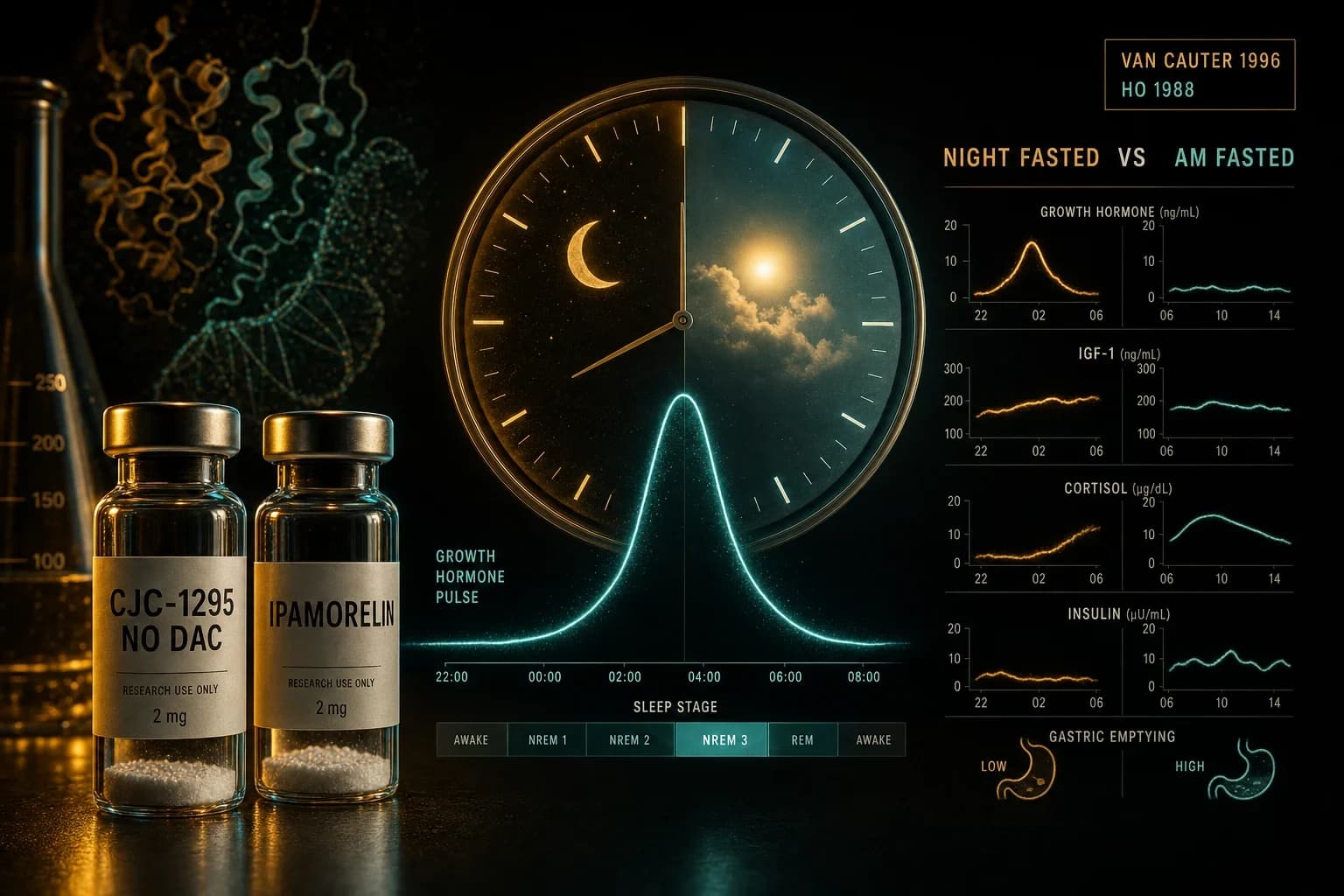
- Most adult GH is secreted during slow-wave sleep (Van Cauter 1996).
- Fasting raises GH pulse size; a recent meal blunts it (Ho 1988).
- CJC-1295 with DAC is weekly. Clock time matters less.
Night. Fasted. That is the short answer, and it is a physiology argument, not a head-to-head trial.
Nobody has published a randomized study that takes CJC-1295 plus ipamorelin, splits people into "7 a.m." and "10 p.m.," and reports IGF-1 or sleep-stage GH. What we have is how GH is actually secreted, how food changes that, and how the two peptides work. The default clock falls out of those three facts.
Bottom line: For the short-acting pairing (CJC-1295 no DAC + ipamorelin), take the main pulse before sleep, two to three hours after the last meal. Add a morning fasted pulse only if you are running a multi-pulse no-DAC protocol. The DAC form is a weekly shot. Clock time is not the interesting variable. Protocol math lives on the CJC-1295 + Ipamorelin dosage chart. The pre-mixed vial is the FIT Stack.
What the peptides actually do to the clock
Ipamorelin is a selective ghrelin-receptor agonist. In the original characterization it released GH without a meaningful cortisol or ACTH rise, unlike older GHRPs (Raun et al., 1998). The pulse is short. Half-life is on the order of two hours. You get one pulse per injection, then you are done.
CJC-1295 is a GHRH analog. The version most people mean when they say "FIT stack" is no DAC: a brief GHRH signal that dies in about 30 minutes. The DAC version is a different drug. A single subcutaneous dose raised mean GH 2- to 10-fold for six days or more and IGF-1 1.5- to 3-fold for 9 to 11 days, half-life 5.8 to 8.1 days (Teichman et al., 2006). Overnight sampling a week later still showed pulsatile GH, not a flat line (Ionescu and Frohman, 2006).
If your vial is DAC, asking "morning or night" is the wrong question. You are covering days, not a bedtime window.
If your vial is no DAC plus ipamorelin, you are trying to time one or two pulses. That is the rest of this page.
Why night is the default
Most of an adult's daily GH is released in pulses during slow-wave sleep, especially early in the night (Van Cauter and Plat, 1996). A GHRH analog plus a ghrelin agonist, given shortly before that window, is aimed at the pulse that is already scheduled.
A second, independent reason is food. A two-day fast in healthy men raised GH secretion more than five-fold and amplified pulse amplitude (Ho et al., 1988). Carbohydrate and a recent insulin rise go the other direction. Injecting on a full stomach is how you pay for a peptide and then blunt the thing you bought it for.
So the practical rule is ugly and specific: last meal two to three hours before the shot, then lights out. Not "with dinner." Not "right after dessert."
There is no trial that proves this pairing "improves deep sleep." GHRH given during sleep can increase slow-wave sleep in some designs. That is not the same as "ipamorelin is a sleep drug." If you sleep worse after a bedtime injection, move the pulse to a morning fasted window and stop arguing with a forum.
When morning is the right second shot
The dosage chart lists a multi-pulse no-DAC pattern: 100 mcg of each, two or three times a day. The extra pulses only make sense if each one is fasted.
| Pulse | Clock | Condition |
|---|---|---|
| Primary | 30 to 60 minutes before sleep | 2 to 3 hours after food |
| Optional AM | On waking | Nothing but water first, 30+ minutes before breakfast |
| Optional midday | Only on a true no-DAC 3x protocol | Empty-stomach window again |
Morning-only, skipping night, is a compromise for people who will not inject before bed or who get wired. You lose the slow-wave coincidence. You keep the fasted pulse. That is a real trade. It is not a failed protocol.
Do not stack a DAC weekly shot on top of a 3x daily no-DAC schedule and call it "more GH." Those are two different exposure shapes.
What this is not
It is not a human combination trial. Teichman and Ionescu studied CJC-1295 with DAC, alone, in healthy adults. Raun studied ipamorelin, alone, in a characterization paper. Van Cauter described sleep-related GH. Ho described fasting. The stack is a community pairing that uses those mechanisms. The FIT Stack protocol writeup and the CJC-1295 + Ipamorelin stack protocol cover dose and duration. This page is only the clock.
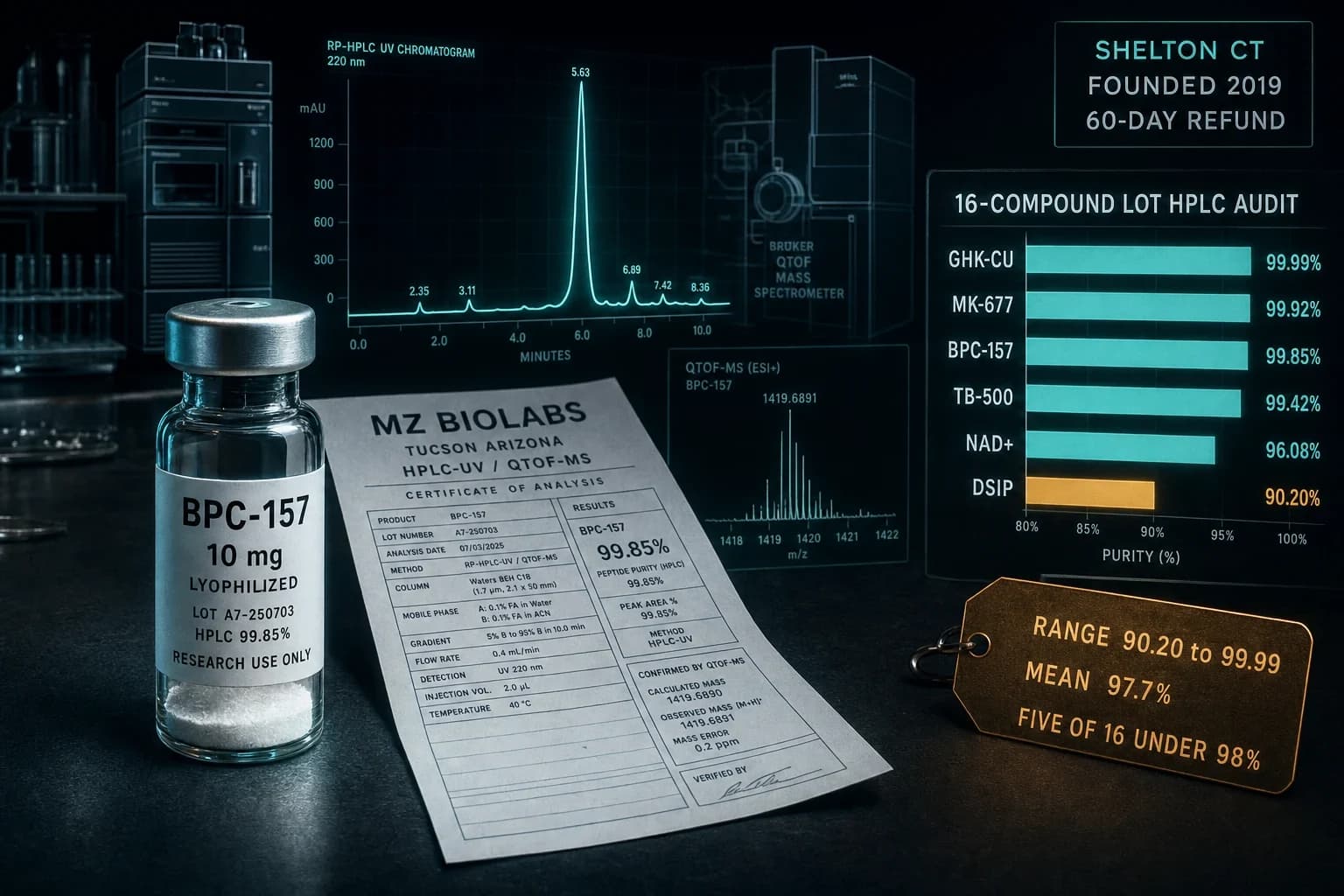
Sourcing still matters more than whether you picked 6 a.m. or 10 p.m. A short or mislabeled vial makes the timing debate decorative. The lot-matched library is the Ascension Peptides review. Code ENHANCED is 50% off the FIT Stack and the separate vials. Confirm the lot in the lab-tests library before you decide which hour to use it.
FAQ
When to take CJC-1295 and ipamorelin, morning or night?
Night, fasted, is the default for the no-DAC pairing. Morning is an optional second pulse or a substitute if bedtime injection wrecks your sleep.
How long after eating?
Two to three hours. The Ho 1988 fasting data is about a multi-day fast amplifying GH, not a stopwatch. The practical rule is: no recent carbohydrate sitting in the system.
Does the DAC version need a bedtime slot?
No. Teichman 2006 is a weekly or biweekly exposure lasting days. Pick a consistent weekday. Empty-stomach still helps the injection you are giving that day. It does not turn DAC into a nightly peptide.
Can I put both in one syringe?
Yes, for the no-DAC pairing, if both are reconstituted in bacteriostatic water and you are using them immediately. Use the reconstitution calculator so the unit marks match the printed milligrams on this lot.
This article is for research and educational purposes only. Research peptides are not approved drugs or dietary supplements. Nothing here is medical advice or an instruction to self-administer. We have an affiliate relationship with Ascension Peptides and disclose it.