At a glance
- Combined GHRH + GHRP produces 10-15x baseline GH vs 2-5x for either alone
- Ipamorelin is the cleanest GHRP: no cortisol, prolactin, or appetite increase
- Use CJC-1295 without DAC (30-min half-life) for pulsatile GH release
- Inject fasted, 30-60 minutes before bed to sync with natural GH pulse
- 12-week cycle, 4-week off; sleep improvement is the first noticeable effect
Why stack?
Growth hormone secretion isn't regulated by a single signal. The anterior pituitary responds to two independent pathways:
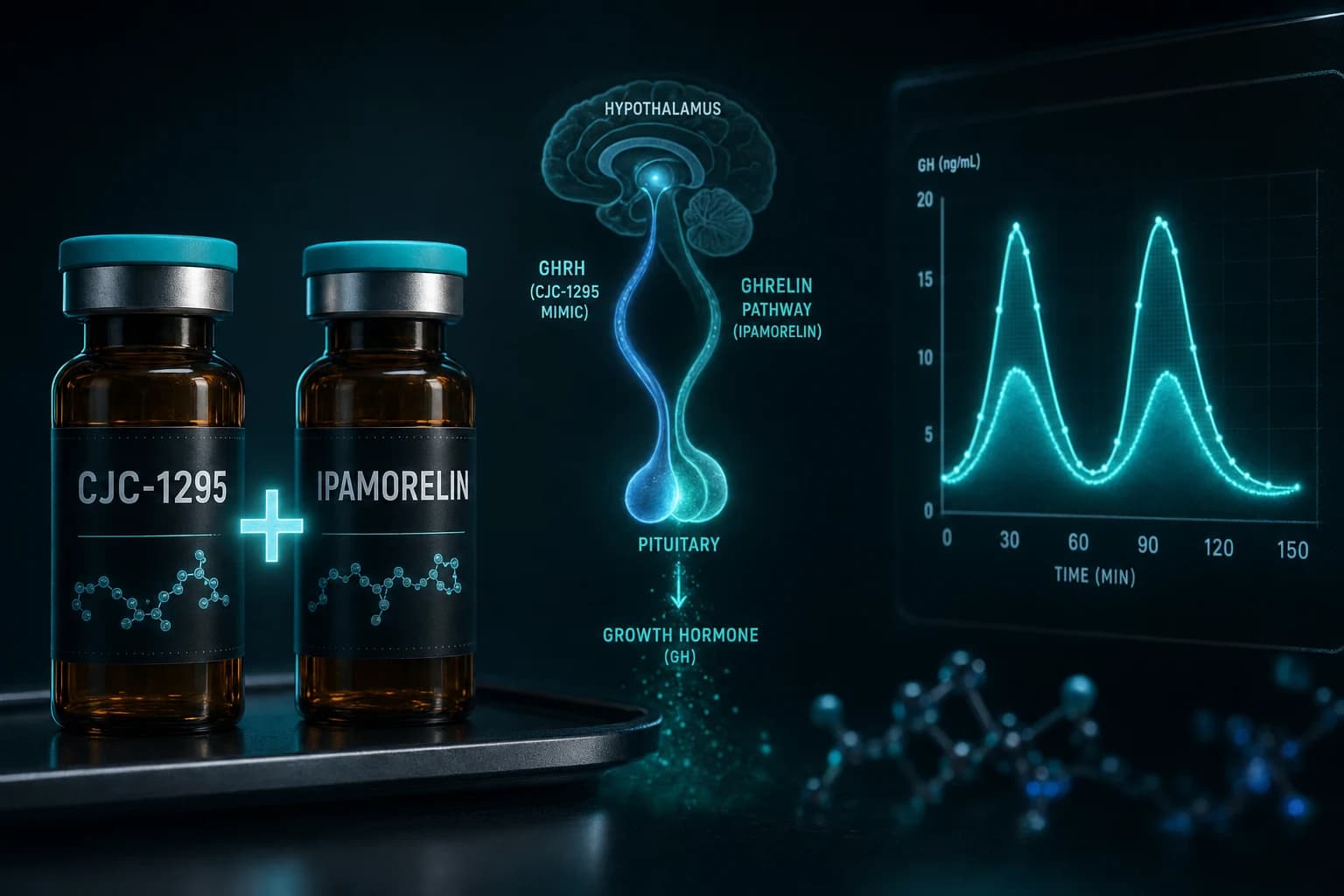
- GHRH (growth hormone releasing hormone): binds the GHRH receptor and increases GH pulse amplitude
- GHRP / ghrelin: binds the ghrelin receptor (GHSR) and increases GH pulse frequency while inhibiting somatostatin
CJC-1295 is a GHRH analog. Ipamorelin is a selective GHRP. On their own, each produces a modest GH pulse. Used together, the pulses are roughly synergistic rather than additive. A study by Veldhuis et al. (2009) in the American Journal of Physiology examined GHRH-GHRP synergy in 47 men and confirmed that simultaneous stimulation of both receptor pathways produces a GH response significantly greater than the sum of individual responses. Combined GH output typically reaches 2-3x what either compound produces alone, with some protocols reporting even higher amplification.
This is why the CJC-1295 + Ipamorelin stack has been the canonical growth hormone peptide protocol in research circles for well over a decade. It hits both pathways, it's clean (no prolactin or cortisol elevation from Ipamorelin's selectivity), and it produces a GH pulse that closely resembles a natural physiological pulse rather than a supraphysiological flood.
Why Ipamorelin specifically? Not all GHRPs are equal in selectivity. The landmark 1998 study by Raun et al. in the European Journal of Endocrinology established Ipamorelin as "the first selective growth hormone secretagogue." Unlike GHRP-6 and GHRP-2, which stimulate ACTH release from corticotroph cells (leading to downstream cortisol secretion) and can elevate prolactin, Ipamorelin did not raise ACTH or cortisol at levels significantly different from GHRH alone. This selectivity held even at doses more than 200-fold higher than the ED50 for GH release. In practical terms: GHRP-6 produces the strongest raw GH output in the class but brings hunger spikes (via ghrelin receptor cross-activation), cortisol elevation, and prolactin rises. GHRP-2 sits between the two in selectivity. Ipamorelin matches the GH-releasing potency of GHRP-6 while producing substantially less off-target hormonal activity, which is why it's the preferred GHRP for long-term stacking protocols.
GHRP comparison
| GHRP | Selectivity | Cortisol Impact | Appetite Stimulation | GH Release Potency | Best For |
|---|---|---|---|---|---|
| Ipamorelin | High (no off-target hormonal activity) | None | None | Moderate-strong | Clean long-term GH protocols, stacking with CJC-1295 |
| GHRP-6 | Low (broad receptor activation) | Moderate increase | Strong increase (ghrelin cross-activation) | Strong | Maximum acute GH output when side effects are acceptable |
| GHRP-2 | Moderate | Mild increase | Mild increase | Strong | Stronger GH than Ipamorelin with fewer side effects than GHRP-6 |
| Hexarelin | Low | Moderate increase | Moderate increase | Very strong (highest in class) | Short-term maximum GH (desensitizes within 2-4 weeks) |
Ipamorelin's advantage is clear for stacking protocols: it delivers comparable GH potency to GHRP-6 without cortisol, prolactin, or appetite side effects, and it does not desensitize the receptor at standard doses. Hexarelin produces the strongest single-dose GH release but is unsuitable for protocols longer than 2 weeks due to rapid receptor desensitization.
The synergy in numbers
Published research on GHRH + GHRP co-administration shows:
- GHRH alone: ~2-4x baseline GH
- GHRP alone: ~3-5x baseline GH
- GHRH + GHRP together: ~10-15x baseline GH
The synergy comes from two mechanisms operating at once: GHRH primes the pituitary somatotrophs and pushes them to release more GH per pulse, while the GHRP suppresses somatostatin (the brake on GH release) and amplifies pulse frequency through a separate receptor pathway. Bowers et al. (2004) showed that over a 24-hour period, the GHRH + GHRP combination best restored natural GH pulsatility. A key study by Veldhuis et al. (2009) in the American Journal of Physiology quantified GHRH-GHRP synergy in 47 men and found that the magnitude of this synergy correlated negatively with age and abdominal visceral fat (both P < 0.001) and positively with baseline IGF-1 (P < 0.001). In practical terms, younger and leaner subjects with higher baseline IGF-1 see the strongest synergistic amplification. Neither compound alone produces the full effect because each leaves half the regulatory system untouched.
If you're only going to run one compound, the research argument is weak; you're leaving the synergy on the table. Stacking is the point.
Which CJC-1295?
Critical distinction before proceeding: there are two versions of CJC-1295.
CJC-1295 without DAC (sometimes called Mod GRF 1-29):
- Half-life: ~30 minutes (the native GRF 1-29 peptide has a half-life under 10 minutes; four amino acid substitutions in the modified version extend it to ~30 minutes by protecting against enzymatic degradation)
- Produces discrete GH pulses that mimic natural rhythm
- Dose 1-3 times daily
- This is the version you want for the stack
CJC-1295 with DAC (Drug Affinity Complex):
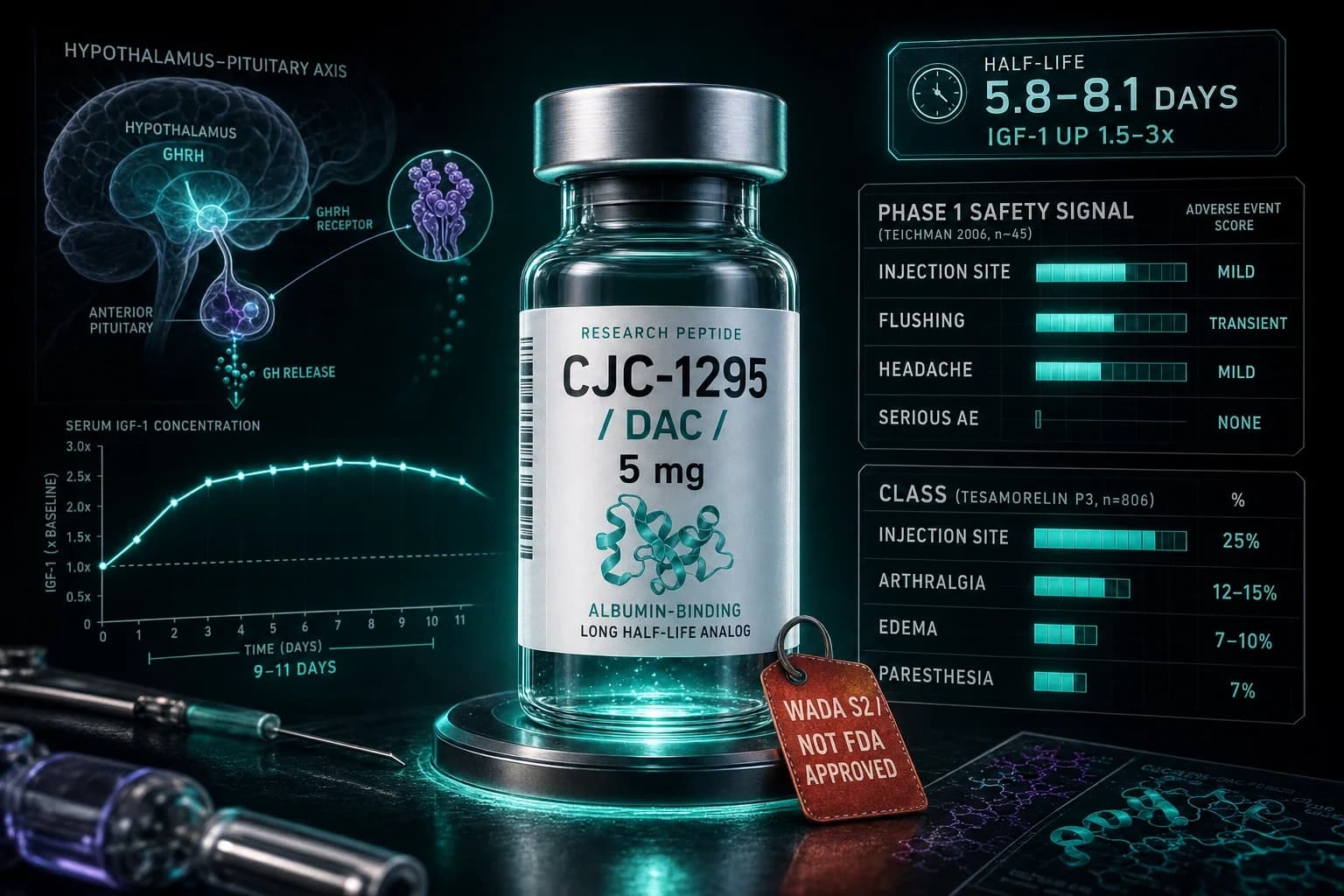
- Half-life: 5.8-8.1 days (Teichman et al., JCEM 2006). The DAC moiety binds covalently to serum albumin after injection, dramatically slowing clearance.
- A single SC injection raised mean plasma GH 2- to 10-fold for 6+ days and IGF-1 1.5- to 3-fold for 9-11 days in healthy adults (no serious adverse reactions reported). After multiple doses, mean IGF-1 levels remained above baseline for up to 28 days.
- Produces a sustained "bleed" of GHRH signal rather than discrete pulses
- Dose once or twice weekly
- Less commonly stacked with Ipamorelin; the DAC version's continuous signal blunts the pulsatile benefit of pairing with a GHRP
The research community defaults to CJC-1295 without DAC for the Ipamorelin stack because the pulsatile mechanism is the whole point. The DAC version elevates GH and IGF-1 for days at a time (useful for certain research questions), but that steady-state signal works against the purpose of pairing with a GHRP, where the synergy depends on synchronized pulsing.
See the CJC-1295 guide for the full comparison.
The protocol
Dosing
Standard research protocol:
- CJC-1295 (no DAC): 100-300 mcg per dose
- Ipamorelin: 200-300 mcg per dose
- Route: Subcutaneous (abdomen or thigh)
- Frequency: 1-3 times daily
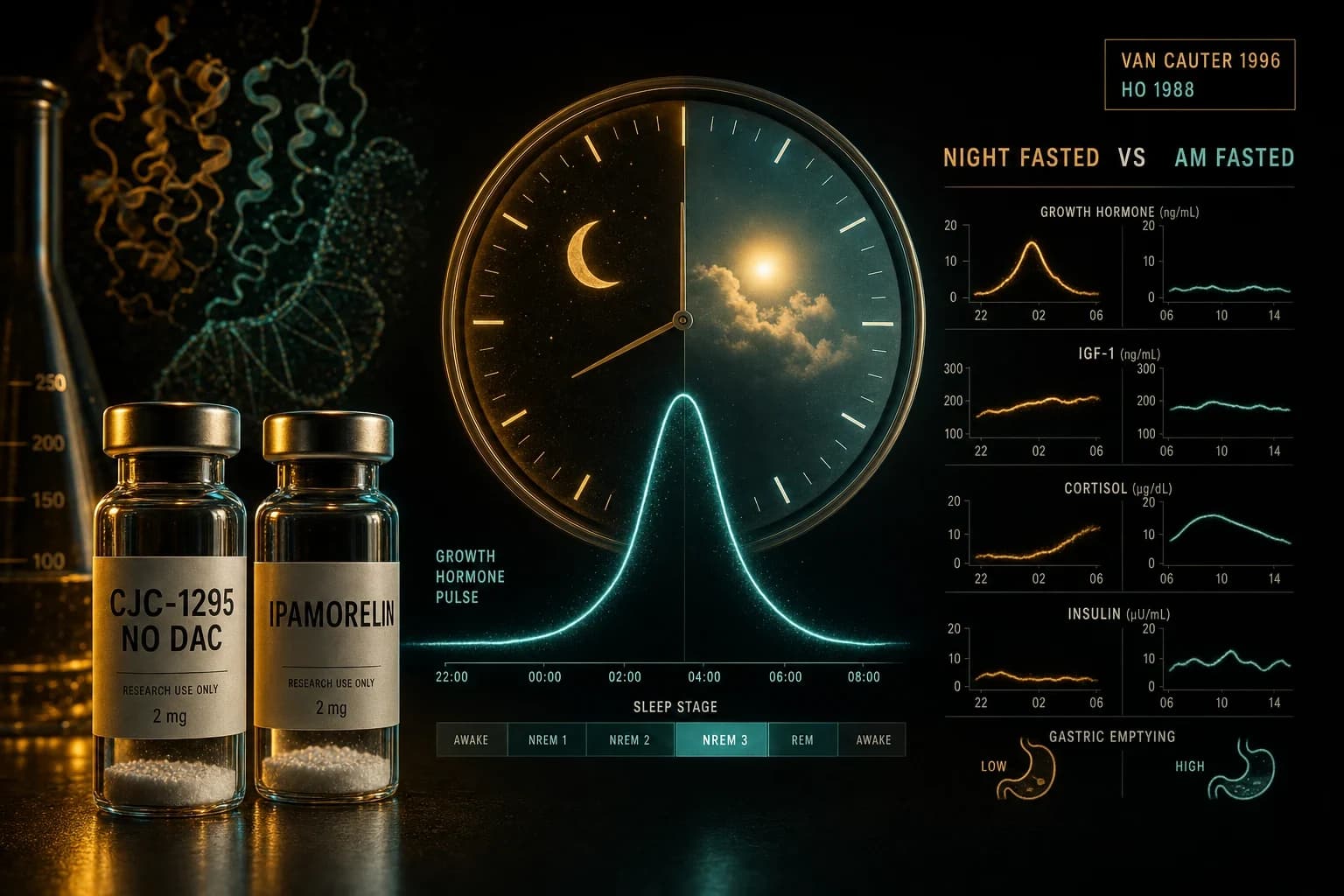
Most researchers start with CJC-1295 100 mcg + Ipamorelin 200 mcg, once daily, before bed. This captures the body's natural nighttime GH pulse (~90 minutes into sleep) and amplifies it. If you're pushing for more aggressive results, escalate to twice daily (morning fasted + before bed) or three times daily (morning, afternoon, before bed).
Timing matters
Both compounds need to be injected on an empty stomach, roughly 30 minutes before or 2 hours after eating. Elevated blood glucose suppresses the GH response through somatostatin. Eating too close to the dose kills most of the pulse you'd otherwise get.
The before-bed dose is the most important one because:
- It stacks with the natural GH pulse that occurs ~90 minutes into sleep
- There's no eating window to worry about
- Sleep-linked GH is the most anabolically relevant pulse in the 24-hour cycle
If you're only running one daily dose, make it the bed-time dose.
Cycle structure
Standard cycle:
- Weeks 1-12: Active dosing per protocol above
- Weeks 13-16: Off period (4 weeks minimum) before next cycle
- Reassessment: Track endpoints (body composition, recovery, sleep quality) before and after each cycle
Cycling matters for GH peptides because continuous stimulation can downregulate receptor sensitivity. The 12-on / 4-off structure keeps the pituitary responsive across long-term research.
Reconstitution math
Using standard 2mg vials for both compounds:
CJC-1295 (no DAC) 2mg vial + 2mL BAC water
- Concentration: 1 mg/mL = 1,000 mcg/mL
- 100 mcg dose: 0.10 mL = 10 units on a U-100 syringe
- 200 mcg dose: 0.20 mL = 20 units
- 300 mcg dose: 0.30 mL = 30 units
- Doses per vial (at 100 mcg): 20
Ipamorelin 2mg vial + 2mL BAC water
- Concentration: 1 mg/mL = 1,000 mcg/mL
- 200 mcg dose: 0.20 mL = 20 units
- 300 mcg dose: 0.30 mL = 30 units
- Doses per vial (at 200 mcg): 10
Combined draw
Because both compounds are in the same concentration and are compatible in solution, you can draw both into the same syringe for a single SC injection:
- 100 mcg CJC (10 units) + 200 mcg Ipa (20 units) = 30 units total
- 200 mcg CJC (20 units) + 300 mcg Ipa (30 units) = 50 units total
One swab, one stick, both compounds delivered. Verify any combination in the reconstitution calculator.
Expected effects over 12 weeks
Published research and the broader research community converge on a rough timeline:
- Weeks 1-2: Improved sleep depth (very common, often the first noticeable effect). Mild flush or light-headedness for ~20 minutes post-injection in some researchers; normal and resolves.
- Weeks 3-4: Improved recovery from training, reduced next-day soreness. Skin quality improvements beginning.
- Weeks 5-8: Body composition shifts: reduced visceral adiposity, improved fasting insulin. Joint and connective tissue resilience.
- Weeks 9-12: Accumulated IGF-1 elevation effects: lean tissue changes, hair/nail improvements, continued recovery benefit.
These are research-reported effects consistent with GH's known physiology. Individual responses vary substantially with age, baseline GH/IGF-1, sleep, and training status.
Cycling considerations
The standard 12-on / 4-off cycle is a reasonable default. A few alternatives seen in research protocols:
- 8-on / 4-off for more frequent cycling with higher receptor sensitivity preservation
- 12-on / 8-off for longer recovery between cycles (less aggressive)
- Pulse cycles (5-days-on / 2-days-off within each week); less common, lower total exposure
Avoid running the stack continuously past 16 weeks without a break. Receptor desensitization and diminishing returns are both documented.
The FIT Stack alternative
If running two separate vials feels like friction, the verified partner offers a pre-mixed FIT Stack (CJC-1295 + Ipamorelin combined in a single lyophilized vial). One reconstitution, one syringe, one injection per dose. The math is cleaner and there's no possibility of drawing the wrong ratio.
The FIT Stack is the easier on-ramp for researchers new to the protocol. Once you're experienced, separate vials give more flexibility on ratio (e.g., pushing CJC higher while holding Ipa steady).
Alternatives and adjacent compounds
- Sermorelin: shorter-acting GHRH analog, the predecessor to CJC-1295. Well-established but less potent than CJC for the stack.
- Tesamorelin: FDA-approved GHRH analog with extensive visceral fat reduction data. Runs solo, typically not stacked.
- MK-677: oral ghrelin mimetic, produces 24-hour GH elevation. Different mechanism than the pulsatile CJC/Ipa stack; research uses diverge.
Research access
Both compounds are available from Ascension Peptides at research-grade purity with 50% off using code ENHANCED. The pre-mixed FIT Stack is also available for single-vial convenience. Lot records sit in the lab-tests library.
- CJC-1295 research guide →
- Ipamorelin research guide →
- Sermorelin research guide →
- Tesamorelin research guide →
- Reconstitution calculator →
- Half-life visualizer →
Disclaimer
This article describes dosing protocols seen in published research and research-community practice, and is provided for research and educational purposes only. CJC-1295 and Ipamorelin are not approved for general human use. Nothing here is medical advice, and any decision to self-administer should involve a qualified healthcare professional.