At a glance
- Abaloparatide cut new vertebral fractures 86% in the 2,463-woman ACTIVE trial (Miller 2016).
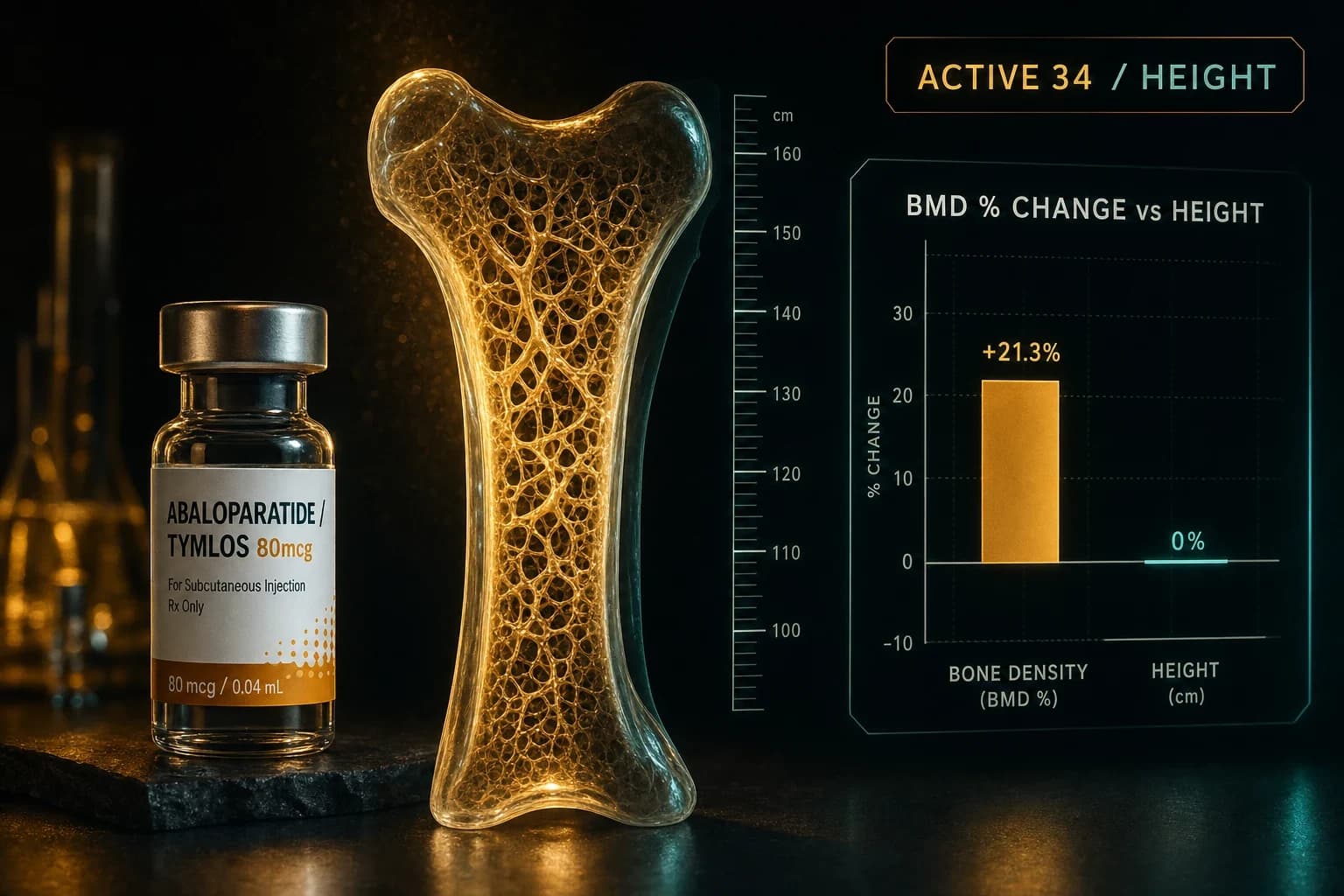
- It added 11.2% lumbar spine density in 18 months, and zero standing height.
- Teriparatide-treated women still lost 2.81 mm of height in its pivotal trial.
- Adult growth plates are fused; no PTH analog lengthens bone after fusion.
- Vosoritide, the one peptide that lengthens bone, only works in open growth plates.
Abaloparatide added 11.2% bone mineral density to the lumbar spines of postmenopausal women in 18 months. Standing height gained: not measured, because nobody running the trial imagined a bone-remodeling drug could make adults taller. Heightmaxxing forums imagined it anyway. The 34-amino-acid peptide sold as Tymlos, a roughly $2,900-per-month osteoporosis drug, has become one of the most discussed compounds in communities chasing adult height.
That claim deserves a straight answer, because the biology underneath it is genuinely interesting and the trial record is genuinely strong. It just proves something different from what the forums think it proves.
What abaloparatide is, and why the fracture data is real
Abaloparatide is a synthetic analog of parathyroid hormone-related protein, specifically PTHrP(1-34), engineered with eight substitutions in its back half to sharpen its receptor behavior. The FDA approved it in April 2017 for postmenopausal women with osteoporosis at high fracture risk, then extended it to men in December 2022. The labeled dose is 80 mcg subcutaneously once daily, and the current label lists a half-life of about one hour. It works by stimulating osteoblasts, the cells that lay down new bone matrix.
Behind the approval sits ACTIVE, an 18-month Phase 3 trial in 2,463 postmenopausal women published by Miller et al. (2016) in JAMA. Three arms: abaloparatide 80 mcg, placebo, and open-label teriparatide 20 mcg (the older PTH analog, Forteo).
| Endpoint at 18 months | Abaloparatide | Placebo | Teriparatide |
|---|---|---|---|
| New vertebral fractures | 0.6% | 4.2% | 0.8% |
| Nonvertebral fractures | 2.7% | 4.7% | 3.3% |
| Major osteoporotic fractures | 1.5% | 6.2% | 3.1% |
| Lumbar spine BMD change | +11.2% | +0.6% | +10.5% |
| Total hip BMD change | +4.2% | -0.1% | +3.3% |
| Hypercalcemia | 3.4% | 0.4% | 6.4% |
That first row is an 86% relative reduction in new spinal fractures (p<0.001). On major osteoporotic fractures, abaloparatide even beat teriparatide head to head (hazard ratio 0.45, p=0.03), the only fracture endpoint where it did. For a skeleton that is losing the remodeling battle, this drug clearly wins it back.
None of which involves bone getting longer. Every number in that table describes existing bone getting denser.
The receptor trick that separates it from teriparatide
Both drugs hit the same receptor, PTH1R, but they hold it differently. Hattersley et al. (2016) showed that abaloparatide binds the receptor's G-protein-coupled RG conformation with roughly 1,600-fold selectivity over the R0 conformation, while teriparatide's ratio is closer to 12-fold. RG binding fires a brief pulse of cAMP signaling and lets go. R0 binding keeps signaling long after the ligand should have left.
Think of it as tapping a doorbell versus taping the button down. Brief, intermittent PTH1R pulses tell osteoblasts to build. Continuous signaling recruits osteoclasts, dissolves bone, and pushes calcium into the blood. Abaloparatide's quick-release binding is why it produced roughly half the hypercalcemia of teriparatide in ACTIVE (3.4% vs 6.4%, p=0.006) while matching or beating it on density.
Hold onto that doorbell image. It comes back to sabotage the height theory in a minute.
Where the height claim comes from
Heightmaxxing logic runs on a three-step chain, and two of the steps are real science.
Step one: PTHrP is a genuine growth-plate hormone. In children, it keeps growth-plate chondrocytes proliferating and delays their maturation, which is part of how bones elongate (Kronenberg, 2003, Nature). True.
Step two: abaloparatide is a PTHrP analog with stronger osteoanabolic output than teriparatide. Also true, per everything above.
Step three: therefore it should lengthen bones in an adult. Here the chain snaps, because step one only operates inside an open growth plate, and adults do not have any.
There is one animal study feeding the fire, and it is worth reading honestly. Wang et al. (2023) gave abaloparatide or teriparatide to rats and found enhanced mandibular growth, with abaloparatide the more potent of the two. One catch: the rats were four weeks old (skeletally immature, plates wide open), the tissue was condylar cartilage rather than a standard growth plate, and the biggest effects required a mechanical jaw-advancement appliance. An adolescent rodent wearing orthodontic hardware is not evidence that a 25-year-old human gains jaw or stature from injections.
Why it cannot lengthen adult bone
Longitudinal bone growth happens in exactly one place: the cartilaginous growth plate, where chondrocytes divide, stack, hypertrophy, and get replaced by bone at the metaphysis. Those plates fuse at roughly 16 to 18 in females and 18 to 21 in males. After fusion there is no cartilage template left to elongate. PTH analogs act on bone remodeling, the continuous renovation of existing bone surfaces. Remodeling changes density and microarchitecture. It cannot add length, the same way renovating a house cannot add a floor.
The clinical record backs the mechanism at every point where anyone looked:
ACTIVE never even measured standing height. The only "height" in the entire trial is vertebral body height, used to grade compression fractures on X-ray.
The best PTH-analog height data shows treated patients still shrinking. In teriparatide's pivotal Fracture Prevention Trial (Neer et al., 2001), both groups lost height over roughly 19 months: 3.61 mm on placebo, 2.81 mm on teriparatide, per the Forteo label. Two years of the most-studied anabolic bone peptide in history bought 0.8 mm of prevented shrinkage. Not gain. Slower loss.
More PTH1R signaling in an open plate makes people shorter, not taller. Jansen-type metaphyseal chondrodysplasia is caused by a mutation that locks PTH1R permanently on (Schipani et al., 1995, Science). The phenotype is short-limbed dwarfism. Remember the taped-down doorbell: constant PTH1R signaling stops chondrocytes from ever maturing into new bone, and growth stalls. Even in the one population with open plates, flooding this receptor is the opposite of a height drug.
The men's trial tells the same story. In ATOM (Czerwinski et al., 2022), 228 men gained 8.5% lumbar spine density in 12 months. Stature outcomes: not measured, not claimed, not observed.
Bottom line: abaloparatide makes existing bone denser and harder to break. In adults with fused growth plates there is no mechanism, no trial signal, and no case report of it adding standing height. The closest verified height effect in its drug class is 0.8 mm of prevented height loss.
What actually changes height, including one real peptide
If you want to know what a genuine height intervention looks like, three exist, and their boundaries are instructive.
| Intervention | Works in | Evidence | Realistic effect |
|---|---|---|---|
| Vosoritide (Voxzogo) | Children with achondroplasia, open plates | +1.57 cm/yr growth velocity vs placebo (Savarirayan 2020, Lancet) | Sustained faster growth while plates remain open |
| Growth hormone | Children with GHD or short stature, open plates | +2.86 cm/yr first-year velocity; adult height +0.84 SD (Finkelstein 2002) | Roughly 4 to 6 cm of adult height |
| Limb lengthening surgery | Adults | 795-patient systematic review (Marwan 2020) | Mean 6.7 cm, at ~200 days in fixation |
| Abaloparatide | Adults with osteoporosis | ACTIVE, ATOM | Density only; 0 cm of height |
Vosoritide is the case that settles the argument, because it is a peptide that genuinely lengthens bone. It is a CNP analog that quiets the overactive FGFR3 brake inside growth-plate chondrocytes, and in its Phase 3 trial it added 1.57 cm per year of growth velocity in children with achondroplasia. Its FDA approval is explicitly limited to patients with open epiphyses. The one peptide proven to create length stops working the day the plates close. That is the wall every "height peptide" runs into, abaloparatide included.
Could height eventually be solved pharmacologically? Maybe. But the solution will look like vosoritide, a signal aimed at active growth-plate machinery, or something that rebuilds a cartilage template that adults no longer have. It will not look like a remodeling drug, no matter how impressive its density numbers are.
What off-label use would cost a healthy 25-year-old
Set aside efficacy and the trade still looks bad.
The label tells the target audience to stay away. Abaloparatide caused dose-dependent osteosarcoma in rats at 4 to 28 times human exposure. The boxed warning was removed in December 2021 after 15 years of teriparatide surveillance found no human signal (Gilsenan et al., 2021), but that reassurance comes from patients over 40 with fused plates. The current label still instructs: avoid use in patients with open epiphyses. Read that twice. The only people with even a theoretical height mechanism are the exact group the label excludes, because active growth plates are where an osteosarcoma risk would live.
There is a lifetime cap. The label recommends no more than 2 years of use in a patient's lifetime, a cap that was never lifted for abaloparatide even as Forteo's was softened. Burning that allowance at 25 means it is gone at 65, when osteoporosis might actually put it to use.
The tolerability profile is not trivial. In ACTIVE: palpitations in 5% (vs 0.4% placebo), dizziness 10%, nausea 8.3%, orthostatic hypotension typically within 4 hours of injection, hypercalcemia 3.4%. Nearly one in ten participants (9.9%) quit the drug over side effects, the highest of the three arms.
The price is surgical. One pen (30 daily doses) runs about $2,870 to $2,940 cash. The full 2-year labeled course lands near $70,000, which is the ballpark of actual limb-lengthening surgery, the intervention that measurably works.
Warning: abaloparatide's own label directs prescribers to avoid it in anyone with open growth plates due to osteosarcoma risk observed in rats. Anyone young enough to theoretically grow is precisely who the safety data excludes.
Can you buy it as a research peptide?
We checked our own partner first: Ascension Peptides does not carry abaloparatide, or any PTHrP analog, anywhere in its catalog. Given the label restrictions, the lifetime cap, and the zero-evidence use case driving demand, a vendor declining this molecule is a point in its favor. Our vendor guide covers how we grade that kind of judgment, and our COA library shows what verified identity testing looks like, which matters double for a 34-residue synthesis with eight non-natural substitutions that grey-market sellers will happily mislabel.
Researchers studying the growth axis have better-characterized tools with actual research ecosystems around them: sermorelin, CJC-1295, and ipamorelin target GH secretion rather than bone remodeling, and the CJC-1295 + ipamorelin stack is the standard protocol in that literature. All are available from Ascension Peptides with 50% off using code ENHANCED. For the adjacent question of what GLP-1 drugs do to the skeleton, our GLP-1 bone density review covers the fracture data.
The verdict
Abaloparatide is a legitimately impressive drug wearing the wrong costume online. An 86% cut in vertebral fractures and 11.2% spine density in 18 months make it arguably the strongest osteoanabolic agent ever approved. Every one of those gains happened inside bones that stayed exactly the same length, in trials that never once measured standing height, with a mechanism that biologically cannot create length after growth plates fuse.
The looksmaxxing pitch collapses on its own sourcing: the growth-plate biology it cites requires plates, the receptor it targets causes dwarfism when overstimulated in children, and the drug's own label bars the only demographic with anything to gain. Denser bones, yes. Taller you, no.
This article is for informational and research purposes only and is not medical advice. Abaloparatide is a prescription medication approved for osteoporosis at high fracture risk. Peptides discussed on this site are sold for research purposes only. Consult a licensed physician before making any decisions about medications or supplements.