At a glance
- Zero published human clinical trials of 5-Amino-1MQ have reported side effects as of October 2026.
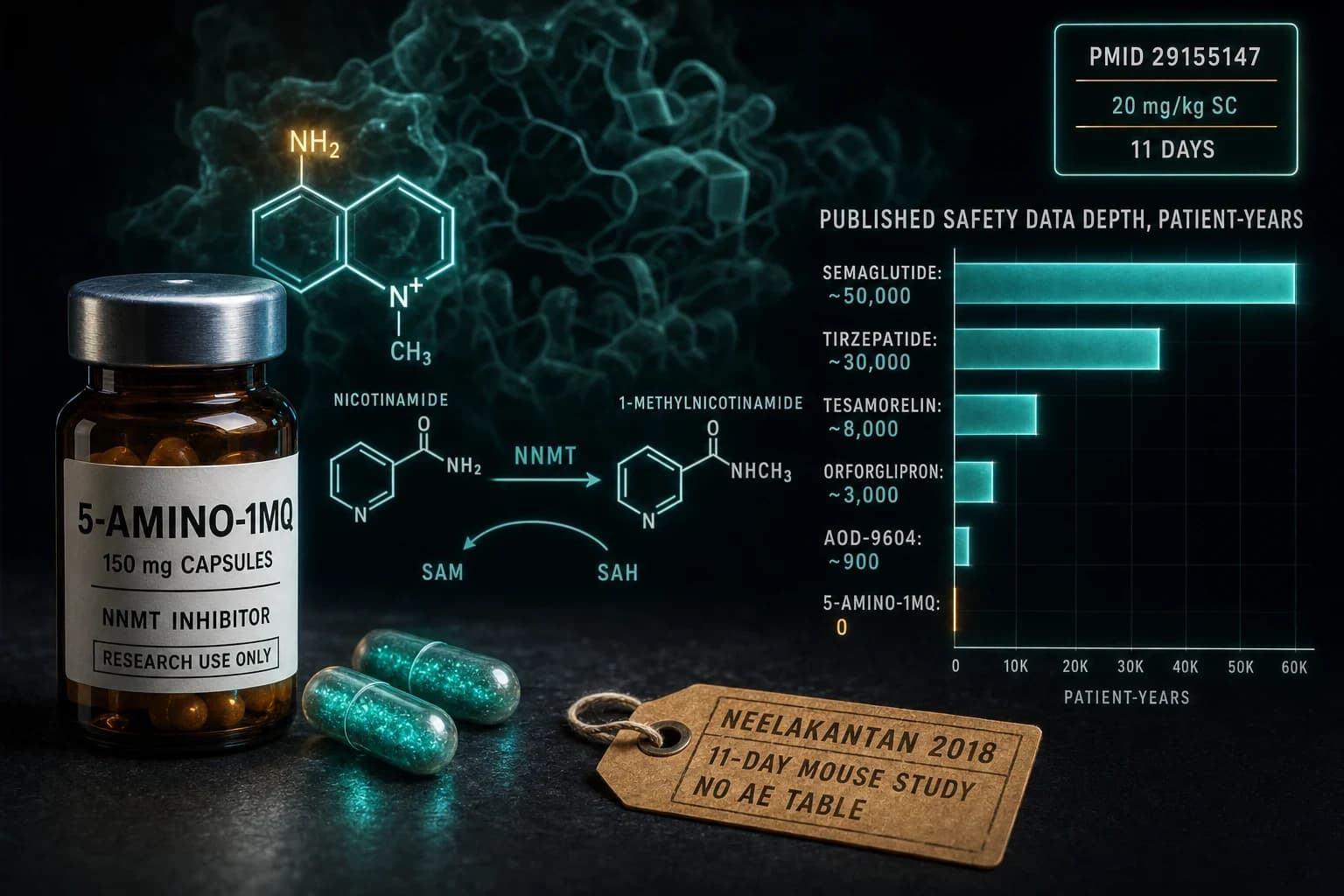
- Neelakantan 2018 (PMID 29155147) ran 11 days at 20 mg/kg three times daily SC in mice, with no gross AEs observed.
- Vendor-cited GI upset and headache rates have no primary source in the published literature.
- Supplier docs cite "no adverse effects" up to 60 mg/kg/day in mice, but endpoint was efficacy, not toxicology.
- Mechanism-based risks (hepatic iron handling, MNA depletion, methylation sink) remain unmeasured in humans.
What the published record actually says about 5-Amino-1MQ side effects
The first page of search results for "5-amino-1mq side effects" hands you a tidy list: mild GI upset, occasional headache, injection-site irritation, maybe fatigue. None of that comes from a published study. As of October 2026, every number anyone has ever quoted for 5-Amino-1MQ adverse events traces back to an 11-day mouse experiment where the researchers were not looking for adverse events in any formal way.
That is the honest starting point for this question. If a vendor page tells you that 5-Amino-1MQ causes GI upset in 20 to 30 percent of users, ask them for the citation. There is not one, because there is no human trial, no completed Phase 1, no published pharmacokinetic study in people, and no toxicology dataset in any species that was designed to characterize side effects rather than confirm weight loss. The compound is sold through research-chemical channels on the strength of two mouse papers and a short run of follow-up work. This piece walks the actual record.
For the full mechanism and evidence hierarchy, see our 5-Amino-1MQ NNMT inhibitor research review. This one stays on safety, where the gap between what the papers measured and what the forums claim is widest.
Bottom line up front: The only side-effect data for 5-Amino-1MQ comes from short mouse studies that were not designed to find side effects. Human exposure data does not exist. Any confident percentage you read for GI, headache, or injection-site rates is template boilerplate from peptide-shop blogs, not pharmacology.
The side-effect record, line by line
Four peer-reviewed studies form the primary record. None of them includes a formal adverse-events table of the kind a human Phase 1 would require.
| Study | Model | Duration | Dose and route | What they reported about tolerability |
|---|---|---|---|---|
| Neelakantan 2018, Biochem Pharmacol | DIO mice | 11 days | 20 mg/kg three times daily, subcutaneous | Weight and fat mass dropped. Food intake unchanged. No behavioral abnormalities described. No labs, histopathology, or AE table. |
| Neelakantan 2019, Biochem Pharmacol | Aged mice, muscle-injury model | Multi-week regeneration window | NNMT inhibitor, dose not standardized across experiments | Satellite cell activity and peak torque rose. Mortality or illness not described as events. No separate toxicology arm. |
| Sampson 2021, Sci Rep 11:5637 | DIO mice plus lean-diet switch | Several weeks | NNMT inhibitor plus diet | Body composition normalized faster. Liver fat fell. Adverse-event reporting absent. |
| Dimet-Wiley 2022, Sci Rep | DIO mice | Several weeks | NNMT inhibitor plus low-fat diet | Gut microbiome shifted toward lean controls. No tolerability analysis. |
The commercial Sigma-Aldrich documentation for the research chemical adds one more line, drawn from the Neelakantan group's broader work: in vivo efficacy in DIO and muscle-injury models with "no adverse effects to the animals (up to 60 mg/kg/d)." That number is useful context, but it comes from the same lab that was running the efficacy studies, and the endpoint was weight or muscle performance, not a GLP-grade NOAEL (No Observed Adverse Effect Level) from a dedicated toxicology study.
Note: "No observed adverse effects" at 60 mg/kg/day in mice is not the same as a toxicology-grade safety ceiling. It means the researchers running the fat-loss trial did not notice anything bad. GLP tox studies look specifically for things like organ-weight shifts, clinical chemistry changes, hematology, and histopathology on a schedule. None of that has been published for 5-Amino-1MQ.
Why "no observed adverse effects" is not a safety profile
A safety profile answers four questions a short efficacy study cannot. What happens with chronic exposure. What subtle organ-level changes occur before gross symptoms appear. Which populations are at higher risk. Which other drugs or supplements change the picture.
The published 5-Amino-1MQ record does none of this. The eleven-day Neelakantan 2018 study was long enough to measure fat loss, not long enough to catch cumulative hepatic, renal, or cardiovascular drift. The aged-mouse 2019 study ran longer but was designed around regeneration endpoints, not organ panels. The Sampson 2021 and Dimet-Wiley 2022 studies collected metabolomic and microbiome data, which is more rigor than most peptide research, but still not an adverse-event audit.
This matters for one practical reason. People do not take 5-Amino-1MQ for eleven days. Vendor-recommended cycles run 8 to 16 weeks, and forum reports describe repeated cycles over months. The published literature does not cover that exposure window in any species, let alone humans.
Mechanism-based risks the trials did not check
Where the data are silent, the biology still constrains what to expect. NNMT inhibition is not a free action on the body. It changes four systems the published mouse studies did not formally measure.
Hepatic iron handling
Hepatocyte work from a 2017 Hepatology Communications paper found that cells with NNMT knocked down were more vulnerable to iron-induced toxicity, not less. The authors proposed NNMT itself may be protective against iron overload stress in the liver. That signal has not been chased in whole-animal studies with pharmacologic NNMT inhibition, and it does not appear in any vendor-facing safety summary. For anyone with hemochromatosis, nonalcoholic steatohepatitis, or high serum ferritin, this is a theoretical concern that has not been ruled out.
Methyl-group economics
NNMT consumes S-adenosylmethionine (SAM) to produce 1-methylnicotinamide (MNA), which, unlike SAM, is not a methyl donor. Ulanovskaya et al. (2013) in Nature Chemical Biology framed this as a "metabolic methylation sink." Cancer cells exploit it to lower histone methylation and raise expression of pro-growth genes. That is why NNMT inhibition is attractive in oncology.
In healthy tissue the same mechanism cuts the other way. Blocking NNMT raises SAM availability, which can shift methylation patterns across DNA and histones in ways the acute mouse studies did not characterize. Over multi-month exposure, this is not neutral. It is also not necessarily harmful. It is unmeasured.
MNA, platelets, and endothelium
MNA was long considered an inert nicotinamide metabolite. Work from Chlopicki and colleagues showed it is not. In rats, MNA reduced thrombus weight and collagen-induced platelet aggregation through a prostacyclin-dependent mechanism, and the effect was abolished by cyclooxygenase inhibition. Later work in ApoE/LDLR-deficient mice linked MNA to reduced atherosclerotic plaque area. If chronic NNMT inhibition drives endogenous MNA down, the question of whether that removes a mild protective anti-thrombotic signal is open. No study has asked it in the context of 5-Amino-1MQ.
Tissue-selective NAD+ shifts
NNMT inhibition raises NAD+ most clearly in tissues where NNMT is upregulated: obese white adipose, aged skeletal muscle. In young healthy tissue, baseline NNMT is already low, so the effect of inhibition on local NAD+ is smaller. The literature does not describe what happens when NAD+ precursor supplements (NMN, nicotinamide riboside) are layered on top. The two inputs push the pool from opposite directions, and the net effect depends on tissue, dose, and chronic exposure, none of which has been studied.
Warning: Each of these four mechanism concerns is theoretical. None has been demonstrated to cause harm in humans. The claim here is modest: "no reported side effects in mice" is silent on all four, so an honest safety write-up has to flag them anyway.
Where the vendor side-effect lists actually come from
Open five vendor pages for 5-Amino-1MQ and you will see similar bullets. Mild gastrointestinal upset. Occasional headache. Possible fatigue. Injection-site irritation. Rare dizziness. The percentages, when any appear, cluster around 15 to 30 percent for the GI claim.
These lists are template boilerplate. They are not drawn from the Neelakantan 2018 paper, which did not quantify any of them. They are not drawn from a Phase 1, which does not exist. In most cases they are copy-pasted across peptide-shop blogs and then back-labeled with a plausible-sounding percentage. The giveaway: the compound is sold as an oral capsule, so "injection-site irritation" should not appear at all, yet it survives in several vendor side-effect lists because the template is adapted from injectable peptide templates.
Tip: When a safety claim does not name a study, treat it as marketing. For 5-Amino-1MQ, the real answer to "what are the side effects" is "we do not know, because nobody has measured them in humans." That is less satisfying than a bullet list. It is the accurate answer.
Dose scaling and the oral-capsule problem
A second gap between the record and the market concerns dose. The Neelakantan 2018 protocol was 20 mg/kg three times a day, subcutaneous, in mice. Allometric scaling by body surface area converts mouse-to-human by roughly a factor of 12. That makes a mouse 20 mg/kg SC dose equivalent to about 1.6 mg/kg SC in a human, or roughly 110 mg/day in a 70 kg adult, if the route stayed the same.
The route does not stay the same. 5-Amino-1MQ is sold as 50 mg or 150 mg oral capsules, often dosed 50 to 300 mg per day. The oral bioavailability of 5-Amino-1MQ in humans has not been published. Nor has its oral half-life, oral Tmax, or oral AUC.
| Parameter | Published value | Comment |
|---|---|---|
| Mouse SC dose (Neelakantan 2018) | 20 mg/kg three times daily | 11 days, DIO mice |
| Human SC equivalent (BSA scaled) | ~1.6 mg/kg | Mathematical, not measured |
| Oral bioavailability, human | Not published | Vendor doses assume absorption without data |
| Human half-life | Not published | Dosing frequency guesswork |
| 24-hour AUC, human | Not published | Impossible to anchor exposure |
The practical consequence is that a 150 mg oral capsule may deliver a sub-therapeutic systemic dose if first-pass metabolism is high, or it may stack over months into cumulative exposure the mouse data never covered. Vendor dosing works either way for the vendor. For a user, the ambiguity is the risk. The 5-Amino-1MQ dosing chart collects the vendor-level protocols that circulate for this reason, with the same caveats on provenance applied.
How the safety record compares to real alternatives
The honest comparison is not 5-Amino-1MQ against another research compound. It is against anything you might actually consider for fat loss.
| Compound | Side-effect record | Population | Duration studied | Regulatory status |
|---|---|---|---|---|
| 5-Amino-1MQ | Qualitative, mouse only | DIO and aged mice | 11 days to a few weeks | None |
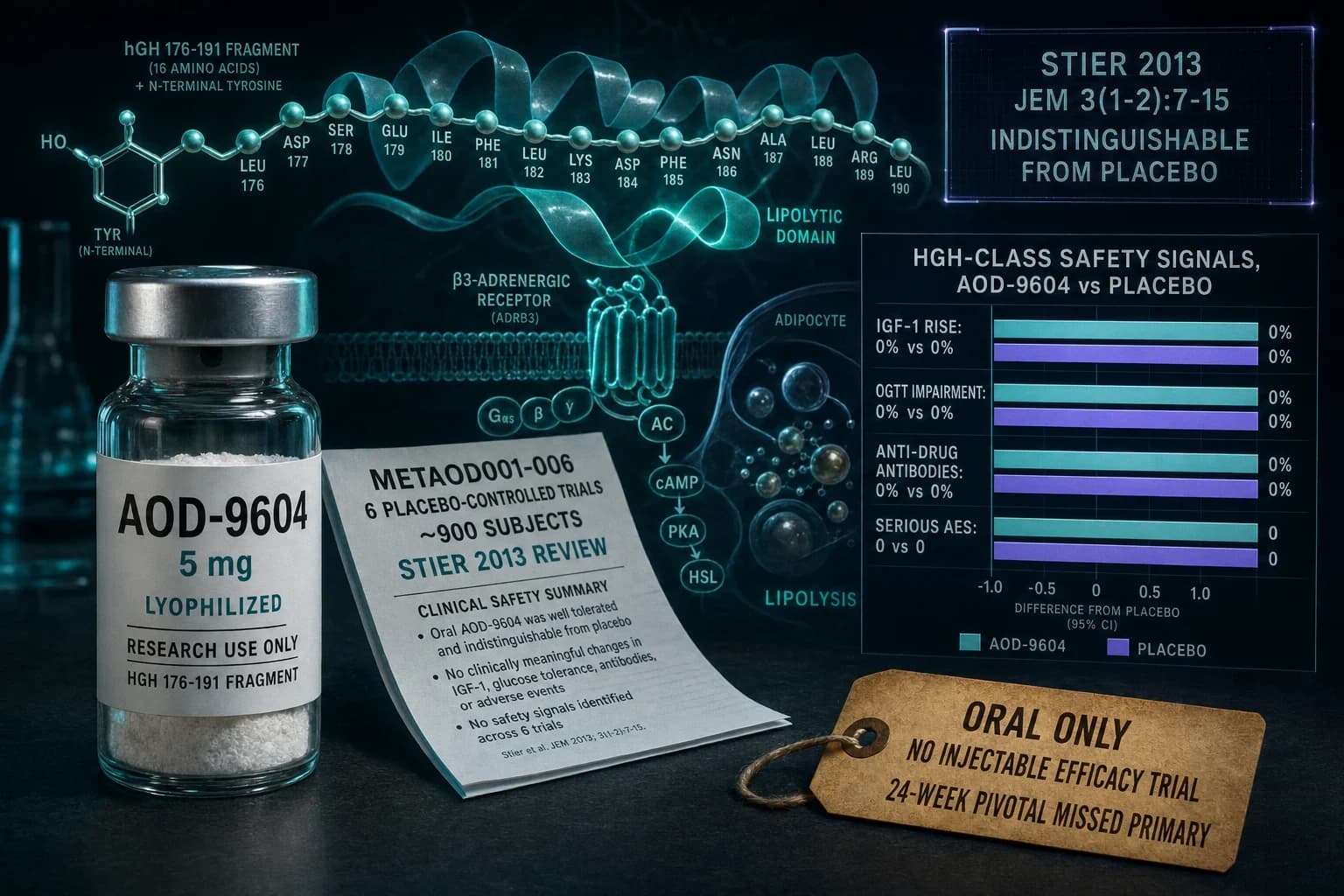
| AOD-9604 | 6 placebo-controlled trials, ~900 subjects | Human adults | Up to 24 weeks | None, failed Phase 2b |
| Tesamorelin | Phase 3 trials | HIV lipodystrophy adults | Years | FDA approved |
| Semaglutide | STEP program, SUSTAIN program | Tens of thousands of patient-years | Years | FDA approved |
| Tirzepatide | SURMOUNT program | Tens of thousands of patient-years | Years | FDA approved |
| Orforglipron | ATTAIN program Phase 3 | Thousands | 72 weeks and ongoing | Pending approval |
Even AOD-9604, which our own side-effect article describes as having a thin and mostly indistinguishable-from-placebo profile, has roughly 900 human-subject-years of placebo-controlled data behind that conclusion. 5-Amino-1MQ has none. Any direct comparison between its "no reported side effects" and a GLP-1's documented tolerability profile is comparing a measurement to the absence of one.
For a sense of what the GLP-1 side-effect record actually looks like at scale, see our writeup on tirzepatide pricing and the Zepbound rollout or the oral analog in the Rybelsus and orforglipron guide.
Interactions and co-therapies the record does not address
5-Amino-1MQ is often stacked. The published record does not address how any of these pair with it.
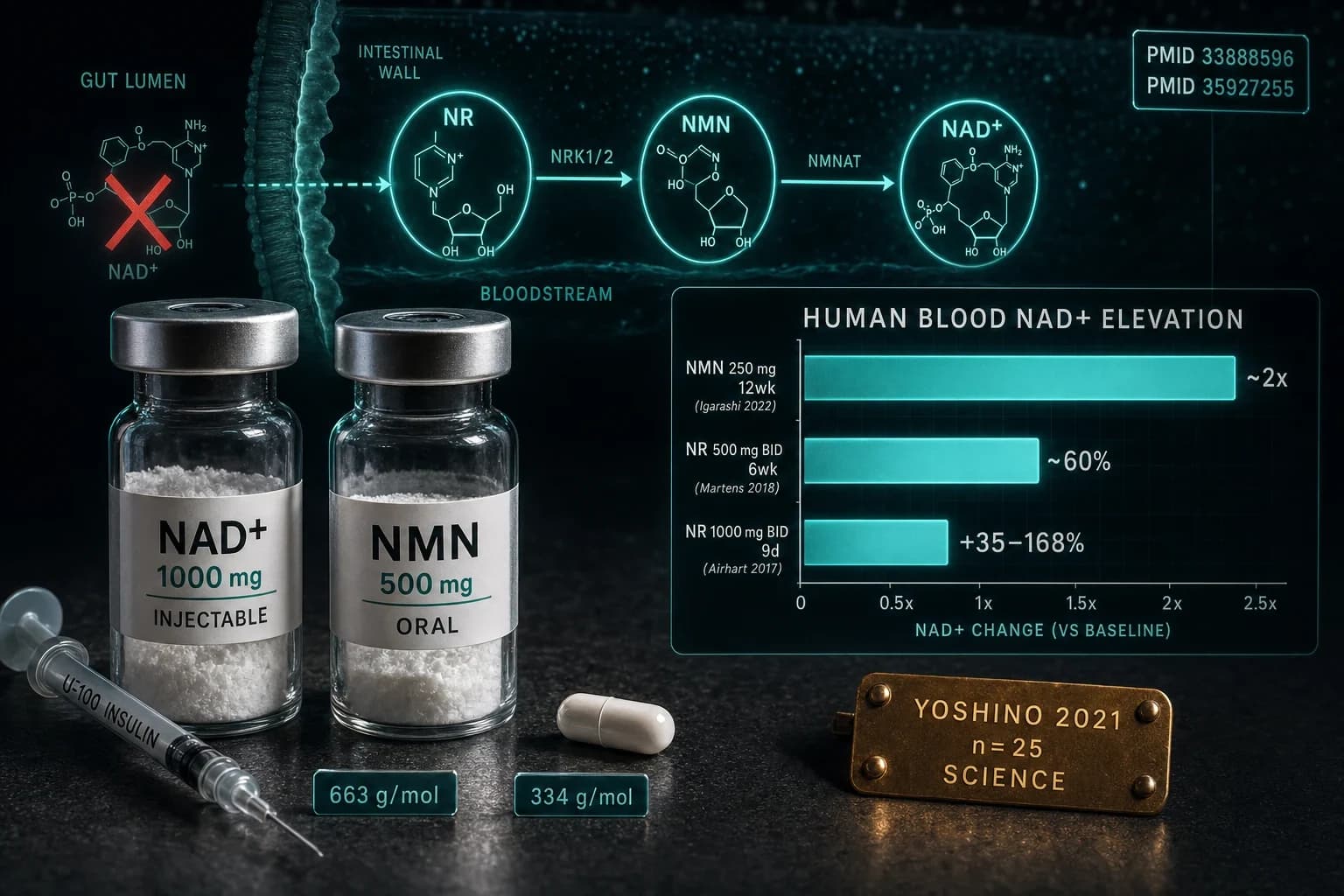
NAD+ precursors (NMN, nicotinamide riboside, NAD+ injections). NNMT consumes nicotinamide, so inhibiting it preserves the precursor pool. Supplementing precursors raises the pool from the other end. Theoretically additive on NAD+ replete tissue; practically unstudied. For context on direct NAD+ dosing, see /peptides/nad-plus.
SAM-depleting drugs. Methotrexate, chronic alcohol use, and some antifolate chemotherapies deplete methyl donors. Combining them with a compound whose main function is to redirect SAM availability is not a documented clinical scenario. Treat it as unknown rather than safe.
Metformin. Both metformin and NNMT inhibition affect NAD+ handling and insulin sensitivity. Pissios and colleagues have specifically called out the metabolic overlap. Whether the combination is additive, redundant, or counterproductive in people has not been examined.
Antiplatelet or anticoagulant therapy. If chronic NNMT inhibition lowers endogenous MNA, and MNA has a mild prostacyclin-mediated antithrombotic effect, the combination with aspirin or clopidogrel could in principle shift the balance in either direction. The data to answer that are animal only.
GLP-1 receptor agonists. The forum thesis is that 5-Amino-1MQ preserves muscle during a GLP-1 cut. The muscle data behind that claim come from Neelakantan 2019 in aged mice with injury, not from middle-aged humans on tirzepatide. There is no human study of this stack.
Who should sit this one out
The following profiles are the ones where the gaps in the record become operational concerns.
- History of malignancy within five years. NNMT inhibition is attractive in oncology precisely because tumors exploit the methylation sink. In healthy tissue, chronic suppression of the same pathway has not been characterized for cancer-recurrence surveillance.
- Hemochromatosis, high ferritin, or active liver disease. The hepatocyte iron-overload signal is not conclusive, and it also is not refuted. The default should be caution.
- On antiplatelet or anticoagulant therapy. The MNA-prostacyclin signal is theoretical, but so is most of this compound's safety case. Combining two theoretical pathways is not a research-protocol decision to make lightly.
- Pregnancy, nursing, or active attempt to conceive. No reproductive or developmental toxicology data exist in any species.
- Taking SAM, methyl-folate, or methyltransferase-active drugs for a specific indication. Shifting methyl economics on top of a dose titrated for a different reason has unpredictable effects.
- Anyone unwilling to accept open-ended uncertainty. Accepting uncertainty is the single most important filter for research-chemical use. Treat that as a feature of the decision, not a shortcut around it.
Red flags and when to stop in a research protocol
If someone is going to use 5-Amino-1MQ anyway, these are the markers worth tracking rather than ignoring. None of this constitutes a safety protocol in the clinical sense, because no such protocol exists for a compound with no human trials.
Baseline, before starting:
- CBC with platelets
- ALT, AST, GGT, alkaline phosphatase
- Ferritin and transferrin saturation
- Fasting glucose and insulin, with HOMA-IR
- Resting blood pressure and pulse
Repeat at 4 to 6 weeks of use, then again at the end of a cycle. Stop and reassess on any of:
- Unexplained bruising or nosebleeds
- Dark urine, right-upper-quadrant pain, or jaundice
- Sustained resting pulse increase over 15 bpm
- New or worsening chest pain
- Any lab trending outside the reference range on two consecutive draws
Preparation and sourcing feed into this too. Verifying what is actually in the vial you are drawing from is non-negotiable with an uncharacterized compound. For how to read a vendor's certificate of analysis, see /lab-tests and our audit of research-chemical sourcing. For reconstitution math on any companion injectable in the same stack, /calculators/reconstitution handles the arithmetic.
How this fits next to other NAD-pathway compounds
5-Amino-1MQ sits in the same bucket as MOTS-c, NAD+ injections, and a long tail of NAD+ precursors. The honest read: all of these have thin human safety data and interesting rodent mechanism stories. 5-Amino-1MQ is not an outlier in that pattern, but it does occupy the deepest end of the data gap, because unlike MOTS-c or NAD itself, it has no completed human trial of any kind.
For a comparison that stays in the NAD+ pathway, see our writeup on MOTS-c side effects, which shows a similar pattern of marketing confidence outrunning published data, but with slightly more actual human exposure behind it.
Buyers already set on trying it face vendor-level questions first: compound identity, purity, consistency across lots. These are the same questions the Ascension Peptides review addresses for the broader research-chemical market. Our standing recommendation is Ascension for injectable research peptides, with 50% off using code ENHANCED.
Bottom line
The published side-effect record for 5-Amino-1MQ reads: no gross adverse events observed, 11 days, mice, 20 mg/kg SC. Everything beyond that line is extrapolation, template boilerplate, or theory. The compound may well turn out to have a mild tolerability profile in humans; it also may not. Both outcomes are consistent with the current literature, because the literature was not designed to answer the question.
If you are weighing 5-Amino-1MQ against an approved GLP-1 for weight management, the honest frame is not "which has worse side effects" but "which has side effects we can describe." For now, that is only one of the two.
This article is for educational and research purposes only. 5-Amino-1MQ has never been evaluated in a published human clinical trial as of October 2026. Nothing above constitutes medical advice. Products discussed are sold for research use as described by the vendor. Consult a qualified clinician for individual decisions about supplementation or use of any investigational compound.