At a glance
- HGH 191AA is somatropin, the authentic 191-amino-acid human GH sequence
- The 191 vs 192 distinction became obsolete when somatrem was discontinued
- Rudman 1990 ran 12 men for 6 months. It launched a whole industry
- Liu 2008 found GH raised lean mass but not strength or exercise capacity
- GH distribution outside approved indications is a federal felony (21 USC 333(e))
Every vendor selling growth hormone puts "191AA" on the label. They present it as a purity grade, the way you would advertise 99% HPLC. It is not a grade. It is a sequence count, it describes the only version of the molecule anyone has manufactured legitimately since 1987, and the distinction it refers to was settled before most people reading this were born.
Here is what the number actually means, what the research found once the studies got bigger than twelve people, and why the compounds researchers reach for instead are a different class entirely.
What 191AA describes
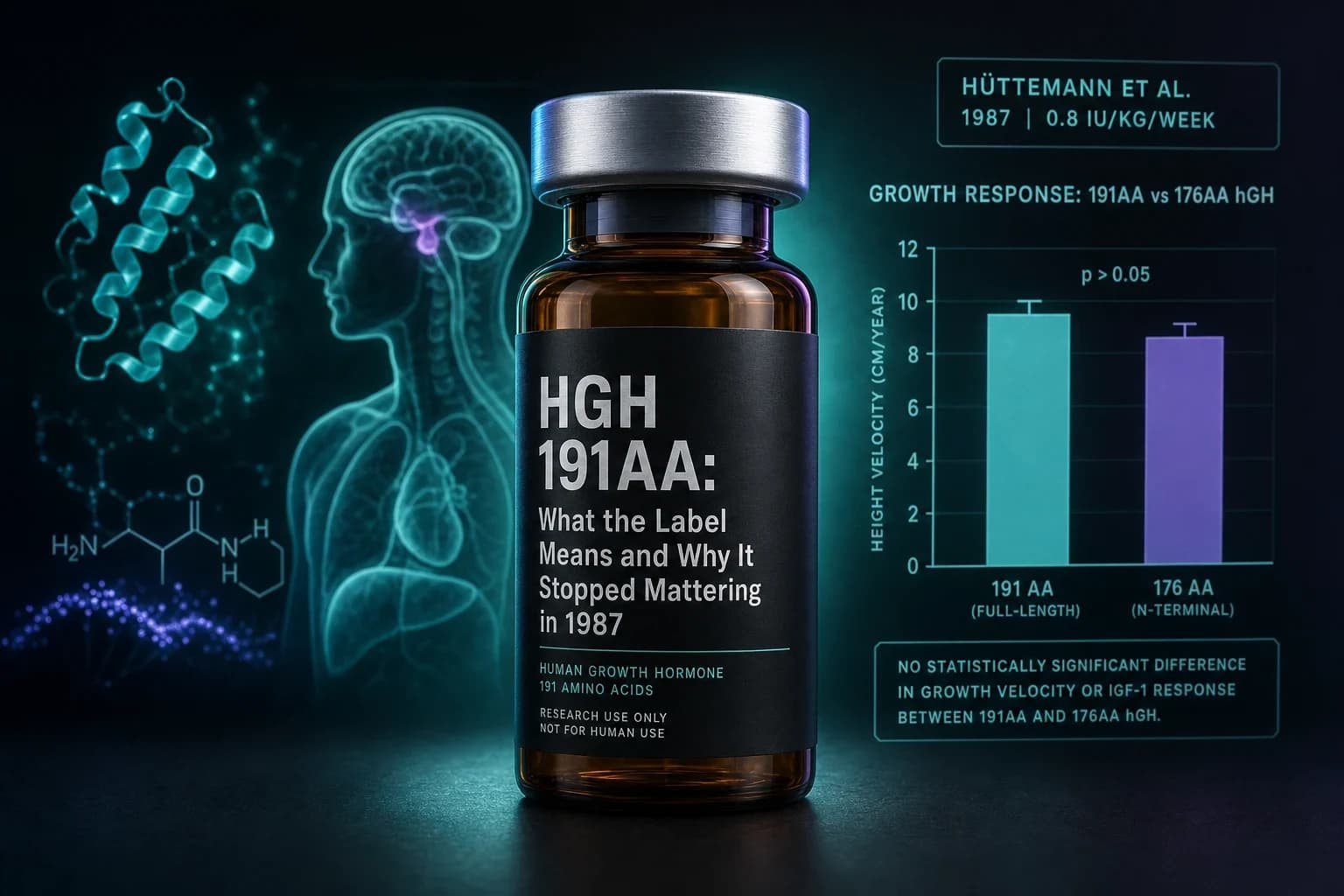
Human growth hormone is a single polypeptide chain of 191 amino acids, roughly 22 kDa, secreted in pulses by the anterior pituitary. That is the native molecule. When a label says 191AA, it is claiming the product matches that sequence exactly.
The claim exists because for a few years it was not automatic.
Genentech's Protropin, approved in 1985, was the first recombinant hGH. Producing it in E. coli left an extra methionine residue on the N-terminus, giving a 192-amino-acid molecule called somatrem. One residue longer than anything the human body makes. That single addition was enough for the immune system to notice.
Buzi and colleagues tracked antibody formation across both versions and found the authentic 191-amino-acid sequence markedly less antigenic than the methionylated form (Buzi et al. 1989). The immunogenicity problem was significant enough that Genentech ran dedicated animal models to characterize it (Jones et al. 2002).
Eli Lilly's Humatrope followed in 1987 with the authentic 191-residue sequence. Somatrem was eventually discontinued. Every legitimate recombinant hGH manufactured since is 191AA.
Bottom line: "191AA" distinguishes somatropin from a product that left the market decades ago. It tells you nothing about purity, potency, or whether the vial contains what the label claims.
Why vendors still print it
Because it sounds like a specification, and specifications sell.
A number on a label implies testing happened. It borrows the visual grammar of a certificate of analysis without making any claim a lab could actually falsify. Every vial of real somatropin on earth is 191AA, so the statement is simultaneously true and empty.
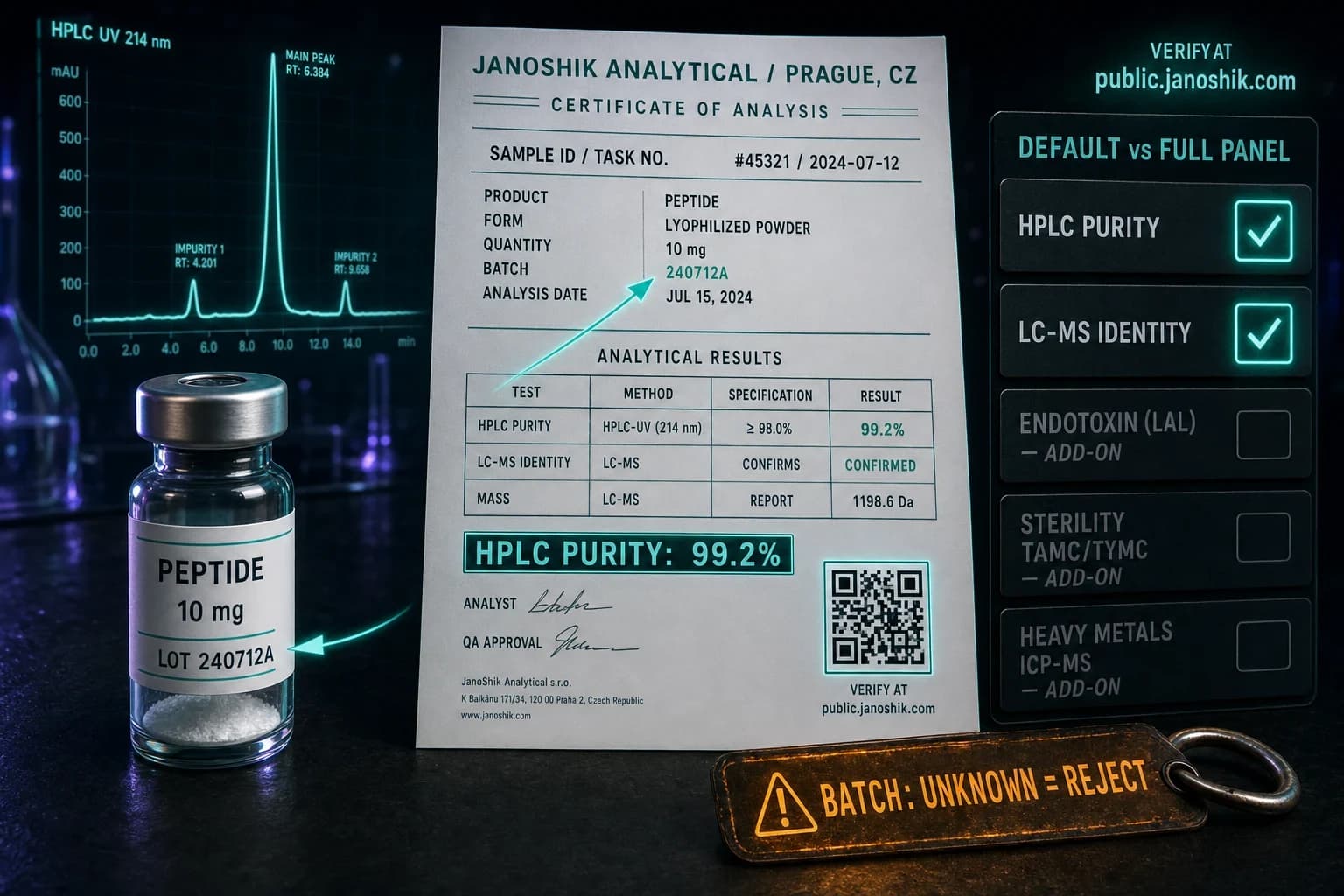
The specification that would tell you something is a per-batch COA with HPLC purity, mass spectrometry identity confirmation, and a lot number you can match to the vial in your hand. That is the document worth reading, and it is the reason we maintain a public library of vendor-published lab tests rather than taking label copy at face value.
The legal wall nobody mentions
Growth hormone sits in an unusual category. Most compounds discussed in research contexts occupy a grey zone: unapproved, unscheduled, sold for laboratory use. Somatropin is not in that zone.
Under 21 U.S.C. § 333(e), distributing or possessing with intent to distribute human growth hormone for any use other than an FDA-approved indication, pursuant to a valid prescription, is a federal felony carrying up to five years. Congress wrote a criminal statute specifically for this one molecule. Anabolic steroids are Schedule III; hGH got its own bespoke provision.
This is why you will not find somatropin alongside BPC-157 and ipamorelin at any vendor operating with a compliance department. Reputable suppliers carry growth hormone secretagogues, which are a legally and pharmacologically distinct class.
Warning: Sites offering "HGH 191AA" for sale are not operating in the same regulatory grey area as research peptide vendors. That is a different kind of risk, and it does not fall on the seller alone.
What the research actually found
The modern GH-for-aging industry traces to a single paper.
Rudman gave recombinant hGH to twelve men over sixty for six months. Lean body mass rose 8.8%, adipose tissue mass fell 14.4%, lumbar vertebral density and skin thickness increased (Rudman et al. 1990). Published in the New England Journal of Medicine. The numbers were real.
Twelve men. Six months. No functional endpoints.
The NEJM later published an editorial cautioning against exactly the commercial extrapolation that followed. It did not matter. Those percentages have been reprinted in sales copy for thirty-five years.
The follow-up work is where it gets interesting.
Blackman ran a randomized controlled trial of GH with and without sex steroids in healthy aged women and men. Body composition shifted in the expected direction. Adverse effects were common enough to matter (Blackman et al. 2002).
Liu then pooled the healthy-elderly literature systematically. The conclusion: small changes in body composition, no demonstrated functional benefit, and meaningfully elevated rates of soft tissue edema, arthralgia, carpal tunnel syndrome, and glucose intolerance (Liu et al. 2007).
The athletic performance question got its own review. GH increased lean body mass. It did not improve strength, and it did not improve exercise capacity. Lactate rose during exercise, suggesting the added mass was not translating into work (Liu et al. 2008).
That last finding deserves a second read. The lean mass increase is largely fluid retention rather than contractile tissue. The scale moves. Performance does not.
Somatropin versus the secretagogue class
Exogenous GH replaces the signal. Secretagogues ask the pituitary to produce more of its own, which preserves pulsatility and leaves the feedback loop intact.
| Somatropin (191AA) | GHRH analogs | Ghrelin-receptor agonists | |
|---|---|---|---|
| Examples | Humatrope, Genotropin | Sermorelin, CJC-1295, Tesamorelin | Ipamorelin, MK-677 |
| Mechanism | Replaces GH directly | Stimulates GH release via GHRH receptor | Stimulates via GHS-R1a, suppresses somatostatin |
| Release pattern | Sustained, non-pulsatile | Amplifies natural pulses | Amplifies natural pulses |
| Negative feedback | Bypassed | Preserved | Preserved |
| Needs working pituitary | No | Yes | Yes |
| US legal status | Federal felony outside approved use | Research compound | Research compound |
The feedback row is the one that matters mechanistically. Sustained exogenous GH suppresses endogenous production through the somatostatin loop. GHRH analogs work with that loop, which is why protocols time them to the natural nocturnal pulse rather than dosing around the clock.
The two classes also get combined. GHRH analogs raise pulse amplitude while ghrelin-receptor agonists suppress somatostatin, so pairing something like CJC-1295 with ipamorelin produces a larger release than either alone. We broke the GHRH options down in sermorelin vs tesamorelin if you want the comparison at that level.
Where researchers actually go
If the interest is GH-axis research rather than the specific molecule, the practical entry points are the secretagogues:
- Sermorelin is native GHRH(1-29), the shortest fragment that retains full activity. Half-life in minutes, so protocols time it to sleep onset. Protocol reference: sermorelin dosage chart.
- CJC-1295 modifies that same sequence for protease resistance, trading the sharp pulse for sustained elevation. See the CJC-1295 dosage chart.
- Ipamorelin is the selective ghrelin-receptor agonist, chosen over GHRP-6 because it moves GH without dragging cortisol and prolactin along.
- Tesamorelin is the only one in this group with an FDA approval, for visceral fat reduction in HIV-associated lipodystrophy, and the only one with a clinical record on a specific body composition endpoint.
Anything reconstituted needs the math done properly. The reconstitution calculator handles the vial-to-units conversion.
Tip: Whatever the compound, ask for the per-lot COA before the purity claim on the product page. A vendor that publishes lot-matched HPLC and mass spec is telling you something. A vendor printing "191AA" is not.
All four secretagogues above are carried by Ascension Peptides, with 50% off using code ENHANCED. We went through their COA practices, sourcing, and what the lab documents actually show in our Ascension Peptides review.
The short version
191AA means the molecule matches the human sequence. It resolved a manufacturing question from the mid-1980s and has been the default ever since, which makes it a historical footnote rather than a quality signal.
The research that built the reputation was twelve men. The research that followed found body composition changes without functional gains, alongside a real adverse event profile. And in the United States, the compound carries a criminal distribution statute written specifically for it.
The secretagogue class asks a different question: not how to replace the signal, but how to make the pituitary send more of its own.
Research purposes only. Nothing here is medical advice, and nothing here should be read as encouragement to obtain a prescription drug outside a valid prescription. Compounds discussed are sold for laboratory research use. Consult a qualified clinician before making health decisions.