At a glance
- Event held Sunday, May 24, 2026 at Resorts World Las Vegas; Kristian Gkolomeev swam the 50m freestyle in 20.81s, undercutting Cameron McEvoy's 20.88 world record and claiming the $1M bonus
- Fred Kerley's 9.97s in the 100m sprint would have finished last at the 2024 Olympics, well shy of Usain Bolt's 9.58 record and Kerley's pre-event pledge
- Only one world record fell across swimming, sprinting, and weightlifting combined; James Magnussen finished 4th in the 100m free in 49.44s and earned about $100,000
- Enhanced Group began trading on the NYSE as ENHA on May 8, 2026 at a $1.2B enterprise value; the stock has drifted below $2 through August 2026
- ASCEND001 clinical trial (NCT07568574, sponsored by Enhanced) reports 91% of the 36 enrolled athletes used testosterone or testosterone esters in the 12 weeks before the Games; peptides, anabolic agents, metabolic modulators, and stimulants were the other four permitted categories
The pitch is simple: stop pretending
For decades, elite sport has operated on a polite fiction. Athletes dope. Governing bodies test. Catches happen just often enough to keep the system looking functional. Meanwhile, the real pharmacology stays three steps ahead of the lab.
The Enhanced Games wants to tear that curtain down.
Founded in 2023 by Australian lawyer-turned-entrepreneur Dr. Aron D'Souza, the Enhanced Games is a planned multi-sport competition where performance-enhancing substances are not just tolerated but openly disclosed. No drug tests. No bans. Athletes tell the medical staff exactly what they are taking, receive cardiac screening and blood panels, and then compete.
The inaugural event was held on Sunday, May 24, 2026 at Resorts World Las Vegas. Three sports. About 42 athletes on the night. A purpose-built venue with a 4-lane 50-meter pool, a 6-lane sprint track, and a weightlifting stage. Prize money that makes most Olympic sports look like hobby leagues.
And a $1.2 billion valuation.
What actually happened on May 24, 2026
The pre-event promise was that a doping-permitted meet would rewrite the record book. It did not. Only one world record fell across the entire slate. Here is the shortlist of headline results:
| Event | Athlete | Result | Note |
|---|---|---|---|
| 50m freestyle | Kristian Gkolomeev (GRE) | 20.81 s | Beat Cameron McEvoy's 20.88 official WR; claimed the $1,000,000 world-record bonus plus event prize (about $1.25M total). Not ratified by World Aquatics. |
| 50m freestyle | James Magnussen (AUS) | Did not win | The "juice to the gills" attempt at Bolt-tier headlines fell short of the record he came out of retirement to chase |
| 100m freestyle | James Magnussen | 49.44 s, 4th | Earned about $100,000 across the two events he entered |
| 50m butterfly | Ben Proud (GBR) | 22.32 s | Missed the 22.27 s world mark by five hundredths |
| 100m sprint | Fred Kerley (USA) | 9.97 s | Would have finished last at the 2024 Paris Olympic final; multiple false starts and a shoe issue reset the blocks four times. Kerley had pledged Bolt's 9.58 would be "destroyed" |
| Overall records | 1 | The rest of the swimming, sprinting, and weightlifting card produced fast, but not history-making, marks |
Kerley described himself as competing "clean" despite the permissive doping rules. Gkolomeev's swim was streamed live on Roku, YouTube, Twitch, Kick, and Rumble on the evening of May 24. Neither World Aquatics nor World Athletics recognizes any of the marks set at the meet, and both bodies have telegraphed that any Enhanced Games participant risks sanction in the sanctioned circuit.
The read for the peptide audience is narrower. The doping rules did not manufacture superhuman performance in a single meet. What they did produce is public, itemized disclosure of what elite athletes actually take. The ASCEND001 clinical trial data below is the first structured version of that disclosure.
Bottom line: one world record, three near-misses, and a headline sprint that would have missed the Olympic final. The interesting outputs from May 24 are the disclosure data and the safety monitoring, not the times themselves.
The money behind the curtain
The investor list reads like a who's-who of Silicon Valley contrarianism. Peter Thiel (PayPal, Palantir) led the seed round alongside Christian Angermayer (Apeiron Investment Group) and Balaji Srinivasan (former Coinbase CTO). Later rounds brought in the Winklevoss twins, Donald Trump Jr. through 1789 Capital, and Prince Khaled bin Alwaleed Al Saud.
In November 2025, Enhanced Ltd announced a SPAC merger with A Paradise Acquisition Corp (originally NASDAQ: APAD) at a $1.2 billion enterprise value. The deal closed and Enhanced Group began trading on the New York Stock Exchange under the ticker ENHA on May 8, 2026, roughly two weeks before the Las Vegas event. The initial ticker paperwork was drafted for NASDAQ; the final listing landed on NYSE, and post-transaction disclosures show existing Enhanced shareholders retained about 81% of the combined company. Enhanced is now the first publicly traded operator built around openly disclosed PED use in sport. The stock has struggled in the months since: ENHA was quoted around $2.63 in mid-July 2026 and drifted below $2 into early August, so the public-market vote on the business is closer to skeptical than triumphant so far.
The money is not just about the games. Enhanced Ltd operates two principal business lines: the sporting events themselves and Live Enhanced, a direct-to-consumer wellness platform selling clinician-guided hormone optimization, peptide protocols, and supplement stacks. The games are the attention engine. The wellness platform is the revenue engine.
What athletes are actually taking
This is where it gets directly relevant to anyone reading this site.
James Magnussen, the Australian Olympic silver medalist who came out of retirement specifically for the Enhanced Games, has publicly disclosed his full PED stack:
- Testosterone at supraphysiological doses
- BPC-157 (Body Protection Compound-157)
- CJC-1295 (modified GHRH analog)
- Ipamorelin (selective GHRP)
- Thymosin Beta-4 / TB-500
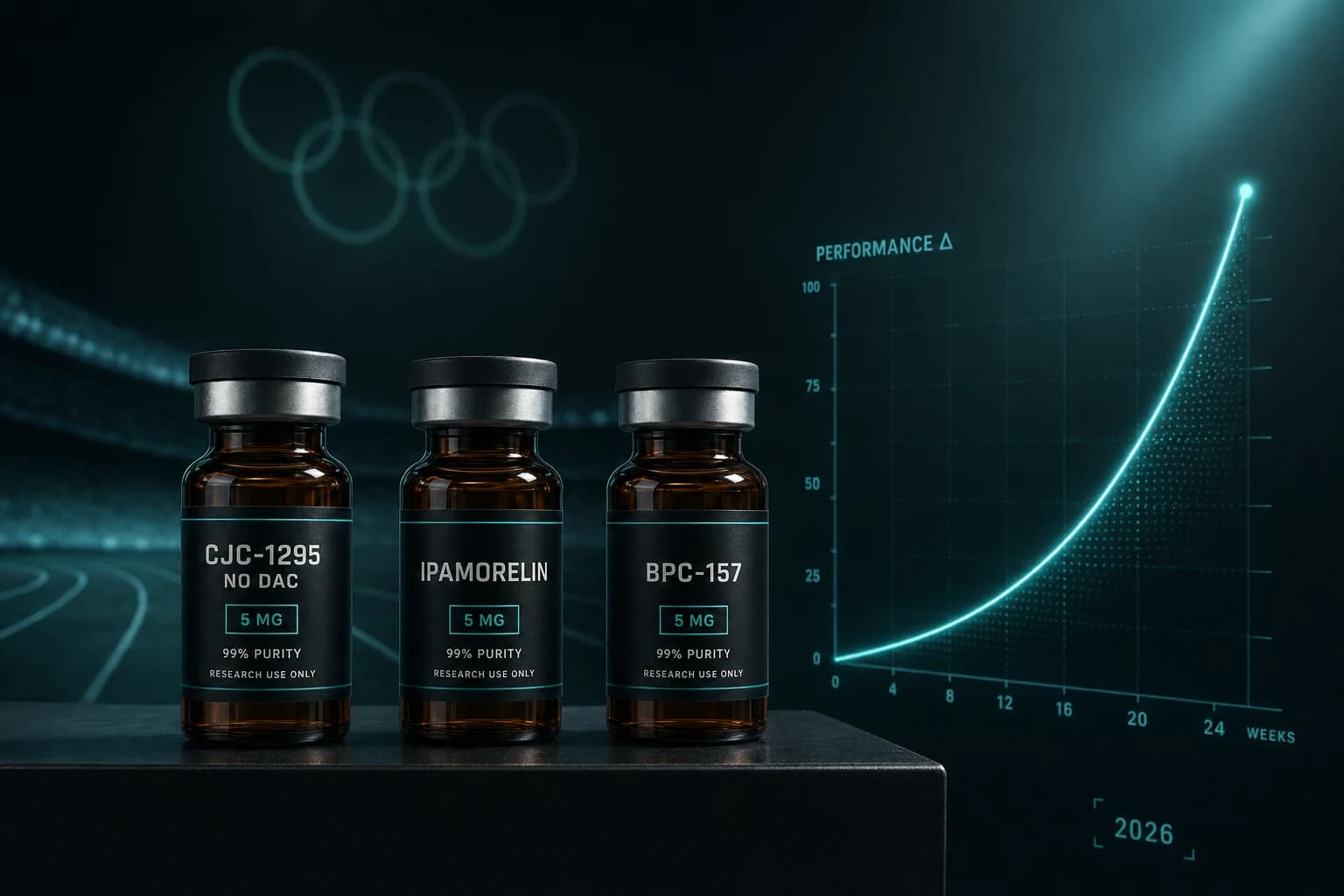
If you are a peptide researcher, you will recognize that list immediately. BPC-157 + TB-500 is the Wolverine Stack. CJC-1295 + Ipamorelin is the FIT Stack. Magnussen is essentially running two of the most popular pre-mixed peptide protocols on the market, layered on top of a testosterone base.
The mechanistic case for that recovery stack is not hypothetical. In transected rat Achilles tendon explants, BPC-157 dose-dependently increased tendon-fibroblast outgrowth, cell survival under oxidative stress, and cell migration, with FAK and paxillin phosphorylation as the downstream molecular readout (Chang et al. J Appl Physiol 2011, PMID 21030672). The pro-angiogenic half of the mechanism runs through VEGFR2: in a chick chorioallantoic membrane assay, endothelial tube-formation assay, and a rat hindlimb ischemia model, BPC-157 upregulated VEGFR2 and activated the downstream Akt/eNOS pathway (Hsieh et al. J Mol Med 2017, PMID 27847966). A broader review through 2019 catalogs consistent accelerated healing signals across rat medial collateral ligament, quadriceps tendon, and Achilles models, though the review authors are careful to note that no controlled human tendon-healing trials have been completed (Gwyer et al. Cell Tissue Res 2019, PMID 30915550). For anyone building a personal-use protocol from what Magnussen disclosed, the BPC-157 dosing protocol guide covers the actual numbers, and the reconstitution calculator handles the mixing math on standard 5 mg and 10 mg vials.
The pre-event result: Magnussen gained roughly 20 kg of muscle and swam a 50-meter freestyle time of 20.89 seconds in an early showcase event, faster than Cesar Cielo's 2009 record of 20.91. Greek swimmer Kristian Gkolomeev then matched that 20.89 in a February 2025 Greensboro showcase and lowered it again to 20.81 seconds at the actual Enhanced Games on May 24, 2026, undercutting Cameron McEvoy's 20.88 official world record. Gkolomeev's swim was the meet's one bonus-earning record; Magnussen's own headline attempt did not survive contact with the finals. The five peptides on Magnussen's disclosed stack still mechanistically make sense as a research protocol; they simply did not manufacture a Bolt-tier upset on the night.
The athlete roster
38 athletes were confirmed as of February 2026, with a target of 50 for the inaugural event. The roster splits across three sports:
Swimming has attracted the biggest names. Alongside Magnussen and Gkolomeev, the lineup includes Hunter Armstrong (two-time Olympic gold, USA), Ben Proud (Olympic gold, UK), Shane Ryan (Ireland, Olympian), Andriy Govorov (Ukraine, 50m butterfly world record holder), and Megan Romano (USA, multiple relay golds as the first female athlete to sign).
Armstrong's situation is particularly interesting. He joined on March 3, 2026 as a self-declared "Non-Enhanced Athlete", meaning he will compete clean against enhanced competitors. His motivation is financial: his primary sponsor dropped him, and the Enhanced Games pay a salary plus prize money. He believes he can remain eligible for future Olympic teams as long as he stays in the WADA testing pool.
Track and field features Marvin Bracy-Williams (USA, former world silver medalist currently serving a 45-month USADA ban), Clarence Munyai (South Africa), and several other sprinters.
Weightlifting rounds out the lineup with snatch and clean-and-jerk events.
The sports and the money
Three sports. Eight swimming events (50m and 100m freestyle, 50m and 100m butterfly). Sprint events (100m, 110m hurdles for XY division, 100m hurdles for XX). Olympic weightlifting (snatch, clean and jerk).
Prize purses are significant:
- $500,000 per event ($250K to the winner, $250K split among remaining competitors)
- $250,000 bonus for breaking an official world record
- $1,000,000 bonus for world records in the 50m freestyle or 100m sprint
For context, Olympic athletes receive zero prize money from the IOC. National federations sometimes offer bonuses (USA pays $37,500 for gold), but the Enhanced Games purse dwarfs traditional sport compensation for all but the very top tier.
Gender divisions use XX and XY chromosome categories rather than male/female designations. This is a choice that has drawn criticism from the scientific community, since chromosome-based sex verification was abandoned in mainstream sport by the late 1990s.
The safety question
The most serious objection to the Enhanced Games is the health risk.
Enhanced claims athletes must pass medical screening, disclose all substances, and submit to cardiac profiling and regular bloodwork. An Independent Medical Commission of cardiologists, endocrinologists, and pharmacologists oversees protocols. Only "FDA-approved substances" are supposed to be allowed (partly for insurance reasons), and outright dangerous substances or Class A drugs are prohibited.
The problem: several compounds Magnussen disclosed using, including BPC-157, CJC-1295, Ipamorelin, and TB-500, are not FDA-approved. They are research peptides. This contradiction between the official "FDA-approved only" policy and the actual disclosed stacks has not been convincingly resolved.
Critics are not shy about the risks. Travis Tygart (USADA CEO) called it "a dangerous clown show." Witold Banka (WADA president) called it "ridiculous" and "very dangerous." Multiple peer-reviewed papers in journals like Frontiers and the British Journal of Sports Medicine have analyzed the medical and ethical concerns.
The counterargument from Enhanced supporters: many accepted sports (boxing, MMA, motorsport, American football) already involve enormous bodily risk. The prohibition model pushes doping underground, where athletes use unknown substances without medical supervision. Open use with medical oversight, the argument goes, is actually safer than the status quo.
It is a debate without a clean answer.
The ASCEND001 clinical trial data
The single most useful artifact to come out of the 2026 Games is not a swim time. It is the disclosure schedule published under the ASCEND001 clinical trial (ClinicalTrials.gov identifier NCT07568574, sponsored by Enhanced, titled "Impact of Medically Supervised Performance-Enhancing Substances (PES) on Elite Athletes"). The trial is registered as a safety and tolerability study across a 25-week PES exposure period plus a five-year long-term follow-up in 60 planned participants. According to the Enhanced May 2026 clinical trial update, 36 of the 42 competing athletes were enrolled in the study, and Enhanced reported that the interventional phase concluded with all monitored athletes healthy and cleared to compete.
The most concrete disclosure in the update: 91% of the 36 enrolled athletes used testosterone or a testosterone ester in the 12 weeks leading up to the Games. The remaining nine percent covers naturally competing athletes and athletes on non-androgen protocols. Enhanced categorizes the permitted PES universe into five buckets:
- Testosterone and testosterone esters
- Anabolic agents
- Peptides and growth factors
- Metabolic modulators
- Stimulants
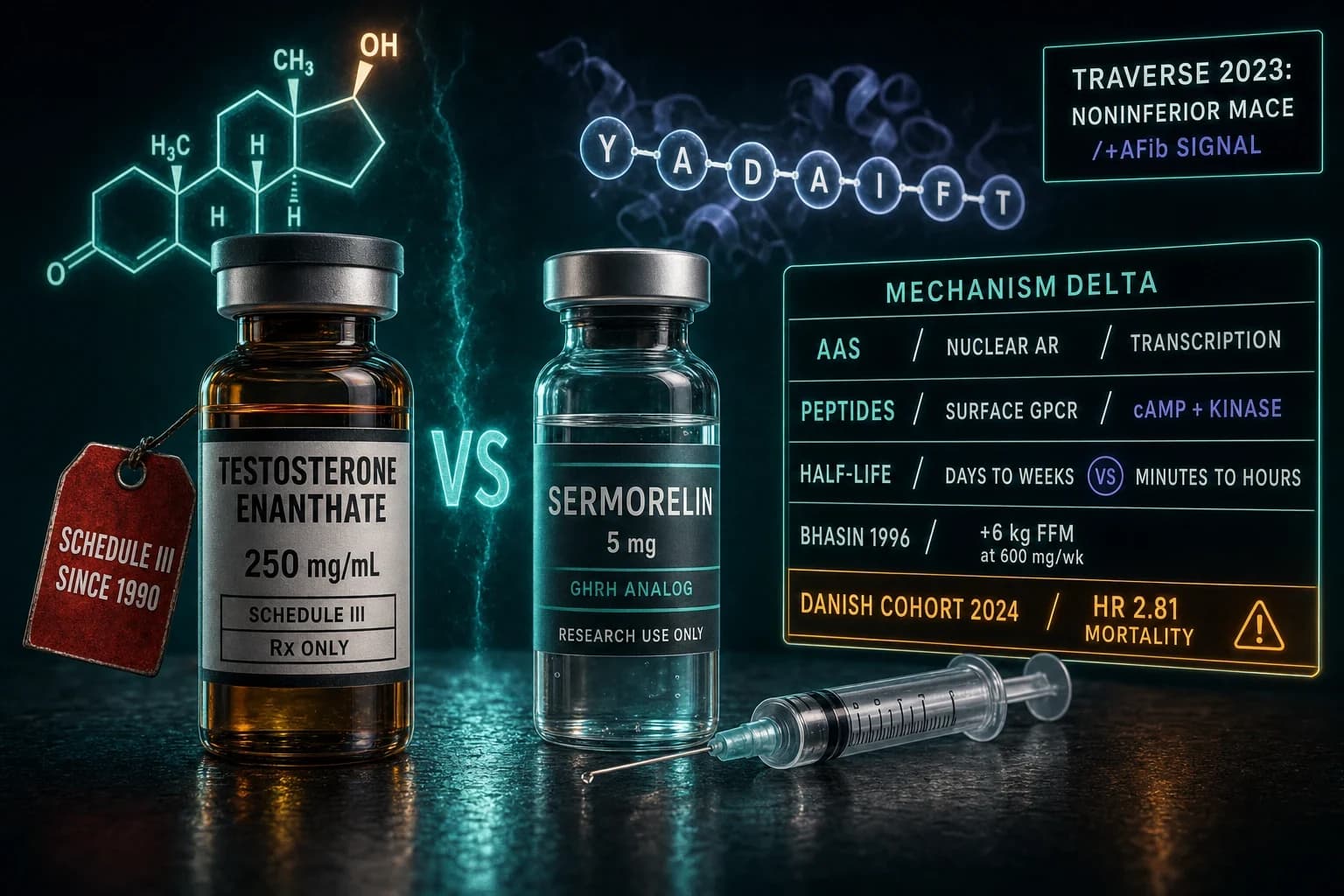
The peptides-and-growth-factors bucket is where the compounds this site covers actually sit inside the Enhanced Medical Program. Enhanced's public statements repeatedly note that no compound on the FDA's Category 2 restricted list was used inside the trial. That excludes some of the more speculative research peptides but leaves a wide catalog, including prescription GHRH analogs like sermorelin and Rx-side growth-hormone secretagogue chemistry, in scope. The specific per-athlete PES list remains under trial protocol and has not been individually published; the aggregate testosterone number is the concrete data point.
For the peptide audience, three implications are worth naming directly:
- The testosterone-first pattern (91%) is closer to a legacy anabolic-androgenic protocol than a peptide-first one. Peptides layered on top of a hormonal base is the archetypal stack, not peptides in isolation.
- The clinical trial framing gives Enhanced a defensible cover story: any peptide the Enhanced athletes touch inside ASCEND001 is by construction limited to FDA-legal categories, not the gray-market GLP-1 or research-peptide fringe.
- A five-year observational follow-up is genuinely useful safety data if it is published. That is one of the few structured, prospective cohorts of medically supervised elite-athlete PES use anywhere in the literature.
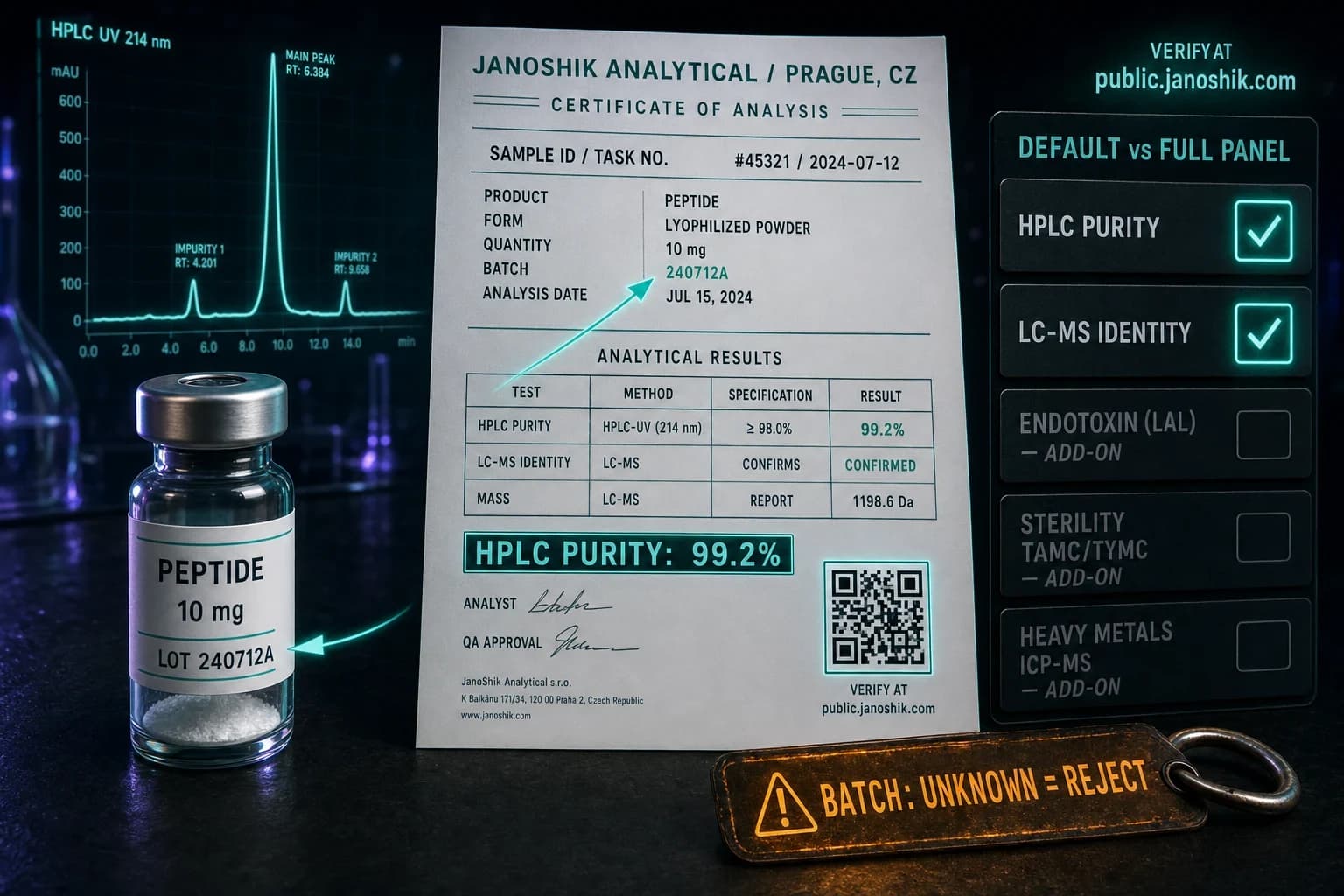
For readers using this article to decide whether Enhanced's medical claims are more than PR, the ASCEND001 protocol on ClinicalTrials.gov is the primary source; the /lab-tests library is the parallel trust asset for the research-peptide side of the field, and covers the certificate-of-analysis question that Enhanced's clinical framing does not solve for vendors selling to non-athletes.
Note: ClinicalTrials.gov registrations describe intent and protocol, not results. The peer-reviewed publications from ASCEND001 have not yet appeared and Enhanced's press updates should not be read as substitutes for eventual peer-reviewed safety data.
The business model: games first, peptides second
Here is the part most commentary misses. The Enhanced Games are not a standalone sporting event. They are a customer acquisition funnel for Live Enhanced, the company's direct-to-consumer wellness platform.
Live Enhanced currently sells clinician-guided Sermorelin (an FDA-approved GHRH analog) and plans to add Tesamorelin, Glutathione, and Oxytocin. They also offer hormone replacement therapy for men and women, proprietary supplement lines (STRONGER+ for performance, LONGER+ for longevity), and coaching protocols.
The SPAC filing makes this explicit. Enhanced Ltd's two principal revenue streams are (1) live sporting events and (2) consumer wellness products. The games generate massive media coverage; the wellness platform monetizes the audience.
For the peptide market specifically, the Enhanced Games represent something unprecedented: a mainstream, billion-dollar media event where peptide compounds are discussed openly on camera by elite athletes. BPC-157, CJC-1295, and Ipamorelin have never had this kind of visibility. Whether that visibility ultimately helps or hurts the research peptide space is an open question.
The legal battlefield
Enhanced filed an $800 million antitrust lawsuit against World Aquatics, WADA, and USA Swimming, alleging they illegally coordinated to prevent athletes from competing. A federal judge in New York dismissed the case, ruling Enhanced failed to show World Aquatics holds monopoly power. Enhanced was given 30 days to refile but chose not to appeal.
The legal question for athletes is murkier. Hunter Armstrong believes he can compete at the Enhanced Games and remain Olympic-eligible as long as he stays clean and in WADA's testing pool. Whether that interpretation holds up under the various federations' rules remains untested. Any currently active Olympic athlete who competes could face sanctions, although the legal basis for punishing someone who doesn't actually violate any anti-doping rule by competing alongside enhanced athletes is unclear.
The leadership shuffle
A notable development: D'Souza stepped down as CEO in November 2025 and was replaced by Maximilian Martin, an investment banker and co-founder of Bitfield (a bitcoin mining company acquired by Northern Data for approximately EUR 400 million). D'Souza remains a shareholder but is no longer running day-to-day operations.
Whether this signals instability or a natural transition from founder-led startup to operator-led company is debatable. The timing, right before the SPAC announcement, suggests it was planned as part of the public-company transition.
What this means for peptide research
The Enhanced Games put peptide compounds in front of a global audience for the first time. When James Magnussen stands on a podium and tells cameras he is running BPC-157, CJC-1295, Ipamorelin, and TB-500, that is unprecedented mainstream exposure for compounds that have historically existed in a niche research community.
The potential upside: normalized conversation around peptide research, increased public understanding of what these compounds do and how they work, and a possible push toward more clinical research and eventual regulatory pathways.
The potential downside: association with "steroid Olympics" framing could paint peptides with a broader PED brush, regulatory backlash from increased visibility, and misinformation as mainstream media inevitably oversimplifies the pharmacology.
Regardless of where you land on the ethics, the Enhanced Games are now a $1.2 billion reality heading for NASDAQ. They will happen in Las Vegas in May 2026. And the compounds at the center of the conversation are the same ones you will find throughout this site.
Key dates
- May 8, 2026: Enhanced Group closes its SPAC merger with A Paradise Acquisition Corp and begins trading on the New York Stock Exchange as ENHA at a $1.2B enterprise value
- May 24, 2026: Inaugural Enhanced Games at Resorts World Las Vegas; Kristian Gkolomeev's 20.81s 50m freestyle is the only world record broken across the entire event card
- May 2026: Enhanced publishes the ASCEND001 clinical trial update reporting 91% testosterone use across the 36 of 42 competing athletes enrolled; five-year observational follow-up commences
- August 2026: ENHA drifts below $2 per share; Enhanced signals a $10M world-record bonus for the men's 100m at the 2027 edition, location and date still to be announced
Compounds referenced by Enhanced Games athletes
| Compound | Type | FDA Status | Our guide |
|---|---|---|---|
| Testosterone | Hormone | Approved (Rx) | N/A |
| BPC-157 | Peptide | Not approved | BPC-157 guide |
| TB-500 | Peptide | Not approved | TB-500 guide |
| CJC-1295 | Peptide (GHRH) | Not approved | CJC-1295 guide |
| Ipamorelin | Peptide (GHRP) | Not approved | Ipamorelin guide |
| Sermorelin | Peptide (GHRH) | Approved (Rx) | Sermorelin guide |
Pre-mixed stacks used by Enhanced Games athletes
Magnussen's disclosed protocol maps directly to commercially available pre-mixed stacks:
- Wolverine Stack (BPC-157 + TB-500): The recovery foundation of his protocol. Targets tissue repair, anti-inflammation, and angiogenesis.
- FIT Stack (CJC-1295 + Ipamorelin): The growth hormone optimization layer. Synergistic GHRH + GHRP pairing for natural GH release.
Both stacks are available from our partner in the Ascension Peptides review with 50% off using code ENHANCED.
This article is for educational and informational purposes only. The Enhanced Games and all referenced compounds involve complex medical, legal, and ethical considerations. We do not endorse the use of any substance for purposes other than legitimate research. Always consult a qualified healthcare professional.