At a glance
- 15.2% visceral fat reduction at 26 weeks in the Phase 3 trial (Falutz et al. 2007)
- FDA-approved since 2010; weekly-reconstitution EGRIFTA WR (F8) approved March 2025
- Liver fat dropped 37% relative vs placebo at 12 months (Stanley et al. 2019)
- Standard dose: 2 mg subcutaneous daily at bedtime; ~26 min half-life
- IGF-1 elevation and glucose intolerance require monitoring during use
The fat you lose on a GLP-1 is not the fat you most want to lose
If you have dropped 18% of your body weight on semaglutide or tirzepatide and still see a stubborn ring of belly fat on a DEXA scan, that is not a failure of discipline or dosing. It is a mechanism gap. GLP-1 and GLP-1/GIP agonists pull weight off across all compartments roughly in proportion to how much fat is there to lose. They do not preferentially target the fat wrapped around your liver, intestines, and pancreas: the visceral adipose tissue (VAT) that drives most of obesity's cardiometabolic risk.
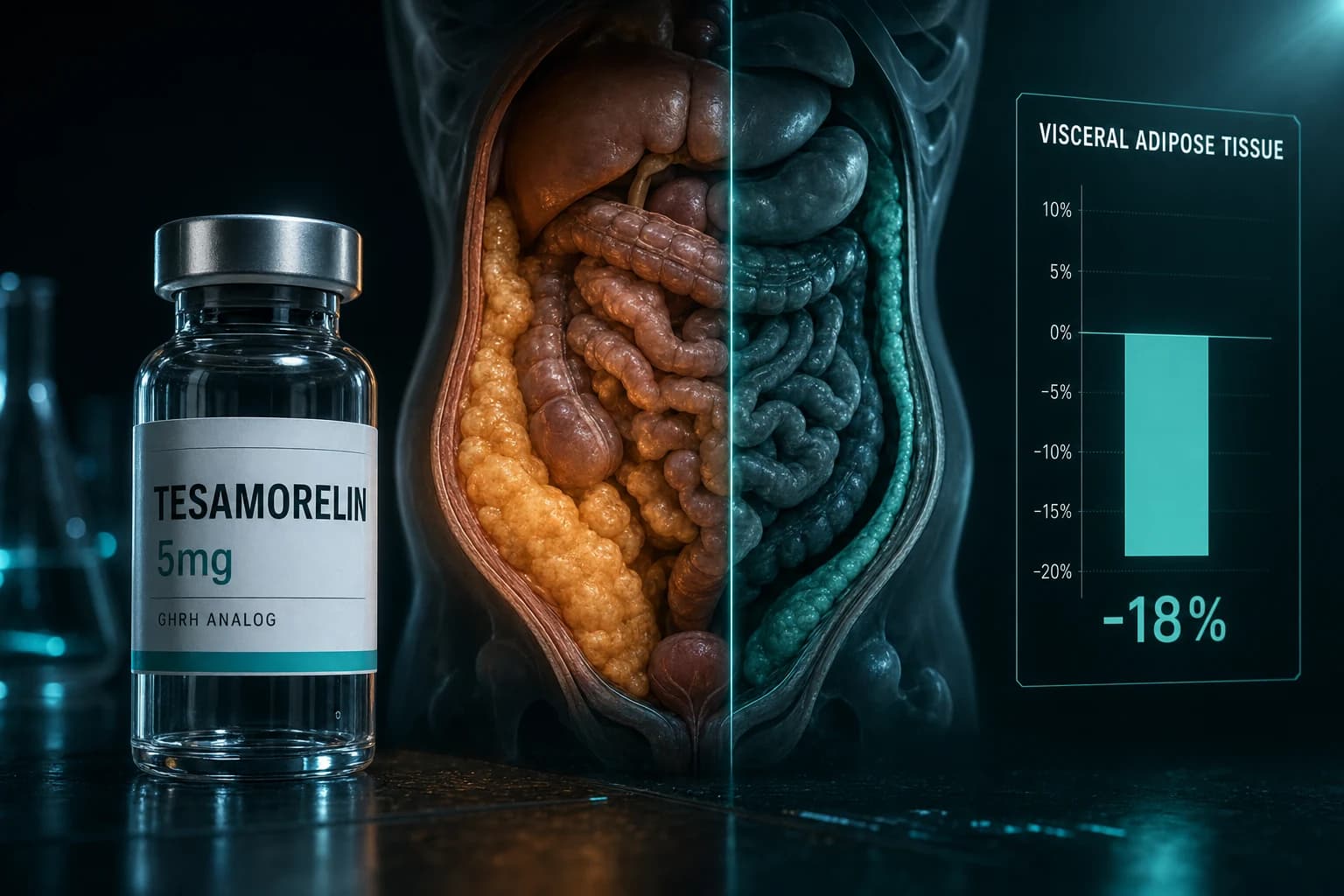
Tesamorelin does. The FDA approved exactly one peptide to reduce visceral fat in a specific clinical setting, and the Phase 3 data behind that approval is one of the cleanest body-composition trials in peptide medicine. In 412 patients across 26 weeks, tesamorelin cut VAT by 15.2% while placebo VAT crept up by 5.0% (Falutz et al., NEJM 2007). The effect was confined almost entirely to the visceral compartment. Subcutaneous fat and limb fat barely moved.
This guide covers what tesamorelin actually does, what 15 years of published evidence shows, where the safety ceiling lives, and how the new weekly-reconstitution formulation (EGRIFTA WR, approved March 2025) changes the practical research calculus.
What tesamorelin actually is
Tesamorelin is a synthetic analog of human growth hormone-releasing hormone (GHRH 1-44). The peptide carries a trans-3-hexenoyl modification at the N-terminus that slows enzymatic degradation by DPP-IV. Native GHRH has a plasma half-life measured in minutes. Tesamorelin stretches that to roughly 26 minutes after subcutaneous injection, long enough to produce a clean pulse of endogenous growth hormone from the pituitary.
That distinction matters. Tesamorelin is not recombinant GH. It does not clamp your GH axis at a constant elevated level. It restores a physiological pulse. The pituitary still decides how much GH to release, feedback loops from somatostatin and IGF-1 stay intact, and the downstream biology looks closer to natural GH pulsatility than to an HGH injection.
Because GH preferentially mobilizes visceral fat (VAT has higher GH receptor density and higher basal lipolytic rate than subcutaneous fat), a GHRH-driven GH pulse lands disproportionately on the abdominal organ depot. That is the mechanistic thread connecting tesamorelin to its clinical effect.
The original Phase 3: what 412 patients showed
The registration trial for tesamorelin was not cosmetic. It enrolled HIV-positive adults on antiretroviral therapy who had developed lipodystrophy: a redistribution of fat that concentrates visceral mass, shrinks limbs, and drives severe dyslipidemia. This is a hard patient population with real cardiovascular risk, not a body-composition curiosity.
Falutz and colleagues randomized 412 patients to 2 mg tesamorelin subcutaneously daily or placebo for 26 weeks (Falutz et al., NEJM 2007). The results:
- VAT decreased 15.2% on tesamorelin, increased 5.0% on placebo
- Triglycerides dropped 50 mg/dL on tesamorelin, rose 9 mg/dL on placebo
- Total cholesterol and non-HDL cholesterol improved significantly
- Subcutaneous fat did not significantly decline
- Insulin-like growth factor 1 (IGF-1) rose into the upper physiologic range
A pooled analysis of two Phase 3 trials plus an open-label safety extension (Falutz et al., JAIDS 2010) confirmed the 15-20% VAT reduction across 6 to 12 months. In the extension, patients who continued tesamorelin held their VAT loss. Patients switched from tesamorelin to placebo at week 26 saw VAT return toward baseline within 3 months, which tells you something important: the effect is maintenance-dependent. Stop the peptide, lose the effect.
Bottom line: Tesamorelin's headline 15.2% VAT reduction is from a real 412-patient double-blind Phase 3. It is not an animal study extrapolated to humans.
Liver fat: the Massachusetts General studies
Visceral fat is metabolically ugly for a reason: it drains into the portal vein, so what happens in your omentum does not stay in your omentum. It lands in your liver as free fatty acids. The Stanley lab at Massachusetts General set out to test whether tesamorelin's VAT-specific effect also reached the hepatic fat depot.
The 2014 pilot (Stanley et al., JAMA 2014) randomized 50 HIV patients with abdominal fat accumulation to 2 mg tesamorelin or placebo for 6 months. Liver fat fell modestly on tesamorelin and rose on placebo. That opened the door to a larger, longer trial.
A 12-month follow-up (Stanley et al., Lancet HIV 2019) enrolled 61 patients with documented NAFLD (hepatic fat fraction ≥5%). Hepatic fat fraction fell 4.1 percentage points on tesamorelin versus placebo, a 37% relative reduction (95% CI -67% to -7%, p=0.02). Biopsy data suggested attenuation of fibrosis progression. For a peptide never designed to treat liver disease, that is a striking signal.
These were HIV populations with metabolic NAFLD features. The extent to which the liver effect generalizes to non-HIV metabolic dysfunction-associated steatotic liver disease (MASLD) is still an open research question. It is plausible given the mechanism. It is not proven.
Dosing, timing, and the new weekly formulation
Every Phase 3 tesamorelin trial used the same regimen: 2 mg subcutaneously, once daily, administered at bedtime. The bedtime timing is not arbitrary. Endogenous GH is secreted in pulses that peak during slow-wave sleep, and a pre-sleep GHRH pulse layers onto the natural rhythm rather than competing with daytime somatostatin tone.
Injection technique follows the prescribing information: abdominal subcutaneous tissue, rotating sites to avoid lipohypertrophy. Reconstitution traditionally used sterile water, and the original EGRIFTA SV formulation required refrigeration and daily reconstitution.
The March 2025 FDA approval of EGRIFTA WR (F8 formulation) changed the logistics. Each vial now contains 11.6 mg of tesamorelin sufficient for seven doses, reconstituted weekly rather than daily, and stable at room temperature before and after reconstitution. The daily 2 mg dose did not change. Bioequivalence to the original F1 formulation was demonstrated in Phase 1 pharmacokinetic studies.
Here is a practical reconstitution reference using the older 5 mg vial format that most research-grade tesamorelin ships in. The reconstitution calculator handles different vial sizes automatically.
| Vial | BAC water | Concentration | Target dose | Draw volume | Units (U-100) |
|---|---|---|---|---|---|
| 5 mg | 2 mL | 2.5 mg/mL | 1 mg | 0.40 mL | 40 |
| 5 mg | 2 mL | 2.5 mg/mL | 2 mg | 0.80 mL | 80 |
| 10 mg | 2 mL | 5 mg/mL | 1 mg | 0.20 mL | 20 |
| 10 mg | 2 mL | 5 mg/mL | 2 mg | 0.40 mL | 40 |
Most research protocols titrate up: 1 mg daily for the first 2 to 4 weeks to assess IGF-1 response and tolerability, then 2 mg daily if IGF-1 stays within the normal range and no significant edema or arthralgia develops.
Tesamorelin vs GLP-1s for visceral fat
This is the question most people now arrive with. If semaglutide or tirzepatide already produces 15-22% body weight reduction, what does tesamorelin add?
The short answer: they target different tissues by different mechanisms, and they can address different residual problems.
| Feature | Tesamorelin | Semaglutide / Tirzepatide |
|---|---|---|
| Receptor target | GHRH receptor (pituitary somatotrophs) | GLP-1 (and GIP for tirzepatide) |
| Downstream signal | Pulsatile GH release, IGF-1 elevation | Appetite suppression, slowed gastric emptying, insulin sensitivity |
| Preferred fat depot | Visceral (preferential) | Total adipose (roughly proportional) |
| Total weight loss in trials | ~1 kg in HIV VAT trials | 15-21% in obesity trials |
| Lean mass | Preserved or slightly increased | 26-40% of lost weight can be lean tissue |
| FDA-approved indication | HIV-associated lipodystrophy | Type 2 diabetes and obesity |
| Injection frequency | Daily SC | Weekly SC |
| Hallmark side effects | Arthralgia, edema, IGF-1 rise, glucose intolerance | Nausea, vomiting, other GI issues |
| Appetite effect | Typically increases | Sharply suppresses |
The tissue-specificity difference is the key thread. GLP-1 agonists drop total fat. Tesamorelin redistributes body composition toward less VAT and preserved or slightly higher lean mass. These are complementary profiles, not equivalent ones.
A researcher whose primary problem is obesity and appetite dysregulation is not well served by tesamorelin as a first-line tool. A researcher whose primary problem is residual visceral adiposity after substantial GLP-1 weight loss is exactly the use case tesamorelin was designed around. The GH/IGF-1 axis work is also, incidentally, why tesamorelin pairs conceptually with the same GHRH-GHS logic behind the CJC-1295 and Ipamorelin stack, though the tesamorelin data is in a different class: it is registered, not extrapolated.
Safety: what requires monitoring
Tesamorelin has one of the more complete safety datasets in peptide research, in part because it cleared the FDA bar. That also means the risk profile is well characterized rather than hopeful.
IGF-1 elevation. This is the obligate pharmacology. GH release drives hepatic IGF-1 production. In the Phase 3 data, about 47% of tesamorelin-treated patients had IGF-1 above +2 SDS and 36% above +3 SDS at 26 weeks. The long-term oncologic implications of sustained IGF-1 elevation are not fully characterized. Active malignancy is a contraindication.
Glucose intolerance. Growth hormone is counterregulatory to insulin. The original Phase 3 found an odds ratio of roughly 3.3 for development of HbA1c ≥6.5% on tesamorelin versus placebo. In a dedicated 12-week trial in patients with established type 2 diabetes (Clemmons et al., PLoS One 2017), fasting glucose, HbA1c, and diabetes medication adjustments were not significantly different from placebo, but this was a short study in a selected population. Routine HbA1c monitoring is standard.
Fluid retention. Peripheral edema, arthralgia, myalgia, and carpal tunnel-like symptoms are the classic GH-related adverse events. They typically appear in the first 8 weeks and often attenuate over time. They are dose-related. If 2 mg produces significant discomfort, 1 mg often does not.
Contraindications. Active malignancy, disruption of the hypothalamic-pituitary axis from surgery or radiation, pregnancy, severe hypersensitivity.
Warning: Sustained IGF-1 elevation above the normal physiologic range has not been fully characterized for long-term cancer risk. Tesamorelin research protocols routinely measure baseline IGF-1 and re-check at 4 to 8 weeks. Discontinue or reduce dose if IGF-1 exceeds +2 to +3 SDS.
The cognitive data you probably have not seen
Outside its metabolic use, tesamorelin has one of the better randomized trials for GHRH-axis effects on cognition. Baker and colleagues randomized 152 older adults (66 with mild cognitive impairment, 86 cognitively normal) to 1 mg tesamorelin or placebo subcutaneously at bedtime for 20 weeks (Baker et al., Archives of Neurology 2012).
The results were narrow but real. Tesamorelin improved executive function (Task Switching accuracy, Stroop interference reaction time, Self-Ordered Pointing Test, Word Fluency) and showed a trend on verbal memory. Visual memory did not change. The MCI and cognitively normal subgroups responded similarly, which matters because most cognition trials show larger effects in the impaired group.
A companion MR spectroscopy study (Friedman et al., Neuroimage 2013) found increased brain GABA in several regions and decreased myo-inositol in the posterior cingulate after 20 weeks of tesamorelin. These are reasonable correlates of improved executive function, not proof of a neuroprotective effect.
Treat the cognitive signal honestly. It exists. It is modest. It replicates the general GH-axis cognition story from sermorelin and recombinant GH studies in older adults. It is not approved indication, not established therapy, and not a reason to take tesamorelin on its own for subjective "brain fog."
Who tesamorelin is actually for
Research use cases where tesamorelin has the cleanest rationale:
- HIV-associated lipodystrophy with persistent abdominal fat. This is the registered indication. Efficacy is established. Insurance coverage is possible.
- Post-GLP-1 residual visceral adiposity. Researcher has achieved substantial total weight loss on semaglutide, tirzepatide, or retatrutide but DEXA or imaging still shows elevated VAT and associated triglycerides. The mechanism gap here is real.
- Metabolic NAFLD/MASLD research in adults with visceral obesity. The Stanley 2019 signal is promising. Not yet an approved indication.
- GH-axis research in older adults, including cognitive endpoints. Less common, but the Baker 2012 data is the reason anyone studies it here.
Research use cases where tesamorelin is a poor fit:
- Bulk muscle gain. GH/IGF-1 elevation contributes modestly to lean mass; it is not a short-path to hypertrophy and carries real metabolic cost.
- Acute fat loss goals without regard to depot. A GLP-1 receptor agonist will move more total fat faster.
- Anyone with untreated hyperglycemia, active cancer, or pituitary dysfunction.
For sourcing, tesamorelin is available through Ascension Peptides with 50% off using code ENHANCED. Compare the GHRH-class options on the tesamorelin research page and the related sermorelin, CJC-1295, and ipamorelin pages if you are mapping out the broader growth hormone peptide space. If you would prefer an oral GH secretagogue entirely, MK-677 is the closest functional cousin, though it raises GH continuously rather than pulsatilely and has a different safety profile.
Bottom line
Tesamorelin is the most evidence-backed peptide for reducing visceral adipose tissue. The Phase 3 effect size (15.2% VAT reduction in 26 weeks) is real, reproducible, and now extended by a 12-month NAFLD trial showing meaningful hepatic fat reduction. The 2025 EGRIFTA WR approval made the product materially easier to administer without changing the underlying regimen.
It is not a GLP-1 replacement. It does not drive appetite suppression or large total-body weight loss. It does do one thing GLP-1s do not: it specifically lowers the fat that matters most for cardiometabolic risk, while preserving or slightly increasing lean mass.
The safety profile is well understood. IGF-1 monitoring, HbA1c monitoring, and attention to edema and arthralgia are part of the research protocol, not afterthoughts. The effect is maintenance-dependent: visceral fat rebounds within 3 months of discontinuation.
For the reader who is already past the GLP-1 phase and looking at what to add next, tesamorelin is the most defensible peptide to study. For everyone else, the peptide is a specialist tool, not a generalist.
Related reading
- CJC-1295 + Ipamorelin Stack Protocol
- Injectable vs Oral Peptides: Bioavailability Guide
- MK-677 Oral GH Secretagogue Guide
- Peptide Reconstitution Complete Guide
- Reconstitution Calculator
This article is for educational and research purposes only. Tesamorelin (EGRIFTA SV, EGRIFTA WR) is FDA-approved for the reduction of excess abdominal fat in adults with HIV-associated lipodystrophy. All other applications discussed are investigational. Cited efficacy and safety data are derived from published peer-reviewed research and FDA prescribing information. Consult a qualified healthcare professional before making any decisions about peptide research.