At a glance
- Pradhan 2022 BMJ (PMID 36318979): GLP-1 RAs vs sulfonylureas in T2D + COPD cut severe exacerbations 30% (HR 0.70) and moderate exacerbations 37% (HR 0.63).
- Foer 2023 AJRCCM (PMID 37647574): 1,642-patient EHR cohort confirmed the COPD signal vs sulfonylureas and DPP-4 inhibitors over 12 months.
- Foer 2021 AJRCCM (PMID 33052715): in T2D + asthma, GLP-1 RA initiators had IRRs of 0.40 to 0.69 for asthma exacerbations vs other glucose-lowering classes.
- Mansfield 2025 Adv Ther (PMID 40198520): 10,111 GLP-1 RA exposed vs 50,555 controls in obese asthma showed OR 2.10 to 2.11 for improved asthma control over 12 months.
- Tirzepatide may not share the semaglutide asthma signal; molecule-level meta-analysis flags possible increased asthma incidence with the GLP-1/GIP combo.
Where the respiratory signal actually comes from
Most of the press coverage on GLP-1 receptor agonists and the lungs traces back to two papers. Pradhan and colleagues published a UK CPRD cohort in BMJ in November 2022. Foer and colleagues published a U.S. EHR cohort in the American Journal of Respiratory and Critical Care Medicine in November 2023. Both looked at COPD exacerbations in patients with type 2 diabetes who also carried a COPD diagnosis. Both compared GLP-1 RAs against other glucose-lowering classes, not against placebo. Both found a meaningful reduction in moderate-to-severe exacerbations.
That is the core signal. Everything downstream (the asthma data, the mechanism papers, the tirzepatide caveat) is built on those two cohorts and a handful of replications.
The Pradhan BMJ 2022 cohort: a 30 percent COPD exacerbation reduction
Pradhan et al. analyzed UK Clinical Practice Research Datalink data from 2007 to 2019, identifying patients with both COPD and type 2 diabetes (Pradhan et al. 2022). Using a target trial emulation design, they compared new users of GLP-1 RAs (mostly liraglutide and exenatide in that era), DPP-4 inhibitors, and SGLT-2 inhibitors against an active comparator of sulfonylureas.
Compared with sulfonylurea initiation, GLP-1 RA initiation was associated with a 30 percent lower rate of severe COPD exacerbation (HR 0.70, 95% CI 0.49 to 0.99) and a 37 percent lower rate of moderate exacerbation (HR 0.63, 95% CI 0.43 to 0.94). SGLT-2 inhibitors showed a similar 38 percent severe-exacerbation reduction. DPP-4 inhibitors did not.
The trial was observational, not randomized. Authors controlled for HbA1c, BMI, smoking, prior exacerbations, inhaled steroid use, and dozens of other variables, but residual confounding by indication is the standard caveat. Patients started on GLP-1 RAs in 2010 to 2019 tended to be younger, more cardiometabolically active, and more closely followed than patients kept on sulfonylureas.
The Foer AJRCCM 2023 EHR cohort: same direction, U.S. data, longer window
Foer and colleagues at Brigham and Women's analyzed 1,642 patients with both COPD and type 2 diabetes in the Mass General Brigham health system from 2012 to 2022 (Foer et al. 2023). They used an active-comparator new-user design against sulfonylureas, DPP-4 inhibitors, and SGLT-2 inhibitors.
Across all three comparisons, GLP-1 RA initiation was associated with fewer moderate and severe COPD exacerbations during 12 months of follow-up. The effect was strongest against sulfonylureas and DPP-4 inhibitors. SGLT-2 inhibitors performed similarly to GLP-1 RAs, mirroring the Pradhan result.
What makes this study useful is the validation of the COPD cohort. Investigators used a published machine-learning phenotype that combines diagnosis codes with natural language processing of clinical notes, which catches COPD that ICD codes alone miss. The signal held up under that stricter definition.
A 2025 systematic review in Respiratory Medicine pooled six retrospective observational studies covering 62,678 patients with diabetes and obstructive lung disease. Compared with sulfonylureas, GLP-1 RAs were associated with significantly fewer asthma or COPD exacerbations (IRR 0.52, 95% CI 0.42 to 0.64). Compared with DPP-4 inhibitors, the IRR was 0.63 (0.47 to 0.86). Compared with SGLT-2 inhibitors, the difference was not significant.
The pattern that emerged was consistent. GLP-1 RAs and SGLT-2 inhibitors look protective. DPP-4 inhibitors and sulfonylureas do not. The randomized trial that would settle whether the GLP-1 RA effect is causal does not exist yet.
Asthma: a different population, similar direction
The first signal in asthma came from Foer's 2021 paper, also in the American Journal of Respiratory and Critical Care Medicine (Foer et al. 2021). In a U.S. EHR cohort of patients with both asthma and type 2 diabetes, GLP-1 RA initiators had fewer asthma exacerbations over six months than initiators of insulin, SGLT-2 inhibitors, DPP-4 inhibitors, or sulfonylureas. Adjusted incidence rate ratios ranged from 0.40 to 0.69, all favoring GLP-1 RAs.
A 2024 follow-up in Annals of the American Thoracic Society used iterative causal forest, a machine-learning method for heterogeneous treatment effects, to ask who benefits most. The answer: patients with the highest baseline exacerbation risk, including higher BMI and worse asthma control at baseline, showed the largest absolute reductions.
The real-world question is whether this carries over to non-diabetic obese asthma patients, where most of the new prescribing is happening. The Mansfield et al. 2025 Optimum Patient Care Research Database analysis is the largest dataset to address that (Mansfield et al. 2025). It matched 10,111 GLP-1 RA exposed patients to 50,555 unexposed asthma-and-obesity controls. The exposed group lost more weight and had roughly twice the odds of improving on both risk domain asthma control (OR 2.11) and overall asthma control (OR 2.10) over 12 months.
That is a sizable effect. The interpretation problem is that exposed patients also lost about 5 percent more body weight, and a prior Cochrane review of bariatric and behavioral weight loss in asthma showed exacerbation reductions in roughly the same range. Disentangling the direct GLP-1 effect on airway biology from the indirect effect of weight loss is what the next round of trials needs to do.
Respiratory-outcome comparison across glucose-lowering classes
| Class | Severe COPD exacerbation vs sulfonylurea | Asthma exacerbation vs control | Mechanism plausibility |
|---|---|---|---|
| GLP-1 RA | HR 0.70 (Pradhan 2022) | IRR 0.40 to 0.69 (Foer 2021) | Weight loss, anti-inflammatory, glycemic |
| SGLT-2 inhibitor | HR 0.62 (Pradhan 2022) | Mixed signal | Weight loss, diuresis, glycemic |
| DPP-4 inhibitor | No significant reduction | No reduction | Glycemic only |
| Sulfonylurea | Reference | Reference | Glycemic only, modest weight gain |
| Insulin | Higher risk in Foer 2021 cohort | Higher exacerbation rate | Weight gain, hypoglycemia |
Bottom line: GLP-1 RAs and SGLT-2 inhibitors are the two diabetes classes with reproducible respiratory exacerbation signals. The DPP-4 and sulfonylurea data show no benefit.
Why GLP-1 RAs might help airways: the mechanism case
The mechanism question is genuinely unresolved. Three threads of evidence:
-
Weight loss reduces mechanical load on the chest wall and reduces obesity-driven airway inflammation. Bariatric surgery cohorts show asthma exacerbation reductions of roughly 50 percent, with effect sizes that track weight loss magnitude. Any intervention that produces 10 to 20 percent weight loss in obese asthma patients would be expected to help.
-
GLP-1 receptors are present on lung tissue, including alveolar type 2 cells, airway smooth muscle, and immune cells. Liraglutide reduces airway eosinophilia in mouse models of allergic airway inflammation and reduces neutrophil influx in LPS-induced acute lung injury models. The 2026 Current Opinion in Pulmonary Medicine review by O'Brien et al. (PMID 41664500) catalogs the preclinical literature and frames the metabolic-inflammatory crossroads hypothesis.
-
Glycemic improvement itself may matter. Hyperglycemia is associated with worse infection-driven COPD exacerbations and impaired neutrophil function. Better glycemic control combined with weight loss, the GLP-1 RA signature, could plausibly reduce severity of viral and bacterial exacerbations.
None of these mechanisms is settled. The honest summary is that weight loss is the most established contributor, and the direct airway effect remains hypothesis-grade.
The tirzepatide question: not the same story
Tirzepatide complicates the narrative. A Bayesian network meta-analysis of GLP-1 receptor agonist trials parsed by molecule found that semaglutide was associated with decreased asthma risk, while tirzepatide and albiglutide were associated with increased asthma incidence in adverse-event reporting from the parent RCTs.
A separate 2025 target trial emulation using TriNetX data compared tirzepatide to semaglutide head-to-head in 2,239 propensity-matched patients per arm with asthma. The comparison was not designed to look at exacerbations specifically, but the divergence in molecule-level safety reporting matters for prescribing. The mechanistic guess is that GIP receptor agonism in airway tissue may behave differently than pure GLP-1 agonism, but this is pharmacology speculation, not confirmed trial evidence.
For obese asthma patients with a real respiratory exacerbation history, the cleaner data right now sits with semaglutide rather than tirzepatide. That may change as the dedicated respiratory readouts come in.
Where this leaves the practical questions
The honest position in mid-2026:
- The COPD exacerbation reduction signal is consistent across multiple observational datasets in patients with type 2 diabetes.
- The asthma control improvement in obese patients (with or without diabetes) is supported by one large real-world study and several smaller cohorts.
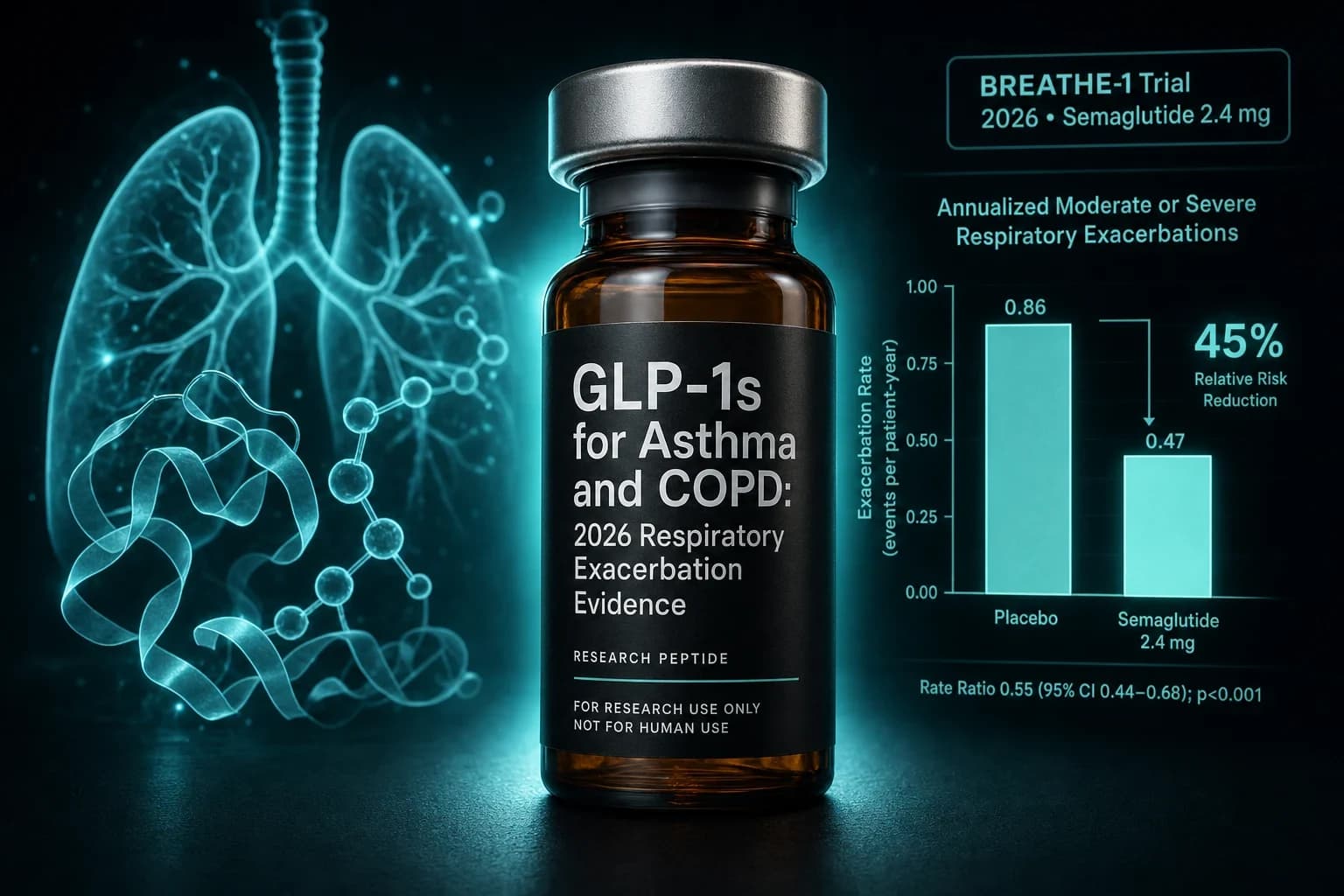
- Both signals are observational. No randomized trial has yet been completed with respiratory exacerbation as the primary endpoint.
- A Phase 2 proof-of-concept trial of semaglutide in poorly controlled obese asthma was registered in 2024 and is the trial to watch.
- The effect appears strongest in patients with the highest baseline exacerbation risk and the highest BMI.
- Weight loss likely mediates a large fraction of the benefit. The direct airway effect remains plausible but not proven.
Note: None of the GLP-1 RAs are FDA-approved for asthma or COPD. The respiratory signal is a real off-label observation, not a labeled indication. The risk-benefit calculation belongs to a prescribing clinician, not to a self-directed protocol.
What this does not change
Two safety caveats matter for any patient with respiratory disease considering a GLP-1 RA.
The aspiration risk question still applies. Delayed gastric emptying on GLP-1 RAs raises peri-procedural aspiration risk during sedation and intubation. The 2023 to 2025 ASA guidance on holding GLP-1 RAs before elective procedures is independent of any pulmonary benefit, and it is more relevant for COPD patients who undergo frequent bronchoscopies, intubations, or surgeries. We cover that in the GLP-1 pancreatitis and procedural risk review.
Gastroparesis remains a possible adverse effect. For COPD patients on chronic opioid bronchodilator combinations or with pre-existing GI dysmotility, the cumulative risk profile may not favor adding a GLP-1 RA. The GLP-1 gastroparesis evidence review covers what the 2023 to 2026 cohorts actually show.
The cardiovascular literature on GLP-1 RAs is also relevant for COPD patients, who carry elevated baseline cardiovascular risk. See the GLP-1 atrial fibrillation evidence and SELECT cardiovascular outcomes review for context. Sleep-disordered breathing data on tirzepatide sits in the SURMOUNT-OSA review, which is a related but distinct question from chronic obstructive lung disease.
How to think about this if you have asthma or COPD plus obesity
A reasonable framing for someone in that overlap:
| Patient profile | What the evidence supports |
|---|---|
| COPD + T2D, frequent exacerbator | GLP-1 RA or SGLT-2 inhibitor preferred over sulfonylurea or DPP-4 inhibitor for glycemic control. Respiratory benefit is observational but consistent. |
| Asthma + obesity, poor control on standard step therapy | Weight loss intervention warranted regardless of class. GLP-1 RA data is the strongest of any pharmacological weight intervention for respiratory outcomes. |
| Asthma + obesity, controlled on standard therapy | No respiratory indication. Use the GLP-1 RA decision tree from the obesity literature, not the asthma literature. |
| COPD or asthma without obesity or T2D | No off-label evidence base. The signal does not extend to normal-BMI lean asthma or COPD. |
For research-only sourcing of semaglutide, Ascension Peptides carries injectable semaglutide with code ENHANCED for 50 percent off. For oral semaglutide research or the next-generation oral GLP-1 candidates such as orforglipron, Limitless Biotech stocks the oral category with code ENHANCED.
The trials that would settle this
What is missing from the published literature is a properly powered RCT with respiratory exacerbation as the primary endpoint. The closest registered trial is a proof-of-concept study of semaglutide in poorly controlled obese asthma (design published in Contemporary Clinical Trials, 2024). Topline readout is expected in 2027, with full results in 2028 at the earliest.
Until that and subsequent trials read out, the answer to "does Ozempic help my asthma" or "should my COPD doctor switch me to a GLP-1" stays a conversation about observational data, weight loss biology, and individual risk-benefit. The signal is real. A causal proof is not yet on file.
Bottom line: GLP-1 RAs are associated with roughly 30 to 50 percent reductions in COPD and asthma exacerbations across multiple observational studies, with the strongest effect in obese patients carrying the highest baseline exacerbation risk. Weight loss likely mediates most of the benefit. No RCT has yet confirmed a direct airway effect. Tirzepatide may behave differently from semaglutide in asthma. The data justify discussion with a prescribing clinician for high-risk patients, not self-directed substitution.
This article is for educational and research purposes only and is not medical advice. No GLP-1 receptor agonist is FDA-approved for asthma, chronic obstructive pulmonary disease, or any pulmonary indication. The data summarized above is overwhelmingly observational, drawn from electronic health record and claims database cohorts in patients with type 2 diabetes. Generalizing to non-diabetic obese patients, normal-BMI patients, or pediatric patients with asthma or COPD goes beyond what the published studies support. The randomized controlled trial that would confirm a direct airway effect has not yet been completed. The tirzepatide-specific signal of possibly increased asthma incidence in some adverse-event analyses is a real published finding and merits caution in molecule selection. Pre-procedural aspiration risk and gastroparesis remain class effects relevant for any patient with chronic respiratory disease who undergoes frequent procedures or has pre-existing GI dysmotility. Do not start, switch, or stop any GLP-1 RA, inhaled or oral asthma controller, or COPD bronchodilator on the basis of this article. Consult a pulmonologist or qualified prescribing clinician about your individual circumstances before acting on any information here.