At a glance
- Sodhi 2023 JAMA (PMID 37796527): gastroparesis HR 3.67 (95% CI 1.15 to 11.9) on GLP-1 vs naltrexone-bupropion for weight loss.
- Sodhi 2025 BMJ Open Gastro (PMID 40175094, n=55,460): 6.5 vs 2.1 vs 1.1 cases per 1,000 person-years on semaglutide vs naltrexone-bupropion vs sleeve gastrectomy.
- Abdulraheem 2025 meta-analysis (PMID 40634731): GLP-1 RAs raise retained gastric contents and aborted endoscopies; aspiration events were not statistically different.
- Jalleh 2023 (PMID 37927173): on liraglutide 3 mg, 57 percent had delayed gastric emptying at 5 weeks, but tachyphylaxis restored normal emptying in roughly half by 16 weeks.
- AGA 2024 (PMID 37944573) and multi-society 2024 (PMID 39480373) now favor an individualized approach over a blanket weekly hold for asymptomatic patients.
Why "Ozempic stomach paralysis" became a permanent search term
Slowing gastric emptying is not a side effect of GLP-1 receptor agonists. It is part of how they work. Vagal afferent activation, pyloric tone, and direct receptor signaling in gastric mucosa combine to push food out of the stomach more slowly, which blunts the post-meal glucose spike and stretches the satiety signal. That mechanism is shared by semaglutide, tirzepatide, retatrutide, and the rest of the class. The clinical question that has dragged on since 2023 is whether the same mechanism, in a subset of patients, crosses into true gastroparesis: a delayed-emptying syndrome with vomiting, abdominal pain, early satiety, and weight loss that does not reverse when the drug is held.
The honest answer is yes for some patients, with a real and quantifiable relative risk, on a low absolute baseline. The harder answer is who, and for how long. The 2023 to 2026 cohorts narrow both questions without resolving them.
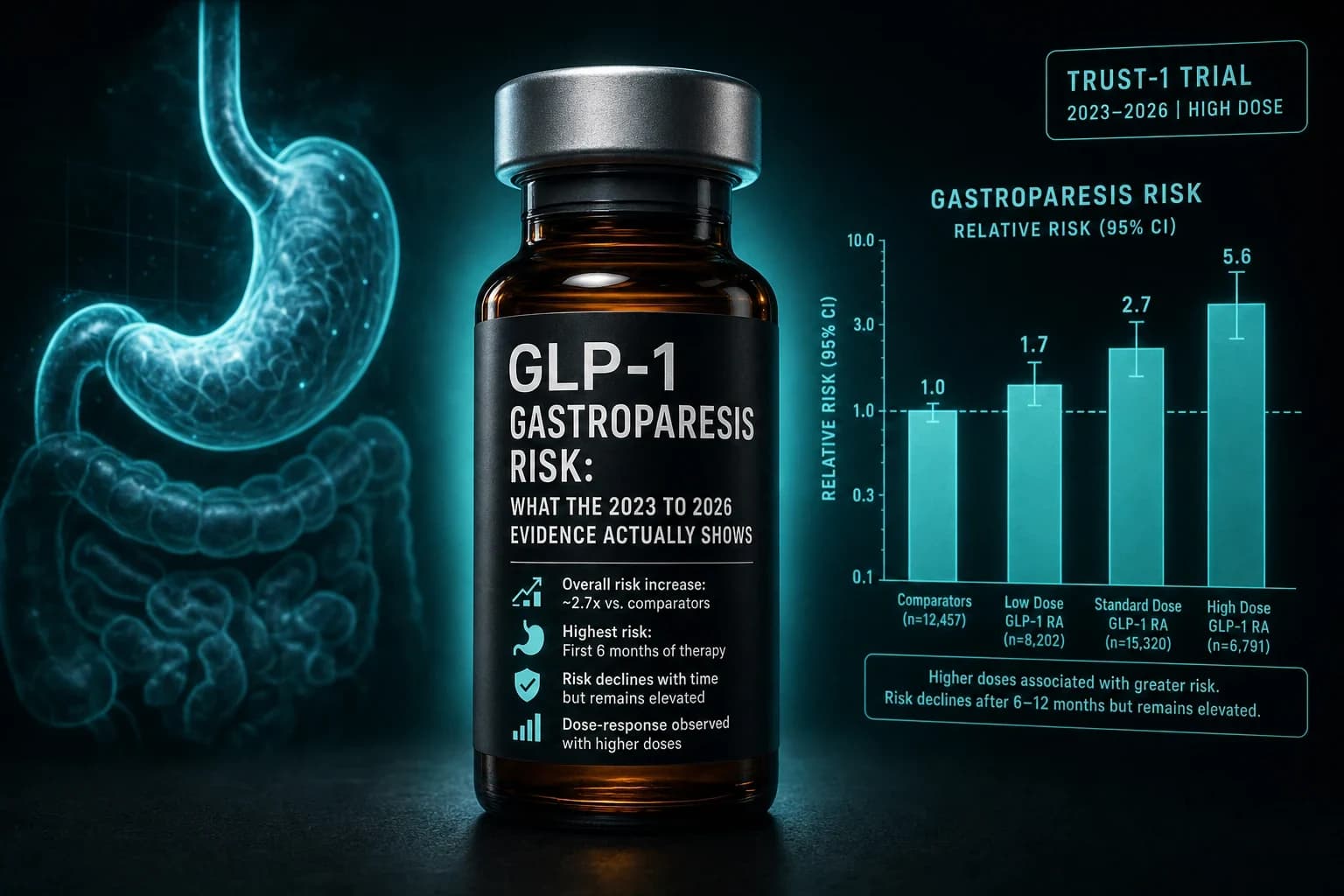
Bottom line: GLP-1 use raises the relative risk of clinically diagnosed gastroparesis roughly 3 to 6 fold versus alternative obesity treatments, on an absolute baseline of about 6.5 cases per 1,000 person-years on semaglutide for weight loss. Endoscopy data shows retained gastric contents are common even in asymptomatic users, but aspiration events have not been clearly increased in pooled analyses. The 2024 multi-society guidance now favors a symptom-driven and risk-stratified approach over a blanket weekly hold.
What gastroparesis actually means in this literature
Two things get conflated in popular coverage. The first is delayed gastric emptying, which is a measurable physiologic effect: a scintigraphy or breath-test result showing food leaves the stomach more slowly than reference. The second is gastroparesis, a clinical syndrome of nausea, vomiting, early satiety, postprandial fullness, bloating, and upper abdominal pain in the setting of documented delayed emptying without mechanical obstruction. Most GLP-1 users have the first. A small minority have the second.
The distinction matters for how to read the data. Cohort studies pull gastroparesis ICD codes from claims and electronic health record data, which captures the clinical syndrome. Endoscopy studies measure retained gastric contents at the moment of the procedure, which captures the physiologic effect but does not necessarily equal a chronic syndrome. Both kinds of evidence are informative. They are answering different questions.
Sodhi 2023: the JAMA result that started the modern alarm
Sodhi and colleagues at the University of British Columbia ran a retrospective cohort using the PharMetrics Plus claims database, covering a random sample of about 16 million U.S. patients with prescription benefits. The analysis pulled new users of semaglutide (n = 613), liraglutide (n = 4,144), and naltrexone-bupropion (n = 654) prescribed for weight loss from 2006 to 2020 (Sodhi et al., JAMA 2023;330(18):1795-1797, PMID 37796527). The endpoints were biliary disease, pancreatitis, bowel obstruction, and gastroparesis, all defined by ICD-10 coding.
The gastroparesis result was a hazard ratio of 3.67 (95 percent CI 1.15 to 11.9) in GLP-1 users versus the naltrexone-bupropion comparator. Bowel obstruction was 4.22 (95 percent CI 1.02 to 17.4). Pancreatitis was 9.09 (95 percent CI 1.25 to 66). The wide confidence intervals reflect a small number of absolute events, which is the standard caveat for active-comparator weight-loss claims data over a five-year accrual period.
Two things matter about that paper. It is the first U.S. claims-based analysis to flag gastroparesis as a class signal in a weight-loss indication, and the relative risk it surfaced has now been replicated. It is also a small-event analysis against a comparator (naltrexone-bupropion) that itself is not the cleanest baseline for absolute incidence questions. That second limitation is what motivated the 2025 follow-up.
Sodhi 2025: the better-powered follow-up no one talked about
Two years later the same group published a larger analysis in BMJ Open Gastroenterology using the Merative MarketScan Research Databases, covering January 2018 through December 2022 (Sodhi et al., BMJ Open Gastroenterol 2025;12:e001735, PMID 40175094). The cohort was 55,460 individuals with obesity and without type 2 diabetes, split across semaglutide (n = 36,990), naltrexone-bupropion (n = 7,369), and sleeve gastrectomy (n = 11,101). The exclusion of diabetes is important. It strips out a major confounder, because diabetes itself is the most common cause of gastroparesis in non-drug populations.
The incidence rates were the cleanest comparison in the modern literature.
| Treatment | Gastroparesis cases per 1,000 person-years | Adjusted HR vs sleeve gastrectomy | Adjusted HR vs naltrexone-bupropion |
|---|---|---|---|
| Semaglutide | 6.5 | 6.14 (95% CI 3.94 to 9.57) | 3.33 (95% CI 2.27 to 4.98) |
| Naltrexone-bupropion | 2.1 | 1.94 (95% CI 1.23 to 3.06) | reference |
| Sleeve gastrectomy | 1.1 | reference | reference |
Read carefully, the numbers say three things. Semaglutide for weight loss in non-diabetics raised clinically diagnosed gastroparesis relative to both alternatives. The relative risk versus a different obesity drug was about threefold. The relative risk versus the surgical alternative was about sixfold. And the absolute baseline is low. Roughly 6.5 cases per 1,000 person-years means about 0.65 percent annual incidence on semaglutide, which is a real signal but not a common outcome.
For the broader GI safety map, the GLP-1 pancreatitis risk evidence, the GLP-1 gallbladder and cholelithiasis evidence, and the GLP-1 before-surgery aspiration risk guide cover the adjacent endpoints in the same population.
The endoscopy literature: retained gastric contents are common, aspiration is not
The second major evidence stream comes from gastroenterology. People taking GLP-1s show up for routine esophagogastroduodenoscopy (EGD), and endoscopists started noticing solid food in stomachs that should have been empty after a standard overnight fast. That observation drove a wave of single-center retrospectives, multicenter cohorts, and ultimately several meta-analyses.
Gu and colleagues at the University of Massachusetts ran a case-control on semaglutide users undergoing EGD and reported a clear association between active semaglutide therapy and retained gastric contents at endoscopy, with the effect appearing larger among patients using the drug for weight loss than for glycemic control (Gu et al., Tech Innov Gastrointest Endosc 2025, PMID 40230563). The mechanism inference is consistent with a higher steady-state semaglutide exposure in non-diabetic weight-loss patients, who titrate toward the 2.4 mg Wegovy dose rather than the 0.5 to 2.0 mg diabetes range.
The largest synthesis comes from Abdulraheem and colleagues in Surgical Endoscopy (Abdulraheem et al., Surg Endosc 2025, PMID 40634731). The updated systematic review and meta-analysis pulled studies through November 2024 plus DDW and ACG 2024 abstracts and ran a network meta-analysis across agents. The signal is consistent across studies. GLP-1 use raises the odds of retained gastric contents on upper endoscopy and raises the odds of an aborted procedure. The signal that did not separate from comparator was clinically documented aspiration. That is the key disconnect between the physiologic finding and the clinical outcome the perioperative debate actually cares about.
The reason aspiration did not increase as much as retained contents almost certainly is the change in airway-management practice. Anesthesiologists who know the patient is on a GLP-1 take more conservative airway precautions, and the procedural conversion from elective EGD to a deeper-sedation protected airway technique becomes routine when retained contents are spotted on the way in. That kind of clinical adaptation does not show up in the meta-analytic numerator, but it changes the absolute risk.
Why some patients get tachyphylaxis and others do not
The mechanism of GLP-1 induced delayed emptying involves vagal afferent activation, pyloric tone increase, and direct binding to GLP-1 receptors on gastric mucosa and antral pacemaker cells. Most users adapt. Some do not.
Jalleh and colleagues at the University of Adelaide directly measured gastric emptying on liraglutide 3 mg in 67 patients with obesity at 5 weeks and at 16 weeks using scintigraphy (Jalleh et al., Diabetes Obes Metab 2023, PMID 37927173). At 5 weeks, gastric emptying was delayed in 57 percent of patients. At 16 weeks, about half of those patients had returned to normal emptying through tachyphylaxis, leaving roughly 30 percent of the full cohort still delayed and 70 percent normalized. The 30 percent figure matches the pattern endoscopists are seeing in the long-term users: a minority who never adapt and continue to have measurable delayed emptying for as long as they remain on therapy.
Jalleh and colleagues also led the broader synthesis of mechanistic and clinical effects of delayed gastric emptying across the GLP-1 class and tirzepatide (Jalleh et al., J Clin Endocrinol Metab 2025;110:1-15, PMID 39418085). The clinically actionable points are that the delayed-emptying effect attenuates substantially in most patients after 16 to 20 weeks of weekly semaglutide 2.4 mg exposure, but persists in a subset, and that intravenous erythromycin (about 3 mg/kg) has been shown to acutely reverse the GLP-1 induced delay if needed for an urgent procedure.
The early prediction question (which patients will not adapt) is not resolved. Female sex, lower BMI at baseline, weight-loss indication rather than diabetes indication, and use of the higher-dose 2.4 mg semaglutide regimen all track with higher persistent delay in observational data, but no validated predictive score has been published.
Risk-stratification table for the practical question
Most users do not need to think about gastroparesis at all. A smaller group does. The relevant variables for the practical risk question are dose, duration, indication, and current GI symptoms.
| Profile | Practical gastroparesis risk | What to monitor |
|---|---|---|
| Diabetes, semaglutide 0.5 to 1.0 mg weekly, no GI symptoms | Low | Routine follow-up; no special action |
| Obesity, semaglutide 2.4 mg weekly, no GI symptoms, more than 16 weeks on therapy | Low to moderate | Symptom awareness; dose hold if new GI symptoms appear |
| Obesity, semaglutide or tirzepatide, persistent nausea or postprandial fullness beyond titration window | Elevated | Clinical evaluation; consider gastric emptying study |
| Pre-existing diabetic gastroparesis or autonomic neuropathy | High | Specialist input before initiation; consider non-GLP-1 alternative |
| Scheduled upper endoscopy or surgery under sedation | Procedural risk, not chronic risk | Follow AGA/multi-society liquid-diet preparation pathway |
| New severe vomiting, weight loss beyond expected, or food found at endoscopy | Established physiologic delay | Discontinue, assess gastric emptying, refer to gastroenterology |
The vast majority of users sit in the first two rows. The minority who slide into the third or sixth row are the ones the surveillance literature is actually picking up.
What the 2024 guidance actually changed
For about a year after the original ASA preoperative guidance was issued in mid-2023, the default was to hold weekly GLP-1 agents for the full week before any procedure requiring sedation. That blanket hold was popular with anesthesia, unpopular with endocrinology (because metabolic control drifts), and clinically unproven at the time.
The AGA Rapid Clinical Practice Update (Hashash et al., Clin Gastroenterol Hepatol 2024;22:705-707, PMID 37944573) was the first major society to publicly walk this back. The AGA position is that in asymptomatic patients on GLP-1 receptor agonists who follow the standard 8-hour solid-food fast and 2-hour clear-liquid fast, it is reasonable to proceed with endoscopy without discontinuing the drug. In symptomatic patients (nausea, vomiting, abdominal distension, dyspepsia), the AGA advises additional precautions, including transabdominal gastric ultrasound where feasible.
The multi-society perioperative guidance that followed in October 2024 (Kindel et al., Clin Gastroenterol Hepatol 2024, PMID 39480373) pulled the AGA, ASMBS, SAGES, ISPCOP, and ASA into a single risk-stratified framework. The headline change is the move to a 24-hour liquid diet for higher-risk patients (higher doses, weight-loss indication, persistent GI symptoms) rather than a one-week medication hold for everyone. For most patients on the GLP-1 class, continuation through surgery is now the default position, modified by symptom assessment and procedure type.
This matters because the prior conservative approach caused real harm. Patients had hyperglycemic excursions, missed surgeries, restarted titration from scratch, and in some cases gained back weight that the drug had taken months to address. The 2024 update reset the clinical default to a symptom-driven approach that still respects the retained-gastric-contents signal at endoscopy.
Tip: If you are scheduled for an upper endoscopy or anesthesia-required procedure while on a GLP-1, ask your endoscopist or anesthesiologist explicitly which protocol they are following. As of mid-2026 the AGA and multi-society pathway is the consensus default, but some institutions still operate on the older weekly-hold rule.
When pausing the drug actually helps
Two scenarios are worth flagging because the answer is not the same as "stop the GLP-1."
The first is symptomatic gastroparesis that develops during titration. In most patients, dose-finding nausea peaks within 4 to 8 weeks of each dose step and resolves with continued exposure. If postprandial fullness, vomiting, or food intolerance persists beyond that window, a 4 to 8 week drug hold is reasonable to test whether the symptoms are dose-related and reversible. A gastric emptying study during the hold helps distinguish drug-induced delay from a pre-existing or emerging non-drug gastroparesis. The same logic applies to tirzepatide and other incretin co-agonists.
The second is patients with established gastroparesis at baseline. The Sodhi and Jalleh data both suggest these patients should not be starting GLP-1 receptor agonists outside specialist input. The mechanism stacks on top of an already failing gastric pump, and the literature does not contain a clean dose-finding protocol for this subgroup. Non-GLP-1 alternatives or surgical pathways are the more conservative first move.
The third is patients facing a procedure under sedation. Here the answer is procedural pathway selection, not chronic discontinuation. The 24-hour clear-liquid diet plus standard fasting plus, for higher-risk profiles, point-of-care gastric ultrasound is the multi-society default. That pathway is faster, safer, and more clinically rigorous than a one-week drug hold, and it does not interrupt metabolic care.
Practical implications
For most people on a GLP-1, the gastroparesis question is theoretical. Roughly 0.65 percent annual incidence on semaglutide 2.4 mg is a real signal worth knowing about but not a high-base-rate adverse event. The clinical action is symptom awareness through the first 16 weeks of titration and again at every dose escalation, plus knowledge that persistent postprandial fullness beyond the expected adaptation window is the marker to flag.
For people titrating onto semaglutide, tirzepatide, or one of the dual or triple agonist research molecules covered in the GLP-1 dosing comparison and the maridebart cafraglutide MariTide Phase 2 evidence writeups, the mental model is the Jalleh 5-to-16-week adaptation curve. Most users adapt. A meaningful minority do not, and that minority should be picked up by the nausea-and-fullness symptom trail rather than by a numerical risk score.
For people scheduled for surgery or endoscopy, follow the AGA and multi-society liquid-diet pathway, not the older weekly-hold default. For people with pre-existing gastroparesis, autonomic neuropathy, or long-standing diabetic GI symptoms, this class is not a default-on protocol. The GLP-1 mental health and depression evidence and the GLP-1 muscle-loss evidence cover the other two adverse-event clusters that share the same population-level discussion.
Sourcing for researchers
Researchers comparing GLP-1 receptor agonists across dose, titration speed, and adaptation kinetics for gastric-emptying endpoints typically source injectable semaglutide and tirzepatide from vendors that publish certificates of analysis. Ascension Peptides covers research vials in this class with code ENHANCED for 50% off. For oral and nasal formats (oral semaglutide research analogs, oral orforglipron analogs), Limitless Biotech covers that side with code ENHANCED. Neither sourcing channel substitutes for clinical care, and the gastroparesis evidence summarized above is a research-monitoring topic, not a research-vial protocol target. Anyone with symptomatic delayed emptying belongs in a gastroenterology clinic, not a self-protocol.
This article is for educational and research purposes only and is not medical advice. No GLP-1 receptor agonist carries any FDA-approved indication related to gastroparesis. The data summarized above derive from retrospective cohorts, single-center endoscopy series, and meta-analyses subject to residual confounding and indication bias. Gastroparesis is a clinical syndrome that requires evaluation by a qualified gastroenterologist, including a gastric emptying study, before diagnosis or management decisions are made. Do not start, switch, or stop any GLP-1 receptor agonist on the basis of this article. Consult a qualified clinician about your individual risk profile, symptoms, and treatment options before acting on any information here.