At a glance
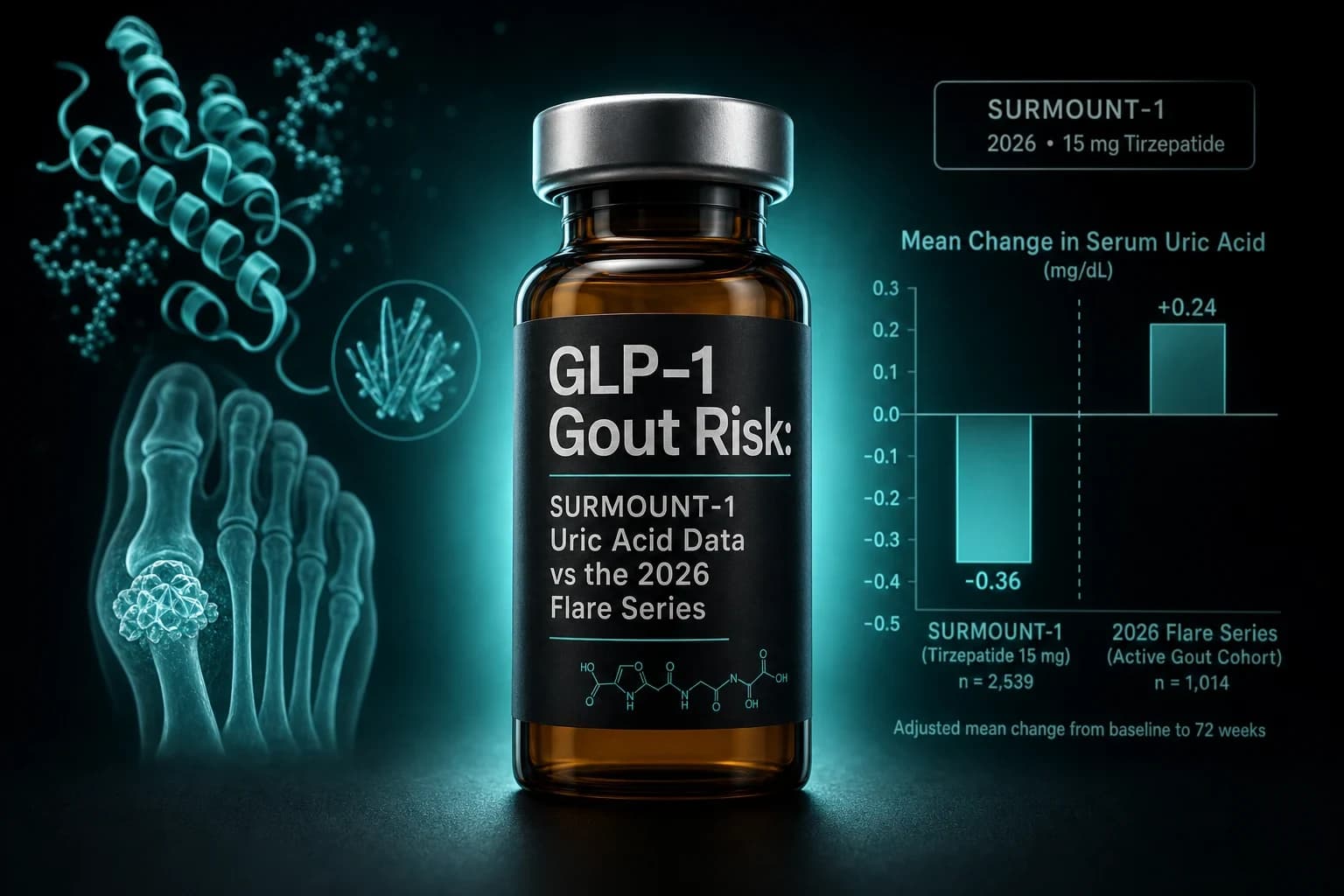
- SURMOUNT-1 post hoc (PMID 41198460) showed tirzepatide 15 mg cut serum uric acid by 0.95 mg/dL at 72 weeks; weight loss mediated 72.7% of the drop.
- Chaaya 2026 in AACE Endocrinology and Diabetes documented transient uric acid rises 3 to 5 months in for 3 of 4 patients on tirzepatide or semaglutide.
- Maglio 2017 SOS data (PMID 28076240) showed bariatric surgery cut incident gout by HR 0.60 over 19 years, with the same early-window flare pattern.
- Najafi 2022 (PMID 35384008) pooled 24 GLP-1 RA trials; the SUA reduction was real, modest, and largely weight-mediated.
- Liu 2024 network meta-analysis (PMID 38796335) found GLP-1 RAs neutral on incident gout in CVOTs; SGLT2 inhibitors were the protective class.
The cleanest result in the GLP-1 uric acid literature came out of the SURMOUNT-1 post hoc analysis published in November 2025. Tirzepatide 15 mg lowered serum uric acid by 0.95 mg/dL at 72 weeks, mediation analysis attributed 72.7 percent of that drop to weight loss, and the effect held across baseline BMI and baseline uric acid strata. Six months later, a four-patient case series in AACE Endocrinology and Diabetes documented the opposite pattern: uric acid rose 3 to 5 months into therapy, two patients had acute gout flares, and one of those flares happened with a normal serum uric acid on urate-lowering therapy. The trial data and the clinical data are not contradicting each other. They are describing different parts of the same time curve.
This article walks through the 2022 to 2026 evidence base in order, lines up what tirzepatide and semaglutide actually do to uric acid kinetics, compares the result to two decades of bariatric surgery follow-up that confronted the same problem, and ends with a monitoring framework for clinicians and patients who want to know whether starting Ozempic, Wegovy, Mounjaro, or Zepbound is going to flare their gout.
Bottom line: Long-term GLP-1 use lowers serum uric acid and reduces gout incidence, primarily through sustained weight loss. The transient signal in the first 3 to 5 months reflects rapid catabolism rather than the drugs themselves, the same pattern bariatric surgery patients showed in the Maglio and Yeo data. Patients with prior gout or hyperuricemia should expect a slow titration, baseline labs, and either continued or initiated urate-lowering therapy during the early ramp.
Why obesity raises gout risk in the first place
The connection between adiposity and gout is one of the most stable findings in epidemiology. Choi et al. (2005) followed 47,150 men in the Health Professionals Follow-up Study for 12 years. Compared to BMI of 21 to 22.9, men with BMI of 25 to 29.9 had a relative risk of 1.95 for incident gout. BMI of 30 to 34.9 took it to 2.33. BMI of 35 or higher pushed it to 2.97. Choi 2005 also showed that men who gained more than 30 pounds since age 21 had a relative risk of 1.99 for incident gout versus weight-stable peers. The signal runs in both directions: gain weight, raise gout risk; lose weight, drop it.
Mechanistically, three pathways do most of the work. Visceral adipose tissue is metabolically active and contributes to insulin resistance, which lowers renal uric acid excretion. Excess adiposity raises serum xanthine oxidase activity, which generates uric acid from purine breakdown. And obesity-driven inflammation primes the NLRP3 inflammasome, lowering the threshold for a monosodium urate crystal deposit to actually trigger a flare. Treat the obesity and all three pathways improve. That is the theoretical case for using a GLP-1 receptor agonist in a patient who has both obesity and gout.
What SURMOUNT-1 showed at 72 weeks
The SURMOUNT-1 trial (NCT04184622) randomized 2,539 adults with BMI of 30 or higher (or 27 with at least one weight-related complication) to placebo or tirzepatide at 5, 10, or 15 mg subcutaneously once weekly. The primary readouts on weight were published in 2022 in the New England Journal of Medicine. The post hoc uric acid analysis (SURMOUNT-1 uric acid, 2025, PMID 41198460) pulled the secondary metabolic labs and asked one question: did the weight loss translate into measurable changes in serum uric acid, and if so, was the molecule itself doing anything beyond what the weight loss alone explained?
Mean baseline serum uric acid was 5.45 mg/dL across the cohort. At 72 weeks:
- Placebo: mean change of negative 0.18 mg/dL
- Tirzepatide 5 mg: negative 0.69 mg/dL
- Tirzepatide 10 mg: negative 0.92 mg/dL
- Tirzepatide 15 mg: negative 0.95 mg/dL (all P less than 0.001 vs placebo)
The clinically interesting number was the mediation result. The authors decomposed the SUA drop into a weight-mediated effect and a direct effect of tirzepatide independent of weight change. Weight reduction explained 72.7 percent of the total uric acid drop. The remaining 27.3 percent was small, statistically present, and consistent with mechanistic data on GIP and GLP-1 signaling at the renal proximal tubule. The clean read on this trial: tirzepatide is a uric acid lowering agent, but most of the lowering is what would have happened with any equivalent weight loss intervention.
The 2026 case series and what it actually documented
In April 2026, Chaaya et al. published a four-patient case series in AACE Endocrinology and Diabetes. Three of four patients showed a consistent rise in uric acid within 3 to 5 months of starting tirzepatide or semaglutide, irrespective of baseline uric acid status. Two patients had acute gout attacks during the ramp. One of those patients had a normal serum uric acid at the time of the flare and was already on urate-lowering therapy with recurrent episodes despite that coverage. The series is small. It is not population-level evidence and cannot estimate incidence. What it documents is a pattern: rapid weight loss can transiently elevate uric acid and provoke flares in the early months even when the long-term trajectory is favorable.
The mechanism is the same one that drives the early-flare problem after starting a low-purine restrictive diet, after the keto adaptation phase, or after bariatric surgery. Rapid catabolism breaks down adipose tissue, releases nucleotides into circulation, and increases purine turnover. The renal tubule cannot clear the bolus quickly, and serum uric acid rises for weeks to a few months before the new lower steady state kicks in. A secondary mechanism is ketosis-driven competitive inhibition of renal urate excretion, the same effect seen in fasting states and ketogenic diets. Patients with crystal deposits already in the joints are the most likely to flare during that window, because the inflammatory threshold for a crystal-driven attack is sensitive to fluxes in serum uric acid in either direction, independent of the absolute level.
Tip: A flare during the first three months on a GLP-1 receptor agonist does not mean the drug is causing gout in any chronic sense. It almost always means the patient had latent monosodium urate crystals in the joint, the rapid catabolic state perturbed steady-state uric acid, and the flare unmasked existing disease. The long-term trajectory still favors fewer flares once weight loss stabilizes.
What two decades of bariatric surgery data say
The same problem played out in the bariatric surgery literature from 2010 onward. The data are useful here because the magnitude of weight loss and the catabolic kinetics overlap with what tirzepatide produces over 72 weeks.
The Swedish Obese Subjects (SOS) study followed 1,982 surgical patients and 1,999 matched controls for a median of 19 years. None had gout at baseline. Maglio 2017 reported an adjusted hazard ratio of 0.60 (95 percent CI 0.48 to 0.75) for incident gout in the surgery arm. The number needed to treat to prevent one incident case of gout at 15 years was 32. Hyperuricemia incidence dropped even harder, HR 0.47 (95 percent CI 0.39 to 0.58).
Yeo 2019 pulled this together in a meta-analysis of 20 studies and 5,233 patients. Subgroup analysis showed mean serum uric acid decrease of 0.73 mg/dL by the third postoperative month and 1.91 mg/dL by year three. The signal got stronger with longer follow-up. Linear meta-regression confirmed that proportionate change in BMI predicted proportionate change in uric acid.
The catch is what happened in the first month. Earlier cohorts confirmed a transient hyperuricemia spike during weeks 1 to 4 driven by acute catabolism. Studies of post-bariatric gout flares put the early flare incidence at 17.5 percent in the first month after surgery compared to 1.8 percent in matched nonsurgical controls. The pattern is identical to what Chaaya saw on tirzepatide and semaglutide. Different intervention, same catabolic time curve.
What the meta-analyses say across the GLP-1 class
Najafi 2022, Br J Clin Pharmacol, pooled 24 randomized controlled trials of GLP-1 RAs in patients with or without type 2 diabetes. The pooled mean difference in serum uric acid versus comparator was a small but statistically meaningful reduction. The effect was heterogeneous across studies, larger for trials with greater weight loss, and consistent with the SURMOUNT-1 mediation read: most of the effect was indirect, mediated by weight reduction rather than a direct uricosuric or urate-lowering action of the molecule.
Liu 2024 ran a network meta-analysis of the major cardiovascular outcomes trials of newer glucose-lowering drugs. The endpoint was incident gout. GLP-1 RAs and DPP-4 inhibitors were neutral on incident gout. SGLT2 inhibitors were significantly protective. The clean read: at the population scale and over the multi-year follow-up of CVOT-style trials, GLP-1 RAs do not appear to either cause or prevent gout, while SGLT2 inhibitors clearly do prevent it.
The neutrality finding from Liu 2024 should be read with care. CVOTs enrolled mostly type 2 diabetes patients with established cardiovascular disease, not the obesity-driven cohorts in SURMOUNT. The weight loss magnitudes in the included GLP-1 trials were smaller. Whether a 20 percent body weight reduction over 72 weeks moves the gout endpoint at the same scale as SGLT2 inhibitors is a question the meta-analysis was not powered to answer.
Wei 2024, Arthritis & Rheumatology, used a UK primary care cohort (THIN) to test the dose-response between weight loss rate on orlistat and gout outcomes. In 131,000 patients without baseline gout, fast weight loss (10 percent or more in year one) was associated with lower incident gout risk versus weight-stable patients. In 3,847 patients with established gout, fast weight loss was associated with fewer recurrent flares. Orlistat is not a GLP-1, but the analysis is the cleanest population test of the question "does intentional pharmacological weight loss reduce gout risk," and the answer was yes.
How GLP-1s differ from SGLT2 inhibitors on uric acid
This matters because clinicians often need to decide which class to add when both are reasonable. SGLT2 inhibitors increase urinary uric acid excretion through the URAT1 and GLUT9 transporters in the proximal tubule. The mechanism is direct, dose-dependent, and shows up in the first week of therapy. GLP-1 RAs lower uric acid mostly through weight reduction, with a smaller direct effect that may be linked to GIP signaling for tirzepatide specifically. The time course is months, not days.
| Class feature | SGLT2 inhibitors | GLP-1 / GIP receptor agonists |
|---|---|---|
| Mechanism on uric acid | Direct uricosuric via URAT1/GLUT9 | Mostly weight-mediated, small direct component |
| Time to effect | Days to weeks | 3 to 18 months |
| Effect on incident gout (CVOT meta) | Significantly reduced (Liu 2024) | Neutral (Liu 2024) |
| Early-phase flare risk | Low | Real but transient (months 1 to 5) |
| Long-term SUA reduction | Modest, sustained | Larger when weight loss is sustained |
| Best evidence in dedicated trials | EMPA-REG, CANVAS, DECLARE | SURMOUNT-1 post hoc, Maglio SOS analog |
A patient with diabetes, obesity, and gout will likely get more uric acid benefit from adding an SGLT2 inhibitor to whatever weight loss strategy they are running than from a GLP-1 RA alone. A patient with obesity and gout but no diabetes does not have an SGLT2 indication, and the GLP-1 path is the cleaner option, with the caveat that the first three to five months need a flare plan.
What the data says about who flares and when
Putting the SURMOUNT-1, Chaaya, Maglio, Yeo, Najafi, Liu, and Wei findings on the same timeline:
| Time point | Effect on serum uric acid | Effect on gout flares | Evidence base |
|---|---|---|---|
| Weeks 0 to 4 | Mild rise possible | Slight increase, especially with prior gout | Bariatric surgery analog; Chaaya case series |
| Months 1 to 5 | Variable, sometimes rising | Transient flare risk above baseline | Chaaya 2026 case series |
| Months 6 to 12 | Net decline begins | Returns toward baseline | SURMOUNT-1 post hoc; Yeo subgroup |
| Months 12 to 24 | Sustained decline of about 0.7 to 1.0 mg/dL | Below baseline | SURMOUNT-1; Maglio SOS |
| Years 2 to 19 | Sustained decline | Lower lifetime incidence (HR 0.60) | Maglio 2017 SOS |
The two highest-risk groups based on these data:
- Patients with prior gout or active hyperuricemia who start at the maximum titration speed without baseline urate-lowering therapy in place.
- Patients on rapid weight loss strategies who lose 10 percent or more body weight in the first 90 days.
Neither group needs to avoid GLP-1 RAs. Both need a flare-prevention plan that mirrors what rheumatologists do for bariatric surgery candidates: baseline serum uric acid, urate-lowering therapy continued or initiated at the standard ramp, prophylactic colchicine through the active titration window per the 2020 ACR gout guidelines, and uric acid recheck at month one and month three.
Warning: A patient with prior gout, hyperuricemia, or CKD who starts a GLP-1 receptor agonist without baseline labs and a flare-prevention plan is reproducing the exact early-bariatric-surgery error pattern from the 2000s, before the post-bariatric urate-lowering protocols were standardized. The literature already solved this problem in one population. The same playbook applies to GLP-1 titration.
What this means practically
The honest version of the SURMOUNT-1, Chaaya, Maglio, Yeo, Najafi, Liu, and Wei synthesis: the molecule is not the problem. The catabolism is. Anyone losing weight rapidly through any mechanism has the same gout-flare exposure window. GLP-1 receptor agonists happen to be the most effective weight loss tool currently available outside of bariatric surgery, so they trigger this issue at scale for the first time in a population that includes a lot of people with subclinical hyperuricemia or undiagnosed gout.
The right framing is not "does Ozempic cause gout." The right framing is "rapid weight loss has a known transient hyperuricemia window in the first 3 to 5 months, and any tool capable of producing that weight loss needs to be paired with the rheumatology playbook that bariatric surgery already established." Tirzepatide, semaglutide, retatrutide, and the upcoming amylin and GIP-related compounds are all subject to the same kinetics.
For research-use peptides, the catabolic mechanism applies whether the user is running semaglutide or tirzepatide. The reconstitution calculator handles the dose math but does not change the catabolic window. The GLP-1 muscle loss research discusses the same early catabolic phase from a different angle. The stopping GLP-1s withdrawal evidence is the inverse problem: weight regain comes with rebounding uric acid trajectories on a compressed time scale.
For injectable reference vials of semaglutide and tirzepatide, Ascension Peptides applies code ENHANCED for 50 percent off. For the oral route, Limitless Biotech carries research-use oral GLP-1 peptides with code ENHANCED.
What is still unknown
Five questions the literature has not yet answered:
- Is there a tirzepatide-specific direct effect on uric acid beyond what the SURMOUNT-1 mediation analysis showed? GIP signaling at the proximal tubule is plausible. No clean human mechanistic study has isolated the direct effect.
- Does dual GLP-1/glucagon agonism (survodutide, mazdutide, pemvidutide) produce a different uric acid trajectory than pure GLP-1 or GLP-1/GIP combinations? Glucagon agonism is catabolic and may increase the early uric acid bolus.
- What is the true incidence of transient hyperuricemia and gout flares in the SURMOUNT, STEP, and REDEFINE populations when uric acid is measured monthly rather than at the trial endpoints? The case series suggests this signal is being missed in trial design.
- Does prophylactic urate-lowering therapy with allopurinol or febuxostat blunt the early flare risk for patients starting a GLP-1 RA, as it does for bariatric surgery candidates? No prospective trial has tested this.
- Does the slower titration schedule used in older patients (5 mg tirzepatide for 12 weeks before any dose increase) reduce the catabolic bolus and flatten the uric acid curve relative to the standard 4-week ramp?
The Najafi meta-analysis, the SURMOUNT-1 post hoc, and the Liu network analysis settled the long-term direction. The Chaaya case series flagged the short-term window. The work between those two points has not yet been done.
Related coverage
- GLP-1 pancreatitis risk evidence
- GLP-1 cancer risk meta-analysis
- GLP-1 muscle loss research
- GLP-1 bone density and fracture risk
- Semaglutide FLOW trial CKD evidence
- Stopping GLP-1s withdrawal trials
- Tirzepatide vs semaglutide SURMOUNT-5
- Semaglutide for knee osteoarthritis STEP 9
This article is for educational and research purposes only and is not medical advice. No GLP-1 receptor agonist is FDA-approved for the treatment, prevention, or management of gout, hyperuricemia, or any rheumatic condition. The case series, post hoc analyses, and meta-analyses summarized above are not equivalent to a dedicated prospective trial of GLP-1 receptor agonists for gout outcomes, and generalizing the findings to any individual clinical decision should be done with a rheumatologist or qualified prescribing clinician. Patients with prior gout, active hyperuricemia, or chronic kidney disease who are considering starting semaglutide, tirzepatide, or any related compound should have baseline labs and a flare-prevention plan in place before titration begins, including consideration of continued or initiated urate-lowering therapy and prophylactic colchicine per the 2020 ACR gout guidelines. Do not start, switch, or self-source any GLP-1 receptor agonist on the basis of this article. Consult a qualified clinician about your individual circumstances before acting on any information here.