At a glance
- Roughly 15 to 40% of bariatric patients experience weight regain within 5 years; about 1 in 7 start a GLP-1 to address it
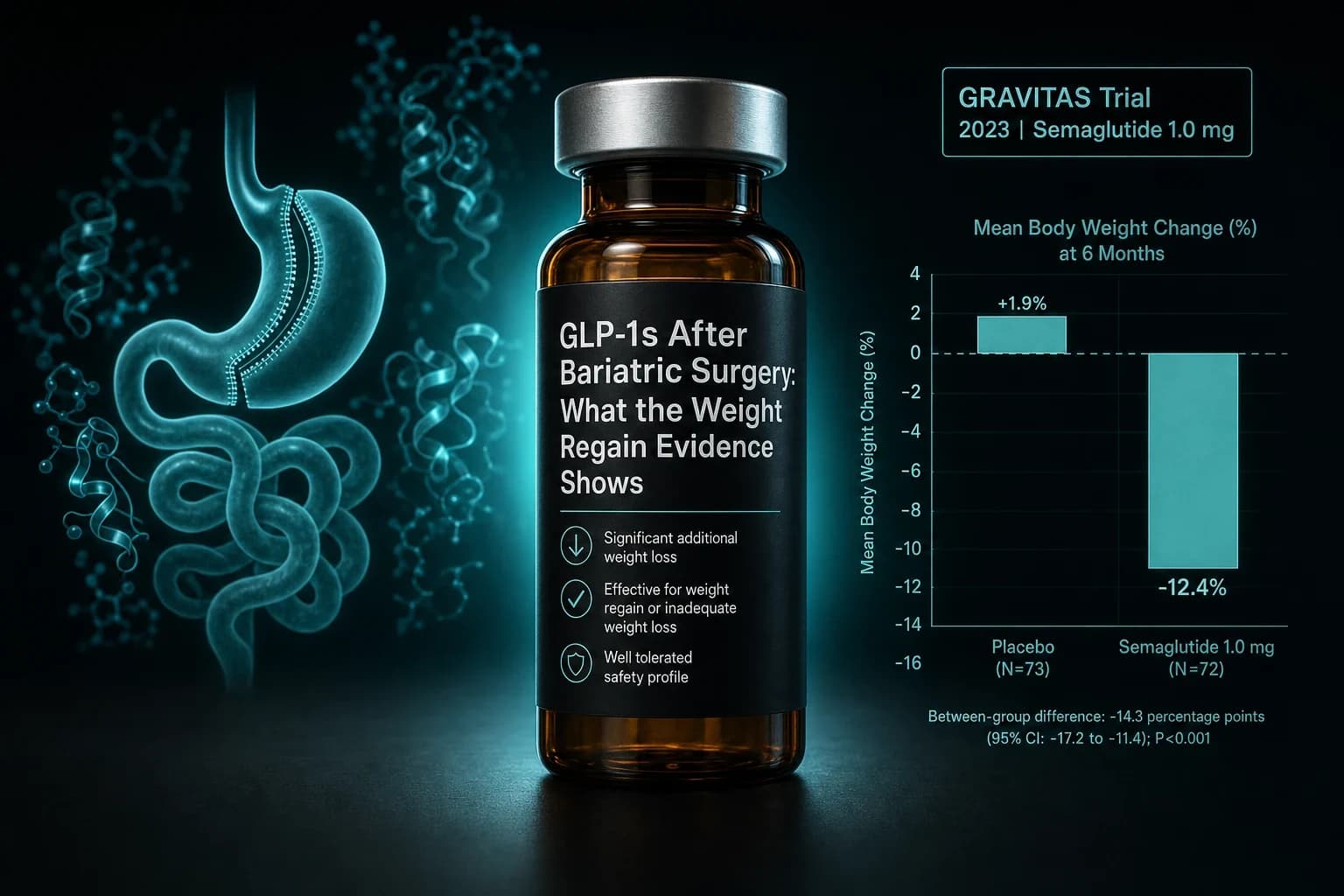
- Liraglutide 3.0 mg produced statistically significant extra weight loss vs placebo at 56 weeks in the Lofton 2024 RCT (n=132 post-RYGB)
- Retrospective semaglutide cohorts show 10 to 13% total weight loss at 6 to 12 months in post-bariatric patients
- Tirzepatide cohorts suggest larger effects than semaglutide in this population, with no head-to-head RCT to confirm
- Esparham 2024 meta-analysis (19 studies) confirms class-wide weight loss with safety profiles consistent with non-surgical GLP-1 use
What the post-bariatric weight regain literature actually says
Roughly 15 to 40% of bariatric surgery patients regain a clinically significant fraction of their lost weight within five years, depending on how "regain" is defined and which procedure they had. That is the patient population walking into endocrinology and obesity-medicine clinics now asking whether semaglutide, tirzepatide, or liraglutide will do anything for them. The honest answer is that the evidence is real but uneven: one well-run randomized trial, several retrospective cohorts, a couple of meta-analyses, and a lot of clinician opinion filling the gaps between them.
This article walks through what the published post-bariatric data actually show, drug by drug, with the trial designs and effect sizes intact. The goal is to let researchers, patients, and prescribers see the shape of the evidence before deciding what to do with it.
Bottom line: Liraglutide 3.0 mg has the only randomized placebo-controlled trial in post-bariatric weight regain (Lofton et al., Surg Obes Relat Dis 2025, PMID 39401933). Semaglutide and tirzepatide evidence is retrospective but consistent. The class effect is real in this population; the head-to-head ranking is not yet settled.
How common weight regain after bariatric surgery actually is
The first thing to settle is the denominator. The cited prevalence of post-bariatric weight regain varies because the literature uses several definitions: nadir-to-current weight regain in kilograms, percent of maximum weight lost regained back, return of percent excess weight loss below a threshold, and others. The Esparham 2024 systematic review pooled 19 studies and reported that 15 to 40% of post-bariatric patients meet some version of clinically significant weight regain or insufficient weight loss (Esparham et al., Obesity Reviews 2024, PMID 39134066).
Procedure type matters. Sleeve gastrectomy carries higher long-term weight-regain rates than Roux-en-Y gastric bypass in most cohorts, and adjustable gastric banding has the highest failure rate of the three. Time since surgery matters too: nadir weight typically falls 12 to 24 months postoperatively, with regain trajectories diverging from there. By the five-year mark, the cohort of patients who regained at least 10% of their nadir weight is large enough to make pharmacotherapy a routine clinical question, not an edge case.
The downstream prescribing data tells the rest of the story. In a 2024 US cohort analysis of approximately 113,000 adults who underwent bariatric surgery between 2015 and 2023, about 1 in 7 started a GLP-1 receptor agonist after their procedure. That share has been climbing as semaglutide and tirzepatide entered the obesity indication.
Why weight comes back, mechanistically
The conventional bariatric explanation centered on stomach pouch dilation, stoma widening, and "stretching" of the restrictive component over time. That picture is incomplete. The more important post-bariatric biology runs through gut hormones, including endogenous GLP-1, peptide YY (PYY), and ghrelin.
Sleeve gastrectomy and Roux-en-Y both increase postprandial GLP-1 and PYY immediately after surgery, and decrease fasting ghrelin in the sleeve population. Those changes correlate with appetite suppression and contribute to early weight loss in a way that goes beyond stomach mechanics. Over years, those hormonal shifts can attenuate. A 2024 International Journal of Obesity cohort analysis on post-bariatric weight regain reported that lower endogenous GLP-1 secretion at follow-up correlated with greater weight regain, providing a mechanistic rationale for exogenous GLP-1 receptor agonism in this population.
That biology is the underlying argument for adding a GLP-1 medication after bariatric surgery. The drug reinforces a satiety axis that contributed to the early surgical response and that may have weakened over time. The clinical evidence below tests whether that argument holds up.
The one randomized trial: liraglutide in post-RYGB weight regain
The strongest single piece of evidence in this space is the Lofton et al. 2024 to 2025 trial published in Surgery for Obesity and Related Diseases (Lofton et al., Surg Obes Relat Dis 2025, PMID 39401933). It is the only randomized, double-blind, placebo-controlled trial of a GLP-1 receptor agonist in adults with documented post-bariatric weight regain.
Design specifics worth knowing:
- Population: 132 adults 18 to 120 months post-Roux-en-Y gastric bypass who had achieved at least 25% total body weight loss after surgery and regained at least 10% from their nadir
- Randomization: 2:1 to liraglutide 3.0 mg (n=89) versus placebo (n=43), plus lifestyle counseling in both arms
- Duration: 56 weeks
- Setting: NYU Grossman School of Medicine and partner sites
Liraglutide-arm participants lost statistically and clinically significantly more weight than placebo, with a treatment difference in the 5 to 8 percentage point range at week 56. Serious adverse events were not increased over placebo. Gastrointestinal side effects were the dominant nuisance, concentrated during titration.
What the trial does and does not establish:
- Establishes: liraglutide 3.0 mg outperforms lifestyle alone in a well-defined post-RYGB weight-regain population
- Does not establish: durability past 56 weeks, comparison to higher-efficacy GLP-1s like semaglutide 2.4 mg or tirzepatide 15 mg, applicability to sleeve gastrectomy patients
Semaglutide after bariatric surgery: the retrospective story
There is no randomized trial of semaglutide 2.4 mg in a defined post-bariatric weight-regain population. What exists is a stack of retrospective cohorts that, taken together, draw a consistent picture.
The Lautenbach et al. 2022 retrospective in Obesity Surgery was the first published cohort in non-diabetic post-bariatric patients on semaglutide (Lautenbach et al., Obes Surg 2022, PMID 35879524). Forty-four adults with weight regain or insufficient weight loss after bariatric surgery received semaglutide 1.0 mg weekly (a type 2 diabetes dose, not the obesity dose of 2.4 mg). Mean total weight loss was 6.0% at 3 months and 10.3% at 6 months. That effect size sits between the 5 to 7% range expected from lifestyle intervention and the 13 to 15% range seen at full-dose semaglutide in STEP.
A larger 2023 retrospective from UT Southwestern published in Obesity included 207 adults with post-bariatric weight recurrence treated with semaglutide 1.0 mg weekly (n=115) or liraglutide 3.0 mg daily (n=92) from 2015 to 2021. After 12 months, semaglutide arms had significantly higher rates of achieving more than 10% and more than 15% weight loss than liraglutide arms, with sleeve gastrectomy and Roux-en-Y patients both responding (Murvelashvili et al., Obesity 2023, 31(5):1280-1289, DOI 10.1002/oby.23736).
A 2025 cohort titled "Effectiveness of Adjuvant Semaglutide Following Bariatric Metabolic Surgery" extended the picture to a larger sample and confirmed mean total weight loss in the 10 to 13% range across 6 to 12 months. Procedure type did not strongly predict response.
The semaglutide picture is honest: real weight loss, smaller effect size than the STEP 1 obesity-population number (14.9%), and entirely retrospective. The 2.4 mg dose in this population has not been formally tested.
Tirzepatide after bariatric surgery: less data, larger effect size
Tirzepatide has even less published evidence in this population than semaglutide, but what exists points to a larger effect. The 2025 retrospective titled "Tackling suboptimal clinical response after metabolic bariatric surgery: Impact of tirzepatide on weight loss and body composition" (PMID 39952885) reported significant total body weight loss and improvements in body composition in post-MBS patients started on tirzepatide for insufficient response or weight regain. Effect sizes ran higher than the comparable semaglutide cohorts, consistent with what the SURMOUNT vs STEP head-to-heads have shown in non-surgical patients.
A 2025 single-center retrospective comparing semaglutide and tirzepatide for weight recurrence after sleeve gastrectomy reported numerically larger weight loss with tirzepatide. The 2025 Effects of Semaglutide and Tirzepatide on Recurrent Weight Gain meta-analysis combining eight retrospective studies and 964 patients found total weight loss of approximately 11% with semaglutide and 13.6% with tirzepatide in this specific population, with the tirzepatide point estimate higher but the confidence intervals overlapping.
What the tirzepatide evidence does not establish: no randomized trial, no fixed comparator, dose distributions across the cohorts are heterogeneous. The most defensible reading is that tirzepatide produces at least as much weight loss as semaglutide in post-bariatric patients, with a plausible numerical advantage that has not been settled in a controlled comparison.
Head-to-head: where the class lines up in this population
The published evidence supports the following ranking with appropriate caveats:
| Drug | Best published evidence in post-bariatric population | Mean total weight loss | Evidence grade |
|---|---|---|---|
| Liraglutide 3.0 mg | Lofton et al. 2024 RCT, n=132, 56 weeks | 5 to 8% above placebo | Randomized, single trial |
| Semaglutide 1.0 to 2.4 mg | Lautenbach 2022 (n=44), Murvelashvili 2023 (n=115), 2025 cohorts | 10 to 13% at 6 to 12 months | Retrospective, multiple cohorts |
| Tirzepatide 5 to 15 mg | 2025 cohorts and meta-analysis (n=964 pooled) | 12 to 15% at 6 to 12 months | Retrospective only |
A few interpretive notes belong with the table. First, the liraglutide RCT used the obesity dose (3.0 mg) while most of the semaglutide cohorts used the type 2 diabetes dose (1.0 mg). A direct semaglutide 2.4 mg comparison would likely show larger separation from liraglutide than the cohorts suggest. Second, head-to-head trials in the non-surgical obesity population (SURMOUNT-5 for tirzepatide vs semaglutide 2.4 mg) have not been replicated in the post-bariatric population, so the SURMOUNT-5 ranking is an extrapolation here. Third, all three drugs have produced acceptable safety profiles in the post-bariatric population, with the same GI side effects that dominate in non-surgical use.
For a head-to-head review of tirzepatide and semaglutide in non-surgical patients that informs class-level reasoning here, see our SURMOUNT-5 head-to-head evidence review.
What the meta-analyses actually show
Two meta-analyses give the cleanest summary view of the field as of mid-2026.
The Esparham et al. 2024 Obesity Reviews meta-analysis pooled 19 studies on GLP-1 receptor agonists in patients with weight regain or insufficient weight loss after metabolic bariatric surgery (Esparham et al., Obes Rev 2024, PMID 39134066). Class-level results showed clinically meaningful weight loss, with the liraglutide and semaglutide arms producing roughly 15 to 17% percent change from baseline in pooled analyses, a number that runs higher than individual retrospectives because the meta-analysis included intervention durations of 12 months or longer.
A 2025 systematic review and meta-analysis specifically on weight recurrence and suboptimal clinical response after MBS (PMID 40237975) reached compatible conclusions: GLP-1 receptor agonists produced significant weight loss in this population, with safety profiles consistent with non-surgical GLP-1 use. The 2025 Effects of Semaglutide and Tirzepatide on Recurrent Weight Gain after MBS systematic review and meta-analysis published in Obesity Surgery parsed the semaglutide-versus-tirzepatide question and reported the tirzepatide point estimate above semaglutide, with overlapping confidence intervals.
Note: Every meta-analysis in this space inherits the heterogeneity of the source studies. Doses, durations, surgery types, follow-up windows, and definitions of "weight regain" vary widely. The pooled estimates are useful as direction of effect; they are not equivalent to a placebo-controlled trial number.
Decision framework: when to consider GLP-1s after bariatric surgery
The published evidence supports the following decision logic. None of this is a substitute for individualized clinical judgment, and none of it constitutes medical advice.
- Patient is at least 6 to 12 months post-bariatric surgery and has reached nadir weight
- Lifestyle reinforcement (dietary review, activity, behavioral support, micronutrient labs) has been attempted or is being run in parallel
- Documented weight regain of at least 10% from nadir, or stalled below the expected total weight loss benchmark for their procedure
- No contraindication to GLP-1 therapy (medullary thyroid carcinoma history, MEN2, pancreatitis history, severe gastroparesis, pregnancy)
If those boxes are checked, the published evidence reads as follows. Liraglutide 3.0 mg has the only randomized data and is reasonable when access or insurance favors it. Semaglutide 2.4 mg is the most commonly used GLP-1 in this population and has the most retrospective cohort data behind it. Tirzepatide 10 to 15 mg has the strongest effect size in cohorts and is the natural choice when semaglutide tolerability or response is suboptimal.
For patients who tolerated lifestyle therapy and an initial GLP-1 trial but stalled, the same logic that drives non-surgical dose-escalation and switching applies. See our GLP-1 dosing comparison for the class-wide dosing context and the stopping-GLP-1 weight regain review for what to expect if therapy is discontinued.
Practical considerations beyond the trial data
A few factors the trial literature does not emphasize but that change real-world outcomes in post-bariatric patients.
Muscle preservation. Post-bariatric patients have already lost lean mass during their surgical weight-loss phase. Adding a GLP-1 medication on top of that history can compound lean-mass loss if resistance training and protein intake are not maintained. Our GLP-1 muscle loss review covers the lean-mass evidence and what to do about it.
Micronutrient status. Post-bariatric patients are at baseline risk for vitamin B12, iron, vitamin D, and calcium deficiencies. GLP-1-induced appetite suppression can worsen intake of nutrient-dense foods. Periodic micronutrient labs and structured supplementation should run in parallel.
GI tolerance. Patients post-sleeve or post-RYGB often have residual GI sensitivity. GLP-1 titration in this group can produce more nausea and reflux than in non-surgical patients. Slower titration, with an extra 4 weeks held at each step, is reasonable.
Pre-surgery GLP-1 use and aspiration risk. If bariatric or any major surgery is in the future, GLP-1 dosing requires a planned washout under the most recent ASA guidance. See our pre-surgery GLP-1 aspiration risk guide for the perioperative protocol.
Cost and access. Brand semaglutide and tirzepatide remain expensive without insurance coverage. Compounded versions exist but are under tighter FDA scrutiny in 2026 than they were in 2024. Reconstitution-based protocols require careful BAC water math; our reconstitution calculator handles the dose-by-volume conversion for the common vial sizes.
What this evidence does not tell us
Honest framing matters here. The post-bariatric GLP-1 literature has real gaps that no one should paper over.
- Only one randomized trial (Lofton 2024) exists in a defined post-bariatric weight-regain population
- No published head-to-head RCT of semaglutide versus liraglutide versus tirzepatide in this population
- Durability beyond 12 to 18 months is not established; the long-term maintenance question is open
- No evidence on whether starting a GLP-1 before nadir or after weight regain produces different long-term outcomes
- Pediatric post-bariatric GLP-1 use is unstudied in the published literature
- Health economic analyses on combination therapy (surgery plus chronic GLP-1) are mostly extrapolations
Those gaps bound the existing evidence rather than invalidating it. The case for GLP-1 therapy in post-bariatric weight regain rests on a single RCT, a coherent set of retrospective cohorts, and a sensible mechanistic story. That is enough to justify use in carefully selected patients. It is not enough to support the strong claims that sometimes appear in promotional content for either bariatric surgery or GLP-1 medications.
Sourcing options for researchers and patients
If you are pursuing GLP-1 therapy outside the standard prescribing channels for personal research, do so through reputable suppliers that publish certificates of analysis. Ascension Peptides covers the injectable side, including semaglutide and tirzepatide research vials, with code ENHANCED for 50% off. Limitless Biotech covers the oral and nasal side for compounds where those routes are relevant, with code ENHANCED. Neither path replaces a clinician-supervised program for patients post-bariatric.
For prescription pathways, the most established options include the obesity-medicine subspecialty clinics that follow major bariatric programs, telehealth platforms with weight-management focus, and the manufacturer direct-to-consumer programs. The compounded landscape has narrowed materially since the FDA's 2025 to 2026 enforcement updates.
This article is for educational and research purposes only and is not medical advice. Post-bariatric weight regain is a clinical situation that depends on procedure type, time since surgery, comorbidities, nutritional status, and patient goals. Semaglutide (Wegovy, Ozempic), liraglutide (Saxenda, Victoza), and tirzepatide (Zepbound, Mounjaro) are prescription medications regulated by the FDA and should be used under medical supervision. Off-label use, compounded versions, and self-directed dosing are outside the trial evidence reviewed here. Consult a qualified bariatric or obesity-medicine clinician before starting, switching, or stopping any GLP-1 therapy.