At a glance
- 150+ human subjects across three centers received kisspeptin with zero serious adverse events attributed to the drug (multi-trial summary).
- Injection-site reactions and transient flushing lead the acute profile; nausea and headache stay in single digits in most cohorts.
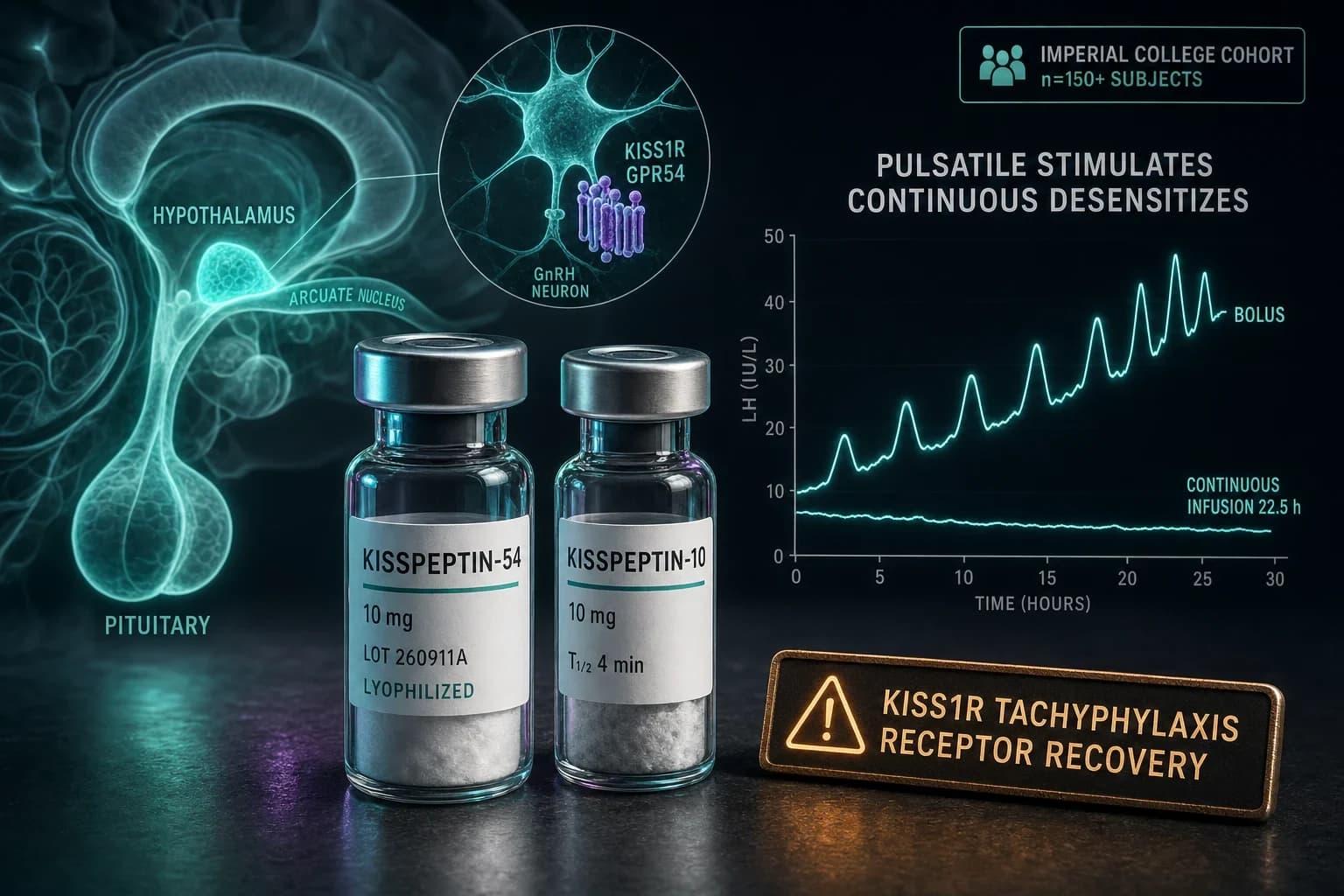
- The real 'side effect' is KISS1R tachyphylaxis: continuous exposure flattens LH output inside a day and can suppress the axis (Jayasena 2009 series).
- Kisspeptin-54 as an IVF trigger produced no OHSS in 60 high-risk women, versus 3 to 8% expected with hCG (Abbara 2015, PMID 26192876).
- The 56% penile rigidity rise in HSDD men came with no serious AEs across 32 subjects (Mills 2023, PMID 36735255).
Kisspeptin has been given to more than 150 human subjects across three university centers, in two isoforms, across doses that span four orders of magnitude, and no serious adverse event attributed to the drug has ever been published. That is a rare sentence in the research-peptide space, and it is the reason kisspeptin sits inside legitimate IVF clinical programs at Imperial College and Hammersmith Hospital rather than in gray-market forum threads alone.
The interesting question is not whether kisspeptin causes side effects. It is which side effects show up, at what rate, in which population, and whether the mechanism behind them is predictable. This page walks through the acute adverse-event profile from the Imperial College trials, splits kisspeptin-10 from kisspeptin-54 where the safety profiles diverge, and treats the one issue that matters most for a research protocol: KISS1R tachyphylaxis, the mechanism that turns kisspeptin from an LH stimulator into a suppressor inside a day of continuous exposure.
Bottom line: The acute profile is mild: injection-site reactions and transient flushing lead, headache and nausea stay in the single digits, blood pressure is not meaningfully affected, and no serious AEs are attributed to kisspeptin in any published trial. The safety issue worth respecting is tachyphylaxis. Continuous or over-frequent exposure desensitizes KISS1R within hours and flattens the LH response the peptide is supposed to produce.
The acute adverse event profile in numbers
Two features shape any read of the kisspeptin safety literature. First, most trials are small: n = 5 to n = 60 per arm, with the Imperial HSDD RCTs and the IVF trigger series clustered at n = 30 to n = 60. Second, they were designed to detect an LH signal, not to generate epidemiological AE rates. Rates from a single 32-subject crossover carry a wide confidence interval by definition. Treat the ranges below as directional.
| Adverse event | Typical rate range across trials | Notes |
|---|---|---|
| Injection-site reaction (SC) or infusion-site discomfort (IV) | 13 to 44% | Mild erythema, tenderness, transient bruising; usually resolves in 24 to 48 hours |
| Transient flushing | 5 to 20% | Vasomotor, minutes to a couple of hours; more visible after IV bolus |
| Headache | 5 to 11% | Mild, self-limited, more common in longer infusions |
| Nausea | 0 to 7% | Uncommon; sub-Q rates higher than IV in the hyperprolactinemia RCT |
| Fatigue | 0 to 10% | Reported mostly in longer IV infusions |
| Serious adverse event attributed to kisspeptin | 0 across published trials | Multi-center summary; the Imperial group and independent sites |
The rate of injection-site or infusion-site reactions is the one number the summary tables move around on, and the reason is dose form. Subcutaneous kisspeptin-54 at IVF-trigger doses (9.6 to 12.8 nmol/kg) leaves a small, sometimes tender bleb at the injection site in roughly 13 to 20% of participants. Intravenous continuous infusion in the hypothalamic amenorrhea and healthy-volunteer studies produces higher local rates because the cannula sits in place for many hours (Jayasena et al., J Clin Invest 2014, PMID 25036713; Abbara et al., JCEM 2015, PMID 26192876).
Two published safety statements set the ceiling on how alarmed a reader should be about acute AEs. The Comninos HSDD-women trial in 32 premenopausal women concluded that kisspeptin-54 modulated sexual brain processing with no serious adverse events reported (Comninos et al., JAMA Network Open 2022, PMID 36287566). The Mills HSDD-men trial in 32 men, which recorded the 56% penile rigidity signal that carries the sexual-function headlines, similarly reported no serious adverse events across the crossover (Mills et al., JAMA Network Open 2023, PMID 36735255).
Kisspeptin-10 vs kisspeptin-54: different half-lives, similar tolerability
The two forms sold in the research market are not pharmacokinetic equivalents, and the safety profile people ask about depends on which one is in the vial.
Kisspeptin-54 is the full parent peptide. Kisspeptin-10 is the C-terminal decapeptide that retains full KISS1R binding activity. Both trigger the same downstream LH and FSH pulse. The plasma half-lives differ by roughly a factor of seven: kisspeptin-10 clears in about 4 minutes, kisspeptin-54 clears in about 28 minutes. That is why the Imperial IVF program used kisspeptin-54 rather than kisspeptin-10 for oocyte triggering: a single subcutaneous injection produces a controlled LH surge over hours rather than minutes.
For acute tolerability, the difference is smaller than the pharmacokinetic gap would suggest. A head-to-head direct comparison of intravenous kisspeptin-10, kisspeptin-54, and GnRH in healthy men found that the two isoforms produced similar gonadotropin secretion at the tested doses, with the acute AE picture likewise similar between them; GnRH was more potent than either kisspeptin isoform on gonadotropin release at the doses studied (Jayasena et al., Hum Reprod 2015, PMID 26089302). The takeaway is that the isoform choice matters more for pharmacokinetics and protocol design than for acute safety.
The dose-response work in men clarifies where the safety envelope stops being flat. Kisspeptin-10 given as an intravenous bolus at 0.01 to 3.0 mcg/kg produced a rapid dose-dependent LH rise with maximum stimulation at roughly 1 mcg/kg; a 22.5-hour infusion at 4 mcg/kg/h maintained an LH signal and a measurable rise in testosterone (George et al., JCEM 2011, PMID 21632807). Nothing in that dose range produced blood-pressure or cardiovascular events; the acute AEs stayed inside the mild-flushing and injection-site cluster described above.
Tachyphylaxis is the real side effect
If a research protocol runs into a genuinely problematic side effect with kisspeptin, this is almost always the one. KISS1R desensitizes under continuous or over-frequent exposure. A single bolus produces a clean LH pulse. Sustained agonism, or dosing intervals shorter than the receptor's recovery window, does the opposite: LH output flattens and then falls below what an unstimulated baseline would produce.
The paradigm study is the Jayasena et al. (JCEM 2009, PMID 19820030) trial in women with hypothalamic amenorrhea. Acute subcutaneous kisspeptin-54 produced a 10-fold LH rise and a 2.5-fold FSH rise; the same peptide administered chronically for two weeks produced tachyphylaxis, and LH secretion collapsed toward pre-injection values. That is not a fringe finding. Follow-up work by the same group extended it: twice-weekly kisspeptin-54 over 8 weeks did continue to stimulate reproductive hormones, showing that the dosing interval, not the drug itself, drives the desensitization (Jayasena et al., Clin Pharmacol Ther 2010, PMID 20980998).
Two practical rules follow, both of which the vendor blogs rarely spell out.
- Pulsatile use stimulates. Continuous use suppresses. The kinetics are the opposite of the GnRH agonist pattern that drives medical castration with leuprolide. Kisspeptin does not need to be administered on a slow drip; a slow drip is exactly what turns it off.
- Interval matters more than dose. A dose that stimulates when given every 3 to 4 days may fail to stimulate when given every 12 hours, and both are safer than a dose given by continuous infusion for more than a few hours.
Note: Tachyphylaxis is why a "kisspeptin side effects" list that only names nausea and flushing misses the point. Continuous dosing does not typically cause an acute AE. It causes the drug to stop working, and in some protocols to actively suppress the axis it was meant to support.
Cardiovascular and metabolic effects
Kisspeptin does not raise blood pressure or heart rate meaningfully in trial populations. Ambulatory blood-pressure monitoring is not standard in this literature the way it is for melanocortin agonists like PT-141, and the reason is straightforward: there was no signal in early trials to justify the extra endpoint. The Imperial healthy-volunteer studies, the IVF dose-finding series, and the HSDD RCTs all recorded vital signs at intervals and none reported a sustained pressor or hypotensive effect at the doses studied. Small transient rises inside the placebo-comparator range appear in some trials, consistent with acute vasomotor flushing rather than a systemic cardiovascular effect.
Metabolic effects are similarly quiet at the doses used for LH stimulation. Kisspeptin does modulate appetite and glucose-stimulated insulin secretion in mechanism-of-action work, but the acute effect at trigger doses is small in humans. Controlled infusion of kisspeptin-54 at 1.0 nmol/kg/h in women with overweight or obesity did not change self-reported appetite or objectively measured food intake, and produced no adverse metabolic events (Izzi-Engbeaya et al., Diabetes Obes Metab 2023, DOI 10.1111/dom.15086). This is not a weight-loss indication and should not be interpreted as one; the practical takeaway is that a kisspeptin dose is not going to derail glucose homeostasis.
IVF triggering is where kisspeptin looks safer than the comparator
The most interesting kisspeptin safety story sits inside the IVF literature, and it runs in the opposite direction from the usual peptide framing. Human chorionic gonadotropin (hCG) is the standard oocyte-maturation trigger in IVF, and it carries a real, dose-related risk of ovarian hyperstimulation syndrome (OHSS): swelling, fluid shifts, and in severe cases hospitalization. The Imperial group tested kisspeptin-54 as a substitute trigger specifically in women at high risk of OHSS.
The 2015 Phase 2 open-label study enrolled 60 women at high risk of OHSS undergoing IVF; each received a single subcutaneous kisspeptin-54 injection at 3.2 to 12.8 nmol/kg. Oocyte maturation rates rose with dose (from about 45% at the lowest dose to 85% at the highest), 12 clinical pregnancies followed, and no woman developed moderate or severe OHSS (Abbara et al., JCEM 2015, PMID 26192876). The 2017 randomized controlled trial in 62 high-risk women compared a single kisspeptin-54 trigger to a two-dose protocol; oocyte maturation rates improved with the second dose, and again OHSS incidence remained low across both arms (Abbara et al., Hum Reprod 2017, PMID 28854728).
The safety picture is inverted for once: kisspeptin-54 is the safer trigger in an OHSS-risk population, precisely because its LH-releasing effect fades faster than hCG's and the ovaries stop being stimulated sooner. This is a narrow, protocol-specific advantage, and it applies only inside a monitored IVF cycle. It is not a general licensing argument for kisspeptin in the research market.
What acute dosing looks like in healthy adults
Two mechanism trials in healthy men give the cleanest picture of what a bolus of kisspeptin does to a person with an intact HPG axis.
The Comninos et al. (J Clin Invest 2017, PMID 28112678) fMRI study in 29 healthy men used an intravenous kisspeptin-54 infusion to record limbic and mood responses to sexual and couple-bonding cues. Acute AEs were mild and consistent with the infusion-site cluster; no participant discontinued for AE. The follow-up work by Yang et al. (JCI Insight 2020, PMID 32051344) extended the same protocol into attraction-cue fMRI without incremental safety concerns.
For men with hypoactive sexual desire disorder, the same infusion protocol produced the 56% penile rigidity increase over placebo that headlines the kisspeptin sexual-function literature, and did so without any serious adverse event across a 32-man crossover (Mills et al., JAMA Network Open 2023, PMID 36735255). The efficacy signal and the tolerability signal came out of the same infusion, which is why the study is cited on both fronts.
Comparing kisspeptin's acute tolerability to another on-demand sexual-health peptide is useful because it highlights how different the mechanisms are:
| Kisspeptin (bolus or short infusion) | PT-141 / bremelanotide (1.75 mg SC) | |
|---|---|---|
| Mechanism | KISS1R agonist, hypothalamic, upstream of GnRH | MC4R agonist, central sympathetic pathways |
| Peak AE (Phase-relevant trials) | Injection/infusion site reaction 13 to 44% | Nausea 40% |
| Flushing rate | 5 to 20%, mild | 20% |
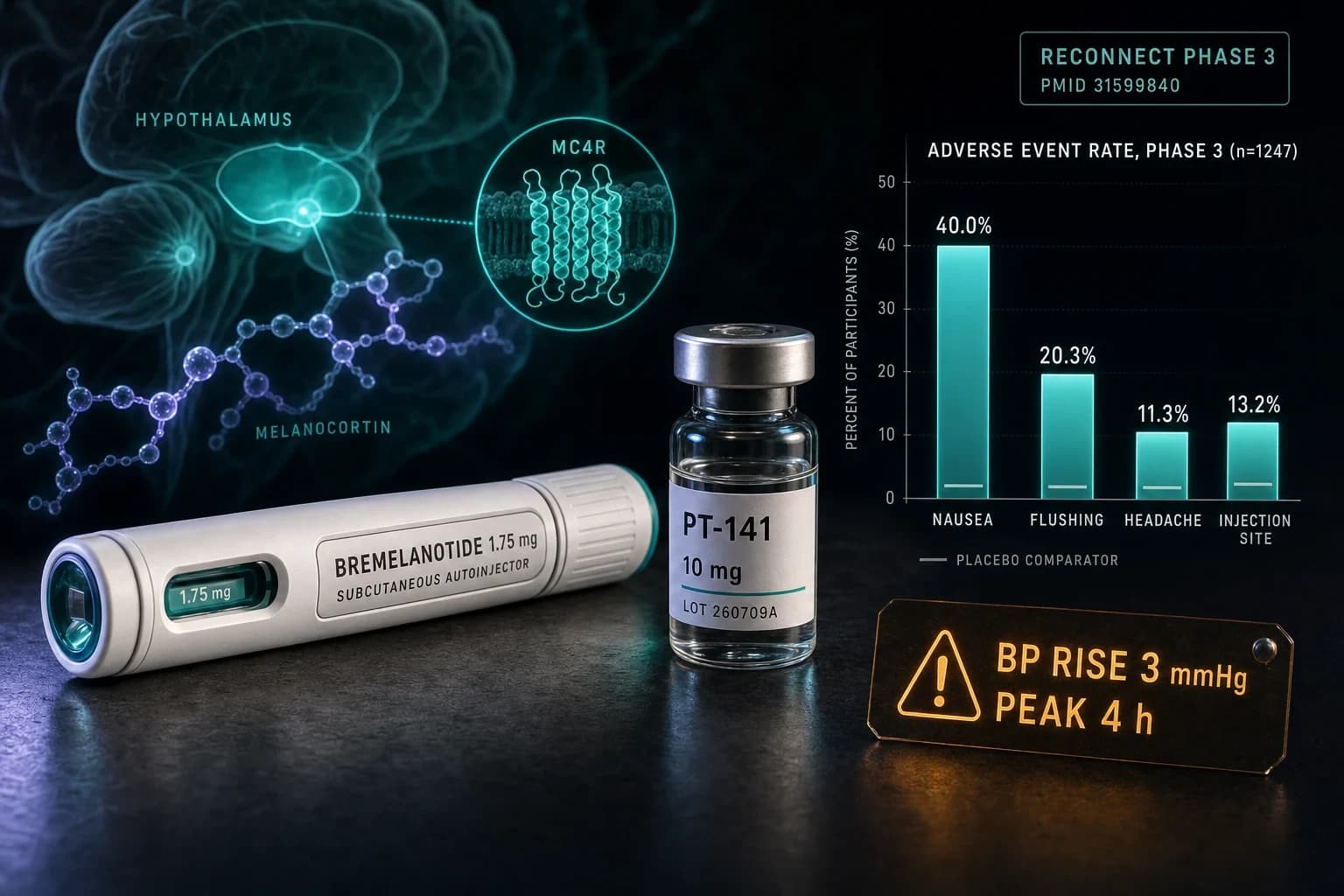
| Blood pressure | No meaningful effect at studied doses | Transient 3 mmHg rise, contraindicated in uncontrolled hypertension |
| Cosmetic risk | None documented | Focal hyperpigmentation at label frequency and higher |
| Serious AE rate | 0 across published trials | Similar to placebo, small |
The comparison is not about which is safer in the abstract; it is that the profiles do not overlap. A person who tolerated PT-141 poorly for melanocortin-driven nausea is asking a different question than one considering kisspeptin.
Contraindications and edge cases
No formal contraindication list exists for kisspeptin because no regulatory approval file exists for it. The trials define the exclusion criteria that a careful research protocol should mirror.
- Known active reproductive-hormone-sensitive cancer. Every kisspeptin trial excludes participants with active hormone-driven malignancy (breast, prostate) because an LH-driven testosterone or estrogen rise is undesirable in that setting.
- Pregnancy or lactation. No trial has administered kisspeptin during pregnancy outside the IVF-trigger indication, and general research use does not have a safety file to draw on.
- Continuous or high-frequency dosing. As above, the drug's own safety story breaks here. Dosing more often than the receptor's recovery window flattens the effect and can suppress the axis.
- Concomitant GnRH agonist or antagonist therapy. The peptide sits upstream of GnRH; layering it on top of leuprolide, cetrorelix, or degarelix produces mechanistically unpredictable results, and there is no controlled data to draw from.
- Unknown pituitary status. In hypopituitarism the LH-releasing effect will not appear. That is not a safety event, but it does invalidate the protocol.
Two practical items round out the list. First, kisspeptin is not sold as an FDA-approved product anywhere in the United States; research-market vials are for laboratory research only and do not carry a clinical indication. Second, the tachyphylaxis rule is dosing hygiene, not a warning label: the reason it is not printed on any vial is that no vial has a printed label reviewed by a regulator.
Sourcing and vial-side safety
Nothing in the trial literature above applies to a vial whose contents are not what the label claims. The kisspeptin research market includes both isoforms, and the price gap between kisspeptin-10 and kisspeptin-54 is large enough that mislabeling has a business model behind it.
The floor for a research-grade vial is a lot-matched Certificate of Analysis showing purity by HPLC and identity by mass spectrometry. The full mechanics of what a COA actually proves live in the Janoshik peptide testing walkthrough and the what is a peptide COA explainer. The lab-test library collects the underlying documentation that a serious vendor ships with each lot.
For sourcing itself, Ascension Peptides carries kisspeptin at 10 mg per vial with per-lot COAs and is the site's primary audited vendor, with 50% off using code ENHANCED. The kisspeptin dosage chart covers the subcutaneous math and reconstitution volumes that match the pulsatile-dosing framework the trials used. For the reconstitution itself, the reconstitution calculator does the mL-to-unit math and the how to reconstitute peptides guide covers aseptic technique.
Sourcing does not change kisspeptin's inherent safety profile, but it decides whether the profile in the vial matches the profile in the trials.
Frequently asked kisspeptin safety questions
Does kisspeptin raise blood pressure? Not meaningfully at trial doses. Ambulatory monitoring was not required in these programs because there was no signal to justify it. This is the opposite of PT-141, whose blood-pressure effect shaped its label.
Is kisspeptin-54 safer than kisspeptin-10? Not in a way that shows up in the acute AE profile. Kisspeptin-54's longer half-life is a pharmacokinetic feature, not a safety one; both isoforms sit inside the same mild-tolerability cluster at the doses studied.
Can continuous dosing be titrated up to overcome tachyphylaxis? No. Continuous exposure is the mechanism that produces the desensitization; raising the dose accelerates it rather than compensates for it. The fix is a longer interval, not a bigger dose.
Is kisspeptin safe in men with hormone-sensitive cancer? Trials exclude that population, and general research use should mirror the exclusion. The LH-driven testosterone rise is undesirable in that setting.
How does the IVF safety picture apply outside IVF? It does not, directly. The kisspeptin-versus-hCG advantage in OHSS depends on ovarian stimulation being the primary risk pathway; that framing is not relevant to a healthy male research protocol.
Should injection-site reactions worsen with continued use? They typically do not. Rates in the trials stayed stable across successive doses in the same subject, and rotating sites is the standard mitigation the reconstitution guide already covers.
What about kisspeptin for children with delayed puberty? Kisspeptin has been used diagnostically in that population under trial conditions to distinguish constitutional delay from congenital hypogonadotropic hypogonadism; the safety profile mirrored the adult data. This is a diagnostic use in academic settings, not a therapeutic one.
What to do next
If you were searching for a kisspeptin side-effect list to decide whether to run a protocol, the honest read is that the acute cluster is small and predictable, the mechanism does not produce cardiovascular or hyperpigmentation risks the way melanocortin agonists can, and the one issue that changes protocol design is tachyphylaxis. Interval matters more than dose. Continuous exposure suppresses the axis rather than stimulates it.
The best next reads on this site are the kisspeptin libido, fertility, and HPG axis research review for the efficacy picture, the kisspeptin dosage chart for the subcutaneous math, and the reconstitution calculator for the mL-to-unit conversion. If sourcing is the next question, the Ascension Peptides review and the lab-test library are the two references built for that decision.
This article is for research and educational purposes only. Kisspeptin is not FDA-approved for any human indication in the United States; research-grade vials are sold for laboratory research and are not intended for human use. Cited PubMed studies are peer-reviewed publications linked inline. Nothing in this article is medical advice; specific dosing, monitoring, and safety decisions should be made by a licensed practitioner familiar with your health status.