At a glance
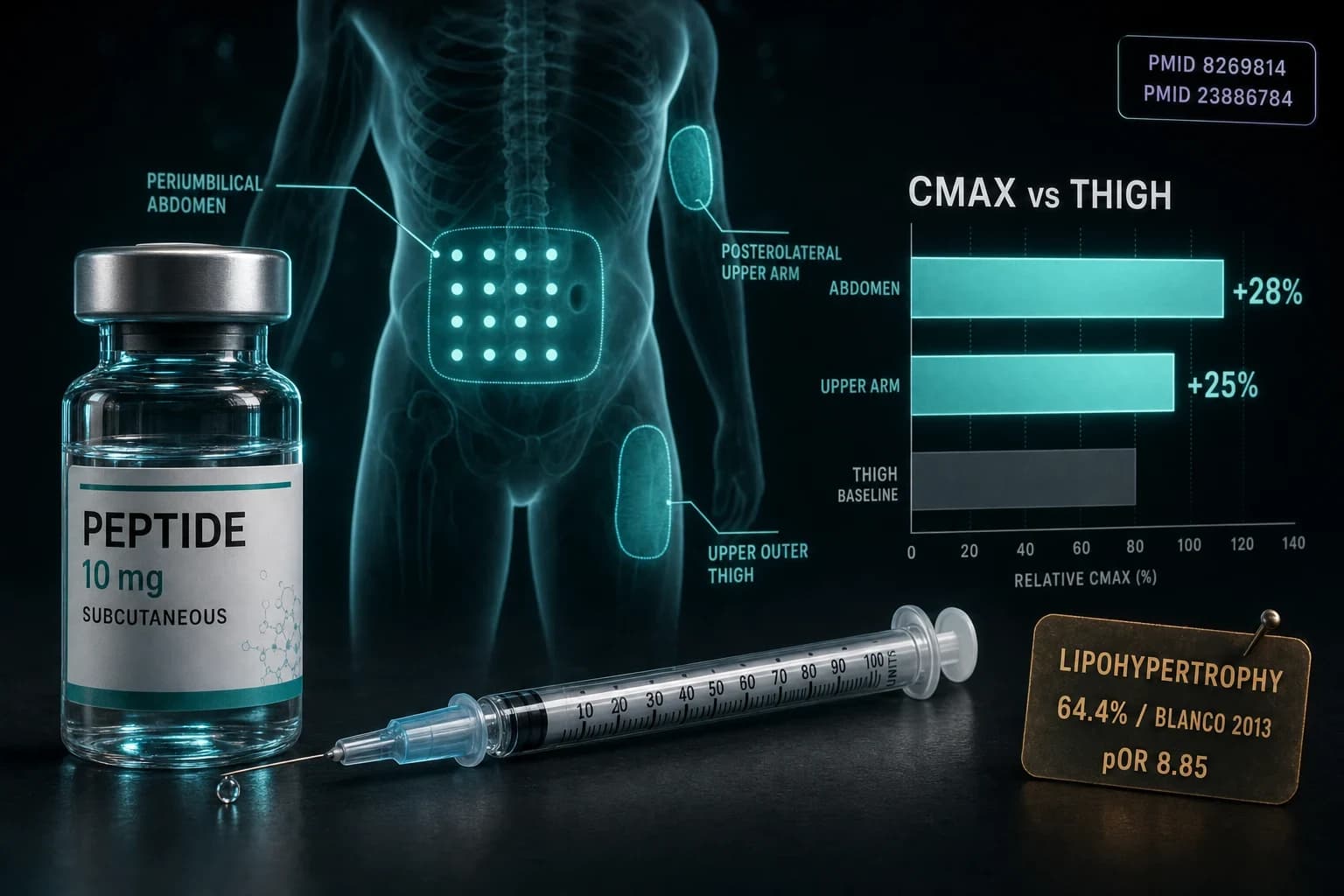
- Regular insulin injected in the abdomen produces roughly 28% higher Cmax and reaches peak more than twice as fast as the thigh (Frid & Linde 1993).
- Semaglutide absorption is only about 12% lower in the thigh than the abdomen, which is why the label lists abdomen, thigh, and upper arm as interchangeable.
- Incorrect site rotation is the strongest predictor of lipohypertrophy (prevalence 64.4% in Blanco 2013, pOR 8.85), and lipohypertrophic tissue drives up to 25% higher required doses.
- BPC-157's rat healing data was generated with local subcutaneous injection near the injury; systemic peptides do not require site proximity to their target tissue.
- The default research technique is a 30 to 31 gauge 5 to 8 mm insulin syringe, 45 to 90 degree angle with a pinched fold, rotated at least 2 cm from the previous shot.
Most guides to peptide injection sites read the same way: three body diagrams, a rotation clock face, a paragraph on hygiene. None of them cite the pharmacokinetic literature that already answered the question decades ago. The insulin trials from the 1990s and the subsequent lipohypertrophy work from the 2010s tell you which sites absorb faster, which ones scar, and by how much. This piece brings that evidence forward and translates it to what researchers actually inject: BPC-157, TB-500, semaglutide, tirzepatide, and the growth-hormone secretagogues.
Site selection is not a vanity concern. It changes peak concentration, time to peak, and dose-to-dose variability. Get it wrong for long enough and it changes the tissue, which changes every future dose.
Why the site changes drug kinetics
Subcutaneous absorption depends on local blood flow, capillary density, and how deep the fat pad is relative to the underlying muscle. The abdomen sits over a rich subdermal vascular plexus and thin muscle fascia. The thigh is deeper, cooler, and less vascular. The upper arm is anatomically similar to the abdomen but harder to self-inject cleanly.
For regular unmodified human insulin, Frid and Linde (1993) showed peak concentration was roughly 28% higher and time to peak roughly half of the thigh's when injected in the abdomen of type 1 diabetic patients. The plasma glucose fall was proportionally faster. For NPH (isophane) insulin, Henriksen et al. (1991) found the thigh actually gave the most consistent absorption profile, which is why long-acting insulins have historically been directed there.
Growth hormone shows the same pattern in reverse. Laursen et al. (1994) compared thigh and abdominal recombinant GH injections in GH-deficient adults and found abdominal injection produced faster absorption and higher plasma GH peaks, with proportionally larger IGF-1 and metabolic responses. Same peptide class as sermorelin and ipamorelin analogues, same principle: an abdominal site delivers a sharper pulse.
The abdomen is not homogeneous either. Frid and Linde (1992) mapped intraregional differences with radiolabeled insulin and found the area above the umbilicus absorbed noticeably faster than lateral or infraumbilical sites. Even within one region, absorption can shift by 20 to 30% depending on where within the region the needle lands.
What each site delivers, with numbers
The table below distills the direct human PK evidence for the three common self-injection sites. Numbers are from insulin and growth hormone trials, which are the only human data at this resolution. Peptides with similar molecular weight and hydrophilicity (GLP-1 analogues, GHRH analogues, healing peptides) inherit the same physics.
| Site | Cmax vs thigh (unmodified insulin) | Tmax vs thigh | Absorption consistency | Ease of self-injection |
|---|---|---|---|---|
| Abdomen (periumbilical, >2 in from navel) | +28% higher | ~50% shorter | Moderate; intraregional differences up to 30% | Highest; pinch is easy, needle angle is intuitive |
| Thigh (upper outer, front) | reference | reference | Most consistent for long-acting formulations | High; visible target, easy pinch |
| Upper arm (posterolateral deltoid tail) | Similar to abdomen | Similar to abdomen | Moderate | Low for self-injection; needs a caretaker or a mirror |
A useful mental model: if the peptide is intended to produce a sharp acute pulse (a mealtime GLP-1 pen shot, a pre-workout secretagogue), the abdomen wins on speed. If the peptide is meant to smooth out over a day (long-acting insulin, tesamorelin, daily NPH), the thigh's slower and more consistent profile wins. Weekly peptides like semaglutide and tirzepatide are engineered to blunt the site effect, and their trial data confirms it.
For semaglutide specifically, Novo Nordisk's clinical program tested abdomen, thigh, and upper arm and reported roughly 12% lower AUC in the thigh compared with the abdomen. On a molecule with a 7-day terminal half-life dosed once weekly, a 12% acute exposure difference is inside the noise. The label lists all three sites as equivalent. For tirzepatide, Lilly's site-comparison study in NCT04050670 reached the same conclusion.
The rotation evidence that most peptide guides skip
Site rotation is not folklore. It is the single largest determinant of whether the next injection into the same region will absorb predictably. The insulin literature quantifies this cleanly.
Blanco et al. (2013) examined 430 insulin-treated patients and found lipohypertrophy in 64.4% of them. Among patients with lipohypertrophy, 98% either did not rotate sites or rotated incorrectly. The prevalence odds ratio for lipohypertrophy given incorrect rotation was 8.85. That is the strongest modifiable risk factor identified in the study.
Lipohypertrophic tissue is fibrotic and hypovascular. Insulin injected into it absorbs erratically. Blanco's cohort reported 39.1% unexplained hypoglycemia and 49.1% glycemic variability in the lipohypertrophy group, versus 5.9% and 6.5% in patients without it. A subsequent meta-analysis (PMID 38215209) confirmed that lipohypertrophy required up to 25% higher total daily insulin dose to achieve the same glycemic result.
Peptides do not have hypoglycemia as a readout, but the underlying tissue physiology is identical. Repeated injection into the same 1 cm circle produces the same fibrotic remodeling. A researcher who has been running BPC-157 for six months in a single abdominal quadrant is injecting into progressively more disordered tissue, and the day-to-day dose response gets noisier for exactly the reasons Blanco documented.
Bottom line: Rotate at least 2 cm from the previous injection. For daily protocols, cycle across four to six mapped points before returning to any single one. Give each point at least a week of rest.
Systemic peptides vs local peptides: the case where site actually matters most
Most peptides are systemic. Once the drug clears the injection site and enters the venous return, it does not care where it started. Growth-hormone secretagogues, GLP-1 analogues, MOTS-c, thymosin alpha-1, and PT-141 all fall in this bucket. Site selection changes kinetics, not distribution.
One class breaks that rule. BPC-157 was validated in rat healing models with local subcutaneous injection near the injured tendon or muscle. Cerovecki et al. (2010) demonstrated ligament healing with BPC-157 delivered locally in a rat medial collateral ligament transection model. Pevec et al. (2010) showed the same for muscle crush injury under corticosteroid impairment. Krivic et al. (2006) reported tendon-to-bone healing after Achilles detachment when BPC-157 was administered near the site. In each case the animals also received systemic doses in comparator arms, and local delivery consistently produced the sharpest histological and biomechanical effect at the target tissue.
The mechanism proposed in that literature is angiogenesis-driven, with local VEGF upregulation and fibroblast recruitment. If you accept that mechanism, "inject BPC-157 near the injury" is not folklore, it is what the animal literature actually did. No human trial has replicated it, so this remains a rat-model justification and not a clinical one, but it is a coherent justification.
For TB-500, the same logic does not hold. TB-500 is a truncated fragment marketed under thymosin beta-4 branding, and the underlying TB4 literature suggests systemic distribution with tissue-specific uptake driven by injury signaling, not by local injection site. Injecting TB-500 near the injury is not wrong, but the mechanistic case is much weaker than BPC-157's.
Compound-specific site strategy
Different peptide classes reward different site choices. This table maps the common research compounds to a reasonable default site and the reasoning.
| Compound class | Example | Preferred default site | Why |
|---|---|---|---|
| Weekly GLP-1 analogue | Semaglutide, tirzepatide | Abdomen, thigh, or upper arm (all equivalent per label) | 12% AUC difference is below the clinical threshold for a weekly molecule |
| Daily GLP-1 analogue | Liraglutide, retatrutide once-daily protocols | Abdomen for consistency and rotation ease | Abdomen tolerates a systematic quadrant rotation |
| GHRH analogue | Sermorelin, tesamorelin | Abdomen at bedtime for pulse alignment | Faster Cmax pairs with the natural nocturnal GH pulse |
| Ghrelin mimetic | Ipamorelin, GHRP-2, GHRP-6 | Abdomen | Same rationale as GHRH analogues; pulsatile intent |
| Local healing peptide | BPC-157 | Subcutaneously within 2 to 5 cm of the affected tissue | Rat healing data used local injection |
| Systemic healing peptide | TB-500 | Abdomen or thigh, rotated | No mechanistic advantage to local delivery |
| Sexual health peptide | PT-141 | Abdomen or thigh, 45 minutes pre-activity | Fastest Cmax on abdomen matches use case |
| Melanocortin agonist | Melanotan II | Abdomen | Same rationale |
| Mitochondrial peptide | MOTS-c, SS-31 | Abdomen or thigh, rotated | Systemic distribution; site is a rotation concern only |
For dose math on any of these, the reconstitution calculator removes the arithmetic errors that show up as "unexplained side effects." For per-compound protocols, see the compound-specific dosage charts including the BPC-157 dosage chart and the semaglutide dosage chart.
Technique that shapes real absorption
Once the site is picked, three technique variables shape whether the injection lands where the pharmacokinetics assume.
Needle length. A 5 to 8 mm 30 or 31 gauge insulin syringe is the standard. Longer needles risk crossing subcutaneous fat into muscle, which changes the compartment and, in insulin trials, produced faster and more variable absorption than intended. This effect is documented across the fast-acting insulin literature, including the aspart absorption work of Mudaliar et al. (1999). Peptide injections aim for the fat pad, not the muscle beneath it.
Angle and pinch. With a 5 mm needle in a lean researcher, a 45 degree angle without a pinch is acceptable. With any subcutaneous fat over roughly 8 mm, a 90 degree angle with a lifted skinfold prevents intramuscular delivery. The pinch releases before the plunger fully depresses so that the depot is not compressed under tension.
Speed of injection. Slow depression over 5 to 10 seconds reduces the risk of a bleb (a subcutaneous pocket that leaks back on withdrawal). A count of five before withdrawing the needle allows the tissue to close around the depot.
Site preparation. Alcohol wipe, air-dry for 20 to 30 seconds, then inject. Injecting through wet alcohol stings and does not add sterility to skin that was clean to begin with.
For a full walkthrough of preparing the vial before it reaches the syringe, the peptide reconstitution complete guide covers the upstream steps that dominate real-world dosing errors. The injectable vs oral peptides bioavailability guide covers why subcutaneous remains the default route for research protocols even when oral capsules exist.
Tip: Map a 4x4 grid on each abdominal quadrant with a skin marker on day one. Draw the previous shot's dot after every injection. The habit prevents unintentional clustering that the eye alone cannot see.
Common mistakes that break the kinetics
Four failure modes account for most of what shows up as "peptide is not working" complaints.
Site clustering. Injecting inside the same 1 cm circle two or three days in a row. This is how lipohypertrophy starts. The tissue looks fine at first; the injection feels fine; the peptide absorbs normally for the first week. By week three the local blood flow is different. Fix it by mapping.
Deep injection into muscle. A long needle or an angle set too aggressively can cross into rectus abdominis or vastus lateralis. Intramuscular absorption is faster than subcutaneous, which for a GLP-1 pen shot can produce sharper nausea and for a growth-hormone peptide can amplify the acute pulse. Fix it by using a 5 to 8 mm needle and lifting a proper skinfold.
Cold injection. A vial straight from the fridge stings more and absorbs more slowly at the injection site because local vasoconstriction limits the initial diffusion. Let the reconstituted vial sit for 10 to 15 minutes at room temperature before drawing. The sting reduction is not aesthetic; it correlates with the initial absorption rate.
Site rotation without map. Rotating "somewhere else" instead of "systematically" gives the illusion of rotation while injections still cluster. Blanco's cohort showed 98% of lipohypertrophy patients believed they were rotating and were not.
For the trust-and-quality side of the equation, the vial itself has to actually contain what its label claims before site technique can matter. The Ascension Peptides vendor audit is the primary trust reference on this site for research-grade injectable peptides with per-lot COAs. If you are already outside our recommended supplier list, the best legit peptide vendors 2026 walkthrough covers the audit process. Ascension carries the injectable classes covered in this guide with 50% off using code ENHANCED.
Bottom line
Peptide injection sites are the least glamorous variable in a protocol and the one that quietly determines whether the dose you calculated is the dose you delivered. Pick the abdomen when you want a pulse. Pick the thigh when you want a smooth curve. Rotate systematically at least 2 cm apart. Injecting BPC-157 near the injury has a rat literature behind it; injecting anything else "near the target tissue" does not. The technique details that separate a research-quality injection from a rushed one are the needle length, the angle, and the pinch, in that order.
For the upstream half of the dose accuracy problem, see how to reconstitute peptides guide and the reconstitution calculator. For the compound overview and mechanism side, the compound pages linked above collect the human evidence for each peptide.
This article is for research and educational purposes only. It is not medical advice, and no content here should be used to diagnose, treat, or prevent any condition. Research peptides discussed here are not approved by the FDA for human use in most indications, and self-injection carries infection, dosing, and cardiovascular risks. Consult a qualified physician before making any decisions related to peptides, hormones, or health.