At a glance
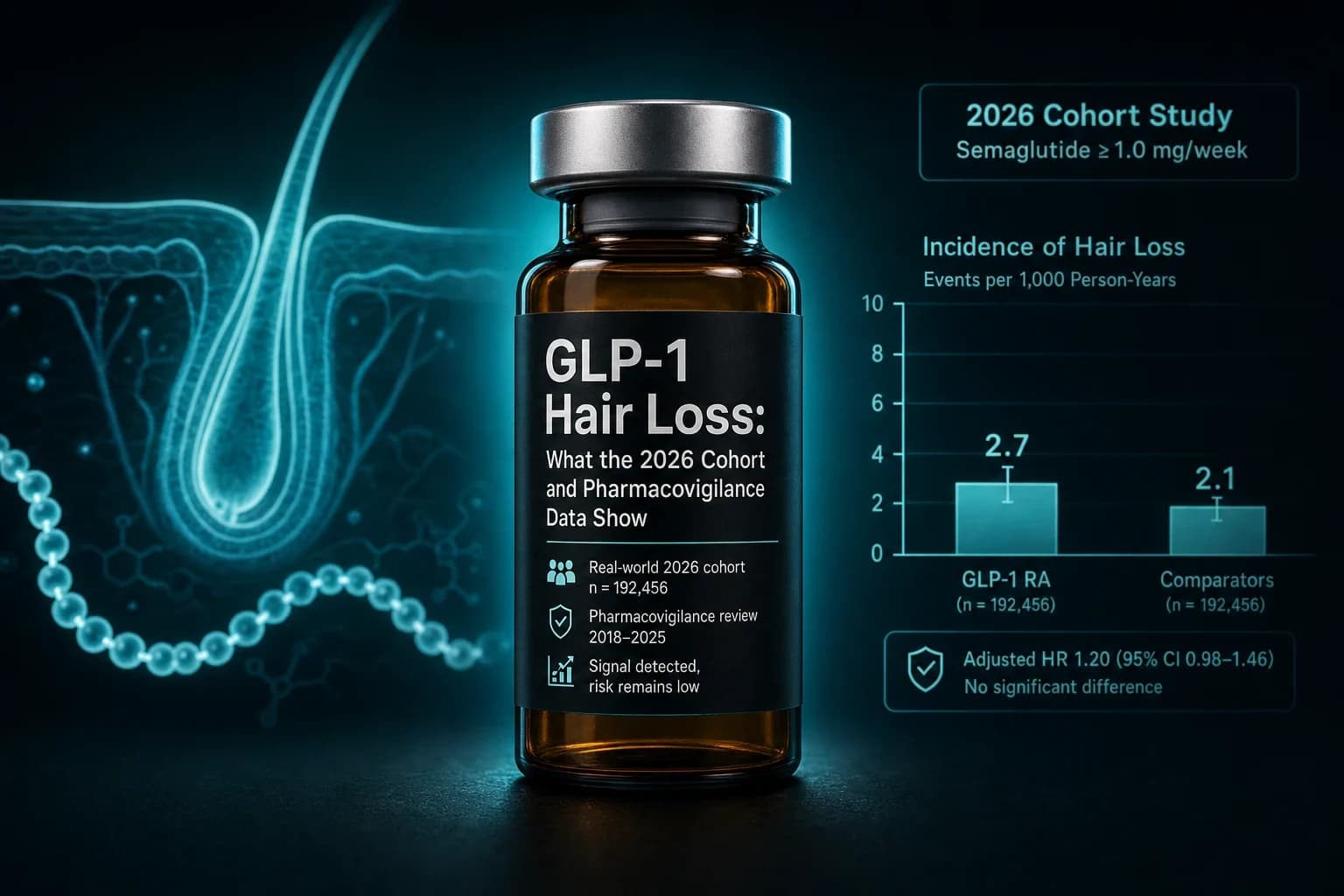
- Vidal-led TriNetX cohort of 547,993 GLP-1 users (2014-2024): androgenetic alopecia aOR 1.62 at 6 months and 1.64 at 12 months versus matched controls.
- FAERS 2022-2023 disproportionality analysis (Godfrey et al., PMID 38925559): semaglutide ROR 2.46, tirzepatide ROR 1.73, with 84% of reports filed by patients not clinicians.
- Wilding STEP 1 (PMID 33567185): 3.0% of semaglutide 2.4 mg patients reported alopecia versus 1.0% on placebo over 68 weeks, the trial baseline that pharmacovigilance has since amplified.
- Most cases look like telogen effluvium triggered by the rapid weight loss itself, not direct follicle toxicity. Onset 2-4 months after dose escalation, recovery 3-9 months after stabilization.
- Mitigation that has evidence: slower titration, 1.6-2.2 g/kg protein, iron and ferritin screening, and topical minoxidil if shedding persists past month 6.
The signal that crossed from forum chatter to the dermatology literature
For the first two years that semaglutide and tirzepatide were widely prescribed for weight loss, hair shedding was a Reddit complaint. By mid-2024, it was a pharmacovigilance signal. By the spring of 2026, it was a propensity-score-matched cohort study in 547,993 patients. The trajectory matters because the dermatology literature now has a defensible answer to the most common question GLP-1 users ask their derm: yes, the shedding is real, no, it is not happening to most people, and the mechanism is almost certainly the weight loss itself rather than a direct drug toxicity.
This article walks through what the four largest data sources actually measured, which patients are highest risk, what onset and recovery typically look like, and the mitigation framework that has any evidence behind it. The honest summary up front: most of the data are observational, the absolute incidence is well under 5% in randomized trials, and the cases that do happen are mostly self-resolving once weight loss plateaus.
Bottom line: GLP-1 receptor agonists carry a real but small absolute risk of nonscarring hair loss, almost entirely telogen effluvium triggered by rapid weight loss rather than direct follicle toxicity. The Vidal TriNetX cohort (n=547,993) found 1.40x odds of nonscarring hair loss at 12 months and 1.76x for telogen effluvium specifically. Semaglutide and tirzepatide show the strongest signal; liraglutide and dulaglutide show less. Onset is typically 2-4 months after dose escalation, recovery is 3-9 months after weight stabilization.
The four data points that matter
Four datasets do most of the work in 2026. Together they form the difference between "GLP-1s cause hair loss" (overstated) and "GLP-1s carry a measurable but modest risk of self-resolving telogen effluvium that is largely a function of how fast you lose weight" (accurate).
| Source | Design | n | Key finding |
|---|---|---|---|
| Wilding 2021 (PMID 33567185) | STEP 1 randomized trial, 68 weeks | 1,961 | Alopecia in 3.0% semaglutide 2.4 mg vs 1.0% placebo |
| Godfrey 2024 (PMID 38925559) | FAERS disproportionality 2022-2023 | 199 sema + 179 tirz reports | Semaglutide ROR 2.46 (95% CI 2.14-2.83), tirzepatide ROR 1.73 (1.42-2.09) |
| Vidal 2026 (JAAD International) | TriNetX cohort, 6 and 12 months | 547,993 | aOR 1.62 AGA at 6 mo, 1.76 TE at 12 mo vs matched controls |
| Lauck 2026 (PMID 41825835) | TriNetX active comparator | Not yet abstract-public | GLP-1 vs metformin: AGA, TE risk elevated |
Wilding's STEP 1 trial is the cleanest single number because it is the only randomized placebo-controlled comparison: 3.0% of semaglutide patients reported alopecia at any point over 68 weeks versus 1.0% on placebo. That is a 2-point absolute increase against a 1-point placebo baseline, and it sets the ceiling for what a perfectly conducted trial sees (Wilding et al. 2021, PMID 33567185).
The Godfrey FAERS analysis is the loudest signal because pharmacovigilance databases amplify rare events. Reporting odds ratios were 2.46 for semaglutide and 1.73 for tirzepatide. The composition of those reports is the part dermatologists keep flagging: 84% were filed by consumers and 16% by clinicians, which means the FAERS signal is heavily weighted by patient-reported symptoms that never reached an in-clinic diagnosis (Godfrey et al. 2024, PMID 38925559).
Vidal's TriNetX cohort, published in early 2026, is the highest-quality observational dataset because it propensity-matched 547,993 GLP-1 users to controls and looked at specific dermatologist-coded diagnoses. At 6 months, GLP-1 use was associated with 1.62x the odds of androgenetic alopecia and 1.26x the odds of overall nonscarring hair loss. By 12 months those numbers grew to 1.64x for AGA, 1.76x for telogen effluvium, and 1.40x for overall nonscarring hair loss. The 12-month telogen effluvium signal is the most mechanistically informative because telogen effluvium is the prototype for stress-driven, weight-loss-driven, self-resolving shedding.
Lauck's active-comparator analysis (PMID 41825835) confirms the cohort finding with a different control group. Comparing GLP-1 initiators to metformin initiators in TriNetX, the elevated AGA and TE risk persisted, which controls for the indication itself (obesity, type 2 diabetes) and leaves a drug-class signal that is harder to explain away as confounding by indication.
Is it the drug or the weight loss?
The most honest answer is "almost entirely the weight loss, with a small remaining drug-specific question."
Telogen effluvium is the dermatology textbook response to any major physiologic stressor. Severe caloric restriction, rapid weight loss, post-partum hormonal shift, high fever, surgery, iron deficiency, and starting or stopping certain medications all push a synchronized cohort of hair follicles out of the growing (anagen) phase into the resting (telogen) phase. About 100 days later, those resting follicles shed. The pattern is diffuse, the recovery is usually complete, and the trigger is usually a discrete event two to four months before the shedding starts.
GLP-1 receptor agonists produce two of the strongest telogen effluvium triggers in one drug class: rapid weight loss and reduced caloric intake. Patients on semaglutide 2.4 mg lose 14-15% of body weight on average in 68 weeks. Patients on tirzepatide 15 mg lose 20-22%. The rate of loss in the first 6 months is steeper than what most weight-management literature considered safe before the GLP-1 era. The body composition deltas are large enough on their own to trigger telogen effluvium without any direct drug effect.
The drug-direct hypothesis is weaker but not zero. The List, He, and Habener 2006 paper in Regulatory Peptides (PMID 16631262) is the foundational study showing that GLP-1 receptors and proglucagon are expressed in mouse skin and concentrated in hair follicles. The functional role of follicular GLP-1 signalling is not characterized, but its existence means a direct drug effect on the hair cycle is biologically plausible. The 2025 Branyiczky systematic review in International Journal of Dermatology (PMID 41174840) explicitly framed the open mechanistic question this way: receptor expression establishes plausibility, the absence of human dermatologic kinetic studies establishes the gap.
What the data do not support is a strong direct toxicity claim. None of the 10 studies in Branyiczky's review found follicle damage, scarring patterns, or any histologic feature distinct from classic telogen effluvium. The 2025 Alsuwailem systematic review in Cureus (PMID 41111833) covering 5 studies and 2,905 patients reached the same conclusion: hair loss was conflicting across studies, dermatology confirmation was usually absent, and where it was present the pattern was telogen effluvium and androgenetic alopecia rather than a novel GLP-1-specific entity.
Note: Androgenetic alopecia is the second most common pattern reported in the cohort data. Most experts read the AGA signal as unmasking of pre-existing pattern thinning rather than new disease. The same telogen effluvium event that causes diffuse shedding also makes existing AGA visible because more total hairs are in telogen at once. Once the telogen pulse resolves, AGA progression usually returns to its prior trajectory.
Which drugs and which patients
The cohort and FAERS signals are not flat across the class. Semaglutide and tirzepatide are consistently the loudest. Liraglutide and dulaglutide are quieter or absent.
Camino-Salvador's 2025 letter in JEADV (PMID 41025593) attributed the gradient to weight-loss magnitude: the more effective the drug at producing rapid loss, the larger the telogen effluvium signal. Liraglutide produces 5-8% weight loss at clinical doses. Semaglutide 2.4 mg produces 14-15%. Tirzepatide 15 mg produces 20-22%. The shedding gradient tracks the weight loss gradient, which is the strongest single piece of indirect evidence that the weight loss is the operative trigger.
Branyiczky's review specifically flagged tirzepatide as showing the greatest magnitude of weight loss and the most frequent linkage to telogen effluvium across the included studies. The Alsuwailem review reported conflicting tirzepatide signals, with some studies showing hair improvement in patients whose insulin resistance was driving androgen-mediated thinning and others showing classic telogen effluvium. Both effects can exist in the same patient population because they reflect two different biological pathways.
Patient-level risk factors that emerge from the case literature and the systematic reviews:
| Risk factor | Why it matters |
|---|---|
| Rate of weight loss > 1% per week | Strongest single predictor of telogen effluvium |
| Female sex | Higher background rate of telogen effluvium, larger reported signal in FAERS |
| Pre-existing thinning or AGA | Telogen pulse unmasks pattern hair loss |
| Iron deficiency or low ferritin | Independent telogen effluvium trigger, often comorbid with caloric restriction |
| Inadequate protein intake | Protein deficiency is a documented hair cycle disruptor |
| Concurrent thyroid disease | Subclinical hypothyroidism on its own can drive shedding |
| Recent surgery or major illness | Compounds the telogen trigger |
Timeline: what to expect
The case-report and forum data converge on a fairly consistent timeline. Most GLP-1-associated telogen effluvium follows the same five-phase pattern any TE event does, with onset latency anchored to the dose escalation rather than the initial start date.
| Phase | What happens | What patients typically notice |
|---|---|---|
| Weeks 1-8 | Subclinical follicular shift into telogen | No visible shedding |
| Weeks 8-16 | Shedding becomes noticeable | More hair in shower drain, brush, and on pillow |
| Weeks 16-24 | Peak shedding | Diffuse pattern, positive pull-test, often the trigger to see a derm |
| Months 6-9 | Trigger plateaus, shedding tapers | New anagen hairs visible at the hairline |
| Months 9-15 | Visible recovery | Density returns; AGA-driven thinning continues at baseline rate |
A few details worth flagging. The Alzahrani 2025 case report of a 23-year-old who developed a patchy alopecia areata pattern after 4 months on semaglutide is the textbook timing for the first visible event, although alopecia areata itself is a less common subtype than telogen effluvium. Pull-test positivity at the periphery of the scalp is the standard dermatology finding during peak shed; visible density loss of 10-20% at the temples and crown is most common in patients with concurrent AGA. Cases that do not follow this pattern are the ones that need a workup, not the ones that do.
Mitigation: what actually has evidence
The 2025-2026 dermatology literature converges on five mitigation strategies. None of them are GLP-1-specific. All of them are standard telogen effluvium management.
Slower titration. Rapid dose escalation produces faster weight loss and a larger telogen pulse. The standard semaglutide titration (0.25 mg, 0.5 mg, 1.0 mg, 1.7 mg, 2.4 mg at 4-week intervals) is already the slowest the label allows. Stretching each step to 8 weeks instead of 4 is the most commonly recommended mitigation in real-world dermatology practice. The trade-off is slower weight loss, which is the point.
Adequate protein. 1.6 to 2.2 g/kg of target body weight per day. The same protein target dermatologists recommend for any rapid-weight-loss patient is the same target the GLP-1 muscle loss research review covers in detail for muscle preservation. The two recommendations come from the same underlying concern: rapid weight loss exposes tissues whose protein turnover is high. Hair follicles and skeletal muscle are both protein-turnover-dependent.
Iron and ferritin screening. Telogen effluvium thresholds for ferritin are debated, but most hair clinics use a ferritin floor of 30-50 ng/mL for women with shedding, and 70 ng/mL for women with concurrent AGA. Patients losing weight rapidly on a low-calorie GLP-1-modulated diet are an iron-deficiency-risk population. Checking is cheap and the fix is straightforward.
Topical minoxidil. 5% minoxidil solution or foam, applied daily, has a long track record in both telogen effluvium and androgenetic alopecia. It does not block the telogen trigger but it shortens the resting phase and accelerates re-entry into anagen. Most dermatologists start it if shedding persists past month 5-6 on a GLP-1.
GHK-Cu and copper peptide approaches. The GHK-Cu hair loss research protocol covers the topical and injectable copper tripeptide data. GHK-Cu has its own evidence base for dermal papilla activity and follicle stimulation, separate from the GLP-1 question. For researchers working with topical hair compounds, Limitless Biotech carries GHK-Cu in nasal/oral/topical formats with code ENHANCED.
Tip: Photograph your scalp at baseline before starting or escalating a GLP-1 and again at 3 and 6 months. Phone photos under consistent lighting are good enough to track diffuse shedding and distinguish it from a temporary higher shed count without density loss. Most dermatology visits start with "do you have any old photos" and the answer being yes saves a workup step.
When to see a dermatologist
The 2025 Branyiczky and Alsuwailem systematic reviews and the 2026 Vidal cohort all converge on the same triage principle: diffuse telogen effluvium that starts 2-4 months after dose escalation and is self-limited does not need a workup beyond the screening labs above. Patterns that should prompt a dermatology visit:
- Patchy hair loss (alopecia areata pattern) rather than diffuse shedding
- Shedding that persists past month 9 despite weight stabilization
- Scalp scarring, redness, or scaling
- Eyebrow, eyelash, or body hair loss alongside scalp shedding
- Concurrent symptoms suggesting thyroid disease, lupus, or another systemic process
- Family history of significant AGA in a younger patient who wants to start anti-androgen treatment
Alopecia areata associated with semaglutide has been case-reported but is rare and is not telogen effluvium (Alzahrani et al. 2025). It needs autoimmune workup rather than nutritional optimization.
What this means for current and prospective GLP-1 users
Three audiences will read this section differently:
- Already on semaglutide or tirzepatide with diffuse shedding at month 3 or 4. This is the expected timing of a telogen effluvium event triggered by the weight loss itself. Stopping the drug to halt the shedding is usually the wrong trade unless the shedding is severe, the weight loss is medically inappropriate, or another cause is identified. The Branyiczky review explicitly noted that the hair loss is generally reversible and rarely a reason to discontinue otherwise effective therapy.
- Considering starting a GLP-1. Absolute risk in randomized trials is 2-3% above placebo over 68 weeks, almost always self-resolving, and largely a function of how fast weight comes off. Mitigation is straightforward and the alternative (not treating obesity) carries larger dermatologic and systemic risks of its own.
- Discontinuing a GLP-1. Weight regain after discontinuation is itself a stressor that can trigger a second telogen effluvium pulse, although this is anecdotal rather than well-documented in the cohort data. The stopping GLP-1 weight regain research review covers the discontinuation dynamics in more depth.
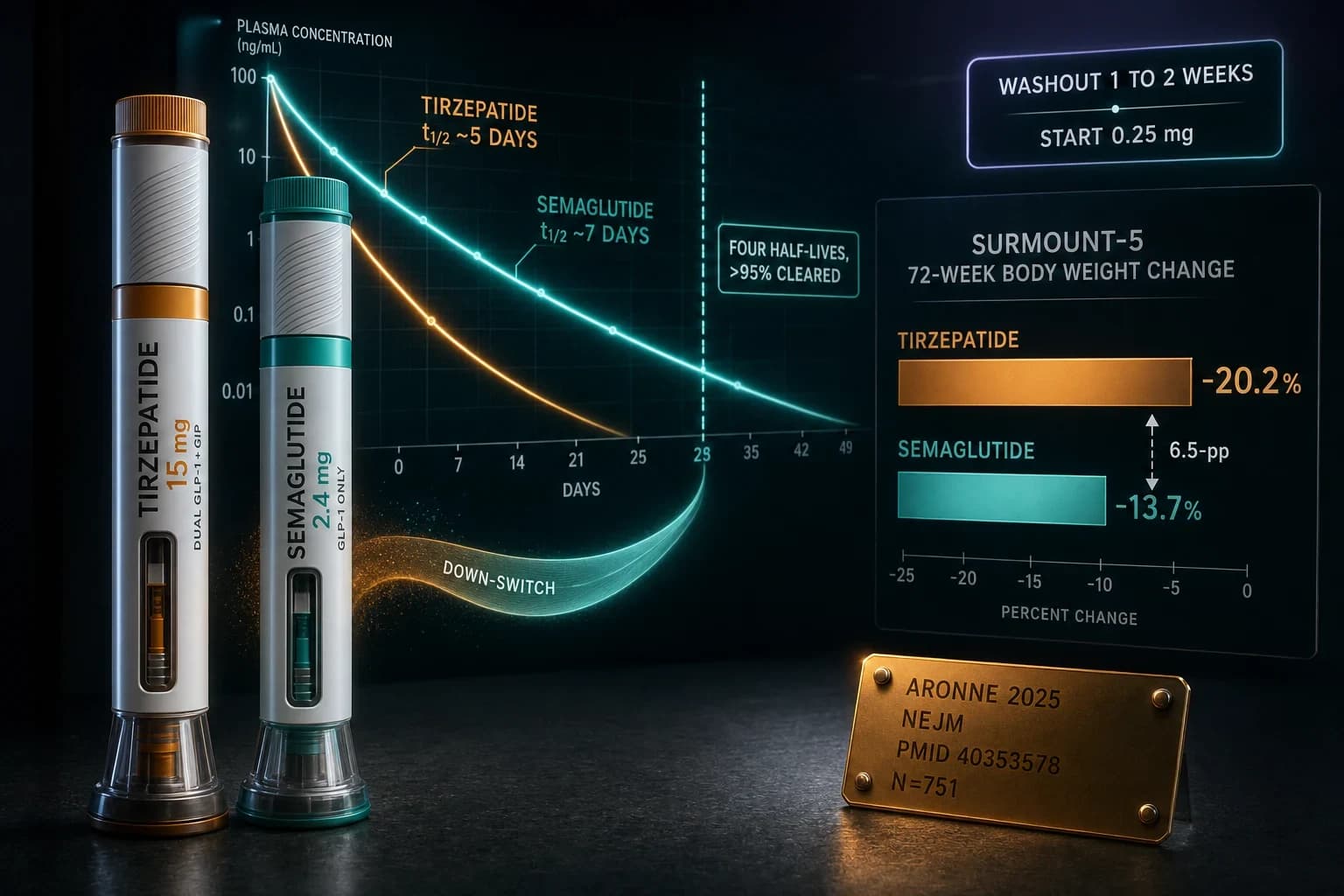
Researchers working with weight-loss peptides today can source semaglutide and tirzepatide from Ascension Peptides with public per-batch COAs and 50% off using code ENHANCED. The tirzepatide vs semaglutide head-to-head evidence review covers the SURMOUNT-5 data on which drug to choose if hair preservation is one of several considerations.
FAQ
Will my hair grow back if I stay on the GLP-1?
In most cases, yes. Telogen effluvium is self-limited once the trigger (rapid weight loss) plateaus. Most patients see visible recovery within 6-9 months of weight stabilization without stopping the drug. The Branyiczky 2025 systematic review noted reversibility as a consistent finding across the included studies.
Does taking biotin help?
There is no clinical evidence that biotin reverses GLP-1-associated telogen effluvium in patients who are not biotin-deficient. Most rapid-weight-loss telogen effluvium is driven by ferritin, zinc, protein intake, or the weight loss itself rather than biotin. Biotin supplementation does interfere with thyroid lab assays, which is the more important reason most dermatologists do not recommend it routinely.
Is tirzepatide worse than semaglutide for hair loss?
The FAERS reporting odds ratios were higher for semaglutide (2.46) than tirzepatide (1.73), but tirzepatide produces a larger weight loss magnitude. The Branyiczky review found tirzepatide most consistently linked to telogen effluvium across studies, likely because the weight loss is larger. The signals are within the same order of magnitude and the practical recommendation is the same: titrate slowly, keep protein high, screen iron.
Should I stop the drug if I notice shedding?
Usually no. Discontinuation produces weight regain, which is its own stressor and may extend rather than resolve the shedding. The standard dermatology recommendation in 2025-2026 is to optimize protein, iron, and ferritin, slow further dose escalation if possible, and add topical minoxidil if shedding persists past month 6. Stopping the drug is reserved for severe or non-resolving cases.
Can I take finasteride or dutasteride while on a GLP-1?
There is no documented drug interaction. Finasteride and dutasteride address androgenetic alopecia rather than telogen effluvium, so the indication question is whether the shedding pattern is AGA-driven or TE-driven. A dermatology pull-test, hair photography, and density mapping are the standard workup before starting anti-androgen therapy.
Why does GLP-1 hair loss usually start 2-4 months after starting the drug?
Telogen effluvium has a built-in delay. The trigger (a major physiologic stressor like rapid weight loss) shifts hairs from anagen into telogen, but those hairs do not shed until the telogen phase completes, which takes roughly 100 days. The 2-4 month onset is the dermatology textbook latency for any TE event and is consistent across triggers from post-partum to post-surgical to severe illness to GLP-1 weight loss.
This article is for educational and research purposes only. It summarizes peer-reviewed pharmacovigilance, observational cohort, randomized clinical trial, and case-report data on hair loss associated with GLP-1 receptor agonists, primarily semaglutide and tirzepatide. Nothing in this article is medical advice, diagnostic guidance, or a recommendation to start, stop, or modify any prescription drug or research compound. Hair loss has many possible causes including thyroid disease, iron deficiency, autoimmune disease, androgenetic alopecia, and others. A dermatologist or treating clinician should evaluate persistent, patchy, or progressive hair loss rather than self-management. Doses and weight-loss percentages described here are what published clinical trials measured and do not constitute a protocol or recommendation for any individual.