At a glance
- ATTAIN-MAINTAIN randomized 205 tirzepatide and 171 semaglutide SURMOUNT-5 graduates to oral orforglipron or placebo for 52 weeks
- Tirzepatide cohort maintained 74.7% of prior weight loss on orforglipron vs 49.2% on placebo
- Semaglutide cohort maintained 79.3% of prior weight loss on orforglipron vs 37.6% on placebo
- First Phase 3 evidence that an oral GLP-1 can hold injectable-driven weight loss in plateaued patients
- Orforglipron (Foundayo, FDA approved April 2026) is a once-daily nonpeptide with no food or water restrictions
If you have lost weight on Zepbound or Wegovy and you keep hearing that the pill version might let you drop the needle, you probably want a straight answer to one question: does it actually hold?
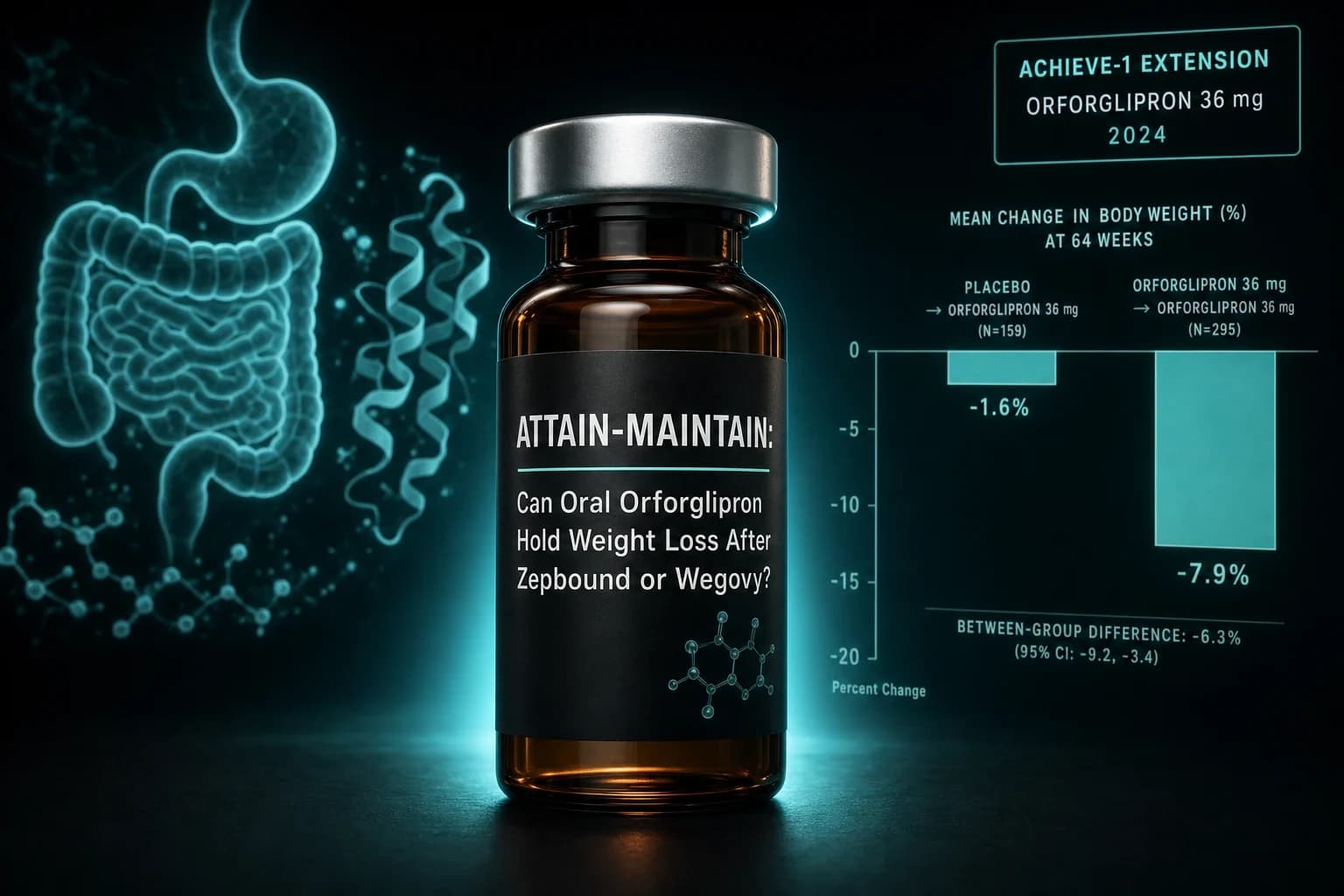
For the first time, a Phase 3b trial has tested that specific handoff. ATTAIN-MAINTAIN randomized SURMOUNT-5 graduates who had plateaued on injectable GLP-1 therapy to either once-daily oral orforglipron or placebo, then watched for 52 weeks. The tirzepatide cohort on orforglipron held 74.7% of their prior weight loss; placebo held 49.2%. The semaglutide cohort on orforglipron held 79.3%; placebo held 37.6% (Aronne et al., Nature Medicine 2026).
That is not a rounding difference. It is the first controlled evidence that a pill can carry the maintenance load after an injectable does the heavy lifting. It is also narrower than the marketing headline. Below is what the trial actually did, where the numbers sit against older withdrawal data, and where the evidence still stops.
What ATTAIN-MAINTAIN was designed to test
The trial pulled participants directly out of SURMOUNT-5, the 72-week head-to-head that compared subcutaneous tirzepatide with subcutaneous semaglutide in adults with obesity and without diabetes (Aronne et al., NEJM 2025, PMID 40353578). Those participants had already spent more than a year on an injectable. ATTAIN-MAINTAIN then randomized:
- Cohort 1: 205 adults who had been on tirzepatide, reassigned to orforglipron or placebo.
- Cohort 2: 171 adults who had been on semaglutide, reassigned to orforglipron or placebo.
The primary endpoint was narrower than "weight change." Investigators pre-defined a plateau population as participants whose body weight moved less than 5% during weeks 60 to 72 of SURMOUNT-5, then measured the percent of that prior weight reduction that was maintained over the 52-week ATTAIN-MAINTAIN window. Placebo participants were tapered off the injectable and moved to a matched pill. The trial ran double-blind. Orforglipron was titrated once daily, no food or water restrictions attached.
That last point matters because it is the practical differentiator against oral semaglutide (Rybelsus), which requires a 30-minute fasted window with plain water for absorption. If you want a full comparison of the two oral GLP-1 mechanics, our oral semaglutide vs orforglipron guide walks through the food rules, bioavailability differences, and dosing schedules side by side.
The maintenance numbers, by cohort
| Prior injectable | Orforglipron maintained | Placebo maintained | Treatment difference |
|---|---|---|---|
| Tirzepatide (Zepbound) | 74.7% | 49.2% | +25.5 pp |
| Semaglutide (Wegovy) | 79.3% | 37.6% | +41.7 pp |
Read the first row carefully. "74.7% maintained" does not mean weight fell by that much. It means that of the total weight participants had already lost on tirzepatide, roughly three quarters was still gone at the end of the 52-week orforglipron window. Placebo held about half. Weill Cornell's press summary, matched to the Nature Medicine paper, put the absolute mean difference from prior weight loss at about 5.0 kg for the tirzepatide graduates and 0.9 kg for the semaglutide graduates. In practical terms, orforglipron kept the treadmill going; placebo did not.
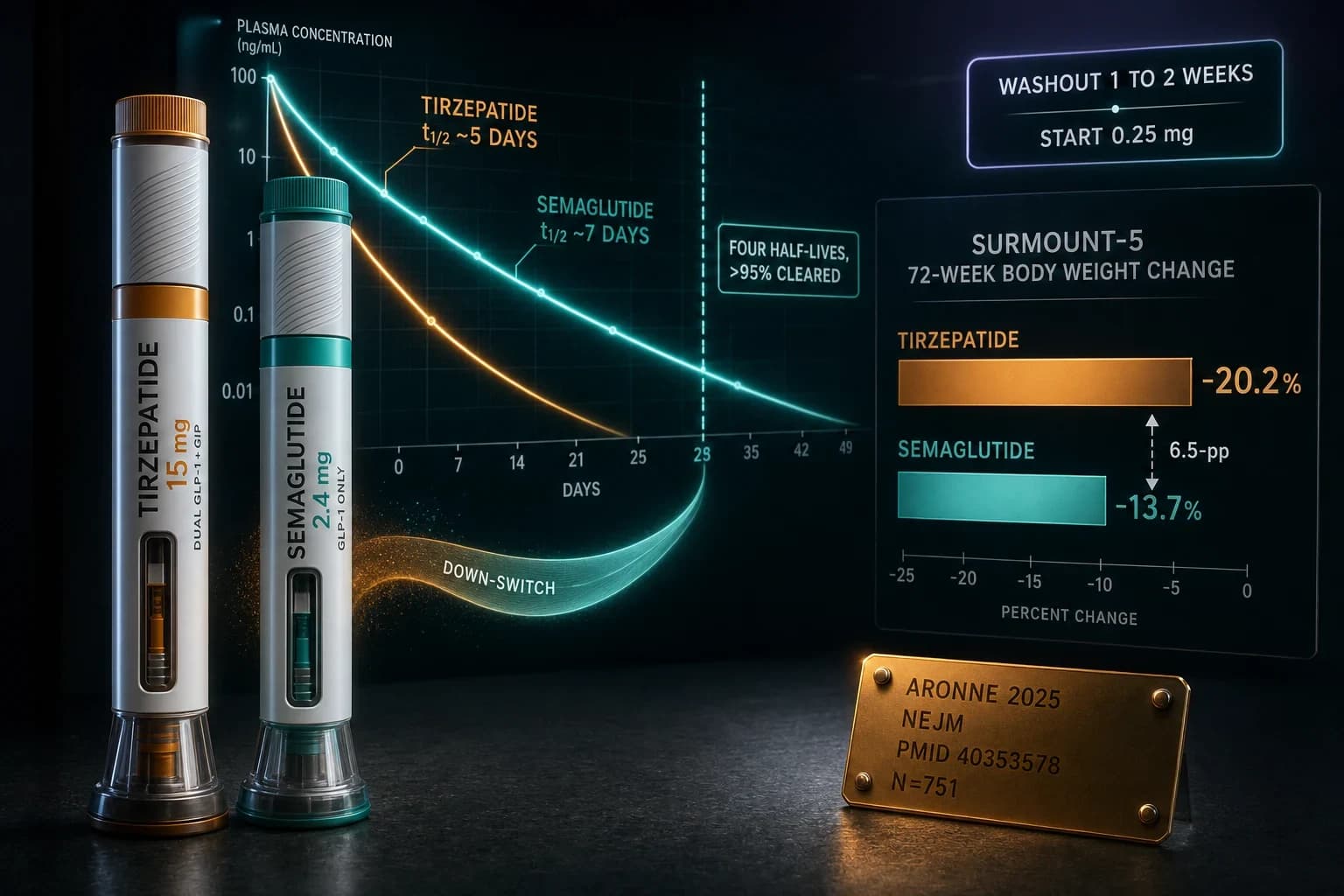
The second row is the more surprising one. Semaglutide-graduate placebo participants lost most of their prior loss (37.6% maintained means about 62% of the loss came back). Orforglipron in the same population held 79.3%. That is the largest between-arm gap in the trial. Two mechanistic pieces sit under that asymmetry. First, SURMOUNT-5 had already established that tirzepatide graduates entered maintenance with more absolute weight loss than semaglutide graduates (Aronne et al., NEJM 2025, PMID 40353578), so their placebo arm had further to fall before hitting baseline. Second, semaglutide's clearance is fast enough that "placebo" is effectively withdrawal within weeks, mirroring the STEP 1 extension pattern discussed below.
How the pill compares to just stopping
The 2024 to 2025 withdrawal literature is the correct comparison for a "should I switch" decision, because the alternative to switching is often just stopping.
- STEP 4 (Rubino 2021, PMID 33755728): after a 20-week run-in on semaglutide 2.4 mg, participants who continued lost another 7.9% of body weight by week 68. Participants moved to placebo regained 6.9% in the same window. That is a 14.8 percentage point separation from continuing versus stopping.
- STEP 1 extension (Wilding 2022, PMID 35441470): after 68 weeks of semaglutide plus a lifestyle program, participants regained 11.6 percentage points of body weight in the year after treatment ended, leaving them with a net 5.6% loss from baseline. About two thirds of what the drug delivered came back.
- SURMOUNT-4 (Aronne 2024, PMID 38078870): after 36 weeks of open-label tirzepatide, participants who continued kept losing (mean additional 5.5%). Participants moved to placebo gained a mean 14.0% back over the same 52-week window.
Against that backdrop, ATTAIN-MAINTAIN's placebo arms behaved exactly as the older trials predicted. What is new is that the orforglipron arms did not. They tracked the "continued injectable" arms of the historical withdrawal trials more closely than the "moved to placebo" arms, which is a clinical result nobody had run through a randomized trial before.
Our earlier read on stopping GLP-1s and weight regain walks through the mechanistic story behind the historical placebo arms, if you want the physiology in more depth.
Bottom line: The ATTAIN-MAINTAIN read is not "switching to a pill is as good as staying on an injectable." It is "switching to this specific pill is dramatically better than stopping altogether, and it closes most of the gap on continued injectable therapy in a 52-week window."
Where orforglipron sits in the GLP-1 map
Orforglipron is a once-daily small-molecule oral GLP-1 receptor agonist. It is a nonpeptide, so it does not get chewed up by digestive proteases the way a peptide GLP-1 like semaglutide does. That is why it clears the oral bioavailability threshold without an absorption enhancer or a fasted dosing window. It received FDA approval as Foundayo in April 2026 for chronic weight management.
The efficacy backdrop, from ATTAIN-1 in adults with obesity without diabetes (Wharton, Aronne et al., NEJM 2025, PMID 40960239):
- 36 mg: mean body weight change of minus 11.2%
- 12 mg: minus 8.4%
- 6 mg: minus 7.5%
- Placebo: minus 2.1%
- At 36 mg, 54.6% of participants lost 10% or more, 36.0% lost 15% or more, 18.4% lost 20% or more
That top-line 11.2% loss over 72 weeks is meaningful, but it sits well below tirzepatide's SURMOUNT-5 result of roughly 20.2% at the same time point and semaglutide's roughly 13.7% (Aronne et al., NEJM 2025, PMID 40353578). This is why the framing matters. Orforglipron is not currently a first-line weight loss engine on efficacy alone. It is a maintenance-capable option with a different route and dosing profile.
If you want the full standalone efficacy write-up, we cover it in orforglipron Phase 3 evidence, and the injectable head-to-head sits in tirzepatide vs semaglutide SURMOUNT-5.
A decision framework for the "should I switch" question
The trial answered one specific question in one specific population. It did not clear every use case. Here is the honest map.
| Situation | What the evidence supports |
|---|---|
| Still losing weight on Zepbound or Wegovy | Stay on the injectable through the loss phase; ATTAIN-MAINTAIN only enrolled plateaued participants |
| Plateaued on Zepbound or Wegovy for 3 or more months | Switching to orforglipron is now Phase 3-supported for maintenance |
| Not yet at max tolerated injectable dose | Not the ATTAIN-MAINTAIN population; a titration plan makes more sense |
| Cost, supply, or needle-fatigue driving the question | Injectable stays first-line on efficacy; oral is the alternative if the barrier is real |
| Injectable intolerable due to GI side effects | Orforglipron shares the GLP-1 GI profile; switching route does not eliminate the mechanism |
Someone reading this from the reader's chair usually falls into row two, and that is exactly the row the trial was designed for. If you fall into row one and you started on a compounded product, our compounded tirzepatide access and supply guide for 2026 and the Ascension Peptides review both cover the vendor and formulary logistics.
Safety and tolerability
The trial's overall safety profile matched prior orforglipron Phase 3 data. The gastrointestinal adverse event pattern was expected: mostly mild to moderate, mostly during dose escalation. No hepatic safety signal was reported.
Discontinuation due to adverse events across the four arms:
| Arm | Discontinued for AE |
|---|---|
| Wegovy graduates on orforglipron | 4.8% |
| Wegovy graduates on placebo | 7.6% |
| Zepbound graduates on orforglipron | 7.2% |
| Zepbound graduates on placebo | 6.3% |
The read from the discontinuation numbers is that switching from a peptide GLP-1 to an oral small-molecule GLP-1 did not spike a tolerability problem. It looked comparable to placebo in each cohort, which is what you would want to see for a maintenance drug.
What ATTAIN-MAINTAIN did not answer
Five gaps deserve to be named directly rather than glossed.
- Beyond 52 weeks. Maintenance was tested for one year. Whether the 74.7% and 79.3% numbers hold across a second year, or whether they drift toward the withdrawal pattern, is not in this dataset.
- Pre-plateau switching. The trial explicitly enrolled participants whose weight had stabilized. Data on switching mid-titration is not the same question and this study cannot answer it.
- Dose-response of the maintenance pill. ATTAIN-MAINTAIN used titration to a target orforglipron dose. Whether a lower fixed maintenance dose could achieve the same result was not tested.
- Head-to-head against a lower injectable dose. If someone plateaued on tirzepatide 15 mg, the counterfactual arm you actually want is "step down to tirzepatide 5 mg" or "step down to semaglutide 1.0 mg," not placebo. That trial has not been run.
- Cardiometabolic markers past the primary endpoint. Blood pressure, HbA1c, and lipids were reported as maintained, but the follow-up window is too short to speak to hard cardiovascular outcomes. That is the province of ATTAIN-Outcomes, which is ongoing.
What this changes for the conversation
The value of ATTAIN-MAINTAIN is not that it recruits a new patient. It reframes an existing one. Until this trial published, the clinical decision was binary: stay on an injectable indefinitely, or accept the withdrawal pattern from STEP 1 and SURMOUNT-4. Now there is a documented third option, at least in the plateaued phase, using a once-daily pill that does not require a fasted window.
That option matters for people dealing with tirzepatide and semaglutide supply constraints, for patients who develop injection-site fatigue after a year of weekly shots, and for prescribers who want to keep the metabolic gains without the pharmacy logistics of a weekly SC injection. Whether it will hold up beyond 52 weeks is the next question, and it is the question the trial did not answer.
For deeper background on the injectable choice that gets you to the plateau in the first place, our GLP-1 dosing comparison for 2026 walks through the titration schedules for semaglutide, tirzepatide, and retatrutide side by side. And if you are looking at research-grade reference vials of semaglutide or tirzepatide to model your own protocol arithmetic before your next clinical visit, Ascension Peptides applies code ENHANCED for 50% off the injectable line (review here). For the oral route, Limitless Biotech carries oral GLP-1 research materials with code ENHANCED.
Research-purposes-only disclaimer
This article summarizes published trial data for informational and research purposes only. It is not medical advice. Orforglipron is a prescription medication in the United States. Any decision to start, stop, or switch a GLP-1 receptor agonist should be made with a licensed clinician who can weigh individual history, comorbidities, and drug interactions.