At a glance
- FDA requested removal of GLP-1 suicidal ideation warning labels in January 2026.
- Wang 2024 (Nat Med): 240,618-patient cohort, HR 0.27 incident suicidal ideation on semaglutide.
- Ueda 2024 (JAMA Intern Med): 124,517 GLP-1 users, no increased suicide death.
- Wadden 2024 STEP post hoc: no meaningful PHQ-9 difference vs placebo over 68 to 104 weeks.
- Lancet Psychiatry 2026 Swedish cohort: 42% fewer psychiatric hospitalizations on semaglutide.
In January 2024, the FDA opened a formal evaluation of GLP-1 receptor agonists and suicidal ideation. Two years later, in January 2026, the agency took the next step. It asked manufacturers to remove the suicidal behavior and ideation warning from the labels of every drug in the class, from semaglutide to tirzepatide to liraglutide. Eight major real-world cohorts and at least three meta-analyses sit behind that decision. Here is what the 2024 to 2026 evidence actually shows, and what it still leaves open.
Bottom line: No high-quality cohort published between 2024 and 2026 has found that GLP-1 receptor agonists increase suicide death, suicide attempt, suicidal ideation, or new depression in adults with diabetes or obesity. Several large datasets found lower risk on semaglutide. The FDA, EMA, and MHRA have all reached the same conclusion. The unresolved questions concern people excluded from those datasets, not the average user.
Where the worry started
The concern traces to mid-2023. The Icelandic Medicines Agency forwarded three case reports to the European Medicines Agency: two reports of suicidal thoughts on semaglutide, one on liraglutide. The EMA's Pharmacovigilance Risk Assessment Committee opened a review of the whole class in July 2023, and the FDA followed in late 2023. The lay press and Reddit threads filled with similar reports almost overnight, often without separating the baseline mental health profile of people prescribed weight-loss drugs from any drug effect. Real-world evidence accumulated quickly.
The reason matters. Adults seeking pharmacotherapy for obesity have higher baseline rates of depression and anxiety than the general population. Spontaneous reports do not capture that, which is exactly the pattern pharmacoepidemiologists expect when a popular new drug class meets a vulnerable user base. Better study designs were the only way to settle the question.
The big real-world cohorts
The first major publication came in January 2024. Wang and colleagues, in Nature Medicine, pulled electronic health records from the TriNetX Analytics Network and built two cohorts: 240,618 patients with overweight or obesity and a parallel cohort of 1,589,855 patients with type 2 diabetes, each comparing semaglutide initiators against initiators of non-GLP-1 anti-obesity or anti-diabetes drugs. Semaglutide was associated with a lower risk of incident suicidal ideation (hazard ratio 0.27, 95% CI 0.20 to 0.36 in the obesity cohort) and lower risk of recurrent suicidal ideation (HR 0.44). The same direction held in the diabetes cohort. The signal pointed the opposite way from the case reports that triggered the regulatory review.
Population-scale cohorts in Europe ran the same question with active comparators. Ueda et al., in JAMA Internal Medicine in November 2024, built an active-comparator new-user cohort across Sweden and Denmark from 2013 to 2021. 124,517 adults initiated a GLP-1 receptor agonist, 174,036 initiated an SGLT2 inhibitor as the comparator. Weighted incidence of suicide death was 0.23 versus 0.18 per 1,000 person-years, hazard ratio 1.25 (95% CI 0.83 to 1.88). For the combined outcome of suicide death or nonfatal self-harm, the hazard ratio ran the other way: 0.83 (95% CI 0.70 to 0.97). Neither direction was conclusive at this scale, which is exactly the point. With a quarter-million person cohort, the GLP-1 class did not move the needle on suicide death.
France's national health insurance database produced one of the strongest design choices in this literature. Bezin and colleagues, in eClinicalMedicine in 2025, used a case-time-control design that compares each case to itself across different exposure windows. They identified 1,102 adults who died by suicide or were hospitalized for a suicide attempt between 2013 and 2021 with at least one GLP-1 dispensing in the prior 180 days. Mean age was 57, 67.6% had a recent psychiatric history, 51.3% had obesity. The case-time-control odds ratio for GLP-1 exposure in the 30 days before the event was 0.62 (95% CI 0.51 to 0.75). The within-person design controls for the fixed confounding that bedevils between-person studies, and the result still ran in the protective direction.
A US dataset filled in the older-adults question. Wang and colleagues, in Annals of Internal Medicine in 2024, ran a target trial emulation in Medicare beneficiaries with type 2 diabetes, comparing GLP-1 initiators against SGLT2 inhibitor or DPP-4 inhibitor initiators. No clear increased risk for suicidal ideation or behavior was identified, although the authors flagged that the confidence intervals could not rule out a modest adverse risk. That is honest reporting and the right caveat to carry forward.
What the Phase 3 RCT data show
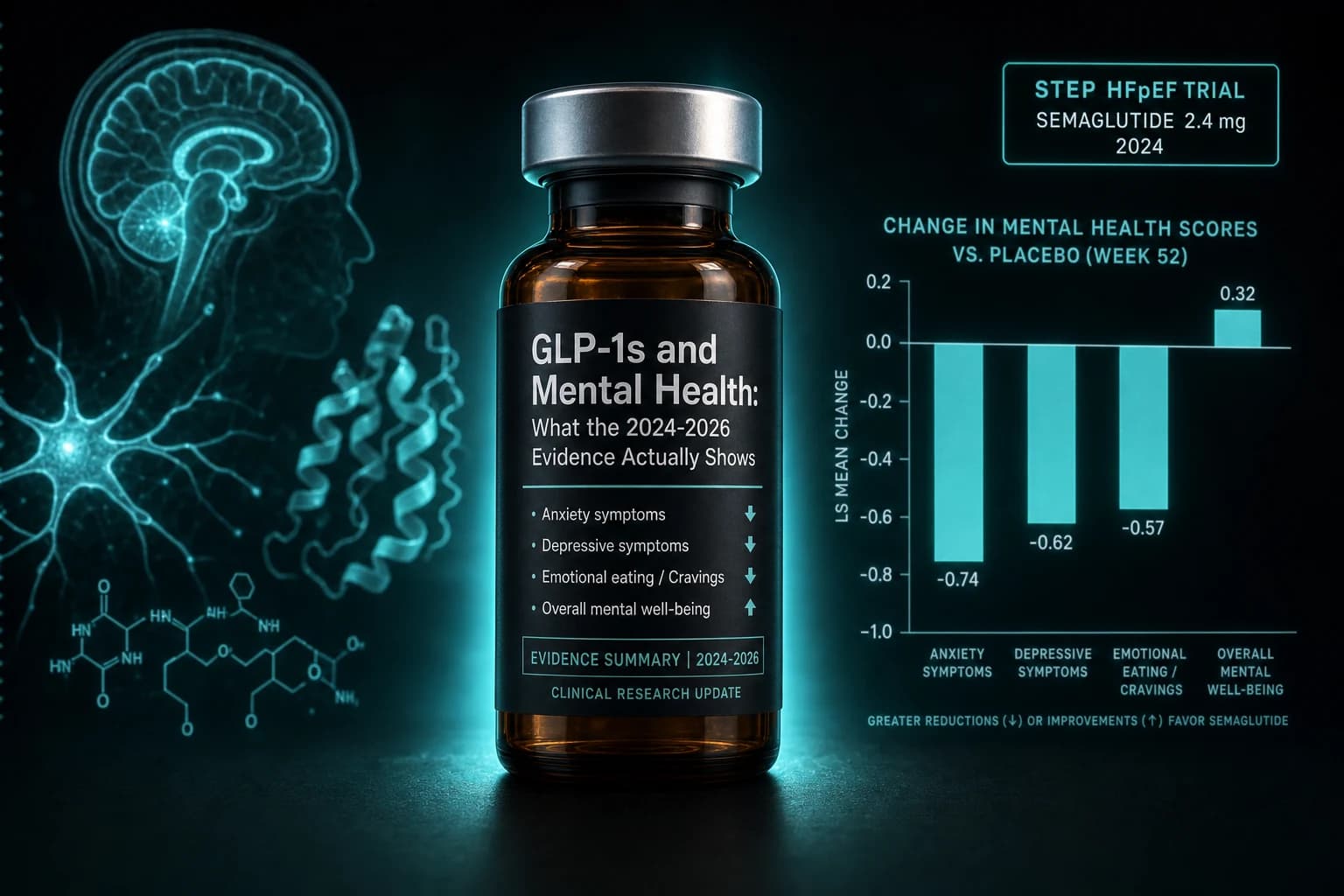
Cohorts are powerful for rare outcomes but vulnerable to confounding. Randomized trial data are smaller but cleaner. The reference dataset is the STEP program, the Phase 3 trials that established semaglutide 2.4 mg for weight management. Wadden and colleagues, in JAMA Internal Medicine in 2024, ran a post hoc analysis of STEP 1, 2, 3, and 5, pooling more than 3,500 participants randomized to semaglutide 2.4 mg or placebo for 68 to 104 weeks. There were no clinically meaningful differences between groups in mean Patient Health Questionnaire-9 depression scores at any timepoint. Reports of suicidal ideation or suicidal behavior were similar between arms. People with current major depressive disorder, schizophrenia, or a recent suicide attempt were excluded from the trials, which is the population the FDA explicitly flagged as still needing study.
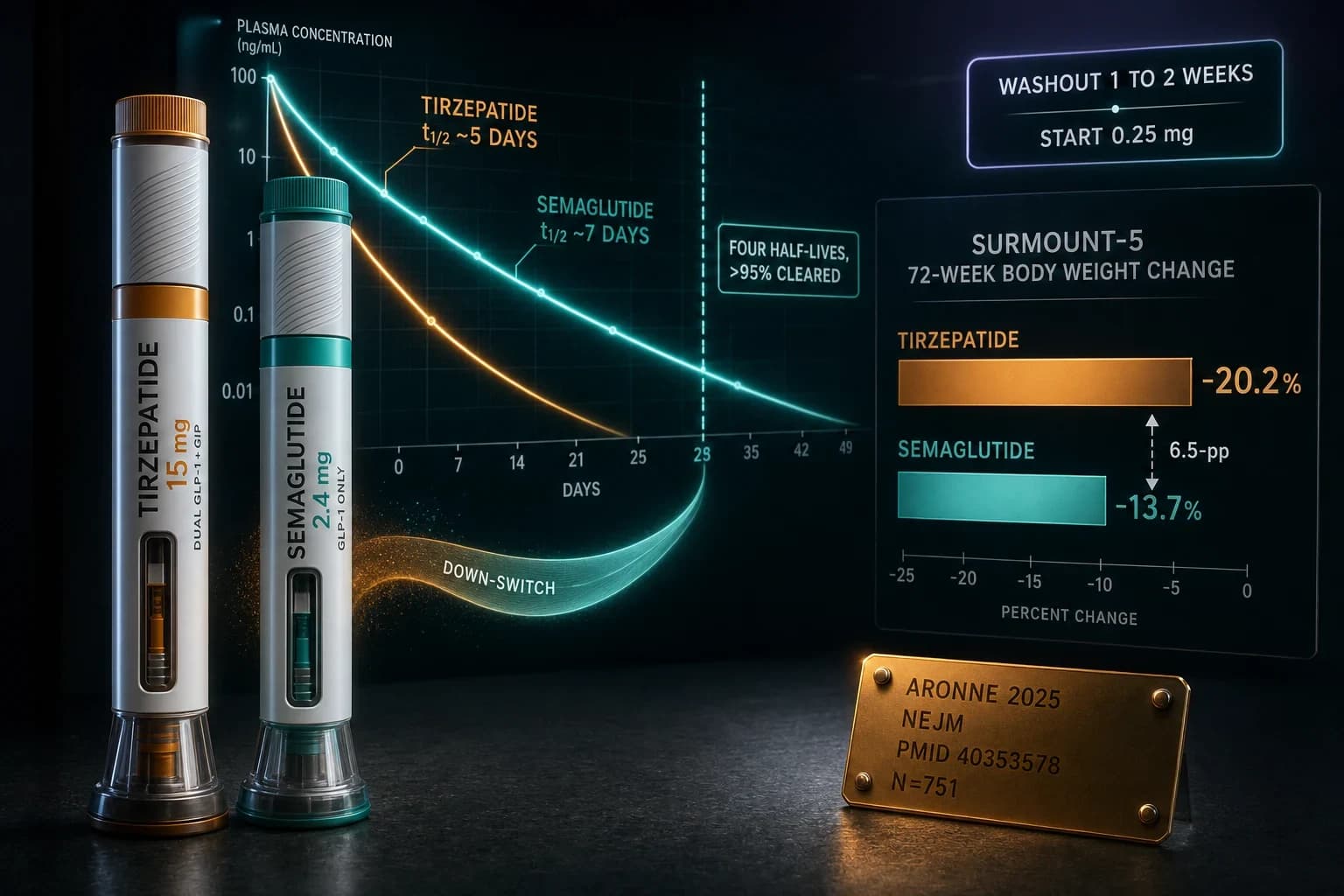
The tirzepatide SURMOUNT program ran the same screening exclusions. Reanalysis of the SURMOUNT-1 through SURMOUNT-4 data has not surfaced a suicidality signal beyond background rates in either arm. For the head-to-head efficacy comparison and the trial designs, see the SURMOUNT-5 read.
The meta-analyses
Pulling everything together, the 2024 to 2025 meta-analyses agree. Bushi et al., in Diabetes Metabolism Research and Reviews in 2025, screened 126 studies and meta-analyzed four observational cohorts. The pooled effect for suicidal outcomes was not statistically different between GLP-1 users and users of other anti-hyperglycemic drugs. A 2024 network meta-analysis of randomized outcome trials (PMID 39075921) compared SGLT2 inhibitors, GLP-1 agonists, and DPP-4 inhibitors across cardiovascular and weight-loss trials and again found no increased risk of suicidal ideation or behaviors. A JAMA Psychiatry systematic review and meta-analysis in 2025 reached the same conclusion across diabetes and obesity populations.
The 2026 Lancet Psychiatry signal
The largest and most recent study is also the most provocative. The Lancet Psychiatry 2026 Swedish national cohort followed more than 95,000 patients with established depression or anxiety who were prescribed antidiabetic medications. 22,480 had ever used a GLP-1 receptor agonist. Within-person comparisons of time on and off GLP-1 therapy showed a 42% reduction in sickness absence and psychiatric inpatient care during periods of semaglutide use, and a roughly 40% reduction in self-harm events. The effect was strongest for semaglutide, with a smaller but consistent effect for liraglutide. The authors flagged that an observational design cannot establish causation and that confounding by indication remains possible. The within-person framing and the size of the effect changed the conversation. Within-person comparisons in this population are associated with fewer psychiatric hospitalizations during GLP-1 use than during non-use periods, the opposite of the original concern.
The evidence in one table
| Study | Design | Population | Headline finding |
|---|---|---|---|
| Wang 2024 (Nat Med) | EHR cohort, TriNetX | 240,618 obesity; 1,589,855 T2D | HR 0.27 incident, HR 0.44 recurrent suicidal ideation on semaglutide |
| Ueda 2024 (JAMA Intern Med) | Active-comparator, Sweden + Denmark | 124,517 GLP-1 vs 174,036 SGLT2i | Suicide death HR 1.25 (0.83 to 1.88); self-harm HR 0.83 (0.70 to 0.97) |
| Wang 2024 (Ann Intern Med) | Target trial emulation, Medicare | Older adults with T2D | No clear increase; residual uncertainty for modest effects |
| Bezin 2025 (eClinicalMedicine) | Case-time-control, France | 1,102 cases, 5,494 controls | 30-day OR 0.62 (0.51 to 0.75) for GLP-1 exposure |
| Wadden 2024 (JAMA Intern Med) | RCT post hoc, STEP 1/2/3/5 | 3,500+ adults without major psychopathology | No PHQ-9 difference; similar suicidality between arms |
| Bushi 2025 meta-analysis | Systematic review | 11 studies, 4 meta-analyzed | No statistically significant association |
| Lancet Psychiatry 2026 | Swedish national cohort | 95,000+ with depression or anxiety | 42% lower psychiatric hospitalization; ~40% lower self-harm |
The studies use different designs, different comparators, and different populations, and they reach the same conclusion. That is the kind of replication that moves a regulatory needle.
Why this many studies converged so quickly
Three reasons. First, the safety question was unusually loud in lay media, which pulled fast-moving real-world evidence into journal queues. Second, GLP-1 prescriptions exploded between 2022 and 2025, giving researchers the cohort sizes needed to detect rare events. Third, the case-report mechanism that prompted the EMA's review (three reports through a small national agency) is well known to overcount in newly popular drug classes, and pharmacoepidemiologists treated the signal accordingly.
The regulators
The EMA's Pharmacovigilance Risk Assessment Committee closed its review in April 2024. The committee concluded that available evidence did not support a causal association between dulaglutide, exenatide, liraglutide, lixisenatide, or semaglutide and suicidal or self-injurious thoughts and actions. No update to product information was required. The UK's MHRA reached a similar conclusion in 2025 after its own review of the Yellow Card scheme.
The FDA's process moved in two stages. The January 2024 preliminary evaluation found no clear evidence of a causal link in FAERS or Sentinel data, but stopped short of removing the warning. The January 2026 update went further. Citing the larger cohorts, the STEP post hoc analysis, and a pooled analysis of 91 placebo-controlled trials covering 107,910 patients, the FDA asked GLP-1 manufacturers to remove the suicidal behavior and ideation warning from the labels of Wegovy, Saxenda, Zepbound, and the rest of the class.
Note: A regulator removing a warning is not the same as proving the drug is protective in everyone. It means the evidence for harm did not survive contact with larger datasets. People at high baseline risk still warrant monitoring, and clinicians still ask the screening questions.
Where the evidence is still thin
Three groups remain underrepresented in the 2024 to 2026 literature:
- Adolescents on GLP-1s for obesity. Real-world EHR studies in this group exist but are small. A target trial emulation in children and adolescents, posted in late 2025, reported lower suicidal ideation in GLP-1 users than in comparator groups, but absolute event counts were small.
- People with active major depressive disorder, schizophrenia, or a recent suicide attempt. The STEP and SURMOUNT trials excluded them, the cohort studies underrepresent them, and the FDA flagged this gap explicitly. The Lancet Psychiatry 2026 cohort is the first large dataset to include people with established psychiatric illness, and the early results are reassuring rather than alarming.
- Long-term users beyond five years. Most cohort follow-up is one to three years. Rare delayed effects cannot be ruled out at this horizon.
A cautious reading still rules out big effects and leaves room for small ones, which is roughly where the FDA landed.
What this changes for someone on or considering a GLP-1
For most people, very little. If you do not have a current diagnosis of major depressive disorder, an active suicidal ideation history, or a recent psychiatric inpatient stay, the cohort and trial data do not flag an added mental health risk from semaglutide, tirzepatide, or liraglutide. For people with stable, treated depression or anxiety, the Lancet Psychiatry 2026 read suggests no signal of worsening on average, though monitoring still belongs in standard care. For people with severe or untreated psychiatric illness, the data are thinner and the right step is shared decision-making with both a prescriber and a mental health clinician.
Mood and appetite changes happen with any rapid weight loss, regardless of mechanism. Eating less changes neurotransmitter precursor availability. Losing a substantial percentage of body weight changes body image, social dynamics, and sometimes alcohol use, which is its own active research area covered in the GLP-1 alcohol cravings work. These are real and worth tracking. They are not the same as a drug-induced suicidal ideation signal, and the literature now separates the two.
Tip: A baseline PHQ-9 before starting a GLP-1 and a repeat at 12 and 24 weeks is a low-cost way to track mood changes against a real reference point. The same applies to GAD-7 for anxiety. If scores worsen, that is a conversation to have with a clinician, not a reason to assume the drug is the cause.
How this fits with other GLP-1 evidence in 2026
The mental health question is one of several where the early signal and the mature evidence diverged. The same pattern played out with thyroid cancer, where a French database signal faded against larger active-comparator cohorts. A similar process is underway for vision loss and NAION, where rare-event analysis is ongoing. The questions worth taking seriously in 2026 are the ones with multiple converging studies behind them, including the cardiovascular benefit seen in the SELECT trial and the muscle-loss tradeoff documented across multiple cohorts in the lean mass research. The suicidal ideation hypothesis did not survive that bar.
Researchers sourcing injectable semaglutide or tirzepatide for study use can find both through Ascension Peptides with 50% off using code ENHANCED. Whatever the source, a current COA and a documented mood history still belong in the research protocol. The mental health data are reassuring on the class level, not a substitute for individual monitoring.
This article is for educational and research purposes only. It summarizes observational cohort studies, randomized trial post hoc analyses, meta-analyses, and regulatory assessments. These establish association and absence of association, not proven causation in either direction. Semaglutide, tirzepatide, liraglutide, and related GLP-1 products are prescription medications in approved markets; peptides sold for research are not intended for human use. Do not start, stop, or change any medication based on this article. If you experience new or worsening thoughts of self-harm, contact the 988 Suicide and Crisis Lifeline in the US or your local crisis service, or a licensed mental health clinician, immediately.